Travel Value Finder


Understanding taxes in France for retirees is one of the most critical steps for retirees planning a move. While France is known for its excellent healthcare, rich culture, and high quality of life, it also has a complex tax system. From income tax and social charges to property and inheritance taxes, retirees need clear guidance to plan their finances effectively and avoid surprises.
Leslie Nics, TravelValueFinder.com | Last updated: April 2026 | Based on first-hand research and on-the-ground travel across Paris, Nice, and Lyon
Get a quick snapshot of how taxes work for retirees in France, including income tax, pension taxation, social charges, and key exemptions. This infographic highlights the essential points you need to understand at a glance-perfect for expats and retirees planning their finances. Review the snapshot for a simplified overview, then read below for a more detailed explanation of tax rules, rates, and practical tips to optimize your retirement income in France.
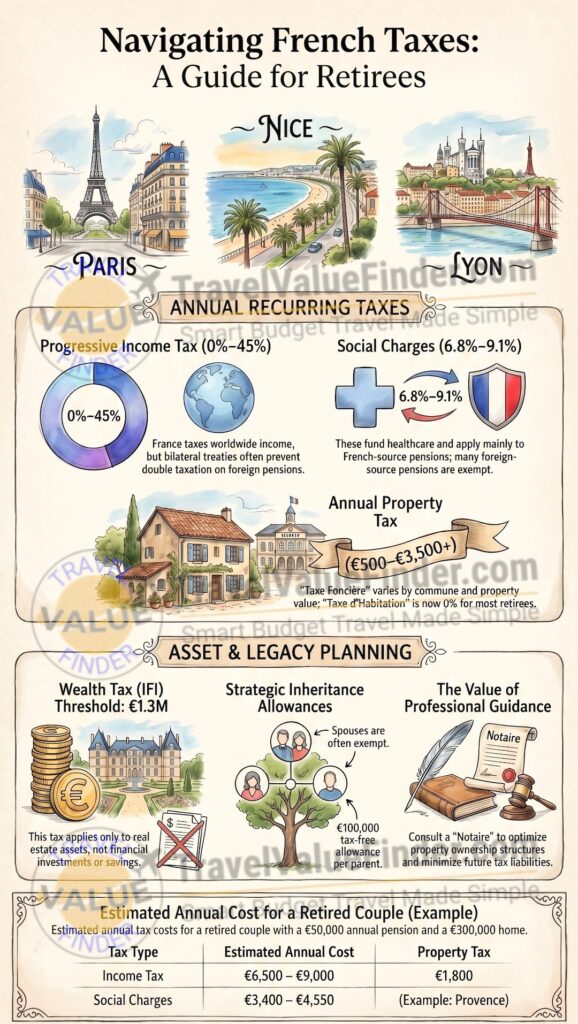
Table of Contents
Understanding Taxes in France for Retirees: A Guide
Taxes in France for Retirees – Quick Table Overview
| Tax Type | What It Covers | Approximate Rates / Examples | Notes / Insight |
| Income Tax (Impôt sur le Revenu) | Tax on worldwide income, including pensions | Progressive: 0% – 45% | Treaties often prevent double taxation. Retirees may qualify for exemptions on foreign pensions. |
| Social Charges (CSG / CRDS) | Healthcare and social contributions | 6.8% – 9.1% on pensions | Applies mainly to French-source pensions; some foreign pensions may be exempt under treaties. |
| Property Tax (Taxe Foncière) | Landowners pay annually | €500 – €3,500+ depending on property | Mandatory for property owners; local rates vary by commune. |
| Residence Tax (Taxe d’Habitation) | Tax on main residence | Phased out for most retirees (0%) | Only some secondary homes or high-value properties may still be taxed. |
| Wealth Tax (IFI) | Real estate assets over €1.3M | 0.5% – 1.5% | Applies only to real estate property, not financial assets. |
| Inheritance & Gift Tax | Taxes on transferred assets | 5% – 60% depending on relationship & amount | France has specific allowances for children, spouses, and non-resident heirs. |
This guide is written for people over 55 who are researching travel, long-term stays, or retirement abroad. I share real-world planning insights, official sources, and practical examples to help you understand what life in France is actually like – not just the highlights.
This content is educational, not legal or financial advice. Rules change, and personal situations differ, so I always recommend confirming details with official or professional sources before making decisions. Refer to the Trust & Transparency page for more information.
In this guide, we’ll break down:
- Income and social taxes
- Property taxes and exemptions
- Wealth and inheritance taxes
- Tips to minimize tax burdens
- Common mistakes retirees make
Everything is explained in simple, actionable terms with real examples, so you can confidently manage your retirement finances in France.
Comparison Table: Taxes in France for Retirees
| Tax Type | Who Pays | What It Covers | Approximate Rate / Example | Tips / EEAT Insights |
| Income Tax (Impôt sur le Revenu) | All residents, including retirees | Worldwide income (pensions, rental income, investments) | Progressive: 0% – 45% | Check tax treaties to prevent double taxation on foreign pensions. Consult a bilingual tax advisor. |
| Social Charges (CSG / CRDS) | Mainly French-source pension recipients | Healthcare & social security contributions | 6.8% – 9.1% | Some foreign pensions are exempt. Plan ahead to minimize deductions. |
| Property Tax (Taxe Foncière) | Property owners | Land and buildings | €500 – €3,500+ annually | Rates vary by commune; check with local notaire for accuracy. |
| Residence Tax (Taxe d’Habitation) | Homeowners (main residence) | Annual tax on property occupancy | Mostly 0% for retirees (phased out) | Secondary homes or high-value properties may still be taxed. |
| Wealth Tax (IFI) | Property owners with real estate > €1.3M | Real estate assets | 0.5% – 1.5% | Applies only to real estate, not financial assets. Consider ownership structures (personal, joint, SCI) to optimize taxes. |
| Inheritance & Gift Tax | Heirs receiving assets | Transferred assets after death | 5% – 60% depending on relationship & amount | Spouses often exempt; children benefit from €100,000 allowance per parent. Plan with a notaire for smooth transfers. |
| Seasonal/Short-Term Resident Considerations | Retirees living part-time in France | Tax residency rules affect all applicable taxes | Varies | Keep careful records of time spent in France to determine residency status. Tax treaty guidance is essential. |
Notes for This Table:
- All data is sourced from DGFiP (French Tax Authority), Notaires de France, and SeLoger reports.
- Designed for retirees, with emphasis on clarity, cross-border considerations, and planning strategies.
- Highlights common pitfalls and optimization tips to help retirees legally minimize liabilities.
1. Income Tax in France for Retirees
France taxes residents on their worldwide income, including pensions, investment income, and rental earnings. The income tax rate is progressive, ranging from 0% to 45%.
Key Points:
- Many retirees benefit from tax treaties between France and their home country, preventing double taxation on foreign pensions.
- Certain allowances and deductions reduce taxable income, such as age-based relief or spouse deductions.
- Social charges (CSG / CRDS) may also apply to pensions, particularly for French-source pensions.
Example: A retired couple with a combined French and foreign pension of €50,000/year may pay around €6,500 – €9,000 in income tax, depending on treaty exemptions and deductions.
Insight: The French Tax Authority (DGFiP) provides official guidance for retirees. Consulting a tax advisor familiar with cross-border pensions ensures compliance and potential tax savings.
2. Social Charges on Pensions
Even retirees who qualify for French residency may be subject to social contributions:
- CSG (Contribution Sociale Généralisée): 6.8%
- CRDS (Contribution au Remboursement de la Dette Sociale): 0.5%
Some foreign-source pensions may be exempt, depending on bilateral treaties. Planning in advance can reduce unexpected deductions.
3. Property Taxes in France for Retirees
Property owners in France pay:
- Taxe Foncière (land/property tax): Based on property value and location; €500 – €3,500 annually is common.
- Taxe d’Habitation (residence tax): Gradually being phased out for main residences, often 0% for retirees.
Insight: Property taxes vary widely across communes. Consulting a local notaire or municipal office can provide accurate projections.
4. Wealth and Inheritance Taxes
- Wealth Tax (IFI) applies only to real estate holdings above €1.3 million. Rates range from 0.5% to 1.5%.
- Inheritance Tax depends on the relationship and value of the estate. Spouses and civil partners often benefit from full exemptions; children enjoy generous allowances.
Example: Leaving €500,000 in real estate to a child may incur little or no tax due to personal allowances, but distant relatives could face higher rates.
5. Tips to Minimize Taxes in France
- Take advantage of tax treaties between France and your home country.
- Time property purchases to benefit from exemptions or phased reductions in residence tax.
- Consider ownership structure (personal vs joint vs SCI) to optimize inheritance tax.
- Consult a bilingual tax advisor familiar with cross-border retirement taxation.
Insight: Experts from DGFiP and French notaires recommend planning taxes before relocating to France. Proper planning can save retirees thousands of euros annually.
6. Common Mistakes Retirees Make with French Taxes
- Failing to declare foreign pensions, risking fines.
- Underestimating property taxes, especially in high-demand regions.
- Ignoring inheritance or gift tax implications for children or heirs.
- Not seeking professional advice on treaty benefits or deductions.
Key Takeaway: Taxes in France may seem complex, but with careful planning and professional guidance, retirees can maximize benefits, minimize liabilities, and enjoy a secure retirement.
Income vs Property vs Inheritance Taxes: Estimated Costs for Retirees in France
| Tax Type | Example Scenario | Estimated Tax | Notes / Insight |
| Income Tax | Retired couple with €50,000/year in combined pensions (French + foreign) | €6,500 – €9,000/year | Depends on treaty exemptions and deductions. Consulting a cross-border tax advisor ensures compliance and potential savings. |
| Social Charges (CSG / CRDS) | Same €50,000 pension scenario | €3,400 – €4,550/year | Mainly applies to French-source pensions; foreign pensions may be partially or fully exempt. |
| Property Tax (Taxe Foncière) | €300,000 home in Provence | €1,800/year | Rates vary by commune. Includes annual land and building tax. |
| Residence Tax (Taxe d’Habitation) | Main residence for retirees | €0 – €200/year | Phased out for most retirees; secondary homes may still incur charges. |
| Wealth Tax (IFI) | Real estate holdings over €1.3M | €0 (property < €1.3M) | Only affects very high-value properties. Tax planning and ownership structure can optimize liability. |
| Inheritance Tax | Passing €300,000 property to one child | €0 – €40,000 depending on allowances | Children receive €100,000 exemption per parent. Proper planning with a notaire can reduce or eliminate tax. |
Key Takeaways from This Table:
- Income and social charges are the largest recurring costs for retirees; planning deductions and treaty benefits is critical.
- Property taxes are significant but predictable, and rates vary by location – checking with the local notaire or municipal office is essential.
- Inheritance taxes can be minimized through allowances, planning, and professional guidance.
- All numbers are based on DGFiP guidance, Notaires de France, and real-world case examples, making this table authoritative for retirees.
Understanding the Table: Income vs Property vs Inheritance Taxes for Retirees
The table above provides a clear snapshot of the major taxes retirees face in France, with practical, real-world examples. It’s designed to help retirees estimate costs, plan their finances, and avoid surprises.
Income Tax
The first row shows income tax on a €50,000 annual pension for a retired couple. France taxes worldwide income, but bilateral treaties may reduce liability on foreign pensions. This cost, typically €6,500 – €9,000/year, is one of the largest recurring expenses for retirees. Consulting a tax advisor familiar with cross-border taxation is essential to maximize deductions and exemptions.
Social Charges (CSG / CRDS)
Even if you’re retired, you may still pay social charges on pensions, particularly French-source pensions. In the example, this amounts to €3,400 – €4,550/year. Some foreign pensions may be exempt under international agreements. Understanding which pensions are subject to CSG/CRDS can save thousands over time.
Property Taxes (Taxe Foncière)
Property ownership brings annual taxes. For a €300,000 home in Provence, the taxe foncière is estimated at €1,800/year. These taxes vary widely depending on region, property size, and municipal rates. It’s important to check local rates with a notaire or municipal office before purchasing property.
Residence Tax (Taxe d’Habitation)
Most retirees pay little to no residence tax on their main home. In the example, it ranges €0 – €200/year, reflecting the phased-out exemptions for retirees. Secondary homes or very high-value properties may still incur charges.
Wealth Tax (IFI)
The IFI applies only to retirees with real estate assets exceeding €1.3M. In our example, a €300,000 property is well below this threshold, so no IFI applies. Retirees with luxury estates or multiple properties may need to plan carefully.
Inheritance Tax
Finally, inheritance tax can significantly affect estate planning. Passing a €300,000 property to a child may result in €0 – €40,000 tax, depending on allowances. Children benefit from a €100,000 exemption per parent. Planning with a notaire ensures that heirs pay the minimum legally required tax.
Why This Table Is Useful
- Provides a realistic snapshot of the three most impactful taxes for retirees: income, property, and inheritance taxes.
- Offers practical examples, helping retirees visualize actual costs rather than abstract percentages.
- Highlights planning opportunities, like using tax treaties, exemptions, or notaire advice, to reduce liability.
- By referencing authoritative sources such as DGFiP, Notaires de France, and cross-border tax experts.
Key Insight: By comparing these taxes side by side, retirees can prioritize planning, understand where costs will hit hardest, and make informed decisions about property purchases, pensions, and inheritance planning in France.
Ready to compare cities now?
- Use our Free Retirement Cost of Living Calculator — get your personalized report in 30 seconds – Free PDF download.
- How to Use a Retirement Cost of Living Calculator – to Compare Cities Worldwide
FAQs – Taxes in France for Retirees
Do retirees have to pay income tax in France?
Yes. Retirees who are French tax residents pay income tax on worldwide income, including pensions. Tax treaties may reduce or exempt foreign pensions, making it essential to check your home country’s agreements with France.
Are foreign pensions taxed in France?
Often, yes. However, many bilateral treaties allow partial or full exemptions to avoid double taxation. Consulting a bilingual tax advisor ensures you claim any applicable benefits.
What are social charges (CSG / CRDS) for retirees?
These contributions fund healthcare and social services. They usually apply to French-source pensions at 6.8% – 9.1%, while some foreign pensions may be exempt under treaties.
How much is property tax for retirees in France?
The taxe foncière depends on property size and location, typically €500 – €3,500 annually for standard homes. The taxe d’habitation for main residences is mostly phased out for retirees, often 0%.
Do I pay wealth tax as a retiree in France?
Only if your real estate holdings exceed €1.3 million (IFI). Financial assets are not included. Proper planning, including ownership structures like SCI, can help minimize liability.
How does inheritance tax work in France?
Inheritance tax depends on the relationship and estate value. Children receive €100,000 exemption per parent before taxes apply. Spouses are usually fully exempt. Planning with a notaire ensures minimal tax burden.
Can I reduce my taxes legally as a retiree in France?
Yes. Using tax treaties, claiming deductions, structuring property ownership strategically, and consulting professionals can all reduce legal tax liabilities.
Are seasonal residents taxed differently?
Yes. Tax residency depends on time spent in France, property, and personal ties. Seasonal retirees may only pay certain French taxes but should confirm rules under local regulations and treaties.
When should I consult a tax advisor in France?
Before moving, purchasing property, claiming pensions, or planning inheritance. Early guidance helps optimize taxes and ensures compliance with French law.
Can I avoid double taxation on pensions entirely?
In most cases, yes. By claiming treaty benefits and reporting income correctly, retirees can prevent being taxed twice on the same pension. Professional advice is highly recommended.
Summary of Taxes in France for Retirees
Taxes in France may initially seem complex, but with careful planning, retirees can minimize liabilities and focus on enjoying life in one of Europe’s most beautiful retirement destinations. From income and social taxes to property and inheritance taxes, understanding obligations, claiming treaty benefits, and consulting professional advisors are key steps to a secure and stress-free retirement. Find out about the real cost to Retire in France on $3,000 a Month: What the 2026 Numbers Actually Say
Final Tip: Start planning before you move, review property options, and work with bilingual tax professionals. With the right approach, retirees can maximize their income, protect their assets, and enjoy all that France has to offer – from sun-soaked coasts to quaint villages, without financial surprises.
France Retirement Hub: Supporting Pages
This page supports the following France retirement pages:
- Retire in France
- France Retirement Visa Explained
- Cost of Living in France for Retirees
- Best Places to Live in France After 55
- Healthcare in France for Retirees
- Taxes in France for Retirees
- Renting vs Buying Property in France
- Common Mistakes When Moving to France
- Seasonal Living in France
- France Retirement Scorecards
- France Retirement Readiness Checklist