Travel Value Finder


Healthcare in Portugal is often praised by retirees for its affordability, quality, and accessibility. Many expats find that public and private healthcare options are reliable, with English-speaking doctors available in major cities. From routine check-ups to specialized care, understanding how the system works can help retirees plan their move and enjoy peace of mind while living abroad.
Leslie Nics, TravelValueFinder.com | Last updated: April 2026 | Based on first-hand research having spent seasonal living in US, UK, Portugal, and Malaysia.
Table of Contents
Healthcare in Portugal For Retirees & Expats
When I first considered retiring in Portugal, one of my biggest concerns was healthcare. Moving to a new country can feel overwhelming, especially when you’re over 55 and want to ensure access to quality care. I want to share my personal experience navigating the Portuguese healthcare system, including public and private options, costs, examples from my day-to-day life, and practical advice to help other retirees make informed decisions.
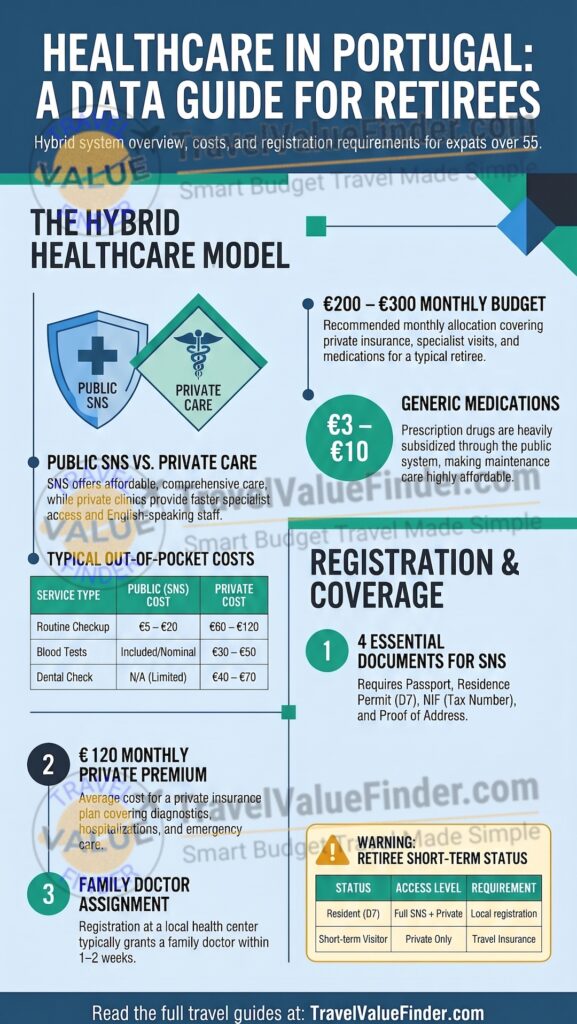
Portugal offers retirees access to both public and private healthcare. Residents can benefit from the National Health Service (Serviço Nacional de Saúde, SNS), which provides affordable medical care, while private clinics offer faster appointments and more personalized services. Many retirees combine public and private care to ensure quality, convenience, and peace of mind while living in Portugal.
Understanding the Healthcare System
When I arrived in Portugal, I need to understand how healthcare in Portugal works. I quickly realized that the system is a mix of public and private services.
Understanding the difference between public and private healthcare was essential.
Both systems are available to retirees like me, and many people find that using a combination of the two works best. Here’s how I navigated it:
- Public healthcare (SNS): Funded through taxes; affordable and comprehensive.
- Private healthcare: Quicker appointments, English-speaking doctors, but costs more.
- Pharmacies: Widely accessible and helpful for minor ailments.
I chose a combination of public and private care to balance cost, speed, and quality.
Public Healthcare (SNS)
I registered with the public healthcare system, called SNS, soon after getting my D7 visa and residency.
I found it straightforward but required some documentation:
Required documents:
- Passport | Identification
- Residence permit | Proof of legal status
- NIF (tax number)
- Proof of address
- Registration at local health center
Once registered, I was assigned a family doctor, which made routine checkups and minor health issues easier to handle. One of the things I appreciated immediately was how affordable it was.
A routine checkup costs me around €5 – €20. Of course, there are waiting times for non-urgent appointments, but I found that for major issues, the system is very reliable.
For example, when I needed a minor surgery, the public hospital handled everything professionally. I had some waiting, but the care was excellent, and I felt safe throughout the process. For many retirees, including myself, the predictability of costs and coverage is a huge comfort.
Private Healthcare
While public healthcare is excellent, wait times for specialists can be long. Private clinics and hospitals are more convenient for routine appointments and elective procedures. The waiting times are shorter, and many doctors speak English, which made my early months much easier.
That’s why I opted for private insurance and services for certain needs.
Costs I experienced:
- Specialist visit | €60 – €120 |
- Routine blood tests | €30 – €50 |
- Private dental check | €40 – €70
For instance, when I wanted a routine eye checkup, I booked a private clinic and had an appointment within a week. The cost was around €80, which I found reasonable compared to what I would have paid back home. Over time, I learned that using private care for convenience and public care for major needs strikes a good balance.
Health Insurance for Retirees
I maintain a combination of private health insurance and public coverage. My monthly premium is €120, which I consider an investment in peace of mind. Here’s what it covers:
- Specialist visits
- Diagnostics and lab tests
- Hospital admissions
- Emergency care
Tip: Choose a plan that includes English-speaking doctors if you don’t speak fluent Portuguese yet.
Cost of Medications and Pharmacies
Pharmacies in Portugal are reliable and affordable. Most prescriptions are partially subsidized if you use SNS. I keep a small budget for OTC medications and supplements:
- Generic prescription drugs: €3 – €10 per month
- Supplements: €15 – €25 per month
- OTC medications: €5 – €15 per item
Example: For seasonal allergies, I found a generic antihistamine at €6, which works perfectly and is cheaper than my home country.
My Personal Experience as a Retiree
Finding a family doctor was one of my first priorities. I registered with a local GP, who coordinates my care and referrals to specialists. Initially, I was nervous about communication, but in larger towns, many doctors speak English. Learning a bit of Portuguese has made a huge difference in feeling comfortable and respected.
When I needed to see a specialist, I sometimes opted for private care to avoid long waits. For example, I had a dermatologist appointment for a routine skin check, and booking through a private clinic meant I could see the doctor within a week instead of waiting a month at the public hospital.
Emergencies are another area where I’ve felt secure. On one occasion, a friend of mine had a minor fall, and the emergency care at the public hospital was fast and professional. Having private insurance helped cover additional tests and comfort items, but the base level of care is already excellent.
Prescription medications are straightforward. Most drugs are available at local pharmacies, and a prescription from a Portuguese doctor is required. I found that costs are reasonable, and the pharmacists are very helpful in explaining dosage and administration.
Adjusting to the Healthcare System
I won’t lie – there was a learning curve. Clinics and offices often close mid-day for lunch, and not everything can be booked online. But after a few months, I developed routines that work well for me. I now know which clinics are efficient, how to schedule appointments, and when to plan ahead for specialist visits.
Adapting to the system also means understanding the culture around appointments and patience. Once I accepted the rhythm, I felt less stressed and more in control.
Tips I’ve Learned for Maximizing Healthcare in Portugal
Here’s what helped me make the most of healthcare in Portugal:
- Get health insurance: Even if you rely on public care, insurance adds comfort and covers elective procedures.
- Learn basic Portuguese phrases: Simple greetings and medical terms go a long way.
- Ask fellow expats or locals: I’ve found neighbors and friends to be invaluable sources of information about the best clinics and doctors.
- Combine public and private care: I use private clinics for routine checkups and public hospitals for emergencies or major procedures.
- Plan for travel time: Some specialized care requires travel to bigger cities. I schedule these appointments in advance to avoid stress.
Real-Life Example : Healthcare in Portugal
When I had a minor knee issue, I first visited my local GP (public system). After discussing my symptoms, he referred me to an orthopedic specialist. I booked through a private clinic and had the consultation within a week.
The procedure itself was done at a public hospital, and I was impressed by how smoothly everything was coordinated. I paid a mix of insurance and small out-of-pocket fees, and my recovery was closely monitored. This experience taught me that combining public and private options works best for retirees like me.
Access and Convenience: My Routine
I chose a town with good access to both public and private healthcare. My typical routine looks like this:
- 1. Monthly checkup: Family doctor at SNS for general health monitoring.
- 2. Specialist appointments: Scheduled privately as needed.
- 3. Pharmacy visits: Regular for prescriptions and minor health needs.
This balance has kept me healthy, confident, and financially comfortable.
Actionable Tips for Retirees
- Register with SNS as soon as possible after residency.
- Combine public and private care for the best balance of cost and speed.
- Keep a health folder with past records and prescriptions.
- Budget for insurance and medications as part of your monthly retirement plan.
- Learn basic Portuguese medical terms to avoid misunderstandings.
- Choose your town wisely based on proximity to hospitals, clinics, and pharmacies.
Understanding Healthcare in Portugal
From my perspective, healthcare in Portugal is one of the country’s biggest advantages for retirees. With affordable, high-quality care in both public and private systems, I feel secure and supported. The key is preparation: understanding the system, getting insurance, learning a bit of Portuguese, and building relationships with local doctors.
From my personal experience, registering early, combining public and private care, budgeting for insurance, and choosing your town wisely are the keys to a smooth healthcare experience. Living here has shown me that with the right preparation, I can enjoy my retirement fully without worrying about access to quality medical care.
For anyone over 55 considering retiring in Portugal, I can say from personal experience: the healthcare system will not only meet your needs but also give you peace of mind to enjoy your retirement. With patience and planning, it becomes one less worry on your journey to living a calm, comfortable life abroad. Find out if you Can You Retire in Portugal on $2,000 a Month? and Is Portugal Safe for Retirees?
Ready to compare cities now?
- Use our Free Retirement Cost of Living Calculator — get your personalized report in 30 seconds – Free PDF download.
- How to Use a Retirement Cost of Living Calculator – to Compare Cities Worldwide
Frequently Asked Questions – Healthcare in Portugal For Retirees & Expats
Q1: Can I use public healthcare as a retiree on a D7 visa?
Yes, once you register with SNS, you can access public healthcare. Short-term visitors without residency may need private insurance.
Q2: How long does it take to get a family doctor?
Usually 1 – 2 weeks after registering with the local health center, but it can vary by town.
Q3: Are there English-speaking doctors?
Many private clinics and some public centers in major towns have English-speaking staff. Always confirm in advance.
Q4: How much should I budget for healthcare?
I budget €200 – €300 per month for a combination of insurance, private visits, and medications, which is sufficient for typical retiree needs.
Q5: Do I need private insurance if I have SNS coverage?
Not strictly, but private insurance provides faster access to specialists and peace of mind, especially in emergencies or for complex treatments.
Q6: Are medications expensive?
Generic prescriptions are very affordable, usually €3 – €10, while branded drugs cost more. Over-the-counter meds are also reasonably priced.
Q7: How do I find a good clinic?
Ask expat groups, local retirees, or your family doctor for recommendations. Visiting in person is the best way to assess quality and comfort.
Pages That Support This Guide
To help with deeper planning, this page connects to detailed guides such as:
- Retire in Portugal (A Warm, Practical Guide for People Over 55)
- Cost of Living in Portugal for Retirees (City-by-City)
- Portugal D7 Visa Explained for US and EU Citizens Over 55
- Healthcare in Portugal: A Retiree’s Perspective
- Renting vs Buying Property in Portugal
- Taxes in Portugal for Retirees
- Common Mistakes When Moving to Portugal
- Seasonal Living in Portugal: 3 – 6 Month Planning
- Portugal Retirement Scorecards for Retirees
- Portugal Retirement Checklist for Retirees
- Find out about Retiring in Portugal: The 4-Week Trial That Proves You Are Ready