Travel Value Finder

Healthcare in Spain is widely regarded as high quality, accessible, and affordable for retirees. Both public and private systems offer excellent services, with many English-speaking doctors available in major cities and popular expat regions. Understanding how the Spanish healthcare system works, including insurance options, costs, and registration requirements, helps retirees plan for a smooth and stress-free transition while living abroad.
Leslie Nics, TravelValueFinder.com | Last updated: April 2026 | Based on first-hand research having spent seasonal living in Spain.
Table of Contents
What Retirees Should Know About Healthcare in Spain
When I planned to retire in Spain, one of my top priorities was healthcare access. After all, the quality of medical care can make or break a retirement plan, especially if you’re over 55. Spain is known for its strong healthcare system, but there’s a lot more beneath the surface that retirees need to understand before moving.
From personal research and conversations with other retirees, I’ve learned that planning ahead for healthcare is not optional-it’s essential. Costs, coverage, and the process of accessing care vary by region, type of insurance, and residency status. Knowing how it works allows you to budget properly and avoid stress later.
This guide is written for people over 55 who are researching travel, long-term stays, or retirement abroad. I share real-world planning insights, official sources, and practical examples to help you understand what life in Spain is actually like – not just the highlights.
This content is educational, not legal or financial advice. Rules change, and personal situations differ, so I always recommend confirming details with official or professional sources before making decisions. Refer to the Trust & Transparency page for more information.
Understanding Healthcare in Spain : The Spanish Healthcare System
Spain has two main healthcare options:
- Public system (Sistema Nacional de Salud)
- Private healthcare system
Public Healthcare
Spain’s public system is well-regarded and widely accessible for residents. Once you hold residency, you can register with local health services and access doctors, specialists, and hospitals.
Example:
One retiree I spoke with in Valencia registered with the local public clinic and could see a general practitioner within a week. Specialist referrals typically take a few weeks.
Tip:
Public healthcare is excellent but can involve waiting times for non-emergency appointments. Many retirees supplement with private insurance to reduce wait times.
Private Healthcare
Private healthcare in Spain is widely used, especially by retirees who need flexibility, English-speaking doctors, or faster appointments. Costs vary by age and coverage level, but monthly premiums generally range from $80 – $200 for a single retiree.
Example:
A 63-year-old retiree opted for private insurance that included specialist visits, diagnostics, and prescription coverage. Monthly cost: $140. This allowed for same-day appointments when needed.
Tip:
Always ensure the policy meets Spain Non-Lucrative Visa requirements if you are on that visa. Even a small coverage gap can affect residency approval.
Regional Differences in Healthcare
Spain is diverse. Healthcare quality and availability can differ by region:
- Madrid & Barcelona: High-quality hospitals, specialists, and public system resources. Expect higher living costs.
- Valencia & Alicante (Costa Blanca): Balanced public and private access, affordable private insurance.
- Northern Spain (Galicia, Asturias): Excellent local care, slower pace, sometimes fewer English-speaking providers.
- Costa del Sol: Strong expat networks, English-speaking clinics widely available, slightly higher insurance premiums.
Example:
A retiree couple living in Costa del Sol chose private insurance that covered English-speaking doctors because one spouse preferred communication in English. In contrast, a retiree in inland Castilla-La Mancha relied on Spanish-language providers and a smaller insurance plan at lower cost.
Tip:
If you don’t speak fluent Spanish, consider regions with expat-friendly clinics or hire a bilingual health advocate temporarily to ease the transition.
How Much Healthcare Costs in Spain
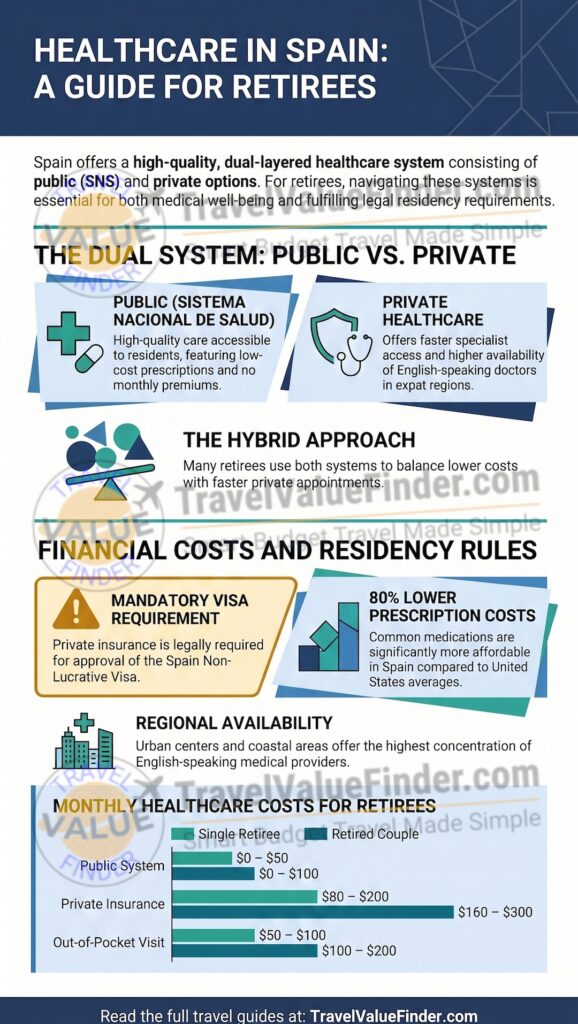
Healthcare costs are very manageable compared to the US, but they depend on the route you take:
| Healthcare Type | Single Retiree | Retired Couple | Notes |
| Public system (residency required) | $0 – $50 / month (mostly co-pays for prescriptions) | $0 – $100 / month | Registration required; medications inexpensive |
| Private insurance | $80 – $200 | $160 – $300 | Age and coverage level affect premium |
| Doctor visits out-of-pocket | $50 – $100 | $100 – $200 | Rare if using insurance |
Example:
A retiree in Valencia spent $1,600 per year on private insurance plus $200 for occasional specialist visits-much lower than US healthcare costs.
Tip:
Factor insurance into your monthly budget, even if public healthcare is accessible. Predictable costs reduce stress for retirees.
Prescription Medications and Pharmacies
Pharmacies in Spain are widely available and usually well-stocked. Prescription medications are typically cheaper than in the US, especially with public coverage.
Example:
A retiree on a common blood pressure medication paid $10/month through public coverage, compared to $50+ in the US.
Tip:
Bring documentation of chronic medications with generic names, as Spanish pharmacies may label drugs differently. Keep copies for initial doctor visits.
Emergency Healthcare
Spain’s emergency services are excellent and accessible via 112 (the universal emergency number). Public hospitals provide high-quality emergency care at low cost for residents.
Example:
A retiree broke an ankle during a walking tour. Emergency care, X-ray, and hospital stay cost under $200 after public coverage, excluding minor incidentals.
Tip:
Always carry proof of residency or insurance coverage in your wallet or phone. It speeds up care and ensures coverage.
Healthcare in Spain Practical Tips for 55+ Retirees
- Combine public and private coverage: Many retirees use both to balance cost and convenience.
- Register locally early: As soon as residency is granted, sign up for the local clinic.
- Choose location strategically: Urban centers have more specialists, while smaller towns offer affordability.
- Keep documentation organized: Income proof, insurance, residency certificates, and medical history.
- Plan for travel insurance initially: Short-term policies can cover you before residency and long-term insurance takes effect.
Common Mistakes Retirees Make
- Assuming private insurance is optional. For NLV visas, it is mandatory.
- Waiting too long to register with local clinics. Early registration ensures faster access.
- Underestimating seasonal costs: summer AC, winter heating, and additional travel for specialist care.
- Not checking if insurance covers all needed treatments.
Example:
One retiree waited 3 months before registering with a public clinic, resulting in delayed appointments. This could have been avoided by early registration. Explore more common mistakes when moving to Spain.
Why This Matters for Retirement Planning
Healthcare isn’t just an expense-it’s a cornerstone of your retirement lifestyle. Having clarity about costs, access, and quality allows retirees to:
- Choose the right city or region
- Budget realistically for insurance and out-of-pocket costs
- Reduce anxiety about medical emergencies
- Integrate seamlessly into Spain’s healthcare system
Example:
A retiree in Valencia structured their retirement budget around healthcare costs first. Housing, food, and lifestyle decisions followed, giving them confidence and predictability.
Getting to Know About Healthcare in Spain
From my experience and what I’ve observed among retirees, healthcare in Spain is high-quality, reliable, and affordable. Planning ahead-choosing the right region, understanding public vs. private options, and budgeting properly-turns a potential source of anxiety into a foundation of confidence.
For retirees over 55, this clarity allows you to focus on lifestyle, travel, and community engagement rather than worrying about medical access. Find out more to Retire in Spain on $2,500 a Month: The Honest 2026 Cost Guide
Ready to compare cities now?
- Use our Free Retirement Cost of Living Calculator — get your personalized report in 30 seconds – Free PDF download.
- How to Use a Retirement Cost of Living Calculator – to Compare Cities Worldwide
Frequently Asked Questions About Healthcare in Spain
1. Do I need private insurance if I have residency in Spain?
Yes, for Spain Non-Lucrative Visa holders. Even after residency, private coverage can reduce waiting times.
2. Are English-speaking doctors common?
More common in coastal expat areas like Costa del Sol and Alicante; less so inland.
3. Are prescriptions expensive?
No, much cheaper than in the US, especially with public coverage.
4. Can I rely only on public healthcare?
Yes, but private coverage is often chosen for faster access and specialist availability.
Pages That Support This Guide
To help with deeper planning, this page connects to detailed guides such as:
- Retire in Spain (A Warm, Practical Guide for People Over 55)
- Cost of Living in Spain for Retirees (City-by-City)
- Spain Non-Lucrative Visa Explained for US and EU Citizens Over 55
- Best Places to Live in Spain After 55
- Renting vs Buying Property in Spain
- Taxes in Spain for Retirees
- Common Mistakes When Moving to Spain
- Seasonal Living in Spain: 3 – 6 Month Planning
- Spain Retirement Scorecards for Retirees
- Spain Retirement Checklist for Retirees