Travel Value Finder


Should Retirees Rent or Buy Property in Portugal? Deciding between renting vs buying property in Portugal is a key choice for retirees. Renting offers flexibility, lower upfront costs, and freedom to explore different regions, while buying provides long-term stability, potential investment growth, and the comfort of owning your home. Understanding the local property market, taxes, and lifestyle factors can help retirees make the right decision for a secure and enjoyable life abroad.
Leslie Nics, TravelValueFinder.com | Last updated: April 2026 | Based on first-hand research having spent seasonal living in US, UK, Portugal, and Malaysia.
Table of Contents
Renting vs Buying Property in Portugal: What Retirees Need to Know
When I first arrived in Portugal, one of my biggest decisions was to consider renting vs buying property in Portugal. Each option has pros and cons, and I wanted to make a choice that balanced cost, flexibility, and long-term comfort. Here’s my personal journey, including examples, tables with costs, actionable advice, and FAQs to help other retirees over 55 make an informed decision to retire in Portugal.
This guide is written for people over 55 who are researching travel, long-term stays, or retirement abroad. I share real-world planning insights, official sources, and practical examples to help you understand what life in Portugal is actually like – not just the highlights.
This content is educational, not legal or financial advice. Rules change, and personal situations differ, so I always recommend confirming details with official or professional sources before making decisions. Refer to the Trust & Transparency page for more information.
Key Costs and Considerations When Renting or Buying in Portugal
I quickly realized that housing impacts financial security, lifestyle, and flexibility. Retirees need to weigh costs, location, length of stay, and lifestyle preferences before committing. For me, the choice between renting vs buying property in Portugal wasn’t just about money; it was about peace of mind and how I wanted to spend my retirement.
Why I Considered Both Options
Renting allows flexibility, testing towns before committing. Buying builds equity and stability but requires a larger upfront investment. I wanted a strategy that allowed me to enjoy Portugal immediately without locking me into a long-term commitment before I knew the area.
Renting vs Buying Property in Portugal
When deciding between renting vs buying property in Portugal, retirees need to weigh flexibility against long-term investment. Renting allows you to move freely, test different regions, and avoid large upfront costs, making it ideal for those new to the country. Buying, on the other hand, offers stability, potential property appreciation, and a sense of ownership-but requires a significant financial commitment and understanding of local taxes and fees. Evaluating your lifestyle, budget, and long-term plans will help determine the best choice for a comfortable retirement.
Renting Property: My Experience
I started by renting for the first year. Here’s what I found:
Pros of Renting
- Flexibility: I could try different areas before committing long-term.
- Lower upfront costs: A deposit and first month’s rent, rather than a large mortgage or property purchase.
- Less responsibility: Maintenance and repairs were often handled by the landlord.
- Tested the market: Renting allowed me to learn which towns and neighborhoods suited me best.
Cons of Renting
- No equity: Rent payments don’t build ownership.
- Rent increases: Some leases have annual increases.
- Limited customization: I couldn’t make major changes to the property.
For example, I rented a small apartment near the Silver Coast for six months and loved the location, but I realized I wanted a slightly larger place. Renting allowed me to move easily without financial stress.
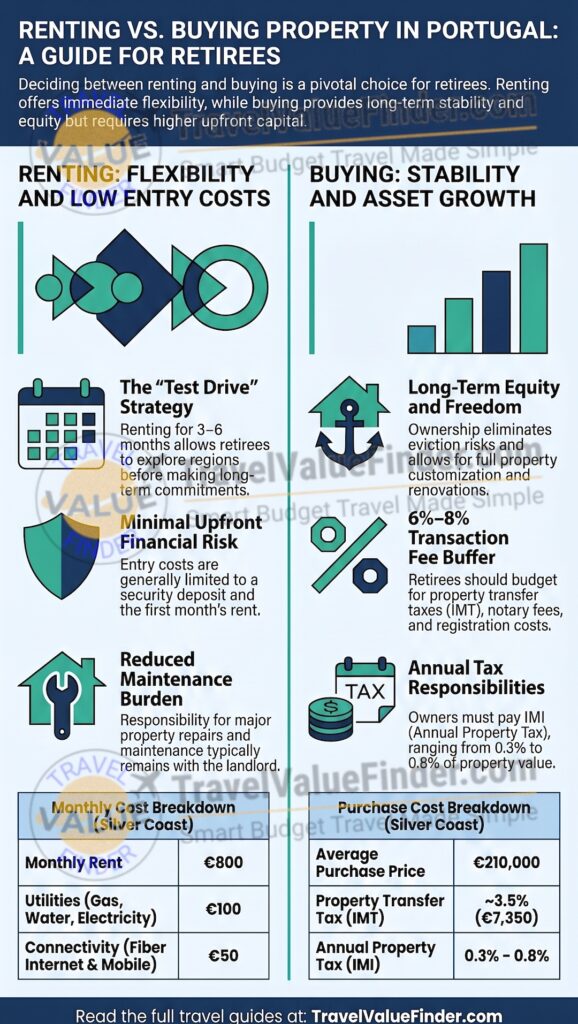
| Cost Component | Monthly (€) | Notes |
| Rent | 800 | One-bedroom apartment on the Silver Coast |
| Utilities | 100 | Electricity, water, gas |
| Internet & Mobile | 50 | Fiber internet + mobile plan |
| Deposit | 800 | Usually one month’s rent |
Example: I rented in Nazaré for six months. This helped me confirm I wanted coastal living without committing to a purchase.
Buying Property: My Experience
After a year of renting, I decided to buy. Here’s what I learned:
Pros of Buying
- Equity and investment: Each payment builds ownership.
- Freedom to customize: I could renovate and decorate to my liking.
- Long-term stability: No risk of eviction, and I can stay as long as I want.
- Potential rental income: If I travel or move, I can rent out the property.
Cons of Buying
- High upfront costs: Property purchase, taxes, notary fees, and registration costs.
- Ongoing responsibilities: Maintenance, insurance, and utilities are fully my responsibility.
- Market risk: Property values fluctuate, so timing matters.
- Slower flexibility: Selling or moving can take time and effort.
I bought a two-bedroom apartment in a quiet town on the Silver Coast. I knew the upfront cost would be higher, but the peace of mind and ability to make it my own made it worthwhile.
| Cost Component | One-Time/Monthly (€) | Notes |
| Property Price | 210,000 | Two-bedroom apartment |
| Property Transfer Tax | 7,350 | 3.5% of purchase price (IMT) |
| Notary & Registration | 1,500 | One-time fees |
| Mortgage (optional) | 850 | Based on €170,000 mortgage at 3% over 20 years |
| Annual Property Tax (IMI) | 700 | Depends on location and property value |
Example: Owning my apartment gave me peace of mind knowing I had a permanent base for my retirement, but I budget carefully for IMI and repairs.
Renting vs Buying Property in Portugal: My Decision Factors
When making my decision, I considered:
- Length of Stay: Renting is better for short-term or trial stays; buying is better for long-term residency.
- Budget: Renting requires lower upfront costs; buying requires savings or a mortgage.
- Lifestyle Preferences: Want flexibility and variety? Rent. Want stability and personalization? Buy.
- Test period: Renting first allowed me to explore regions, confirming my choice.
- Property Market: I researched trends, resale values, and growth potential before deciding.
- Taxes and Fees: Consider IMI, property transfer tax, notary, and maintenance costs.
Location and Neighborhood Insights
Regardless of renting vs buying property in Portugal, location matters most:
- Silver Coast: Affordable, peaceful, great for long-term retirement.
- Algarve: Beautiful, sunny, established expat community, slightly higher costs.
- Lisbon and Porto: More services and amenities, higher prices, busier pace.
- Inland towns: Lower cost, slower pace, fewer services.
By renting first, I discovered which areas matched my lifestyle and budget before committing to purchase.
Legal Considerations and Tips
- Hire a local lawyer: I found it invaluable to review contracts and ensure the purchase complied with Portuguese law.
- Understand taxes: I spoke with a tax advisor about property taxes, rental income rules, and double taxation treaties.
- Verify property status: Make sure the property has clear title, proper licenses, and no debts.
- Budget for fees: Notary, registration, and transfer taxes can add 6 – 8% of property value.
Being thorough saved me stress and unexpected costs. Refer to the Purchase and sale of real estate in Portugal.
My Recommendation
If you’re unsure, I highly recommend renting first. It allows you to explore regions, understand local amenities, and confirm your long-term preferences. Once you’re confident, buying property provides stability, investment, and the freedom to make your home truly yours. Find out if you Can You Retire in Portugal on $2,000 a Month?
Actionable Tips for Retirees
- Rent first: I recommend at least 3 – 6 months to explore the town and lifestyle.
- Compare costs: Include rent, utilities, taxes, insurance, and maintenance.
- Consider location: Coastal, inland, or city? Proximity to healthcare and amenities matters.
- Inspect properties thoroughly: For buying, check construction quality, plumbing, and local services.
- Consult a lawyer: Ensure property contracts are clear and legitimate.
- Budget for annual costs: Property taxes (IMI), insurance, and minor repairs.
Renting vs Buying Property in Portugal
Renting vs buying in Portugal depends on your retirement goals, budget, and lifestyle preferences. From my experience, renting first to explore, budgeting carefully, and then buying a property once confident is the safest approach. This strategy allowed me to enjoy flexibility initially and then establish a stable, comfortable home for my retirement on the Silver Coast.
Ready to compare cities now?
- Use our Free Retirement Cost of Living Calculator — get your personalized report in 30 seconds – Free PDF download.
- How to Use a Retirement Cost of Living Calculator – to Compare Cities Worldwide
Frequently Asked Questions: Renting vs Buying Property in Portugal
Q1: Is it better to rent or buy in Portugal as a retiree?
Rent first to test the area, then buy if you’re confident about long-term living.
Q2: How much does it cost to buy property?
Average €1,500 – €3,500/m² on the Silver Coast; higher in Lisbon and Algarve.
Q3: Are there additional fees when buying?
Yes, including IMT (property transfer tax), notary, and registration fees (approx. 6 – 8% of purchase price).
Q4: How much is the annual property tax (IMI)?
Typically 0.3 – 0.8% of the property’s tax value, varying by municipality.
Q5: Can I get a mortgage as a retiree?
Yes, banks may provide mortgages, but they consider age, income, and repayment capacity.
Q6: Can I renovate a rented property?
Usually minor changes are allowed, but permanent renovations require landlord approval.
Q7: How do I find good rental or purchase properties?
Use local real estate websites, agents, and expat forums. Visiting in person is essential.
Pages That Support This Guide
To help with deeper planning, this page connects to detailed guides such as:
- Retire in Portugal (A Warm, Practical Guide for People Over 55)
- Cost of Living in Portugal for Retirees (City-by-City)
- Portugal D7 Visa Explained for US and EU Citizens Over 55
- Healthcare in Portugal: A Retiree’s Perspective
- Renting vs Buying Property in Portugal
- Taxes in Portugal for Retirees
- Common Mistakes When Moving to Portugal
- Seasonal Living in Portugal: 3 – 6 Month Planning
- Portugal Retirement Scorecards for Retirees
- Portugal Retirement Checklist for Retirees