Travel Value Finder

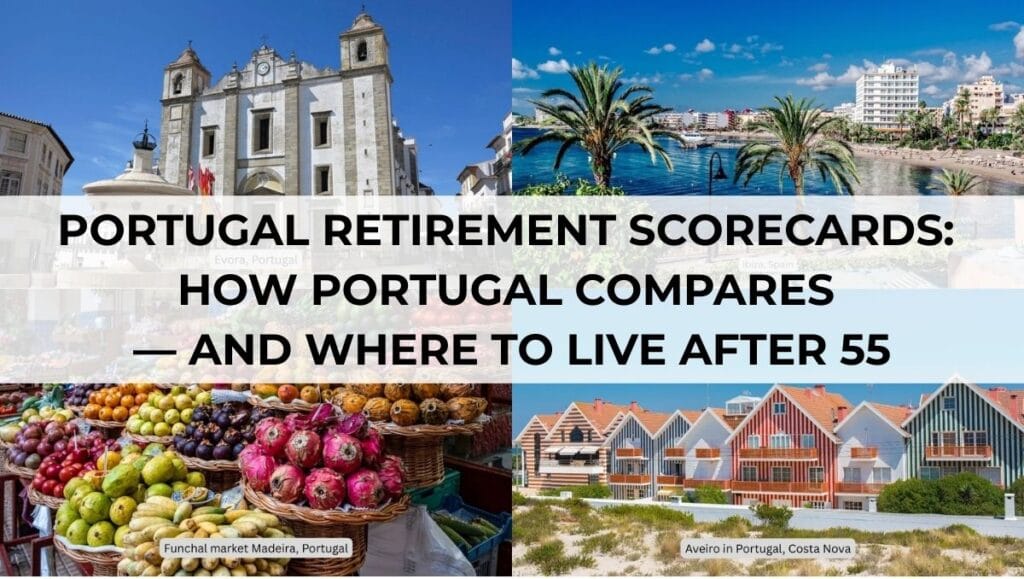
Portugal Retirement Scorecards offer a comprehensive comparison of cities and regions, helping retirees find the ideal location for life after 55. Whether you’re seeking vibrant city life, peaceful countryside, or coastal living, these scorecards evaluate factors like cost of living, healthcare access, climate, and expat communities. By reviewing these key metrics, you can make an informed decision about where to retire in Portugal, ensuring your retirement years are enjoyable and stress-free.
Leslie Nics, TravelValueFinder.com | Last updated: April 2026 | Based on first-hand research having spent seasonal living in US, UK, Portugal, and Malaysia.
Table of Contents
Portugal Retirement Scorecards for Retirees
When I started researching Portugal for retirement and long-term living, I quickly realized something important: not all “popular” places are right for everyone.
Lisbon, Porto, and the Algarve are mentioned everywhere – but what matters most after 55 isn’t hype. It’s how a place actually performs day to day: affordability, healthcare access, walkability, pace of life, and overall comfort. That’s why I created these Portugal Retirement Scorecards. They’re designed to give a clear, side-by-side comparison of the regions retirees most often consider – using practical, real-world criteria instead of marketing language.
This guide explains:
- How the scorecards work
- What each category means
- How to interpret the scores
And which regions tend to suit different retirement lifestyles
This guide is written for people over 55 who are researching travel, long-term stays, or retirement abroad. I share real-world planning insights, official sources, and practical examples to help you understand what life in Portugal is actually like – not just the highlights.
This content is educational, not legal or financial advice. Rules change, and personal situations differ, so I always recommend confirming details with official or professional sources before making decisions. Refer to the Trust & Transparency page for more information.
How the Portugal Retirement Scorecards Work
Each region is scored across eight core retirement factors, using a 1 – 10 scale:
- 1 – 3 = Challenging for most retirees
- 4 – 6 = Mixed or situational
- 7 – 8 = Strong fit for many retirees
- 9 – 10 = Excellent fit for retirees
These are comparative scores, not promises. They help narrow options and guide deeper research.
The Regions Included
These scorecards focus on the best places to live in Portugal most commonly researched by U.S. and European retirees:
- Lisbon Metropolitan Area
- Porto Metropolitan Area
- Algarve
- Silver Coast (Costa de Prata)
- Central Alentejo (Évora and surrounding towns)
Scorecard 1: Portugal as a Retirement Destination
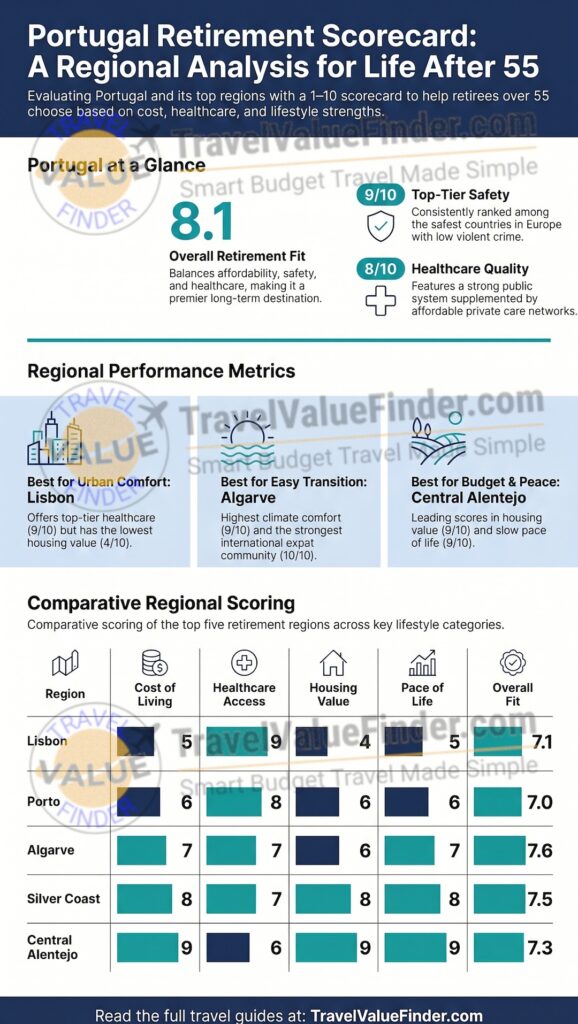
This first scorecard looks at Portugal as a whole. It answers the big question: does Portugal work as a long-term retirement destination before worrying about cities or neighborhoods.
Portugal Retirement Scorecard (Country Level)
| Category | Score (1 – 10) | What This Means in Real Life |
|---|---|---|
| Cost of Living | 8 | Daily expenses remain manageable, especially outside major cities |
| Healthcare Quality | 8 | Strong public system combined with affordable private care |
| Safety | 9 | Consistently ranked among the safest countries in Europe |
| Climate Comfort | 8 | Mild winters and warm summers with regional variation |
| Visa & Residency | 7 | Accessible retirement visas with advance planning |
| Infrastructure | 8 | Reliable transport, utilities, and internet |
| Lifestyle & Pace | 9 | Calm, slower rhythm suited to retirement |
| Language Accessibility | 7 | English widely spoken; Portuguese useful long term |
| Overall Retirement Fit | 8.1 | Strong long-term option for many retirees |
Portugal performs well overall because it balances affordability, healthcare, safety, and lifestyle quality. The primary challenge is bureaucracy, which requires patience and preparation.
Scorecard 2: Where to Live in Portugal After 55
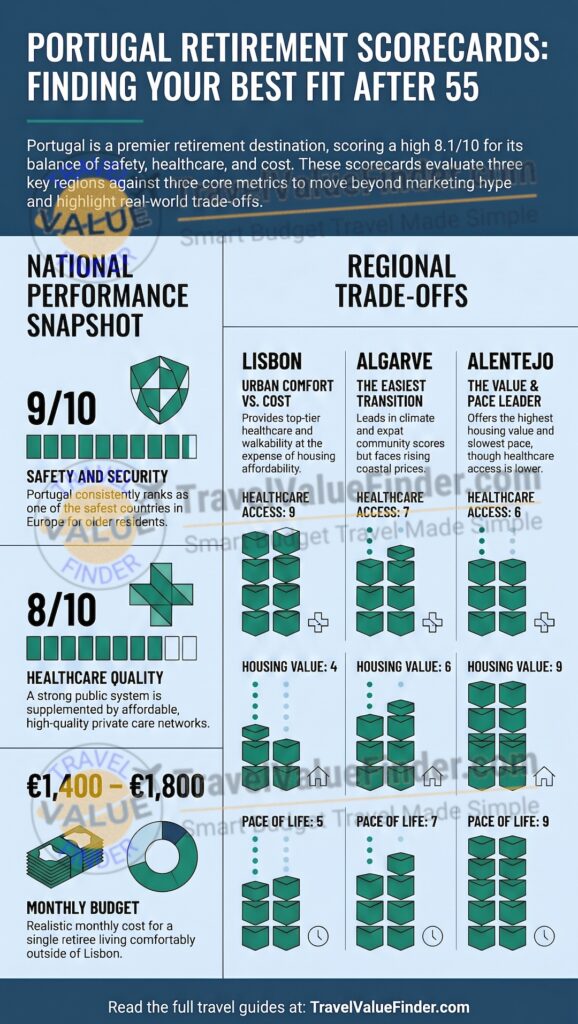
Portugal Retirement Scorecard – Regional At a Glance
| Region | Cost of Living | Healthcare Access | Climate | Safety | Expat Community | Housing Value | Pace of Life | Overall Fit |
|---|---|---|---|---|---|---|---|---|
| Lisbon | 5 | 9 | 7 | 9 | 9 | 4 | 5 | 7.1 |
| Porto | 6 | 8 | 6 | 9 | 7 | 6 | 6 | 7.0 |
| Algarve | 7 | 7 | 9 | 9 | 10 | 6 | 7 | 7.6 |
| Silver Coast | 8 | 7 | 7 | 9 | 6 | 8 | 8 | 7.5 |
| Central Alentejo | 9 | 6 | 8 | 9 | 4 | 9 | 9 | 7.3 |
Understanding the Scores
Scores are comparative, not absolute. Lower scores often reflect higher costs or faster pace rather than poor quality.
Explaining Each Scorecard Category
Scores are comparative, not absolute. Lower scores often reflect higher costs or faster pace rather than poor quality.
1. Cost of Living
This reflects day-to-day affordability, including rent, groceries, utilities, dining, and transportation. Lisbon scores lower due to rising rents Silver Coast and Alentejo score higher because housing and daily costs remain reasonable. This score does not assume luxury living – it reflects a comfortable but realistic retirement lifestyle. Find out if you Can You Retire in Portugal on $2,000 a Month?
2. Healthcare Access
This measures:
- Availability of public and private hospitals
- English-speaking doctors
- Wait times
- Specialist access
- Lisbon and Porto score highest because they have:
- Major hospitals
- Private healthcare networks
- International clinics
Rural regions score slightly lower due to fewer specialists nearby.
3. Climate Comfort
This considers:
- Temperature extremes
- Humidity
- Seasonal comfort
- The Algarve scores highest due to:
- Mild winters
- Abundant sunshine
Northern regions score slightly lower because winters are cooler and wetter.
4. Safety
Portugal consistently ranks as one of the safest countries in Europe.
All regions score high here due to:
- Low violent crime
- Strong community presence
- Safe public transport
Differences are minimal, which is a major advantage of Portugal overall.
5. Expat & International Community
This reflects:
- Presence of foreign residents
- English-language services
- Social integration ease
- The Algarve leads, followed closely by Lisbon.
Silver Coast and Alentejo score lower – not because they’re unwelcoming, but because:
- Fewer international services
- More Portuguese-language dependence
6. Walkability & Transportation
This measures:
- Ability to live without a car
- Public transport access
- Walkable neighborhoods
Lisbon and Porto excel here.
Smaller towns score lower because daily errands often require a car.
7. Housing Value (What You Get for the Money)
This looks at:
- Space
- Quality
- Location relative to price
Alentejo and the Silver Coast score highest because:
- You get more space
- Prices are still reasonable
- Less speculative demand
Lisbon scores lowest due to price pressure.
8. Pace of Life
This is especially important after 55.
It reflects:
- Noise levels
- Crowds
- Stress
- Daily rhythm
Alentejo ranks highest – slow, quiet, and community-oriented.
Lisbon ranks lower due to tourism, traffic, and density.
Regional Insights (What the Scores Really Mean)
Lisbon: Best for Urban Comfort, Not Budget Living
Lisbon is ideal if you want:
- Top-tier healthcare
- Walkability
- Cultural life
But it’s less ideal if:
- You’re on a fixed income
- You want peace and quiet
Many retirees start in Lisbon, then move elsewhere.
Porto: Balanced and Authentic
Porto offers:
- Lower costs than Lisbon
- Strong healthcare
- Traditional culture
The trade-off is:
- Cooler climate
- Fewer international services than Lisbon or Algarve
Algarve: Easiest Transition for Many Retirees
The Algarve scores highest overall because:
- Strong expat network
- English widely spoken
- Excellent climate
The downside:
- Some areas feel seasonal
- Coastal prices are rising
Silver Coast: Value Without Isolation
This region is often overlooked.
It offers:
- Coastal living
- Lower housing costs
- Slower pace
It’s ideal if:
- You’re comfortable learning some Portuguese
- You want value without being rural
Central Alentejo: The Quiet Lifestyle Choice
Alentejo is not for everyone – and that’s okay.
It’s best if:
- You want space, silence, and community
- You value affordability over convenience
It’s less suitable if:
- You need frequent specialist care
- You rely heavily on expat services
Data Sources & Methodology
These Portugal Retirement scorecards are compiled from Statistics Portugal (INE), OECD Health Statistics, Eurostat, Global Peace Index, Portugal’s Ministry of Health (SNS), and adjusted Numbeo cost-of-living data. No single source determines a score; values are averaged and weighted for retiree relevance.
Where the Data Comes From (Transparency)
These scorecards are compiled using multiple reliable sources, combined with long-term retirement planning analysis.
Primary Data Sources:
- INE Portugal (Instituto Nacional de Estatística) – demographics, costs
- OECD Health Statistics – healthcare performance
- Numbeo (aggregated, adjusted) – cost-of-living trends
- Eurostat – safety, infrastructure, regional data
- Portuguese Ministry of Health (SNS) – healthcare access
- Global Peace Index – safety rankings
- Local municipal data – transport and services
How the Data Is Used
- No single source determines a score
- Data is averaged and adjusted for retiree relevance
- Subjective elements (pace of life, expat presence) are weighted conservatively
How to Use These Portugal Retirement Scorecards
I recommend using them in three steps:
- 1. Eliminate regions that don’t fit your priorities
- 2. Shortlist 1 – 2 areas
- 3. Then research neighborhoods, not countries
These scorecards are starting points, not final answers.
Benefits of the Portugal Retirement Scorecards
Portugal can be an excellent retirement destination, but where you live matters more than choosing Portugal itself. These Portugal Retirement Scorecards help reduce overwhelm and support informed, realistic planning. Portugal works very well for many retirees – but where you live matters more than choosing Portugal itself. These scorecards exist to:
- Reduce overwhelm
- Clarify trade-offs
- Encourage realistic planning
- Check out the Retiring in Portugal: The 4-Week Trial That Proves You Are Ready
Ready to compare cities now?
- Use our Free Retirement Cost of Living Calculator — get your personalized report in 30 seconds – Free PDF download.
- How to Use a Retirement Cost of Living Calculator – to Compare Cities Worldwide
Frequently Asked Questions About Retiring in Portugal
Q1. Is Portugal really a good place to retire after 55?
From my research and personal experience, yes – but with context. Portugal works best for retirees who value safety, affordable healthcare, a slower pace of life, and mild weather. It may not be ideal if you want fast-paced city living or minimal bureaucracy. Choosing the right region matters more than choosing Portugal itself.
Q2. How much money do I realistically need to retire in Portugal?
This depends heavily on lifestyle and location. From what I’ve seen:
A single retiree can live comfortably on €1,400 – €1,800/month outside Lisbon.
A couple often needs €2,200 – €2,800/month. Lisbon and prime Algarve areas push budgets higher, while the Silver Coast and Alentejo reduce costs significantly.
Q3. Do I need private healthcare in Portugal?
I strongly recommend it. Portugal’s public healthcare system (SNS) is good, but wait times can be long. Most retirees I’ve spoken to – and what I plan myself – use private insurance for speed and the public system as a backup. Private plans typically cost €50 – €150 per month after 55.
Q4. Which region of Portugal is best for retirees?
There’s no single “best,” but here’s how I see it:
Algarve: Best for expat support and sunshine
Silver Coast: Best value-for-money
Central Alentejo: Best for peace and low costs
Lisbon: Best services, but least affordable
Your choice should match your tolerance for crowds, budget, and healthcare access. See the Portugal Retirement Scorecards above.
Q5. Is the D7 Visa still a good option for retirees?
Yes, the D7 remains one of the most retiree-friendly visas in Europe. It’s ideal if you have pension income, rental income, dividends, or savings. The process requires preparation, patience, and documentation – but it is very achievable with planning.
Q6. Is Portugal safe for older expats?
In my assessment, Portugal is one of the safest countries in Europe. Violent crime is rare, and most issues are limited to petty theft in tourist areas. For retirees, the sense of everyday safety is one of Portugal’s strongest advantages.
Q7. Will I need to learn Portuguese?
You can get by with English at first, especially in cities and expat-heavy areas. However, learning basic Portuguese dramatically improves healthcare interactions, bureaucracy, and daily life. I consider it essential for long-term comfort and integration.
Q8. What are the biggest mistakes retirees make when moving to Portugal?
The most common mistakes I see:
Choosing Lisbon first without cost awareness
Underestimating bureaucracy timelines
Not budgeting for private healthcare
Renting long-term before experiencing seasonal changes
Assuming all regions feel the same
Q9. Is Portugal still affordable compared to other retirement destinations?
Compared to the US, UK, and much of Western Europe – yes. Costs have risen, but Portugal remains more affordable than Spain’s major cities, France, or Italy, especially when healthcare is factored in.
Q10. Can I test Portugal before committing long-term?
Absolutely – and I recommend it. Spending 3 – 6 months seasonally gives you a realistic feel for weather, crowds, healthcare access, and daily costs. This approach prevents costly mistakes and relocation regret.
Pages That Support This Guide
To help with deeper planning, this page connects to detailed guides such as:
- Retire in Portugal (A Warm, Practical Guide for People Over 55)
- Cost of Living in Portugal for Retirees (City-by-City)
- Portugal D7 Visa Explained for US and EU Citizens Over 55
- Healthcare in Portugal: A Retiree’s Perspective
- Renting vs Buying Property in Portugal
- Taxes in Portugal for Retirees
- Common Mistakes When Moving to Portugal
- Seasonal Living in Portugal: 3 – 6 Month Planning
- Portugal Retirement Scorecards for Retirees
- Portugal Retirement Checklist for Retirees