Travel Value Finder

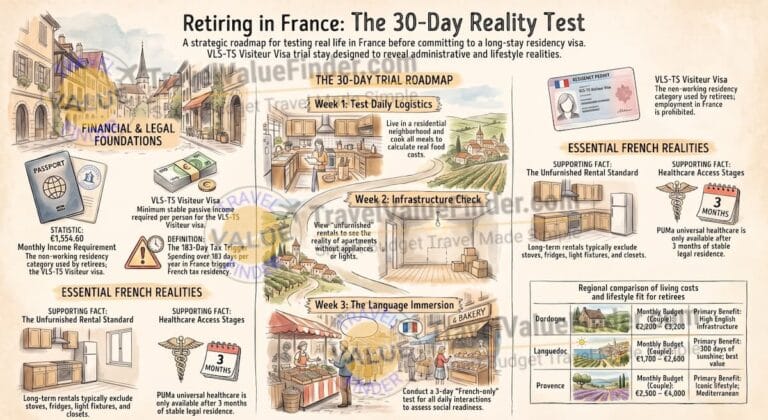
Many people dream to retire in France, drawn by its rich culture, world-class healthcare, and relaxed lifestyle. Understanding the cost of living, healthcare options, and visa requirements is essential to plan a smooth transition. Whether you’re seeking charming villages or vibrant cities, retiring in France offers a unique opportunity to enjoy your golden years in comfort and style. Find out if your budget fits, and the real cost to Retire in France on $3,000 a Month: What the 2026 Numbers Actually Say, and Retiring in France: What 30 Days of Real Life Taught Me Before I Applied for the VLS-TS
Leslie Nics, TravelValueFinder.com | Last updated: April 2026 | Based on first-hand research having spent seasonal living in US, UK, Portugal, and Malaysia.
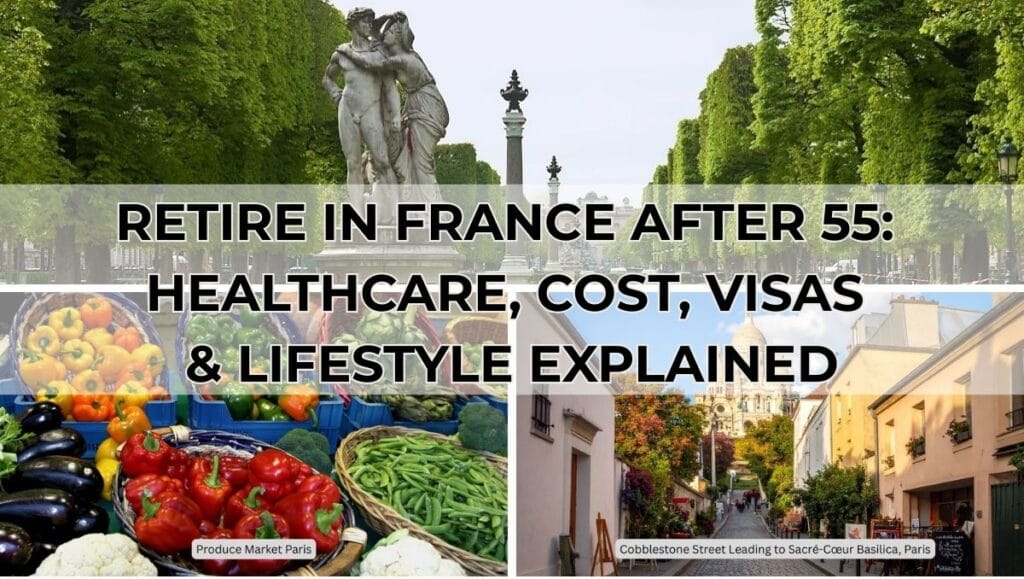
This infographic, “Retire in France After 55: Healthcare, Cost, Visas & Lifestyle Explained,” provides a clear snapshot of everything you need to know before making the move-from understanding visa requirements and accessing France’s healthcare system to comparing living costs and embracing the French lifestyle. It’s a quick, visual guide designed to help you plan your retirement with confidence and clarity.
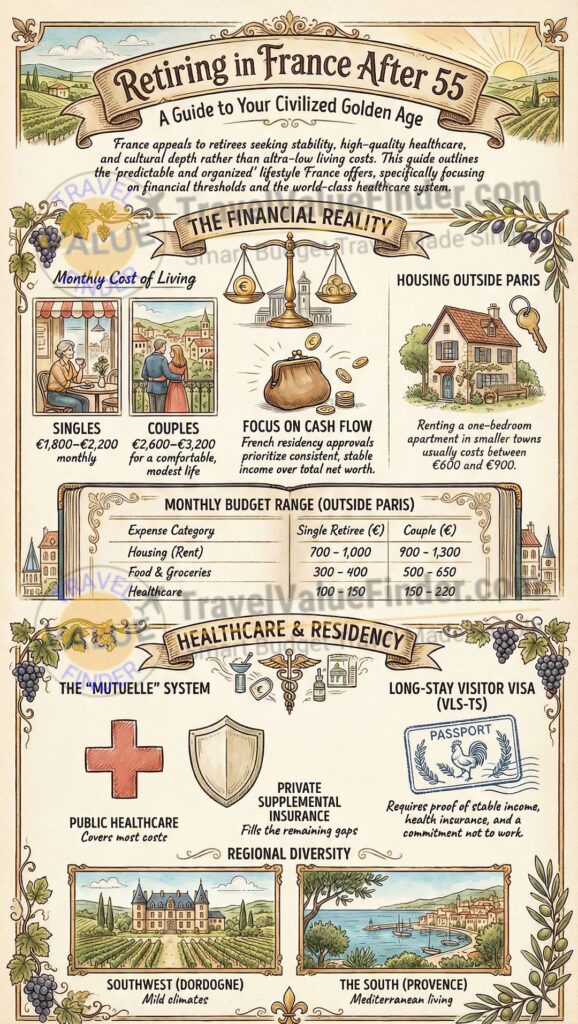
Table of Contents
Retire in France: Healthcare, Cost, Visas & Lifestyle Explained
When people imagine retirement abroad, France isn’t always the loudest option – and that’s part of its appeal. France attracts retirees who are not chasing novelty or bargains. Instead, it appeals to those who want stability, healthcare security, cultural depth, and a life that feels well-supported rather than complicated.
Many of the retirees I’ve spoken with describe France as a place where daily life feels organized, predictable, and civilized – qualities that matter more as we get older.
Is France a Good Place to Retire After 55?
France can be an excellent place to retire – if your expectations align with its reality.
France works best for retirees who appreciate:
- Organization and structure
- High-quality healthcare
- Cultural depth rather than constant novelty
- Slower, routine-based living
It may feel less suitable if you are looking for:
- Ultra-low living costs
- A highly flexible, informal lifestyle
- Minimal bureaucracy
What France offers instead is reliability – and for many retirees, that is priceless.
This guide is written for people over 55 who are researching travel, long-term stays, or retirement abroad. I share real-world planning insights, official sources, and practical examples to help you understand what life in France is actually like – not just the highlights.
This content is educational, not legal or financial advice. Rules change, and personal situations differ, so I always recommend confirming details with official or professional sources before making decisions. Refer to the Trust & Transparency page for more information.
Healthcare in France: A Cornerstone of Retirement Security
How the French Healthcare System Supports Retirees
Healthcare is often the single most important factor for retirees – and France consistently ranks among the top healthcare systems in the world. What makes French healthcare especially attractive is not just quality, but access and predictability. Doctors are widely available, appointments are generally unhurried, and costs are regulated.
After becoming a legal resident, retirees can access the public healthcare system, often supplemented by a private “mutuelle” insurance that covers remaining costs.
Example:
Many retirees describe being surprised by how calm medical visits feel in France. Doctors take time, explain conditions thoroughly, and follow-up care is systematic. As we get older, knowing that healthcare will not become a financial or logistical burden brings enormous peace of mind.
France has one of the most respected healthcare systems in the world. It combines:
- Public healthcare access
- Regulated costs
- Private supplemental insurance (“mutuelle”)
Why this matters when you retire in France after 55:
Healthcare stops being theoretical. It becomes something you interact with regularly.
Cost of Living in France: What Retirees Are Often Surprised By
France is often perceived as expensive – and while Paris can be costly, France is not one price everywhere.
Outside major cities, retirees often find that:
- Grocery costs are reasonable
- Healthcare expenses are low and predictable
- Public transportation reduces car dependence
- Utilities are manageable in smaller homes
Example:
A retiree living in rural western France shared that their monthly living costs were comparable to – or even lower than – their previous life in the U.S., largely due to healthcare savings and walkable living. France rewards retirees who are flexible about location and lifestyle.
Daily expenses such as:
- Groceries
- Transportation
- Healthcare
- Utilities
are often more affordable than expected, especially outside Paris.
The Financial Reality of Retiring in France (What I’d Want to Understand First)
When I talk with retirees about France, money is rarely the first topic – but it’s often the one that quietly determines whether the plan actually works. France does not require retirees to be wealthy. What it does require is financial stability and predictability. The country is structured around systems – healthcare, taxes, housing – and those systems expect you to plan ahead rather than improvise.
Understanding the financial side early helps you retire in France with confidence instead of constant uncertainty.
How Much Income Do Retirees Really Need to Live Comfortably in France?
France doesn’t publish a single “retirement income number,” but practical experience gives us a reliable range. Most retirees live comfortably on:
- €1,800 – €2,200 per month for a single person
- €2,600 – €3,200 per month for a couple
This assumes a lifestyle outside Paris, with modest housing, regular healthcare use, and everyday comforts – not luxury living, but not penny-pinching either.
Example:
A retired couple living in western France shared that their monthly expenses stabilized around €2,700 after their first year – once healthcare, utilities, and food became predictable.
What France Actually Expects Financially for Residency
For the long-stay visitor visa, France typically expects proof of:
- Stable income (pensions, Social Security, investments)
- Sufficient savings
- Ability to cover healthcare and housing
France is not focused on your net worth – it focuses on cash flow.
Tip:
Clear documentation matters more than high income. Organized finances make approvals smoother.
Major Expense Categories Retirees Should Plan For
Housing
Housing is usually the largest expense. Costs vary dramatically by region. Buying introduces upfront costs and taxes, so many retirees rent first. Here is the complete information on Renting vs Buying a Property in France for Retirees.
Renting outside major cities often costs:
- €600 – €900 for a one-bedroom apartment
- €900 – €1,200 for a small house
Healthcare
Healthcare in France is one of the biggest financial advantages for retirees.
Once enrolled:
- Public healthcare covers most costs
- Supplemental insurance (“mutuelle”) fills the gaps
- Out-of-pocket costs are generally low
Example:
Many retirees report healthcare expenses of €100 – €150 per month including supplemental coverage.
Food & Daily Living
Retirees who adopt local shopping habits often spend less than expected. Food costs in France are surprisingly reasonable:
- Local markets are affordable
- Quality is high
- Eating at home keeps costs low
Transportation
Public transportation is excellent in many regions. This can significantly reduce monthly costs.
As a result, many retirees:
- Reduce or eliminate car ownership
- Use trains and local buses
- Walk frequently
Financial Expectations Table for Retirees in France
Below is a realistic monthly budget range for a retiree living outside Paris.
| Expense Category | Single Retiree (€) | Couple (€) |
| Housing (Rent) | 700 – 1,000 | 900 – 1,300 |
| Utilities & Internet | 120 – 180 | 150 – 220 |
| Food & Groceries | 300 – 400 | 500 – 650 |
| Healthcare & Insurance | 100 – 150 | 150 – 220 |
| Transportation | 60 – 120 | 100 – 160 |
| Personal & Leisure | 150 – 250 | 200 – 350 |
| Estimated Total | 1,800 – 2,200 | 2,600 – 3,200 |
These figures reflect comfortable, modest living outside major cities. Paris and prime Riviera locations cost more.
How Currency and Inflation Affect Retirees
If your income is in USD or another currency, exchange rates matter. France rewards retirees who build financial buffers, not those who aim to live at the absolute minimum. Therefore, many retirees:
- Maintain savings in multiple currencies
- Budget conservatively
- Avoid relying on tight margins
What I’d Personally Recommend Financially
France is forgiving – but it favors preparedness. If I were planning retirement in France, I’d aim for:
- At least 15 – 20% buffer above estimated expenses
- Clear documentation of income
- Flexibility in housing during the first years
Where Retirees Choose to Live in France – and Why
France’s regional diversity is one of its greatest strengths. Explore more of the best places to live in France to gain a clearer perspective.
Popular Retiree Regions
- Southwest France (Dordogne, Occitanie):
Known for gentle pace, mild climate, and strong expat communities. - Southern France (Provence, Languedoc):
Appeals to retirees drawn to sunshine, markets, and Mediterranean living. - Western France (Loire Valley, Brittany):
Favored for cooler climates, greenery, and quieter towns.
Paris, while culturally rich, tends to suit retirees who plan part-time living rather than full retirement. Smaller towns and mid-sized cities often offer the best balance of:
- Slower pace
- Lower affordable housing costs than Paris
- Strong healthcare access
- Community-oriented living
- Walkability
Visas & Residency: How Retirees Live Legally in France
The Long-Stay Visitor Visa (VLS-TS)
Most non-EU retirees live in France using a long-stay visitor visa, renewable annually. France is not looking for workers – it is looking for financially stable residents who can support themselves.
Typical requirements include:
- Proof of sufficient income or savings
- Health insurance
- Accommodation
- A commitment not to work in France
Example:
Retirees with pensions, Social Security, or investment income often meet requirements comfortably. The process is structured, predictable, and – with preparation – manageable.
Related: France Retirement Visa Explained
Taxes in France: Understanding the Reality (Not the Rumors)
France has a reputation for high taxes, but the truth for retirees is more nuanced.
Key considerations include:
- Tax treaties that prevent double taxation
- Income types taxed differently
- Social charges linked to healthcare access
- Property and wealth taxes that depend on residency status
Important:
Taxes in France are not something to fear – but they are something to understand early.
Tip:
Taxes in France are manageable when planned properly – but ignoring them is one of the biggest mistakes retirees make.
What Daily Life in France Feels Like After Retirement
Retiring in France is not about sightseeing every day. France encourages a lifestyle where time is respected, and that resonates deeply with retirees who want life to feel less rushed. You might also consider seasonal living in France as a way to experience the lifestyle before making a major move. To retire in France gracefully, it’s about:
- Morning walks to the bakery
- Weekly markets
- Familiar routines
- Seasonal rhythms
- Strong boundaries between work and personal life
Cultural Adjustment: What Retirees Often Underestimate
France is welcoming – but it has a strong sense of cultural norms. Challenges retirees may face include:
- Language barriers
- Bureaucratic processes
- Formal communication styles
These are not obstacles – they are adjustments.
Example:
Retirees who approach French culture with patience and curiosity often find themselves deeply integrated over time. Do consider the common mistakes when moving to France.
Who France Is Best (and Not Best) For
France tends to suit retirees who:
- Value healthcare and stability
- Enjoy culture and tradition
- Prefer structure to improvisation
- Are patient with systems
France may be less suitable if you:
- Want the lowest cost possible
- Dislike paperwork
- Prefer informal environments
Why France Appeals Later in Life
France is not flashy. It doesn’t promise reinvention. What it offers instead is continuity, dignity, and support – qualities that matter deeply as we age. For retirees who want life to feel grounded, well-organized, and quietly rich, retiring in France can be an exceptionally rewarding choice. For retirees who value security, dignity, and a well-supported life, retiring in France can feel less like an adventure – and more like coming home. It quietly offers:
- Stability
- Healthcare confidence
- Cultural richness
- Long-term livability
To plan more effectively, use our France retirement scorecard to evaluate key factors like cost, healthcare, and lifestyle, and follow our France retirement checklist to ensure you’ve covered all essential steps for a smooth transition. Explore our Complete France Travel Guide: Exploring Paris, Nice, and Lyon
Ready to compare cities now?
- Use our Free Retirement Cost of Living Calculator — get your personalized report in 30 seconds – Free PDF download.
- How to Use a Retirement Cost of Living Calculator – to Compare Cities Worldwide
Frequently Asked Questions – Retire in France
Can Americans retire in France?
Yes. Many do so successfully with a long-stay visa.
Is healthcare affordable for retirees?
Yes. Healthcare is one of France’s strongest advantages.
Do I need to speak French fluently?
Fluency helps, but many retirees learn gradually and manage well.
Is France better than Spain or Portugal for retirement?
It depends on priorities. France excels in healthcare and stability. We have an article comparing Spain vs Portugal for retirement.
France Retirement Hub: Supporting Pages
This page supports the following France retirement pages:
- Retire in France
- France Retirement Visa Explained
- Cost of Living in France for Retirees
- Best Places to Live in France After 55
- Healthcare in France for Retirees
- Taxes in France for Retirees
- Renting vs Buying Property in France
- Common Mistakes When Moving to France
- Seasonal Living in France
- France Retirement Scorecards
- France Retirement Readiness Checklist