Travel Value Finder


When I decided to retire in Portugal, understanding how to apply for the Portugal D7 visa was one of my top priorities. The D7 visa, designed for retirees and individuals with passive income, allowed me to live in Portugal legally and access public healthcare. I want to share my personal journey, detailed steps, costs, tips, and common pitfalls, so other retirees over 55 can navigate the process smoothly.
Leslie Nics, TravelValueFinder.com | Last updated: April 2026 | Based on first-hand research having spent seasonal living in US, UK, Portugal, and Malaysia.
Table of Contents
How to Apply for a Portugal D7 Visa as a Retiree
Applying for a Portugal D7 Visa as a retiree involves demonstrating a stable source of passive income-such as pensions or investments-along with securing accommodation and meeting basic documentation requirements like proof of funds, health insurance, and a clean criminal record. The process typically begins in your home country through a Portuguese consulate, followed by a residence permit application once you arrive in Portugal. While the steps are fairly straightforward, the paperwork can be detailed, so it’s a good idea to plan ahead. For a clearer, step-by-step breakdown and helpful tips, be sure to read the blog below.
This guide is written for people over 55 who are researching travel, long-term stays, or retirement abroad. I share real-world planning insights, official sources, and practical examples to help you understand what life in Portugal is actually like – not just the highlights.
This content is educational, not legal or financial advice. Rules change, and personal situations differ, so I always recommend confirming details with official or professional sources before making decisions. Refer to the Trust & Transparency page for more information.
Why the D7 Visa Was Right for Me
I looked at all visa options before moving. The Portugal D7 Visa appealed to me because it’s made for people like me who have a steady income but don’t plan to work in Portugal. My income comes from my pension and some rental property income, which fit perfectly with the requirements.
The visa allows you to:
- Live in Portugal legally
- Access healthcare as a resident
- Eventually apply for permanent residency if you want
For someone over 55 who wants stability and long-term planning, the D7 visa makes a lot of sense.
Who the Portugal D7 Visa Works For
From my experience, the Portugal D7 visa is best for retirees who:
- Have predictable monthly income
- Value stability over flexibility
- Are comfortable handling some paperwork and planning
It’s less suitable if you want to move constantly, avoid bureaucracy, or make last-minute decisions. For me, I appreciated the predictability – it made settling in much easier.
Income Requirements: What I Needed
I needed to show that I could support myself. Portugal ties this to the Portuguese minimum wage, which is approximately €870 per month (gross) in 2025.
For me, the guideline meant:
- Myself (main applicant): ~€870 per month
- My spouse: ~€435 per month additional
- Dependents: ~€260 per month each
I knew that showing a bit more than the minimum helped demonstrate financial stability. My pension plus rental income comfortably met this threshold. I had all documents ready: bank statements, pension slips, and property income records.
Savings and Bank Balance
Besides income, I had to demonstrate some savings. I opened a Portuguese bank account and deposited enough to cover several months of expenses. This isn’t just about numbers; it shows that I could handle unexpected costs without depending on the government. For me, this step was straightforward but important for peace of mind.
Eligibility Criteria
Before applying, I confirmed I met the main requirements:
- Age: 55+ (preferred for retirees, though younger individuals can apply with passive income)
- Income: Minimum monthly income around €1,200 per person; slightly higher if including family members
- Accommodation: Proof of rental or property ownership in Portugal
- Background Check: Clean criminal record in your home country
Tip: I used my pension statements and bank account statements to meet the income requirement. I also rented a furnished apartment, which I included in my visa application.
My Step-by-Step Portugal D7 Visa Process
Here’s the process I followed:
1. Collect Required Documents
| Document | Purpose |
| Passport | Identification and validity proof |
| Income proof | Pensions, dividends, or savings to meet minimum requirement |
| Accommodation | Rental agreement or property deed |
| Criminal record certificate | From home country, translated and notarized |
| Health insurance (optional but recommended) | Covers initial months before accessing SNS |
I made copies and had everything translated into Portuguese to avoid delays. More information is available for Temporary Stay visa for Retirees (People living on their own income).
2. Submit Application at Portuguese Consulate
I scheduled an appointment at the Portuguese consulate in my home country. The process included:
- Presenting documents as above (including the required form)
- Paying the visa fee (€90 – €100)
- Biometric data collection
Tip: Arrive early and double-check the consulate’s requirements. Some consulates ask for specific notarization formats.
3. Wait for Approval
Processing took about 60 – 90 days for me. During this period, I avoided travel that could complicate timelines.
4. Travel to Portugal
Once the temporary stay visa is approved, I entered Portugal with my D7 visa, which allowed a four-month stay while applying for a residence permit.
5. Apply for Residence Permit
I booked an appointment at SEF (Serviço de Estrangeiros e Fronteiras). Steps included:
- Presenting original documents and visa approval
- Proof of address
- Scheduling biometric data collection
I received my residence card within 90 days, valid initially for two years. Please see My Tips below.
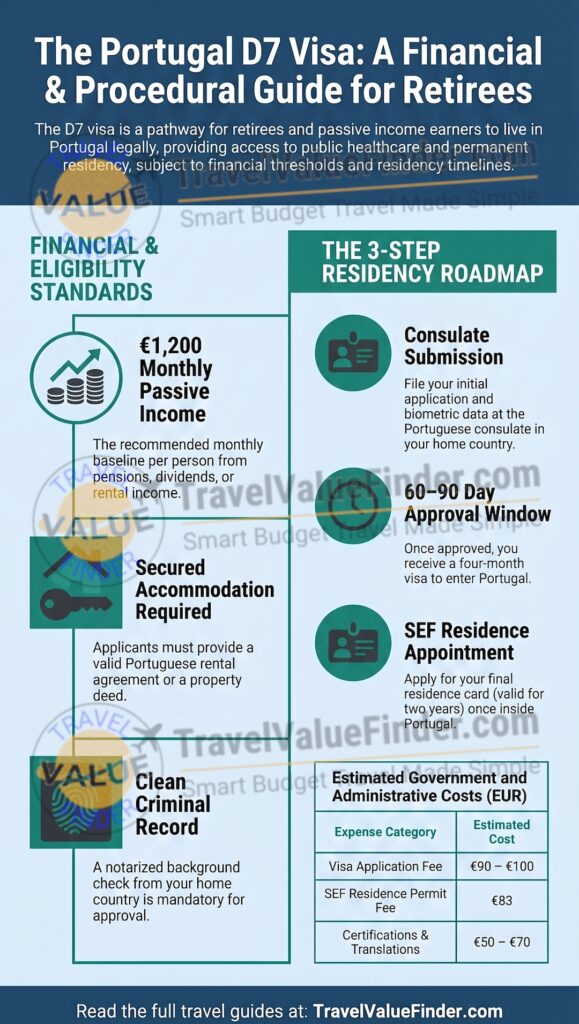
Portugal D7 Visa for Retirees Costs I Experienced
| Expense | Amount (€) |
| Visa application | 90 – 100 |
| Criminal record certification & translation | 50 – 70 |
| Health insurance (optional first months) | 120/month |
| SEF residence permit fee | 83 |
I budgeted extra for translations, notarizations, and travel to SEF appointments, which helped me avoid unexpected expenses.
My Tips for a Smooth D7 Visa Application
- Start early: Collect documents at least 3 – 4 months in advance.
- Use a checklist: Avoid missing documents that can delay approval.
- Translate and notarize properly: Mistakes here are a common reason for delays.
- Maintain proof of income: Consistent bank statements help demonstrate financial stability.
- Plan SEF appointments carefully: They can be limited, so book early.
- Consider a consultant: It would make the process easier to apply for the residence permit through the SEF while in Portugal.
Professional Help: My Experience
I considered handling the process myself, and while it’s possible, I chose to use a local consultant. It helped me avoid errors, saved time, and reduced stress. Some retirees do it independently, but for me, professional guidance was worth the cost.
Common Mistakes I Observed
I was not sure about the common mistakes when moving to Portugal. Talking with other retirees, I noticed common pitfalls:
- Applying with barely minimum income
- Submitting incomplete documentation
- Underestimating processing time
- Assuming rules are flexible
I avoided these by planning carefully, double-checking my documents, and starting early.
Living Requirements After Approval
The D7 visa has some expectations:
- Spend most of the year in Portugal
- Maintain a Portuguese address
- Renew permits on time
I made sure to plan my travel and lifestyle accordingly. For me, it was easy to integrate these requirements into my retirement plan.
Taxes and Residency Considerations
I also learned that holding a D7 visa might make me a Portuguese tax resident. I spoke with a tax advisor to understand obligations and how double taxation treaties work. This planning made me confident that I wasn’t missing anything.
Healthcare Access with the D7 Visa
One of the main reasons I wanted the D7 visa was access to healthcare in Portugal for retirees. After residency:
- I registered with the public healthcare system
- I also maintained private insurance for convenience
For example, I schedule routine checkups privately but rely on public hospitals for emergencies. This combination has worked very well for me and gives me peace of mind.
Is the D7 Visa Worth It? My Take
From my personal experience, the D7 visa is well worth it for retirees who want stability, healthcare access, and long-term residency. It’s not the fastest visa, and it requires careful planning, but the rewards for people over 55 are significant.
How This Fits With My Portugal Retirement Plan
The D7 visa complements other aspects of my life here:
- It allows me to access the healthcare system (covered in the healthcare in Portugal guide)
- It supports my budget and cost-of-living plans
- It makes long-term planning realistic and achievable
It’s the foundation that allows me to enjoy my retirement fully.
My Personal Takeaways to the Portugal D7 Visa
The D7 visa was smoother than I expected, largely because I prepared carefully. Starting early, maintaining organized documents, and budgeting for costs were key. Having this visa allowed me to legally live, access healthcare, and plan my retirement confidently in Portugal. It’s an excellent option for retirees over 55 looking to enjoy Portugal without work obligations and with long-term stability.
The D7 visa is not about shortcuts; it’s about preparation. If you have stable income, a little patience, and a willingness to follow the process, it can open the door to a calm and well-supported retirement in Portugal. From my own journey, I can say that it’s one of the most practical and reliable paths for retirees over 55. Find out if you Can You Retire in Portugal on $2,000 a Month?.
Find out about Retiring in Portugal: The 4-Week Trial That Proves You Are Ready and Cheapest Places to Live in the World for Retirees: Top 10 Ranked by Cost, Safety & Healthcare
Ready to compare cities now?
- Use our Free Retirement Cost of Living Calculator — get your personalized report in 30 seconds – Free PDF download.
- How to Use a Retirement Cost of Living Calculator – to Compare Cities Worldwide
Frequently Asked Questions: Portugal D7 Visa
Q1: Who is eligible for a D7 visa?
Retirees or anyone with passive income, pensions, or savings that meet the minimum requirement can apply.
Q2: How much income do I need?
Around €1,200/month per person, but it depends on family size and consulate rules.
Q3: Can I bring family members?
Yes, spouses and dependents can be included, but you must demonstrate sufficient income for all.
Q4: How long is the initial visa valid?
Four months to enter Portugal and apply for a residence permit.
Q5: How long is the residence permit valid?
Initially two years, renewable for three-year periods.
Q6: Do I need health insurance?
Not strictly, but it’s recommended for the first months before SNS registration.
Q7: Can I apply from within Portugal?
No, you must apply at a Portuguese consulate in your home country.
Pages That Support This Guide
To help with deeper planning, this page connects to detailed guides such as:
- Retire in Portugal (A Warm, Practical Guide for People Over 55)
- Cost of Living in Portugal for Retirees (City-by-City)
- Portugal D7 Visa Explained for US and EU Citizens Over 55
- Healthcare in Portugal: A Retiree’s Perspective
- Renting vs Buying Property in Portugal
- Taxes in Portugal for Retirees
- Common Mistakes When Moving to Portugal
- Seasonal Living in Portugal: 3 – 6 Month Planning
- Portugal Retirement Scorecards for Retirees
- Portugal Retirement Checklist for Retirees