Travel Value Finder


Taxes in Portugal for Retirees can be surprisingly manageable, especially with the country’s favorable tax programs for foreign pensioners. Many retirees benefit from special exemptions, deductions, and the Non-Habitual Resident (NHR) scheme, which can significantly reduce the tax burden. Understanding how Portuguese tax laws apply to your income and investments is essential for planning a comfortable, worry-free retirement abroad.
Leslie Nics, TravelValueFinder.com | Last updated: April 2026 | Based on first-hand research having spent seasonal living in US, UK, Portugal, and Malaysia.
Table of Contents
Taxes in Portugal for Retirees
When I retired in Portugal, understanding the tax system was one of my top priorities. Taxes affect your pension, investments, property, and overall lifestyle. I want to share my personal experience navigating Portuguese taxes, including income tax, property tax, exemptions, practical tips, and FAQs to help other retirees over 55 make informed decisions. You should also explore my retire in Portugal post.
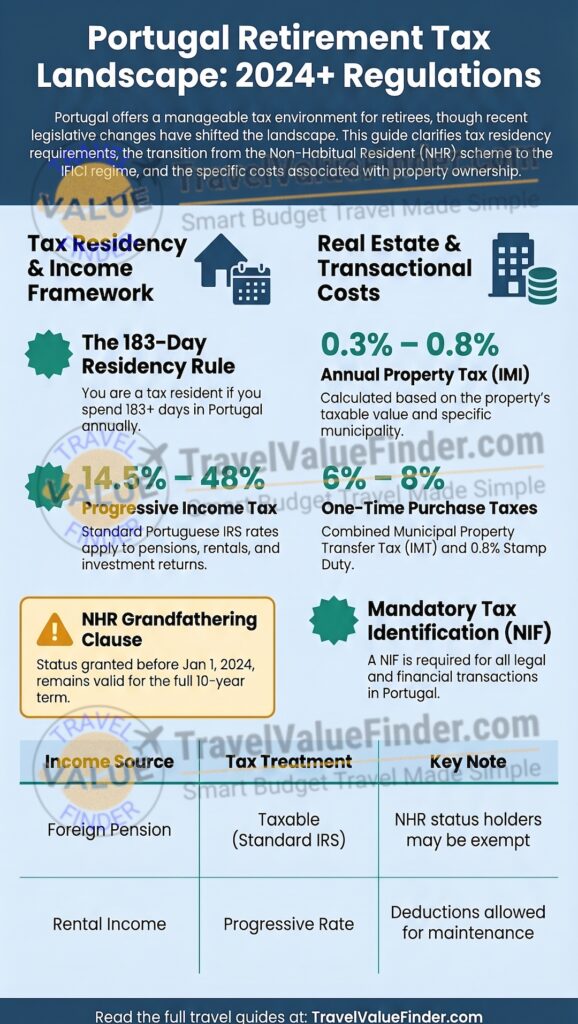
Portugal’s well-known Non-Habitual Resident (NHR) program ended for new applicants on January 1, 2024. It has been replaced by the Tax Incentive for Scientific Research and Innovation (IFICI), sometimes called “NHR 2.0.” Unlike the original NHR, which offered special tax rates on foreign pension income, IFICI focuses on highly skilled professionals in research and innovation, providing a flat 20% rate on qualifying income and exemptions on certain foreign earnings. Retirees considering a move to Portugal should plan carefully, as the new rules no longer offer broad pension tax benefits.
This guide is written for people over 55 who are researching travel, long-term stays, or retirement abroad. I share real-world planning insights, official sources, and practical examples to help you understand what life in Portugal is actually like – not just the highlights.
This content is educational, not legal or financial advice. Rules change, and personal situations differ, so I always recommend confirming details with official or professional sources before making decisions. Refer to the Trust & Transparency page for more information.
Understanding the Portuguese Tax System
Portugal has a combination of income tax, property tax, and other levies. For retirees, the most important taxes include:
- Income tax (IRS): Applies to pensions, rental income, and investment returns.
- Property tax (IMI): Annual tax on property ownership.
- Additional taxes: Stamp duty, municipal taxes, and occasional fees.
I quickly realized that understanding these taxes and planning accordingly was essential to avoid surprises.
Understanding My Tax Residency
One of the first things I learned is that moving to Portugal often makes you a tax resident. This happens if you:
- Spend more than 183 days in a year in Portugal, or
- Have a permanent home here
Becoming a tax resident affects income tax, property tax, and other financial obligations. I spoke with a local tax advisor to ensure I understood my responsibilities.
Income Tax: My Experience
I was concerned about how my pension and rental income would be taxed. Here’s what I found:
- Foreign pensions: Some are fully taxable in Portugal, while others benefit from the Non-Habitual Resident (NHR) program.
- Rental income: Taxed at progressive rates. I maintain detailed records of rent received and expenses to maximize deductions.
- Investment income: Dividends, interest, and capital gains may be taxed differently. I track these carefully with my advisor.
For me, joining the NHR program was a game-changer. It allowed me to pay lower taxes on foreign pension income for the first 10 years of residency.
* Update: How the End of the NHR Program Affects Existing Retirees
Retirees who already obtained Non-Habitual Resident (NHR) status before January 1, 2024 are generally grandfathered in under the old rules. This means they can continue to enjoy the tax benefits on foreign pension income, certain investment income, and other qualifying earnings for the remainder of the standard 10-year NHR period.
Key points for existing NHR retirees:
- Pension income: Foreign pensions that qualified under the original NHR rules continue to benefit from reduced or exempt tax treatment.
- Duration: Benefits last for up to 10 years from the date the NHR status was granted.
- New rules don’t apply: The new IFICI program (“NHR 2.0”) is only for new applicants after January 1, 2024, so existing NHR holders remain under the original framework.
- Planning: Retirees can still plan their finances using NHR benefits, but any new investments or income types may need careful review to see if they remain eligible under existing rules.
Bottom line: Retirees who secured NHR before the cutoff date are largely unaffected for the rest of their NHR period, but anyone applying after January 1, 2024, must follow the new IFICI rules, which do not provide the same pension tax advantages.
Taxes in Portugal for Retirees : Income Tax for Retirees
I receive a pension from my home country and considered how it would be taxed in Portugal. Key points:
| Source of Income | Tax Treatment | Notes |
| Foreign pension | Generally taxable | NHR (Non-Habitual Resident) may offer exemptions for 10 years (refer to update above) |
| Portuguese pension | Taxable | Progressive rates from 14.5% – 48% |
| Rental income | Taxable | Deductible expenses apply |
| Investments | Capital gains tax | Rates vary; NHR may apply |
Example: By applying for the NHR regime, I was able to significantly reduce tax on my foreign pension for 10 years, making retirement more affordable.
Property Taxes: What I Pay
Owning property in Portugal comes with annual property tax called IMI (Imposto Municipal sobre Imóveis). Here’s my experience:
- IMI is based on the property’s tax value and rates range from 0.3% to 0.8%.
- I also budget for occasional maintenance and insurance, which aren’t taxes but affect overall costs.
- For rental properties, I account for rental income tax and related deductions.
I found that understanding IMI ahead of time helped me plan my annual budget more accurately.
Property Taxes (IMI)
Property taxes in Portugal depend on the municipality and property value:
- IMI Rate: 0.3% – 0.8% of the taxable value
- Frequency: Paid annually in one or two installments
- Exemptions: Some new or energy-efficient properties have reduced IMI rates
Example: My two-bedroom apartment on the Silver Coast has an annual IMI of €700. I budget this into my yearly expenses.
Additional Taxes I Encountered
- Stamp Duty (Imposto do Selo): Paid on property purchase (0.8% of the transaction value) and certain financial transactions.
- Municipal Property Transfer Tax (IMT): Paid when buying property; typically 6 – 8% depending on value.
- Vehicle and other small taxes: If you own a car, there’s an annual tax based on engine size and emissions.
- VAT (IVA): Most goods and services have 23% VAT, though restaurants and some items are lower.
Tip: Factor these one-time and recurring taxes into your retirement budget.
Practical Steps I Took for Taxes in Portugal for Retirees
- Hire a tax advisor: Especially in your first year, a local advisor can save headaches and money.
- Registered with the Portuguese Tax Authority: Obtained my NIF (tax identification number).
- Applied for NHR (Non-Habitual Resident): Maximized pension and investment tax benefits (but this scheme has ended since January 2024).
- Tracked property-related taxes: IMI, stamp duty, and transfer tax.
- Maintained records of all foreign income: For accurate reporting and NHR claims.
- Used a local accountant: Helped ensure compliance and optimized my tax situation.
- Document everything: Keep all bank statements, pension slips, and property records.
- Stay informed: Tax laws can change. I subscribe to local tax newsletters and stay in contact with my advisor.
Actionable Tips for Retirees
- Budget for property taxes: Even affordable towns can have IMI that adds up.
- Track all income sources: Foreign pensions, investments, and rentals.
- Consult a tax professional: Especially for first-year filings.
- Keep proof of residency: Needed for NHR and tax filings.
- Plan for annual and one-time taxes: IMI, IMT, stamp duty, and other fees.
Understanding Taxes in Portugal
Taxes in Portugal for retirees can seem complex at first, but with careful planning, they’re manageable. From my experience, registering early, applying for NHR, budgeting for property taxes, and consulting a local accountant ensured a smooth tax experience. Understanding these rules allowed me to enjoy retirement confidently, knowing I could maximize my income and avoid surprises. Find out if you Can You Retire in Portugal on $2,000 a Month? Find out about Retiring in Portugal: The 4-Week Trial That Proves You Are Ready
Ready to compare cities now?
- Use our Free Retirement Cost of Living Calculator — get your personalized report in 30 seconds – Free PDF download.
- How to Use a Retirement Cost of Living Calculator – to Compare Cities Worldwide
Frequently Asked Questions – Taxes in Portugal for Retirees
Q1: What is the income tax rate for retirees?
Portugal does not have a special tax rate for retirees. Income is taxed under the standard progressive personal income tax (IRS) rates. Retirees with existing NHR status (granted before January 1, 2024) may continue to benefit from favorable taxation on foreign pensions, but new applicants must follow the standard rules or the new IFICI regime.
Q2: What is IMI and how much do I pay?
IMI is the annual property tax; rates vary from 0.3% to 0.8% depending on property value and municipality.
Q3: Do I pay tax on rental income?
Yes. Rental income in Portugal is generally taxable. It is declared under your annual IRS (income tax) return and taxed at a progressive rate, with allowable deductions for expenses like maintenance, repairs, and property management. Retirees with NHR status may also have specific rules, so consulting a local accountant is recommended.
Q4: Are one-time taxes high when buying property?
Portugal has one-time property taxes (approx. 6%-8%), including IMT (property transfer tax) and stamp duty, which vary depending on the property price and type. Compared with some countries, these taxes are moderate but can be significant on higher-value homes. Retirees should budget carefully and consider professional advice to understand total upfront costs.
Q5: Should I hire an accountant?
Yes, it’s highly recommended. Portuguese taxes can be complex, especially for retirees with foreign pensions, property, or investments. A local accountant can help you navigate IRS rules, claim deductions, and ensure compliance, saving time, stress, and potentially money. Even retirees with NHR status often benefit from professional guidance.
Q6: How do I plan taxes on foreign pensions?
Planning taxes on foreign pensions depends on your residency status. Retirees with existing NHR status (before Jan 1, 2024) may benefit from favorable or reduced taxation on foreign pensions for up to 10 years. Otherwise, pensions are taxed under standard Portuguese income tax rules. Working with a local accountant can help optimize tax obligations, claim any available exemptions, and avoid surprises.
Pages That Support This Guide
To help with deeper planning, this page connects to detailed guides such as:
- Retire in Portugal (A Warm, Practical Guide for People Over 55)
- Cost of Living in Portugal for Retirees (City-by-City)
- Portugal D7 Visa Explained for US and EU Citizens Over 55
- Healthcare in Portugal: A Retiree’s Perspective
- Renting vs Buying Property in Portugal
- Taxes in Portugal for Retirees
- Common Mistakes When Moving to Portugal
- Seasonal Living in Portugal: 3 – 6 Month Planning
- Portugal Retirement Scorecards for Retirees
- Portugal Retirement Checklist for Retirees