Travel Value Finder

What’s the best no foreign transaction fee credit card for international travel? The Chase Sapphire Preferred is the strongest single pick for most travelers:
- $0 foreign transaction fees,
- wide Visa acceptance abroad,
- transferable travel points, and
- built-in trip protections for a $95 annual fee.
Leslie Nics | TravelValueFinder.com | Updated September, 2026
Disclaimer: This article is for general informational purposes only and does not constitute financial, investment, tax, legal, immigration, or other professional advice. Costs and other figures are estimates and can change. Always verify current information and consult a qualified professional before making significant financial or retirement decisions.
If I could only carry one no foreign transaction fee credit card on my next trip abroad, it’s the Chase Sapphire Preferred.
Most ‘best travel credit card’ roundups hand you a wall of ten options and let you sort it out. I’m not going to do that.
Here’s the one card I’d get, the exact math on why foreign transaction fees matter more than people think, and who should actually consider something different.
Table of Contents
The Best No Foreign Transaction Fee Credit Card for International Travel (My Pick)
Before the reasoning, the answer: for most travelers headed abroad, the Chase Sapphire Preferred is the single best no foreign transaction fee credit card to get before an international trip.
It combines;
- zero foreign transaction fees,
- broad Visa network acceptance,
- transferable points, and
- real trip protections for a $95 annual fee without the complexity or cost of a premium $500+ card most travelers won’t fully use.
Why Foreign Transaction Fees Matter More Than People Think
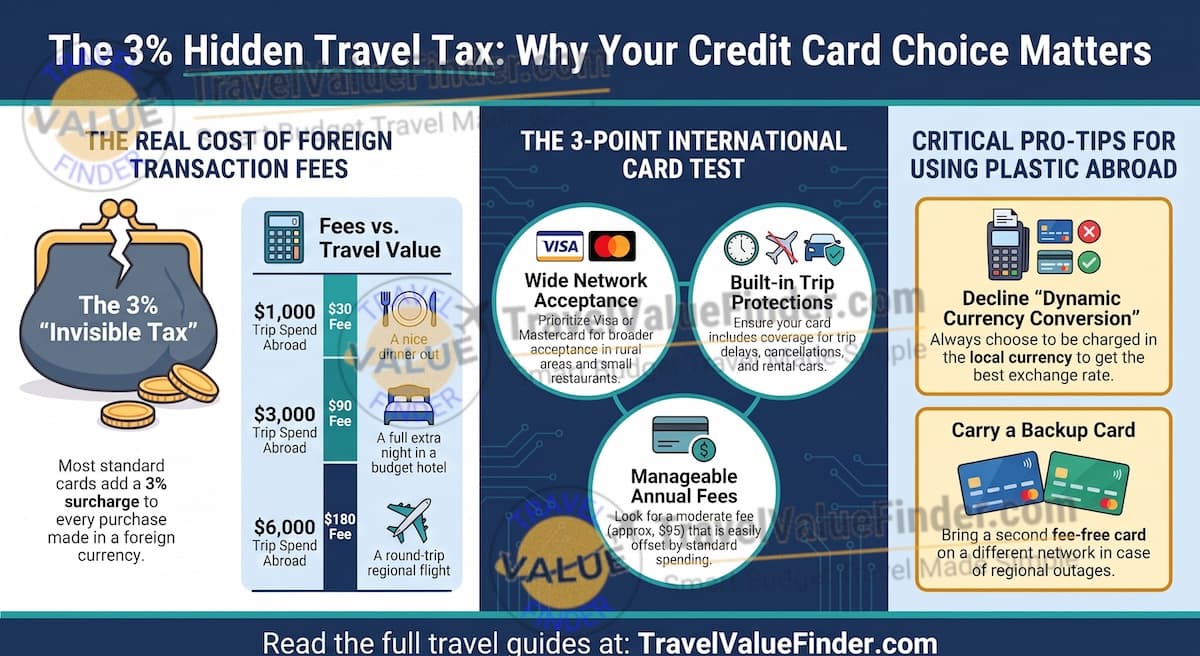
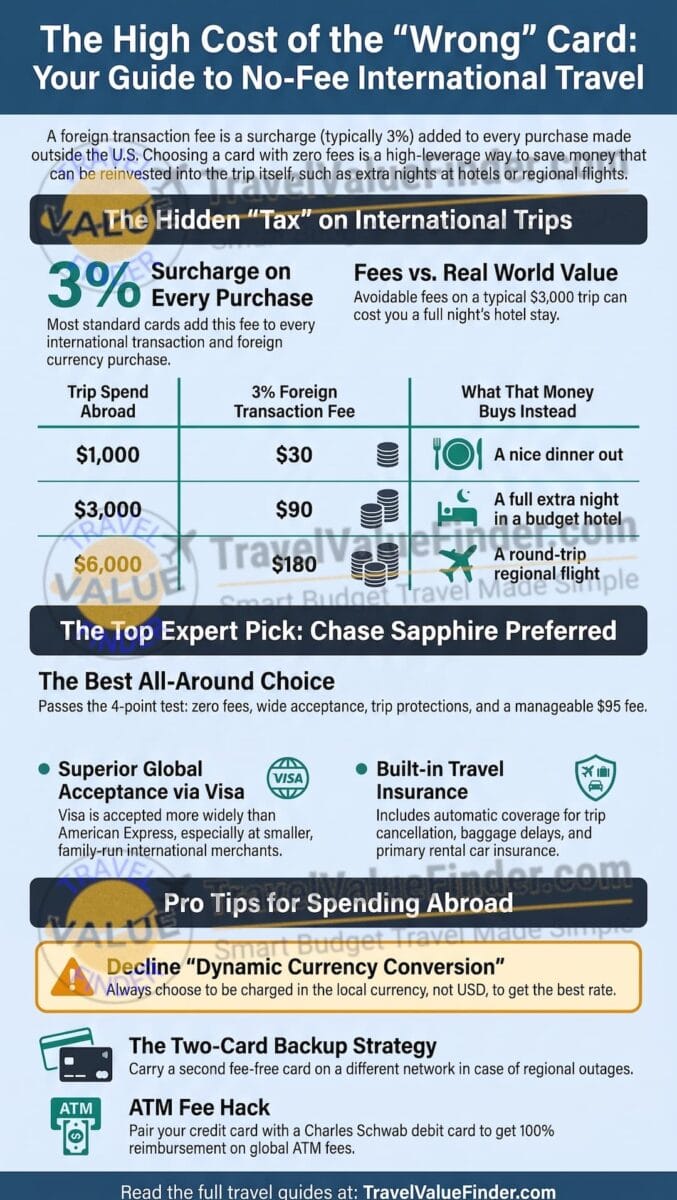
A foreign transaction fee is a surcharge typically around 3% where some card issuers add to every purchase made outside the U.S. or in a foreign currency (even for purchases made online).
It sounds small until you run it against a real trip budget.
| Trip Spend Abroad | 3% Foreign Transaction Fee | What That Buys Instead |
| $1,000 | $30 | A nice dinner out |
| $3,000 (typical 2-week international trip) | $90 | A full extra night in most budget hotels |
| $6,000 (a longer trip or two travelers) | $180 | A round-trip regional flight within your destination |
That $90–$180 isn’t a rewards opportunity cost. It’s money that leaves your account for doing absolutely nothing except using the wrong piece of plastic.
Avoiding it is one of the highest-leverage, zero-effort savings decisions a traveler can make. It’s why I treat it as a harder requirement than any points program.
For more no-effort savings in this vein, see our full budget travel tips guide.
How I Evaluated This: My 4-Point International Travel Card Test
Most credit card roundups score cards on rewards categories and welcome bonuses. For international travel specifically, that’s the wrong starting point.
Here’s the test I actually apply:
| Test | What It Rules Out |
| Zero foreign transaction fees, no exceptions | Any card that charges even 1–2% on international purchases, a ‘low’ fee is still a fee |
| Wide network acceptance abroad | American Express-only cards in regions where Amex acceptance is patchy outside major hotels and tourist zones |
| Real trip protections (trip delay, baggage, rental car coverage) | No-annual-fee cards that skip these entirely, leaving you exposed on the trip itself, not just at checkout |
| A manageable annual fee relative to what you’ll actually use | Premium $400–$800 cards whose lounge access and travel credits go unused by most travelers |
The Chase Sapphire Preferred is the only card I’ve found that passes all four cleanly, which is why it’s the one I’d get rather than a shortlist of five.
Why the Chase Sapphire Preferred Specifically
- Zero foreign transaction fees. Every purchase abroad is charged exactly what it costs. No invisible 3% tax on your trip.
- Visa network. Visa’s acceptance abroad is broader than American Express. Particularly at smaller merchants, family-run restaurants, and rural areas. Precisely where you don’t want a card declined.
- Built-in trip protections. Trip cancellation/interruption insurance, baggage delay coverage, and primary rental car coverage in most states are included automatically. These matters more the farther you are from home when something goes wrong.
- Transferable points. Points move to multiple airline and hotel partners at a 1:1 ratio. So a slow year of everyday spending can become a meaningfully discounted flight or hotel stay later.
- A $95 annual fee you can actually justify. Unlike premium cards charging $400–$800 a year, this fee is easy to offset through normal spending and the sign-up bonus alone.
A note on numbers:
welcome bonuses, exact fees, and terms on any credit card change often and vary by offer. I’m intentionally not quoting a specific bonus amount here.
Check the issuer’s current offer and rates & fees page directly before applying, and treat this article as a decision framework, not financial advice.
Who Should Get Something Different Instead
The Chase Sapphire Preferred is my answer for most travelers, but not everyone.
Here’s when I’d point someone toward a different setup:
| Your Situation | What I’d Get Instead | Why |
| You don’t want to pay any annual fee at all | A no-annual-fee card with no foreign transaction fees (several exist from major issuers) | You lose transferable points and some protections, but you pay nothing to carry it |
| You want ATM withdrawals with zero fees abroad | Pair your credit card with the Charles Schwab debit card | It reimburses 100% of ATM fees worldwide. A favorite among long-term travelers for cash access, not purchases |
| You’re a frequent flyer loyal to one airline | A co-branded airline card with no foreign transaction fees | You’ll get faster elite status progress and airline-specific perks the flexible card doesn’t offer |
| You travel internationally several times a year and use lounges often | A premium card like the Sapphire Reserve or a comparable $400+ option | The higher annual fee is easier to justify with heavy travel and lounge use, but it’s overkill for occasional travelers |
Before You Travel: How to Actually Use This Card Abroad
- Call your issuer or set a travel notification. Not always required today, but a two-minute step that prevents your card being flagged and frozen mid-trip.
- Carry a second card as backup. Card networks occasionally have regional outages. A second no-foreign-transaction-fee card, ideally on a different network, is cheap insurance.
- Always choose to be charged in local currency, not USD. When a foreign merchant or ATM offers ‘Dynamic Currency Conversion’ paying in dollars instead of the local currency, decline it. It applies a worse exchange rate even on a fee-free card.
- Keep your card’s emergency number saved offline. Screenshot it or write it down. You won’t have data access at the exact moment you’re calling to report a lost card.
- Buy travel insurance separately. Card-based trip protections are useful but typically have lower limits and more exclusions than a standalone policy. See our full travel insurance guide for how to fill the gap.
- Check for Credit card reimbursement: My Bag Didn’t Make It to Lisbon : What I Actually Got Back Under the Montreal Convention
How I Save More By Avoiding Foreign Transaction Fee
For years I carried a card with a foreign transaction fee and told myself it didn’t matter because the rewards made up for it. They didn’t.
Doing the actual math, the same $1,000/$3,000/$6,000 comparison above was the moment I switched permanently to a no-foreign-transaction-fee card as a non-negotiable requirement, not a nice-to-have.
For Dynamic Currency Conversion offered by a merchant? I said yes more than once early on, assuming ‘pay in dollars’ was simpler, and it quietly cost me a worse exchange rate on top of an otherwise fee-free card.
A travel credit card is not a rewards strategy first. It’s a cost-avoidance decision first, and a rewards strategy second. Get the first part right and the second part takes care of itself.” Leslie Nics, TravelValueFinder.com
Plan the Rest of Your Trip
- Budget Travel Tips: 30 Strategies to Travel More for Less, where this card fits into a bigger savings strategy
- Travel Insurance Guide, what your card covers and what it doesn’t
- How to Find Cheap Flights: 12 Proven Strategies, put your new card’s points to work
- Best Flights Booking App, find out which apps is the best
- Best Hotel Booking Sites, compare where to book once your flights are set
- Free AI Trip Planner, build your full itinerary once the logistics are sorted
People Also Ask
What is a good no foreign transaction fee credit card?
The Chase Sapphire Preferred is a strong all-around pick because it pairs zero foreign transaction fees with wide Visa acceptance, transferable points, and built-in trip protections for a moderate annual fee. No-annual-fee alternatives also exist for travelers who want to avoid any yearly cost.
Do I need a new credit card for international travel?
Not always, but it’s worth checking your current card’s terms first. If your existing card charges a foreign transaction fee, commonly around 3%, switching to or adding a fee-free card before an international trip is one of the simplest ways to cut avoidable costs.
Is Visa or Mastercard better accepted internationally than American Express?
Yes, generally. Visa and Mastercard have broader global acceptance than American Express. Thisis particularly true at smaller, independent, or rural merchants. Amex acceptance has improved but still lags in many countries outside major hotels and tourist areas.
Does using a debit card abroad avoid foreign transaction fees too?
It depends on the card. Most standard debit cards charge similar foreign transaction fees, plus separate ATM withdrawal fees. A small number of debit cards, such as the Charles Schwab debit card waive both, making them a strong complement to a fee-free credit card for cash access specifically.
Frequently Asked Questions
How much is a typical foreign transaction fee?
Most cards that charge one apply around 3% of each purchase amount. On a $3,000 international trip, that’s roughly $90 in fees for no additional benefit.
Will a no foreign transaction fee card cost me more in other ways?
Not inherently. Many no-foreign-transaction-fee cards carry the same or similar annual fees to comparable cards that do charge the fee. You’re not trading one cost for another, you’re simply avoiding an unnecessary one.
Should I apply for a new credit card right before an international trip?
Give yourself at least 4–6 weeks before departure. This allows time for approval, card delivery, and activation, and avoids the card being flagged as new-and-unused right as you start using it abroad.
Do prepaid travel cards avoid foreign transaction fees too?
Some do, but they typically offer weaker fraud protection than a credit card and lock up your cash in advance. For most travelers, a no-foreign-transaction-fee credit card paired with a fee-free debit card for ATM withdrawals is a stronger combination.
Is this financial advice?
No. This article reflects one traveler’s research and personal decision-making process, not personalized financial advice. Credit card terms, fees, and rewards change frequently. Always review the issuer’s current rates and terms before applying.
Sources
- Consumer Financial Protection Bureau; Credit Card Fees: official guidance on how foreign transaction fees work
- Federal Trade Commission; Credit, Debit, and Charge Cards: official consumer guidance on card protections and fraud liability