Travel Value Finder

The cost of a trip to Croatia runs about $70 to $150 per person, per day. Budget travelers can manage the coast for closer to $60 a day. A one week trip totals roughly $500 to $1,050 before flights, depending on your travel style.
Leslie Nics, TravelValueFinder.com | Last updated: September 2026 | Based on firsthand Croatia trip research and current 2026 pricing
This article is for general informational purposes only and is not financial, legal, or travel advisory advice. Prices are estimates and can change. Confirm current costs before booking.
Table of Contents
Who This Croatia Budget Fits
This guide covers three common travelers. A backpacker moving between hostels, a couple splitting a mid range apartment, and a traveler who wants comfort without limits.
Most US and Canadian visitors land in the mid range tier. That group usually mixes a few splurges, like a boat trip, with mostly ordinary daily spending.
Quick Answer: Cost of a Trip to Croatia by Travel Style
Croatia now prices closer to Italy or Portugal than to its old bargain reputation. Your travel style decides where you land in this range.
| Travel Style | Daily Cost (USD) | What It Covers |
| Budget | $55 to $75 | Hostel bed, groceries, public bus, free sights |
| Mid range | $90 to $140 | Private room, restaurant meals, a few paid tours |
| Luxury | $220 to $350+ | Four or five star hotel, fine dining, private drivers |
People Also Ask About Croatia Travel Cost
Is Croatia expensive to visit in 2026?
Croatia costs more than it did a decade ago. It still runs cheaper than Western Europe for most travelers.
How much money do I need per day in Croatia?
Plan for $55 to $75 a day on a budget trip. Mid range travelers should budget $90 to $140 a day.
Is Croatia cheaper than Italy?
Yes, in most categories. Hotels and restaurant meals in Split or Zagreb cost less than similar options in Rome or Florence.
What is the cheapest way to see the coast?
Base yourself in Split or Zadar instead of Dubrovnik. Use the intercity bus network rather than renting a car.
What Drives the Cost of a Trip to Croatia
Three things move your budget the most:
- season,
- city, and
- how close you stay to the water.
Peak summer pushes coastal hotel rates up sharply. Dubrovnik carries a UNESCO premium that Split and Zagreb do not share.
Distance from the old town or main beach also matters. A room ten minutes away by bus can cost 30 to 40 percent less than one inside the tourist core.
Croatia also joined the euro and the Schengen Area in recent years. Both changes made prices easier to compare with the rest of Europe, and pushed some costs upward.
Cruise ship arrivals matter too. Dubrovnik can see several ships dock on the same summer morning. Restaurants and shops near the port raise prices to match that demand, then hold those prices through the season.
Dubrovnik prices like a European capital now. Split and Zagreb still feel like real value. Leslie Nics, Founder and Lead Travel Writer, TravelValueFinder.com
How the Cost of a Trip to Croatia Compares to Its Neighbors
Croatia sits in the middle of the Adriatic price range. It costs more than the Balkans but less than Western Europe.
| Country | Typical Daily Cost (Mid Range) | How It Compares |
| Croatia | $90 to $140 | Baseline for this guide |
| Slovenia | $85 to $130 | Similar cost, smaller coastline |
| Montenegro | $65 to $100 | 20 to 30 percent cheaper than Croatia |
| Italy | $120 to $190 | 20 to 30 percent pricier than Croatia |
Travelers weighing Croatia against Italy usually find similar scenery for a noticeably lower daily cost, especially outside Dubrovnik.
Accommodation type moves the budget more than any single choice. A shared hostel dorm, a private apartment, and a beachfront resort can sit $150 apart on the very same street.
Daily Cost of a Trip to Croatia by Category
This breakdown assumes two travelers splitting a room, priced per person, per day.
| Category | Budget | Mid Range | Luxury |
| Accommodation | $25 | $50 | $140 |
| Food | $18 | $35 | $85 |
| Local transport | $5 | $8 | $25 |
| Activities | $7 | $17 | $40 |
| Daily total | $55 | $110 | $290 |
Dubrovnik, Split, and Zagreb Cost Compared
Most trip budgets rise or fall based on which cities make the itinerary. This table compares the three most visited bases.
| City | Typical Daily Cost | Why |
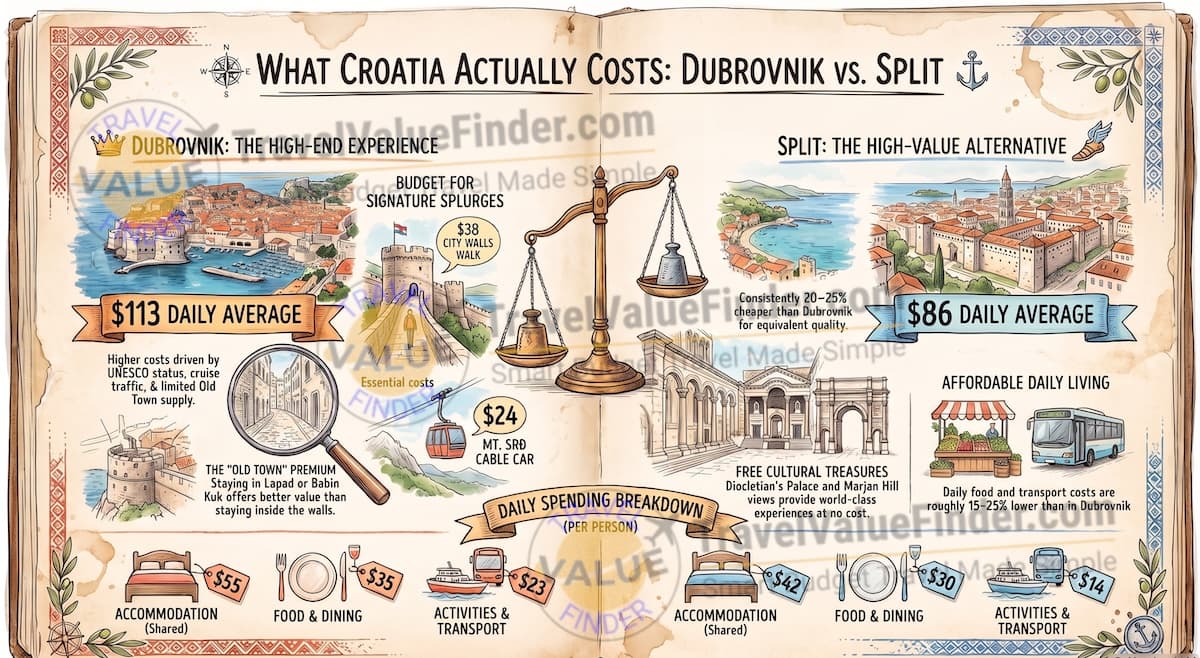
| Dubrovnik | $95 to $150 | UNESCO Old Town, cruise crowds, limited new hotel supply |
| Split | $70 to $115 | Same coastline, fewer decades of movie fame, more supply |
| Zagreb | $55 to $90 | Inland capital, no coastal premium, strong food value |
Pairing Zagreb with the coast is one of the simplest ways to lower a Croatia trip cost without cutting out major sights.
Peak Season vs Shoulder Season Cost of a Trip to Croatia
Season swings the budget more than almost any other factor along the coast.
| Season | Months | Daily Cost Change |
| Peak | June through August | Up to 30 percent higher than shoulder rates |
| Shoulder | April, May, September, October | Baseline pricing used in this guide |
| Off season | November through March | 10 to 20 percent lower, some coastal spots close |
May and September gave me Dubrovnik without the July crowds or the July prices. Leslie Nics, Founder and Lead Travel Writer, TravelValueFinder.com
A Real Mid Range Day in Split
Numbers land differently once you see where they actually go. Here is one ordinary mid range day.
Breakfast at a bakery near Diocletian’s Palace runs about $6. A morning wandering the palace basements and Riva waterfront costs nothing beyond a coffee.
Lunch at a konoba away from the main square runs $14. An afternoon ferry to Bacvice beach and back costs about $4 in local transport.
Dinner with grilled fish and a glass of local wine runs $28. A private apartment for the night, split between two travelers, adds $50 per person.
That single day totals $102 per person, close to the mid range daily average used throughout this guide.
Sample One Week Cost of a Trip to Croatia
Here is a full week, ground costs only, across all three travel styles.
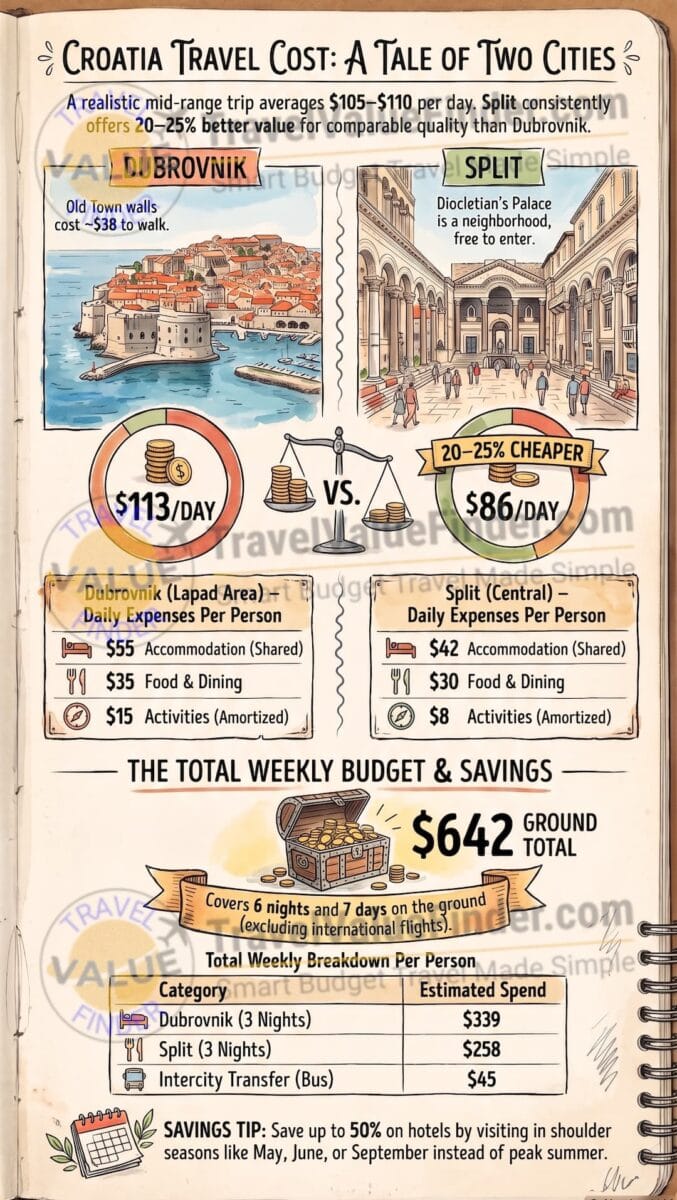
| Travel Style | 7 Day Ground Total | With Flights From the US |
| Budget | $385 to $525 | $865 to $1,475 |
| Mid range | $630 to $980 | $1,110 to $1,930 |
| Luxury | $1,540 to $2,450+ | $2,020 to $3,400+ |
Round trip flights from the US typically run $480 to $950, depending on your departure city and season.
A common two city version of this trip pairs three nights in Split with three nights in Dubrovnik. Add the bus transfer between them for about $25.
Travelers on a tighter budget can swap Dubrovnik for Zagreb and keep every other cost the same. That single swap saves $150 to $250 over a full week.
Where First Time Visitors Overspend in Croatia
A few habits quietly inflate an otherwise reasonable Croatia trip cost. Most are easy to avoid once you know about them.
None of these mistakes ruin a trip. They simply move money away from the parts of Croatia worth paying for, like a good seafood dinner or an island day.
Sleeping inside Dubrovnik’s Old Town walls. Rooms there often cost 40 percent more than the same quality just outside them.
Eating on the main tourist strip. A short walk to a side street konoba usually cuts the meal price in half.
Skipping the bus for taxis. The Split to Dubrovnik bus costs $20 to $30 versus well over $150 for a private transfer.
Booking every island as a day trip. Ferry tickets and tour add ons stack up fast if you try to see Hvar, Korcula, and the Blue Cave in one week.
Changing money at the airport. Airport currency counters and dynamic currency conversion at checkout both charge worse rates than a no fee card.
Skipping travel insurance to save money. A single missed ferry connection or medical visit abroad usually costs far more than a policy would have.
Currency and Payment Tips in Croatia
Croatia uses the euro, which makes budgeting simpler than it was under the old kuna currency.
Cards work in nearly every hotel, restaurant, and larger shop across Dubrovnik, Split, and Zagreb. Carry small euro bills for market stalls, bakeries, and older buses that still expect cash.
Always choose to be charged in euros, not US dollars, when a card terminal asks. That single choice avoids a poor conversion rate on every purchase.
Tipping is not required, but rounding up or leaving 10 percent for good restaurant service is common. Cafe and bar tabs rarely need a tip at all.
Five Ways to Lower Your Croatia Travel Cost
These changes protect the trip without cutting out the highlights.
- Travel in May, June, or September instead of July or August.
- Base yourself in Split or Zagreb and day trip toward the coast.
- Buy breakfast and snacks at Konzum, Lidl, or Spar.
- Book the intercity bus or ferry ahead of your travel dates.
- Use a card with no foreign transaction fee to avoid losing 2 to 3 percent on every purchase.
What I Would Do For My Next Trip to Croatia
On my first trip, I paid extra to stay inside the Dubrovnik walls. I mostly watched the view from a balcony instead of exploring.
Next time I would stay in Lapad, save the difference, and spend it on a Blue Cave boat trip. That swap alone would have improved the trip.
Frequently Asked Questions About Croatia Travel Cost
Do I need a car in Dubrovnik or Split?
No. Both cities are walkable, and the intercity bus network covers the rest of the coast well.
Is Croatia part of the Schengen Area?
Yes. Standard Schengen entry rules apply to US visitors, including the ETIAS requirement once it takes effect.
How much should I budget for food each day?
Plan for $18 a day on a budget trip and $35 a day for a mid range trip with restaurant meals.
Is travel insurance worth the cost in Croatia?
Our travel insurance guide walks through when coverage is worth adding, especially with island transfers.
Should I add Hvar or Korcula to a one week trip?
Only if you have more than seven days. Adding an island extends both travel time and total cost.
Are Croatia’s national parks worth the entrance fees?
Plitvice Lakes and Krka both charge entry, roughly $17 to $40 depending on season. Most visitors call the fee worth paying for Plitvice in particular.
Is it cheaper to rent a car or use buses in Croatia?
Buses win for a coastal only trip. A rental car only pays off if you plan to explore inland regions a bus route does not reach.
Plan the Rest of Your Croatia Trip
- Eastern Europe on a Budget for cheaper countries near Croatia.
- How to Travel Europe on a Budget for wider money saving strategies.
- Senior Friendly Cities in Europe for accessibility notes on Dubrovnik.
- Travel Cost Guide by Destination for more country by country budgets.
Sources
- U.S. Department of State, Croatia Travel Advisory, official safety and entry guidance.
- CDC Travelers’ Health, Croatia, official health and vaccination guidance.
- Croatian National Tourist Board, official destination and travel information.
- Eurostat, official EU price and inflation statistics.
Disclaimer: Prices in this article are 2026 research based estimates. They change by season, neighborhood, and exchange rate. Confirm current pricing before finalizing your trip budget.