Travel Value Finder

The best flight booking apps and sites for cheap airfare in 2026 are:
- Google Flights: best free metasearch tool with price calendar, fare alerts, and AI trip suggestions;
- Kayak: best for flexible travelers, Price Forecast tool, and Hacker Fares;
- Skyscanner: best ‘search everywhere’ and ‘search all month’ functionality;
- Going (formerly Scott’s Cheap Flights): best for mistake fares and curated deal alerts ($49/yr Premium);
- Hopper: best AI price prediction app, tells you whether to buy now or wait;
- Momondo: searches 200+ smaller OTAs and often finds the lowest price;
- Kiwi.com: best for complex multi-city and unconventional routing;
- Expedia: best for flight+hotel bundle savings.
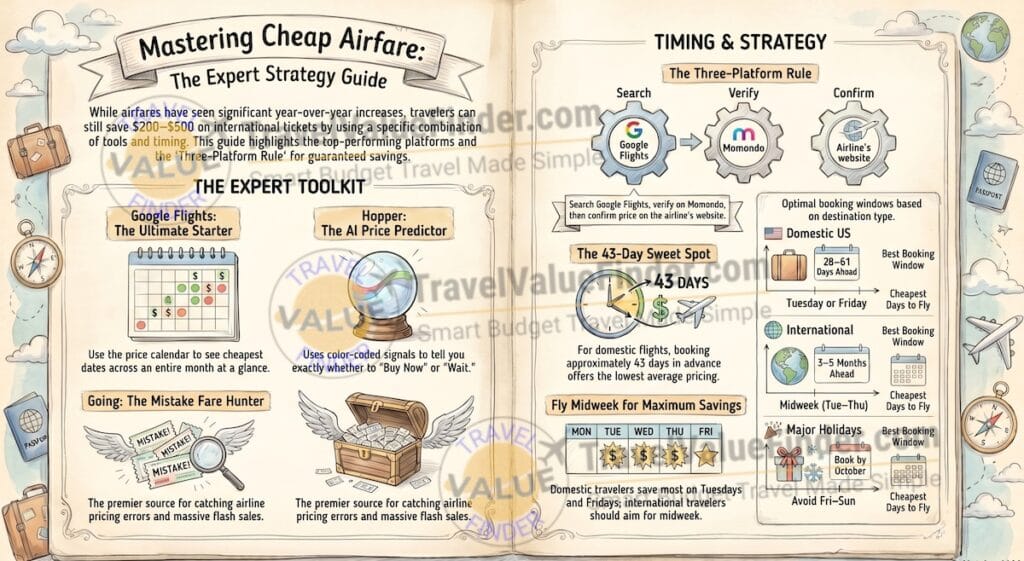
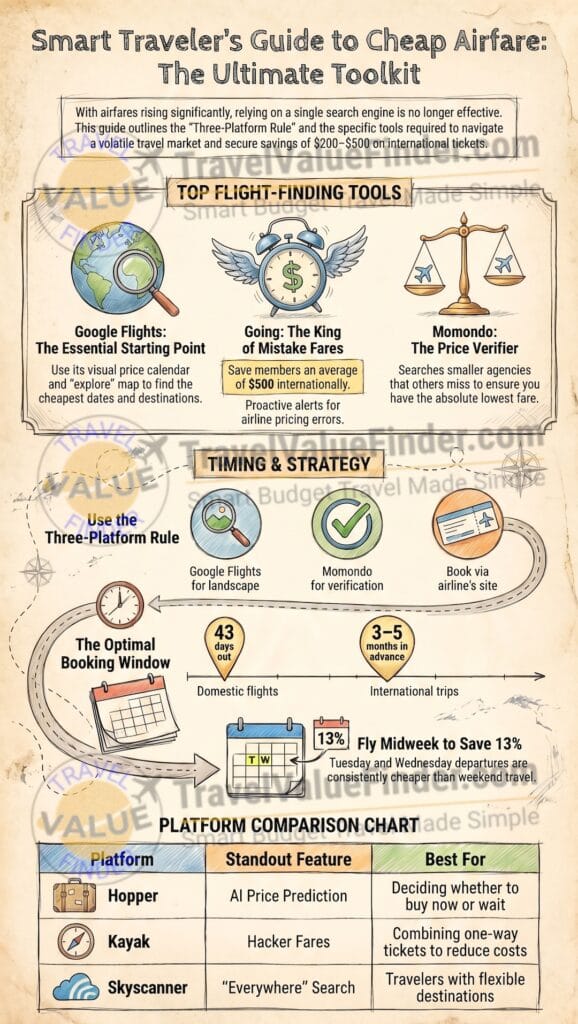
Key 2026 data: Best booking window: 43 days ahead for domestic, 3–5 months for international. Cheapest days to fly: Tuesday or Friday (domestic); midweek for international.
Find out more about The Only No Foreign Transaction Fee Credit Card I’d Get Before My Next International Trip
Leslie Nics, TravelValueFinder.com | Last updated: May 2026 | A practical, no-jargon guide to finding genuinely cheap airfare in 2026. Built on real booking data, not guesswork. Covers the best apps and sites, when to book, and the strategies that consistently work for everyday American travelers.
2026 Flight Booking Apps and Sites: Quick Comparison
| Platform | Type | Best For | Fee? | Standout Feature |
| Google Flights | Metasearch | Starting any search | None | Price calendar, fare alerts, ‘exclude basic economy’ filter, AI trip ideas |
| Kayak | Metasearch | Flexible travelers | None | Price Forecast, Hacker Fares, PriceCheck photo comparison, mix of OTAs |
| Skyscanner | Metasearch | ‘Anywhere’ searches | None | ‘Everywhere’ destination search, monthly cheapest view, 400+ airline coverage |
| Going (fmr Scott’s Cheap Flights) | Deal Alert | Mistake fares & deals | Free / $49 yr Premium | Curated mistake fares; members save avg $500 on intl tickets |
| Hopper | App + Booking | Price prediction | None (add-ons exist) | AI price prediction; color-coded buy/wait signal; freeze fare option |
| Momondo | Metasearch | Finding lowest price | None | Searches 200+ smaller OTAs; often finds prices others miss |
| Kiwi.com | Metasearch + OTA | Complex multi-city | Service fee applies | Combines flights from airlines that don’t normally cooperate; Kiwi Guarantee |
| Expedia | OTA | Flight + hotel bundles | Usually none | One Key rewards; bundles save up to 30%; 400+ airlines |
| Skiplagged | Metasearch | Hidden-city savings | None | Finds hidden-city fares; sometimes $100–$300 cheaper than direct booking |
| Dollar Flight Club | Deal Alert | Email deal alerts | Free / $69 yr Premium | Up to 90% off from your home airport; Premium Plus includes biz class deals |
Sources: Frommer’s 10 Best Airfare Search Sites 2026 | U.S. News Best Apps for Cheap Flights 2026
Table of Contents
Best Flight Booking Apps and Sites: What’s Actually Working in 2026
Here’s the honest truth about finding cheap airfare in 2026; it is harder than it was a year ago, and the apps that helped you last time may not be the right tools today.
The good news: even in a higher-fare environment, the right combination of tools and timing strategies can still save you $200–$500 on an international ticket and $50–$150 on domestic flights.
Flight booking platforms aren’t interchangeable. Google Flights is where you start. Momondo is where you verify. Going is where the real deals land. Using just one is like checking one shelf in a library and deciding the book doesn’t exist. Leslie Nics, TravelValueFinder.com – Updated May 2026
The key is knowing which platform to use for which purpose because no single app wins every search. Here’s the full picture.
The 2026 Airfare Reality: What the Data Actually Says
Before choosing a booking tool, understand the market you’re operating in. The data tells a nuanced story:
- Airfares up 20.7% year-over-year (April 2026): Per the BLS Consumer Price Index via NerdWallet’s Travel Price Index, the sharpest driver is oil price surges from global conflict. This is a meaningful increase and changes how aggressive you need to be with your booking strategy.
- Airfares were down 5.4% year-over-year in November 2025: Per BLS Economics Daily, December 2025, the market swung dramatically in just six months illustrating exactly why timing and alert-setting matters more than ever.
- Mistake fares hit record levels in 2025: According to Going’s 2026 State of Travel Report, mistake fares, genuine pricing errors by airlines, reached record-breaking frequency in 2025 and are expected to continue in 2026. These are the $300 round-trips to Europe that belong to alert subscribers, not casual searchers.
- Airlines have reshuffled routes: Budget carriers expanded routes to secondary cities (Sicily, Puglia, Malta), creating new low-fare opportunities that only platforms searching those carriers will surface. Going’s report notes these can save 40% vs. legacy carrier alternatives.
- Southwest now appears on most major platforms: A significant change flagged by Frommer’s 2026 testing: 8 of their top 10 platforms now surface Southwest fares. Previously, you had to search Southwest.com separately. This substantially improves the completeness of Kayak, Google Flights, Skyscanner, and Momondo results for US domestic searches.
The Three-Platform Rule for 2026
Given the volatile airfare environment, the consistently best approach in 2026 is to use three platforms in sequence:
- Google Flights for the price landscape and calendar view;
- Momondo to verify. It searches smaller OTAs that Google misses and often finds lower prices;
- the airline’s own website to confirm whether booking direct matches the cheapest price found (and earns you loyalty miles).
This takes 10 extra minutes and routinely surfaces $30–$100 gaps between the ‘cheapest’ result on a single platform and the actual cheapest option.
The 10 Best Flight Booking Apps and Sites for 2026: Reviewed Honestly
1. Google Flights: Best Starting Point for Every Search
Type: Metasearch (free) | Fee: None | Best for: Starting any search, price calendars, fare alerts
Google Flights is not technically an app. It lives in your browser but its speed, interface, and data depth make it the undisputed starting point for any serious flight search.
It pulls real-time fares from a vast array of sources, surfaces Southwest fares (now), and does something no other tool does as cleanly; shows you how the price changes day by day across an entire month on a visual calendar.
In August 2025, Google added a significant new filter: ‘Economy (exclude Basic Economy)’ allowing US and Canadian users to search only for fares that include carry-on bags, seat selection, and standard flexibility.
This is a genuine breakthrough for travelers frustrated by the unbundling problem. A $179 fare that turns into $260 after adding a bag and a seat is not a $179 fare. This filter keeps those hidden costs visible before you click.
Google also launched an AI-powered Flight Deals tool that accepts plain-language requests like ‘week-long beach trip in October under $600’ and returns curated suggestions.
According to Frommer’s 2026 site testing, Google’s AI search summary was ‘actually kinda helpful’ explaining route trade-offs in plain language, a legitimately useful addition.
What Google Flights Does Best
- Price calendar: See the cheapest dates in an entire month at a glance. The single most useful tool for flexible travelers.
- Fare alerts: Set an alert for a specific route and receive email notifications when the price drops. Free, reliable, and the most passive way to monitor fares over time.
- ‘Explore’ map: Search flights from your home airport to ‘everywhere’ and see prices plotted on a world map. The best inspiration tool for destination-flexible travelers.
- Multi-airport search: Search up to 7 departure and arrival airports simultaneously. It is extremely useful for travelers near multiple airports (e.g., NYC area: JFK, EWR, LGA).
- No booking fees: Google sends you to the airline or OTA to complete the booking. No markup, no Google cut.
Google Flights Limitation
Not a booking platform: You click through to a third party to complete the purchase. Always verify the total price including bags and seat selection before entering payment.
Ready to search for the best flight prices right now?
Our trusted partner searches hundreds of providers simultaneously: Search Cheap Flights. Real-time prices, no booking fees, secure.
2. Kayak: Best Metasearch for Flexible and Price-Alert Travelers
Type: Metasearch + optional booking | Fee: None | Best for: Flexible date searches, price tracking, Hacker Fares
Kayak has earned its place as one of the most feature-rich metasearch platforms available to US travelers. What separates it from Google Flights isn’t breadth, both cover similar sources, but the depth of its analytical tools.
Kayak’s Price Forecast feature is particularly valuable in 2026’s volatile market: it tells you whether historical data suggests fares on your route are likely to go up or down in the near term, giving you a data point for the age-old question of ‘should I book now or wait?’
According to KAYAK’s own 2026 search data analysis, the platform analyzed search data from January 2025 through March 2026 to produce current booking timing recommendations.
Therefore, making it one of the most data-driven sources for booking timing guidance available to the public.
Kayak’s Standout Features
- Hacker Fares: Combines two one-way tickets on different airlines into a single itinerary. Often cheaper than any round-trip option. A unique capability not available on most platforms.
- Price Check: Upload a screenshot of a competitor’s fare, and Kayak instantly compares it to hundreds of other sources. Launched 2024; genuinely useful.
- Price Alerts: Set alerts on specific routes and receive notifications when prices drop. Works across mobile and email.
- ‘Explore’ and flexible date tools: Similar to Google Flights but with more filter granularity. Filter by number of stops, airline, duration, and departure time window simultaneously.
- In-app booking: Unlike Google Flights, Kayak allows you to complete the booking within its own interface on many routes. Useful if you prefer staying in one platform.
Kayak’s Honest Limitation
Results vary by route: Frommer’s 2026 testing found Kayak performs inconsistently across route types. It’s excellent for flexible multi-date searches but occasionally misses lower prices that Momondo finds by searching smaller OTAs.
3. Skyscanner: Best ‘Search Everywhere’ Tool for Destination-Flexible Travelers
Type: Metasearch | Fee: None | Best for: Open-destination searches, monthly cheapest view, 400+ airline coverage
Skyscanner’s defining capability is its ‘Everywhere’ search. Type in your departure airport, select ‘Everywhere’ as the destination, and Skyscanner ranks every destination by the cheapest available fare.
It’s the most powerful tool in existence for travelers who know when they want to go but not where, or who have maximum flexibility and want to follow the cheapest path.
According to U.S. News & World Report’s 2026 cheap flight app guide, Skyscanner is one of the most reliable tools for this use case.
Skyscanner’s Standout Features
- ‘Everywhere’ search: The best destination-discovery tool for budget travelers. Sort by price from your home airport across all global destinations.
- Whole Month view: Calendar view of every day’s cheapest fare; essential for flexible booking.
- Price alerts: Flags significant price drops (20%+ on round trips) on monitored routes.
- Strong international coverage: Particularly powerful for Asia-Pacific and European routes where it surfaces smaller regional carriers that US-focused tools miss.
Skyscanner’s Honest Limitation
Pricing accuracy at checkout: Occasionally the headline price on Skyscanner differs from what the OTA charges at booking. Always confirm the final total before entering payment details. Frommer’s flagged this as an industry-wide OTA problem, not unique to Skyscanner.
4. Going (formerly Scott’s Cheap Flights): Best for Mistake Fares and Curated Deal Alerts
Type: Deal alert service | Fee: Free (limited) / $49/yr Premium / $99/yr Premium Plus | Best for: Mistake fares, destination-flexible deal seekers
Going is categorically different from the other platforms in this guide. It’s not a search engine you use reactively.
It’s a proactive deal alert service operated by a team of flight experts who scan thousands of routes around the clock looking for genuine anomalies: mistake fares (airline pricing errors), flash sales, and unusually low fares on routes where price history says they shouldn’t be that low.
Who Going Is Right For
- Destination-flexible travelers who want deals to find them, rather than searching manually,
- International travelers who can book 1–3 months ahead when a deal drops,
- Anyone who wants to passively monitor for mistake fares without daily search sessions.
Who Going Is Not Right For
- Travelers who must fly specific dates to specific destinations. Going’s deals rarely align with rigid schedules
- Last-minute bookers: most Going deals require booking at least a few weeks out
5. Hopper: Best AI Price Prediction App
Type: App + AI prediction + booking | Fee: Free (core); add-ons available | Best for: Should-I-book-now decisions, price freeze, mobile-first booking
Hopper occupies a unique niche: it’s the only major platform built around the question every traveler asks but most tools don’t answer – ‘Should I book now or wait?’
Hopper’s AI price prediction engine which the company claims is accurate 95% of the time. It analyzes historical fare data for your specific route and dates, then gives you a color-coded signal: green (great price, buy now), yellow (acceptable, watch it), red (high, wait if you can).
Hopper’s Standout Features
- Color-coded buy/wait signal: The clearest, most actionable ‘should I book now’ tool available on any platform.
- Price Freeze: Lock in a fare while you decide – a meaningful feature in a volatile market where prices can jump $50–$150 overnight.
- Price Drop Guarantee: On some bookings, Hopper credits you if the fare drops after you’ve booked. Terms vary.
- Carrot Cash rewards: Hopper’s in-app currency, earned on bookings and redeemable on future flights, hotels, and rentals.
Hopper’s Honest Limitations
- Some optional features cost money: Price Freeze, cancel-for-any-reason, and change-for-any-reason are paid add-ons. Read what you’re adding before checkout.
- Best for mobile: Hopper is primarily an app experience. Its web interface is functional but less polished than Google Flights or Kayak.
6. Momondo: Best for Finding the Absolute Lowest Price
Type: Metasearch | Fee: None | Best for: Price verification, finding rates others miss, budget-first searches
Momondo is the verification step. The platform you run after Google Flights and Kayak to make sure you haven’t missed a lower price on a smaller OTA.
According to Going’s guide to the best flight search apps, Momondo is specifically recommended because it searches hundreds of smaller OTAs that larger platforms skip. Google Flights and Kayak search many OTAs, but not all. Momondo fills that gap.
Momondo is owned by Booking Holdings (the same company behind Booking.com and Kayak), but operates independently with its own OTA partnerships. The interface mirrors Kayak’s; familiar, functional, and well-filtered.
When to Use Momondo
- After Google Flights as your price verification step before booking,
- On international routes where smaller regional carriers may have lower fares,
- When the Kayak or Google Flights result seems higher than you’d expect, Momondo’s broader OTA search often explains why.
7. Kiwi.com: Best for Complex Itineraries and Unconventional Routing
Type: Metasearch + OTA | Fee: Service fee applies at booking | Best for: Multi-city trips, unconventional connections, open-jaw tickets
Kiwi.com does something genuinely unique: it combines flights from airlines that don’t normally cooperate.
Kiwi’s Standout Features
- Nomad feature: Build multi-city routes optimized for the best value across every leg. Ideal for around-the-world or multi-continent trips.
- ‘Anywhere’ search: Similar to Skyscanner’s ‘Everywhere’ find the cheapest destination from your departure airport.
- Self-transfer itineraries: Kiwi clearly labels self-transfer connections and their associated risk Transparency that other platforms building similar itineraries don’t always provide.
Kiwi’s Honest Limitation
- Service fees: Kiwi charges a service fee at booking. Always compare the Kiwi total (including fees) against the same routing booked separately on each airline before committing.
8. Expedia: Best for Flight + Hotel Bundle Savings
Type: OTA | Fee: Usually none | Best for: Bundle bookings, One Key rewards, travelers booking both flights and hotels
Expedia’s strongest flight use case is the bundle.
When you book a flight and hotel together through Expedia’s package tool, you often unlock rates that neither element alone could access; typically 15–30% below booking each separately.
This is relevant to flight costs because the displayed flight price in a bundle frequently undercuts what you’d pay booking the same flight standalone.
When Expedia Makes Sense for Flights
- When you’re booking both a flight and hotel for the same trip, the bundle discount frequently makes Expedia the cheapest total option
- When One Key Cash from previous hotel bookings can offset part of the flight cost
9. Skiplagged: Best for Hidden-City Fare Savings (With Important Caveats)
Type: Metasearch | Fee: None | Best for: Flexible travelers who understand hidden-city ticketing and its rules
Skiplagged finds hidden-city fares with itineraries where the layover city is your actual destination, and the connecting flight is cheaper than a direct route.
Example: flying New York – Denver with a Chicago layover, disembarking in Chicago, and skipping the Denver leg. All because the New York – Denver ticket costs $150 less than flying direct to Chicago. This is completely legal, but comes with strict conditions.
Hidden-City Ticketing: The Rules You Must Know
Hidden-city ticketing is legal but violates most airline terms of service.
Practical rules:
- Carry-on bags only; checking luggage means your bag goes to the final destination, not your actual stop.
- One-way or final leg only: airlines cancel all remaining flights when you miss a connection, so never use it for the outbound leg of a round-trip.
- Don’t do it repeatedly on the same airline: airlines can and do flag frequent patterns and cancel loyalty miles.
- It requires significant flexibility: if your ‘connection’ flight is canceled or delayed to the point you’d miss the layover, you’re stuck.
Understand the full picture before booking.
10. Dollar Flight Club: Best Budget Alternative to Going for Deal Alerts
Type: Deal alert service | Fee: Free (1 airport) / $69/yr Premium / $99/yr Premium Plus | Best for: Price-sensitive travelers wanting email deal alerts
Dollar Flight Club is the closest alternative to Going. A curated deal alert service that sends subscribers flight deal notifications from their home airports.
According to U.S. News & World Report’s 2026 flight app comparison, the service claims members access deals of up to 90% off airfare from their home airport, with savings of up to $500 per flight.
The Premium Plus tier ($99/year) includes premium economy and business class deals; a differentiator from Going’s standard tier.
The key structural difference from Going:
- free users can only track one departure airport (Going’s free tier also limits departure airports),
- the Premium tier allows four departure airports and 10 dream destination alerts.
Useful for travelers based near multiple airports or with a clear list of target destinations.
When to Book: The 2026 Data on Timing, Days, and Booking Windows
The single most consistent advice from every data source in 2026: timing your booking correctly matters more than which platform you use. The same flight can vary by $150–$300 depending on when you book and when you fly.
Here’s what the current data says:
Flight Booking Timing Reference Table – 2026 Data
| Route Type | Best Booking Window | Cheapest Day to Fly | Data Source |
| Domestic US | 28–61 days ahead (43 days = sweet spot) | Tuesday or Friday | Google 2025 Airfare Report; NerdWallet Expedia 2026 Air Travel Hacks |
| International (all) | 3–5 months ahead | Midweek (Tue–Thu) | The Points Guy via Google 2025 report; KAYAK 2026 search data |
| Holiday (Thanksgiving/Christmas) | Book by October; monitor from August | Avoid Fri–Sun | The Points Guy 2026 Holiday Booking Guide |
| Spring Break (late Mar–Apr) | Late Jan–early Feb | Midweek saves $60+ | Google 2026 data via The Points Guy |
| Last-Minute (within 7 days) | Use Hopper, Kayak, Google Flights for best last-min availability | Varies; flexible dates essential | Frommer’s 2026 Airfare Rankings test methodology |
The Cheapest Days to Fly (2026 Data)
According to NerdWallet’s analysis of Expedia’s 2026 Air Travel Hacks Report, the cheapest days to fly domestically rank from cheapest to most expensive: Friday → Saturday → Wednesday → Thursday → Monday → Tuesday → Sunday (most expensive).
Flying Friday instead of Sunday saves up to 8%. Tuesday comes in approximately 14% cheaper than Sunday in raw average cost.
For midweek travel specifically, The Points Guy’s 2026 booking guide citing Google’s 2025 Airfare Report found that Monday through Wednesday flights average 13% cheaper than weekend departures.
Flying midweek can save nearly $100 per ticket. During busy periods like spring break and summer, midweek savings jump to $60+ per ticket.
How Far in Advance to Book
- Domestic US: 43 days before departure is the sweet spot for cheapest average pricing, per Google’s 2026 data. The range is 28–61 days. Last-minute domestic (within 7 days) is generally more expensive unless using a deal alert service.
- International: 3–5 months ahead is the consistent recommendation across Kayak, and Google. This is especially critical in 2026’s higher-fare environment. International routes fill faster when prices are high.
- Thanksgiving: Book in early-to-mid October. Monitor from August.
- Christmas / New Year’s: Google data shows cheapest fares appear 32–73 days before the holiday. Book by late October/early November. ‘No later than Halloween’ is the rule of thumb from booking experts.
- Spring break: Book late January to early February for late March/early April travel. The 2026 spring break sweet spot is 28–61 days advance.
The Price Alert Strategy: Let the Deal Come to You
Set Google Flights alerts for your target route the moment you decide you want to travel.
Then set a Kayak Price Alert for the same route. You’ll receive notifications from two independent systems when prices drop and on a volatile 2026 airfare market. Prices can drop 15–25% within a few weeks of your initial search.
This takes 5 minutes to set up and runs passively in the background while you go about your life.
The Complete 2026 Flight Booking Workflow: Step by Step
Here’s the exact process I use and recommend for finding genuinely cheap airfare in 2026, from the moment you decide you want to travel to the moment you click purchase.
- Decide on flexibility: Are your dates fixed, or do you have a window? Fixed dates, skip to step 3. Flexible dates, the next two steps become your most powerful tools.
- If flexible: Search Google Flights’ price calendar + Skyscanner’s ‘Everywhere’: Open Google Flights, enter your home airport, and use the calendar view or ‘Explore’ map to find the cheapest period and destination combination. Cross-reference with Skyscanner’s ‘Everywhere’ search for validation.
- Set price alerts immediately on Google Flights and Kayak: For any route you’re seriously considering, set alerts on both platforms. These run in the background and notify you when prices drop. Free, passive, and consistently useful.
- Subscribe to Going or Dollar Flight Club if you’re destination-flexible: $49–$69/year for genuine mistake fares and curated deals. If you travel internationally even once a year, these services typically pay for themselves many times over.
- Run the three-platform check before booking: Google Flights, Momondo, and airline’s direct site. Compare the final total including bags and seat selection on each. The cheapest headline price rarely survives full fee disclosure.
- Use Hopper’s buy/wait signal if you’re uncertain about timing: If the fare looks reasonable but you’re not sure whether to book now or wait, open Hopper, enter the same route, and check the color signal. A green signal is as close to ‘book it’ confidence as any data-driven tool can give you.
- Book direct or through a trusted platform: If the airline’s direct site matches the cheapest price found, book direct. You’ll have better customer service options if anything goes wrong, and you’ll earn loyalty miles. If an OTA is meaningfully cheaper, verify the OTA on the Better Business Bureau before entering payment info, as Frommer’s recommends.
People Also Ask: Flight Booking Questions Answered
What is the best app to find cheap flights?
No single app wins every search. The right combination depends on your flexibility and what you’re optimizing for.
Is Google Flights the cheapest way to book flights?
Google Flights is not a booking platform. It’s a search tool that sends you to airlines or OTAs to complete the purchase.
What is the cheapest day to book a flight in 2026?
For domestic US flights, Tuesday and Friday are the cheapest days to fly, per Expedia’s 2026 Air Travel Hacks Report. Flying on a Friday instead of Sunday can save up to 8%; Tuesday averages 14% less than Sunday. For international flights, midweek departures (Tuesday through Thursday) typically offer the best prices, though the day-of-week variation is smaller than for domestic routes.
How far in advance should I book a flight to get the cheapest price?
For domestic US flights, the sweet spot is approximately 43 days ahead of departure (range: 28–61 days), based on Google’s 2026 airfare data. For international flights, book 3–5 months in advance. For major holidays (Thanksgiving, Christmas), book by early-to-mid October for the best availability and pricing. Ideally with price alerts set from August.
Are flight booking apps safe to use?
Major platforms including Google Flights, Kayak, Skyscanner, Hopper, Expedia, Momondo, Kiwi.com are all legitimate and secure. The risk lies in less-known OTAs that these metasearch engines may send you to for booking.
What is a mistake fare and how do I find one?
A mistake fare is a genuine pricing error by an airline; a $300 round-trip to Tokyo instead of $1,200, or a $150 transatlantic flight that should cost $700. Airlines occasionally honor them, sometimes don’t. The best way to catch them: subscribe to Going (formerly Scott’s Cheap Flights) or Dollar Flight Club.
What is a Hacker Fare?
A Hacker Fare (Kayak’s term) combines two separate one-way tickets on different airlines into a single round-trip itinerary; when the total of two one-ways is cheaper than any published round-trip fare on the route. Kayak surfaces these automatically in search results. The trade-off: if one leg is delayed and causes you to miss the other (which is on a separate airline with no interline agreement), you’re responsible for rebooking. Best used on routes where you have some time buffer between legs.
Does booking directly with the airline save money?
Sometimes, and sometimes not. Airlines occasionally offer exclusive direct-booking rates particularly for sales and flash deals announced via email newsletters and loyalty program communications.
Plan the Full Trip Once You’ve Got Your Flight
Cheap airfare is the foundation. Here’s how to build the rest of the trip on a smart budget with Travel Value Finder’s most useful planning guides:
Accommodation:
- Best Hotel Booking Sites: Where to Find the Cheapest Deals: which hotel booking platforms to use once you’ve booked your flight; Agoda for SEA, Booking.com for Europe, and when to book direct
Destination and budget planning:
- Mexico Travel Budget: How Much Does It Cost Per Day?: build the full Mexico trip budget once flights are booked
- How to Travel Europe on a Budget: Europe trip strategy once you’ve found the cheap transatlantic fare
- How to Eat Cheaply While Traveling: food budget strategy for any destination
- Packing List for Southeast Asia: if your cheap fare lands in Bangkok, Singapore, or KL
Maximize your savings with travel rewards:
- Best Travel Credit Cards for 2026: Earn Points and Travel Free: earn points on pre-trip spending to offset airfare; the Chase Sapphire Preferred and Capital One Venture Rewards are the top tools for flight points
- Free AI Trip Planner: build your full day-by-day itinerary once the flights and accommodation are sorted
Frequently Asked Questions (FAQs)
Q: Is it better to book flights on a phone or computer?
Desktop (or laptop) browsing consistently returns better results for complex flight searches. Google Flights and Kayak offer more filtering options and clearer price calendars on larger screens. However, some apps (Hopper, Expedia) offer app-exclusive deals and features that are only available on mobile. The practical approach: research on desktop, then check the airline’s app for any mobile-exclusive sale before booking.
Q: Does searching flights in incognito mode save money?
The ‘incognito saves money’ claim is mostly a myth. Most major platforms don’t dynamically raise prices based on your search history. However, using incognito ensures you see unmodified, uncookied results; useful for confirming a price you saw earlier hasn’t been influenced by any personalization. It’s a harmless extra step, just not the magic trick it’s sometimes claimed to be.
Q: What is the best flight booking site for international travel?
For international flights: Google Flights (price calendar and alert setting), Momondo (broadest OTA coverage for international routes), Going or Dollar Flight Club (for curated international deals and mistake fares), and Kiwi.com (for complex multi-city or unconventional routing). Always verify the final price on the airline’s direct website and compare with at least two metasearch results before booking.
Q: Why are airfares so high in 2026?
The primary drivers: oil price surges linked to global conflict (airlines’ largest cost), continued post-pandemic demand strength on international routes, and ongoing fare unbundling.
Q: What’s the best flight booking tool for families?
For families, Kayak’s seat map and family filtering tools are particularly useful. You can confirm adjacent seating before booking.
Q: Are budget airline fares actually worth it in 2026?
Budget carriers (Spirit, Frontier, Allegiant domestically; Ryanair, Wizz Air, easyJet in Europe; AirAsia, Scoot, Vietjet in SEA) can offer genuine savings. However, the final price after adding bags, seat selection, and change fees often rivals or exceeds mainstream carrier prices, especially for families or travelers with luggage. The key rule: always calculate the total cost including your specific bag and seat needs before comparing. For carry-on-only travelers, budget airlines frequently deliver genuine value. For families with checked bags, the price advantage often disappears.
Your 2026 Flight Booking Strategy, Simplified
Airfares are higher in 2026 than they were a year ago, that’s the reality.
But the tools available to find the best prices are also better than they’ve ever been, and the timing and platform strategies that work are well-documented.
Here’s the simplified playbook:
- Start every search on Google Flights: Use the price calendar to find the cheapest dates, set a fare alert, and get the landscape of what routes cost.
- Verify on Momondo: Run the same search to catch lower prices on smaller OTAs that Google misses.
- Subscribe to Going or Dollar Flight Club: $49-$69/year is the most cost-effective travel investment available for anyone who flies internationally once a year or more.
- Book at the right time: 43 days ahead for domestic; 3–5 months for international; by October for holiday flights.
- Fly midweek when possible: Tuesday and Friday save 8–14% on domestic fares. That’s $50-$100 per ticket on most routes, simply for shifting your departure day.
- Use Hopper’s buy/wait signal when uncertain: The clearest data-driven answer available to ‘should I book now?’
- Earn points on your flight spending: A travel credit card that earns 3–5x on travel purchases turns every flight into partial credit toward the next one.
The best time to find a cheap flight is when you’re not desperate to fly. Set the alerts, subscribe to the deals, and let the cheap fare find you. That mindset shift from reactive searcher to patient alert subscriber is worth more than any single booking trick. Leslie Nics, TravelValueFinder.com – Updated May 2026
Ready to plan the trip? Use our Day-to-Day Trip Planner to build your full itinerary, and check our Best Hotel Booking Sites guide to lock in accommodation once your flights are confirmed.
Sources & References
- Frommer’s: The 10 Best and Cheapest Airfare Search Sites for 2026 (18 sites tested, 32 itineraries)
- NerdWallet: Travel Price Index: May 2026 (BLS/CPI airfare data)
- NerdWallet: Best Days to Book a Flight and Fly (2026 Expedia Air Travel Hacks data)
- U.S. Bureau of Labor Statistics : Airline Fares Decreased 5.4% Year-Over-Year, November 2025
- U.S. News & World Report: Best Apps for Finding Cheap Flights 2026
- KAYAK: Best Time to Book a Flight & Cheapest Days to Fly 2026 (updated March 2026)
- Going (formerly Scott’s Cheap Flights): 2026 State of Travel & Flight Deals Report
- Going: Best Apps for Booking Flights Guide
- The Points Guy: Best Time to Book a Flight 2026 (Google 2025 Airfare Report cited)
- Upgraded Points :12 Best Websites for Booking Cheap Flights 2026
- U.S. Travel Association: Travel Price Index (TPI) 2026
Affiliate Disclaimer: Some links in this article are affiliate links. We may earn a referral commission on qualifying bookings at no additional cost to you