Travel Value Finder

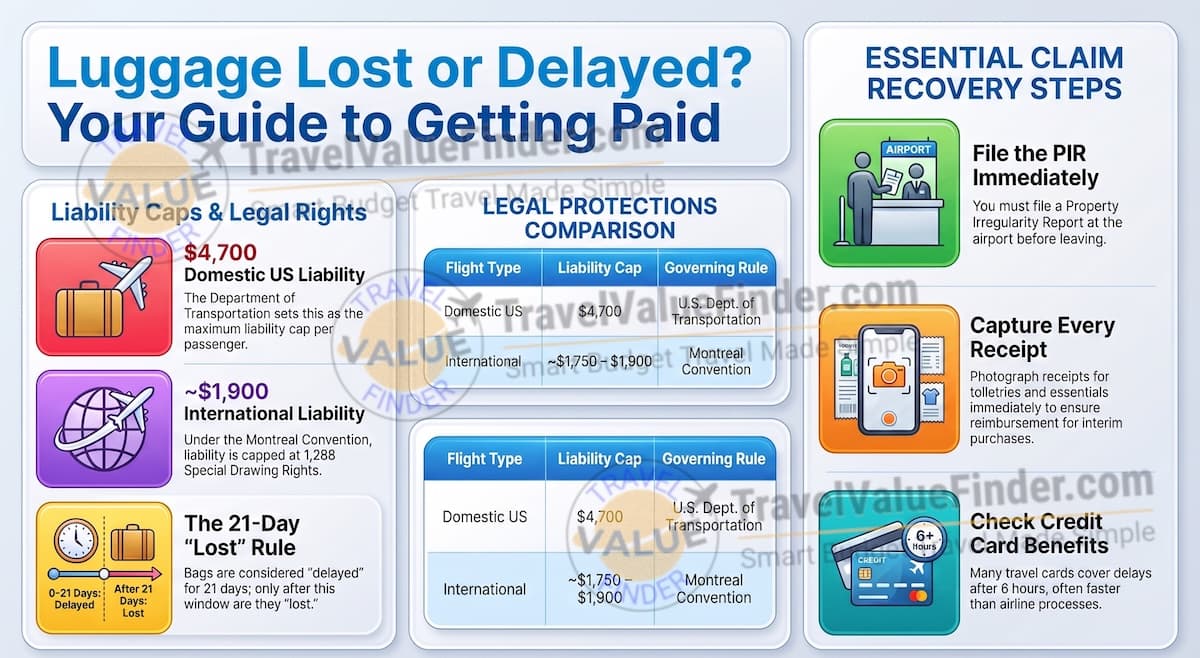
For lost or delayed luggage on an international flight, airlines are liable for up to roughly 1,288 Special Drawing Rights (about $1,750–$1,900 depending on exchange rates) under the Montreal Convention.
File a Property Irregularity Report (PIR) at the airport before leaving, keep every receipt for interim purchases, and know that a bag isn’t officially declared “lost” (versus delayed) until 21 days have passed.
On domestic US flights, DOT rules cap airline liability at $4,700.
Leslie Nics, TravelValueFinder.com | Last updated: Aug 2026 | Based on first-hand experience and current airline liability research
Every lost or delayed luggage guide tells you to “file a report and keep receipts.” What almost none of them tell you is what actually happens after that;
- how much you’re realistically entitled to,
- how long the process takes, and
- what I actually got back when my bag didn’t make a connection in Lisbon.
This guide is built around that real claim: the exact process, the real numbers, and the specific mistakes that would have cost me money if I’d made them.
Here’s what surprised me most going through the actual process. Airlines are required to compensate you for this, but almost nothing about the process is proactively explained at the airport in the moment.
The person at the baggage service desk hands you a reference number and sends you on your way.
The liability caps, the 21-day rule, and the receipt requirements are things you have to already know or dig up yourself, under stress, in an unfamiliar airport.
Table of Contents
Lost or Delayed Luggage: What You’re Actually Entitled To
The number that matters most, and the one most guides bury, is the airline’s actual liability cap — and it’s different depending on whether your trip is domestic or international.
For international flights, the Montreal Convention caps airline liability at 1,288 Special Drawing Rights per passenger; roughly $1,750–$1,900 depending on current exchange rates.
For domestic US flights, the Department of Transportation sets a separate liability cap of $4,700 per passenger.
| Flight Type | Liability Cap | Governing Rule |
| International (to/from the US) | ≈1,288 SDR (≈$1,750–$1,900) | Montreal Convention |
| Domestic US | $4,700 | US Department of Transportation |
Those are caps, not guarantees. Airlines typically reimburse the depreciated value of your actual lost items, not the cap amount automatically, and they’ll ask for receipts or a reasonable itemized estimate of what was in the bag.
What Actually Happened in Lisbon
A tight connection in Madrid meant my checked bag didn’t make the same flight I did. Here’s exactly what I did, in order, and what came of each step:
- Filed a Property Irregularity Report (PIR) at the baggage service desk before leaving the airport. This took about 20 minutes and is the single non-negotiable first step. No PIR generally means no claim.
- Received a reference number and the airline’s promised delivery window (48 hours, in my case): worth writing down or photographing immediately, since it’s easy to misplace a small printed slip in the chaos of an unfamiliar airport.
- Bought a change of clothes, a toothbrush, and basic toiletries that first night: kept every receipt, which turned out to matter a lot. I photographed each receipt with my phone the same evening, since faded thermal-paper receipts are a real, common problem by the time a claim actually gets filed.
- The bag arrived on day 2, within the promised window, but many delays run longer, and the interim-expense reimbursement process is the same either way.
- Submitted the interim-expense receipts through the airline’s online claims portal within their stated window (varies by airline, commonly 7–21 days).
- Received reimbursement for the interim purchases about 3 weeks later; not instant, but a real, working process.
The PIR felt like a formality at the time. It’s not, it’s the one document that makes everything after it possible. Skip it, and there’s effectively no claim to make.” Leslie Nics, Founder & Lead Travel Writer, TravelValueFinder.com
Delayed vs. Lost: The 21-Day Line That Changes Everything
This distinction matters more than most people realize going in. A bag is officially considered delayed for the first 21 days after it goes missing, during which airlines typically reimburse reasonable interim expenses (toiletries, a change of clothes) but not the bag’s full contents.
Only after 21 days without recovery does a bag become officially lost, triggering the full liability-cap claim process for the bag and its contents.
Reality Check: Most delayed bags are recovered within 24–48 hours; the 21-day threshold is a real, if uncommon, worst case.
Still, know the distinction before you travel: a bag stuck in limbo for two weeks isn’t officially “lost” yet, and trying to file a full lost-bag claim before that window closes will typically be rejected or delayed further.
Filing the Claim, Step by Step
- At the airport, before leaving baggage claim: file the PIR with the airline’s baggage service desk, and get a reference number and copy of the report.
- Keep every receipt for interim purchases (toiletries, a change of clothes, essential medications). Photograph them immediately in case a physical receipt fades or is lost.
- Check the specific airline’s claims window. Most require submission within 7–21 days of the PIR, and missing that window can void the claim entirely.
- For a bag that crosses into “lost” status at 21 days, submit an itemized list of the bag’s contents with reasonable value estimates such as photos of packed items before the trip, if you have them, genuinely help here.
- If the airline’s response feels inadequate, escalate through the DOT’s complaint portal for domestic issues, or the equivalent aviation authority for international carriers.
What Airlines Don’t Advertise: Exemptions That Can Reduce Liability
The Montreal Convention’s liability cap isn’t unconditional.
Airlines can limit or deny compensation for fragile or perishable items, valuables like jewelry or electronics packed in checked luggage rather than carried on, and damage attributable to the item’s own inherent defect rather than airline mishandling.
There’s also a lesser-known option worth knowing about: excess valuation declaration, where you can declare a higher value for specific checked items at check-in for an additional fee. This raises the effective liability cap above the standard amount.
This is genuinely useful for anyone checking a bag with contents worth more than the roughly $1,750–$1,900 standard cap.
- Never check irreplaceable valuables, medications, or electronics. The standard liability cap almost never covers their real replacement value, and some airlines exclude them from compensation entirely.
- Ask about excess valuation declaration at check-in if you’re checking a bag with contents genuinely worth more than roughly $1,800.
- Keep a basic itemized packing list (even a phone note) for any checked bag carrying anything of real value. It becomes the backbone of a claim if needed.
Credit Cards That Cover This Automatically
This is worth knowing before you even book the flight. Many travel rewards credit cards include baggage delay insurance and lost luggage reimbursement as a built-in benefit, layered on top of whatever the airline pays often covering delays after as little as 6-12 hours. Well before the airline’s own process kicks in.
I didn’t even think to check my card’s benefits until after the trip. It turned out the card I’d used to book the flight would have covered the same interim purchases without needing airline reimbursement at all”. Leslie Nics, Founder & Lead Travel Writer, TravelValueFinder.com
Lesson Learned for My Next Trip
I’d photograph the packed contents of my checked bag before every international flight, not just after this happened once. It’s a 60-second habit that makes an itemized claim dramatically easier to substantiate if a bag genuinely goes missing past the 21-day line.
I’d also check my credit card’s baggage delay benefits before traveling, not after. Knowing which coverage kicks in fastest changes which receipts to prioritize and which claims process to start first.
Prevention: What Actually Reduces the Risk
- Pack essential medications, a change of clothes, and chargers in your carry-on, not checked luggage; this doesn’t prevent a delay, but it neutralizes most of its impact.
- Choose longer layovers over the tightest legal connection time when booking a multi-leg international itinerary. Tight connections are the single biggest driver of misconnected bags.
- Remove old baggage tags from previous trips before checking in; a leftover tag occasionally causes routing errors.
- Add a AirTag or similar tracker inside checked luggage; it won’t prevent a misroute, but it turns “the airline says it’s somewhere” into an actual location you can see yourself.
- Choose a distinctive bag or a bright luggage strap; genuinely reduces the odds of another passenger accidentally grabbing a similar-looking bag off the carousel, a surprisingly common cause of “lost” luggage that’s really just mis-delivered.
- Book direct flights when the cost difference is reasonable. Every additional connection is another opportunity for a bag to get misrouted.
Find Out More About Travel Planning
- Travel Insurance Guide
- No Foreign Transaction Fee Credit Card
- Europe Packing List
- Travel Packing List
- Lisbon vs Porto Cost Comparison
You May Be Interested In
- Tourist Scams in Europe
- Amalfi Coast Itinerary
- I Got Altitude Sick on My First Night in Mexico City: Here’s What I Wish I’d Known
People Also Ask
How much compensation do you get for lost luggage?
Up to roughly $1,750–$1,900 on international flights under the Montreal Convention, or up to $4,700 on domestic US flights under DOT rules. These are caps, and airlines typically reimburse actual documented value, not the cap amount automatically.
What is the difference between delayed and lost luggage?
A bag is considered delayed for the first 21 days after going missing, during which airlines typically cover reasonable interim expenses. After 21 days without recovery, it’s officially considered lost, triggering a full contents claim.
What should I do immediately if my luggage is lost?
File a Property Irregularity Report (PIR) at the airline’s baggage service desk before leaving the airport. This is required for any later claim, and get a reference number and copy of the report.
Do credit cards cover lost or delayed luggage?
Many travel rewards credit cards include baggage delay and lost luggage insurance as a built-in benefit, often triggering faster than an airline’s own process. Check your specific card’s benefits guide before traveling.
FAQ
How long do airlines have to return delayed luggage?
There’s no universal legal deadline for return, but a bag is officially reclassified as lost (rather than delayed) after 21 days without recovery, which changes the claims process.
What documents do I need for a lost luggage claim?
The Property Irregularity Report (PIR) filed at the airport, receipts for any interim purchases, and for a fully lost bag, an itemized list of contents with reasonable value estimates.
Can I claim for items I didn’t have receipts for?
Often yes, with a reasonable itemized estimate, though claims with original purchase receipts or pre-trip photos of packed contents are processed more smoothly and with less back-and-forth.
Is travel insurance worth it just for lost luggage coverage?
It depends on what your credit card already covers. Many travel rewards cards include comparable baggage delay and loss benefits at no extra cost, which can make standalone insurance redundant for this specific risk.
What is a Property Irregularity Report (PIR)?
The official report filed with an airline’s baggage service desk when checked luggage doesn’t arrive; it’s the required first step for any delayed or lost baggage claim, and should be filed before leaving the airport.
Sources
Disclaimer: This article is for general informational purposes only and does not constitute financial, investment, tax, legal, immigration, or other professional advice. Costs and other figures are estimates and can change. Always verify current information and consult a qualified professional before making significant financial or retirement decisions.