Travel Value Finder

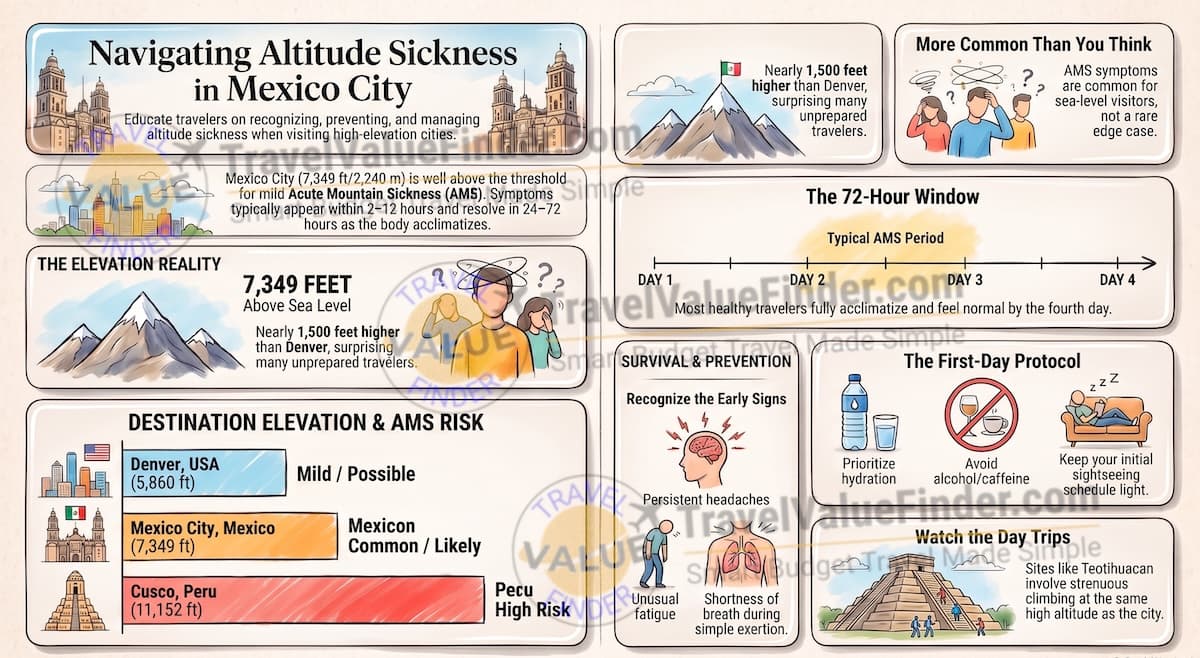
Altitude sickness in Mexico City is a real, common issue for visitors from sea level. The city sits at 7,349 feet (2,240 meters), well above the roughly 6,000–8,000 foot threshold where mild acute mountain sickness (headache, fatigue, nausea, shortness of breath) commonly begins. Symptoms typically appear 2–12 hours after arrival and resolve within 24–72 hours as your body acclimatizes.
Hydration, avoiding alcohol the first day or two, and a light first-day schedule are the most effective prevention steps for most healthy travelers.
Leslie Nics, TravelValueFinder.com | Last updated: July 2026 | Based on first-hand experience and current medical-source research
Every guide to altitude sickness in Mexico City lists the same three facts: the elevation number, the symptom list, and “stay hydrated” and moves on.
What most don’t tell you is what it actually feels like on the ground, and specifically how different it is from anything a sea-level traveler has probably experienced before, including a bad flight or ordinary travel fatigue.
This guide is built around that gap: what genuinely happened on my first night, what the real medical guidance says versus what’s overstated, and the specific first-day decisions that would have made the adjustment noticeably easier.
Here’s what’s worth knowing upfront: this isn’t a reason to skip Mexico City, and for most healthy travelers it’s genuinely mild and short-lived.
It’s also not nothing, treating it like ordinary jet lag, the way I did, means missing the specific, evidence-based things that actually make the first 48 hours meaningfully easier.
Table of Contents
People Also Ask
Can you get altitude sickness in Mexico City?
Yes, at 7,349 feet, Mexico City sits well above the roughly 6,000–8,000 foot threshold where mild acute mountain sickness commonly begins, and it’s a genuinely common experience for visitors arriving from sea level.
How long does altitude sickness last in Mexico City?
For most healthy travelers, symptoms appear within 2–12 hours of arrival and resolve within 24–72 hours as the body acclimatizes.
How can I prevent altitude sickness in Mexico City?
Hydrate well before and during the trip, avoid alcohol and limit caffeine the first day or two, keep the first day’s itinerary light, and avoid strenuous activity for the first 24–48 hours.
Is Mexico City altitude dangerous?
For most healthy travelers, no, symptoms are typically mild and self-resolving. Travelers with pre-existing heart or lung conditions should discuss the altitude specifically with a doctor before the trip.
Altitude Sickness in Mexico City: Why the Elevation Catches People Off Guard
Mexico City sits at 7,349 feet (2,240 meters) above sea level among the highest capital cities in the world, behind only La Paz, Quito, and Addis Ababa.
Acute Mountain Sickness (AMS) can begin at elevations above roughly 6,000–8,000 feet, which puts Mexico City squarely in the range where mild symptoms are genuinely common, not a rare edge case.
For comparison, Denver sits at 5,860 feet and still causes mild symptoms in some visitors. Mexico City is nearly 1,500 feet higher.
| City | Elevation | AMS Risk for Sea-Level Visitors |
| Denver, USA | 5,860 ft (1,786 m) | Mild symptoms possible in sensitive individuals |
| Mexico City, Mexico | 7,349 ft (2,240 m) | Common: mild symptoms genuinely likely for many sea-level visitors |
| Cusco, Peru | 11,152 ft (3,399 m) | High: more severe symptoms more likely without acclimatization |
| La Paz, Bolivia | 11,975 ft (3,650 m) | Highest risk among major capital cities |
Nobody warned me this was really a mild-altitude-illness risk, not just ‘you might feel a little tired the first day.’ I’d traveled internationally dozens of times and never once needed to think about elevation before Mexico City. Leslie Nics, Founder & Lead Travel Writer, TravelValueFinder.com
What Actually Happened on Night One
I flew in from sea level, checked into a hotel in Roma Norte, and spent the afternoon walking, probably my first mistake.
By early evening I had a persistent headache that ibuprofen barely touched, noticeable breathlessness climbing a single flight of stairs, and a restless, shallow-feeling sleep that first night. None of it was severe, but all of it was genuinely disorienting for something I hadn’t planned for at all.
By the second afternoon, the headache had faded to a dull background presence, and by day three it was gone entirely, consistent with the typical 24–72 hour acclimatization window most medical sources describe.
Common Symptoms and What They Actually Feel Like
| Symptom | Typical Onset | What It Actually Feels Like |
| Headache | 2–12 hours after arrival | A dull, persistent pressure that over-the-counter pain relief only partially helps |
| Fatigue / low energy | First day, often worse in the evening | A heavier tiredness than ordinary travel fatigue, even without much physical activity |
| Shortness of breath | Noticeable with any exertion | Climbing stairs or walking uphill feels harder than it should, even for fit travelers |
| Nausea, mild dizziness | First 24 hours, variable | Comes and goes, often worse if dehydrated or after alcohol |
| Disrupted sleep | First 1–2 nights | Lighter, more restless sleep than usual, sometimes with brief waking |
A Realistic Acclimatization Timeline
| Day | What’s Typical |
| Day 1 | Headache, fatigue, breathlessness with exertion most likely to start; symptoms often worse by evening |
| Day 2 | Symptoms typically begin easing; still noticeable but less intense than day 1 |
| Day 3 | Most healthy travelers feel largely normal; occasional mild residual fatigue |
| Day 4+ | Full acclimatization for the large majority of visitors without underlying health conditions |
This timeline is a general pattern, not a guarantee. Some travelers adjust faster, some take a day or two longer, and factors like overall fitness, sleep quality on arrival, and how aggressively you push the first day’s itinerary all genuinely affect where you land within that range.
Who’s Most Likely to Feel It
- Travelers arriving directly from sea level or low elevation : the bigger the jump, the more noticeable the adjustment tends to be.
- Anyone arriving after a long-haul flight with poor sleep : dehydration and fatigue from the flight itself compound altitude symptoms rather than existing separately from them.
- Travelers who schedule a physically demanding first day (a long walking tour, an early hike, alcohol-heavy dinner) rather than easing in.
- Notably, general fitness level is a weaker predictor than people expect : being in good cardiovascular shape doesn’t meaningfully protect against altitude adjustment the way it might against ordinary fatigue.
What Genuinely Helps: Evidence-Based Prevention
- Hydrate well before, during, and after arrival. Water helps your blood carry oxygen more efficiently, and dehydration measurably worsens symptoms.
- Avoid alcohol and limit caffeine for the first day or two. Both are dehydrating and can worsen headache and sleep disruption specifically.
- Keep the first day genuinely light. A slow walking day rather than a packed sightseeing itinerary gives your body real time to start adjusting before you ask more of it.
- Avoid strenuous physical activity for the first 24–48 hours. This is exactly when symptoms are most likely and most pronounced.
- Eat lighter meals the first day or two. A heavy meal on top of altitude adjustment can compound the nausea some travelers experience.
Reality Check: For most healthy travelers, Mexico City’s altitude causes genuine but mild, self-resolving symptoms not the more serious High Altitude Cerebral Edema (HACE) that can occur at much higher elevations. That said, anyone with a pre-existing heart or lung condition should talk to a doctor before the trip specifically about the altitude, not just general travel health.
If You’re Also Visiting Higher-Altitude Sites Nearby
Several popular day trips from Mexico City sit at similar or higher elevation, worth knowing before you assume a day trip is a break from the adjustment:
Cholula (home to the Great Pyramid) sits at 7,052 feet, and Teotihuacan’s pyramids involve real stair-climbing at similar elevation to the city itself, neither is a meaningful altitude break, and both are more physically demanding at altitude than the equivalent activity would be at sea level.
What I Learned for My Future Trips to Mexico
I’d plan the first day as a genuinely slow one.
A short neighborhood walk and an early dinner, not the ambitious multi-neighborhood itinerary I actually attempted. These made the headache and breathlessness noticeably worse than a gentler first day likely would have.
The mistake I’d flag loudest is treating day one like any other first day of a trip. Mexico City genuinely asks something different of your body for about 48 hours, and planning around that instead of against it makes the whole rest of the trip better.” Leslie Nics, Founder & Lead Travel Writer, TravelValueFinder.com
Find Out More About Visiting Mexico City
You May Be Interested In
FAQ
What elevation is Mexico City?
7,349 feet (2,240 meters) above sea level, among the highest capital cities in the world.
What are the first signs of altitude sickness?
Headache, fatigue, shortness of breath with exertion, mild nausea, and disrupted sleep, typically appearing 2–12 hours after arrival.
Should I take medication for Mexico City’s altitude?
Most healthy travelers don’t need medication for Mexico City’s elevation specifically. Prescription options exist for more severe cases or higher elevations, and should be discussed with a doctor before travel, not decided on arrival.
Are Cholula and Teotihuacan also affected by altitude?
Yes, both sit at similar or higher elevation than Mexico City itself, and neither offers a meaningful altitude break if you’re still acclimatizing.
When should I see a doctor for altitude symptoms?
If symptoms are severe, worsening rather than improving after 48–72 hours, or include confusion, severe shortness of breath at rest, or persistent vomiting, seek medical attention rather than assuming it will resolve on its own.
Sources
Disclaimer: This article is for general informational purposes only and does not constitute financial, investment, tax, legal, immigration, or other professional advice. Costs and other figures are estimates and can change. Always verify current information and consult a qualified professional before making significant financial or retirement decisions.