Travel Value Finder

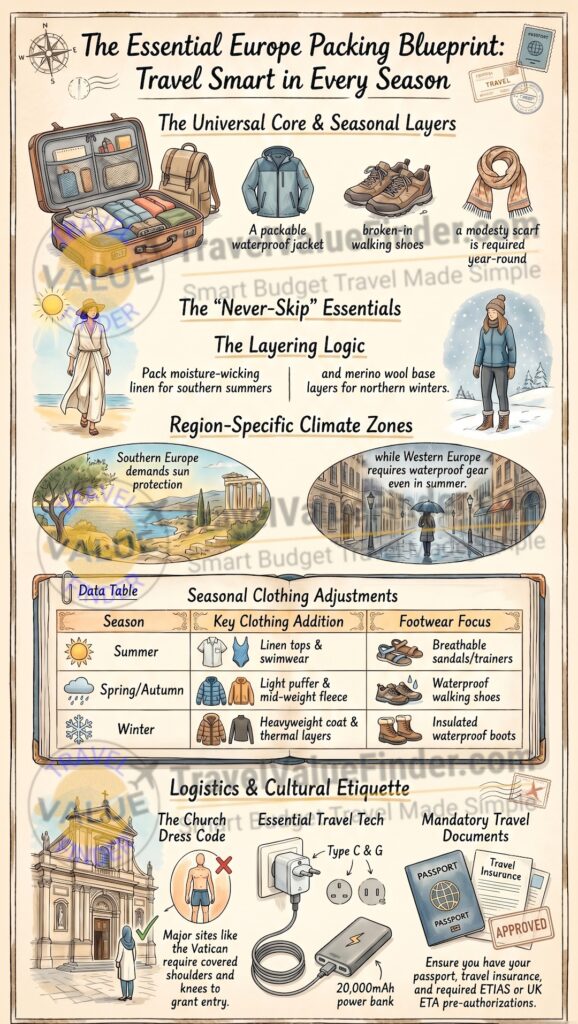
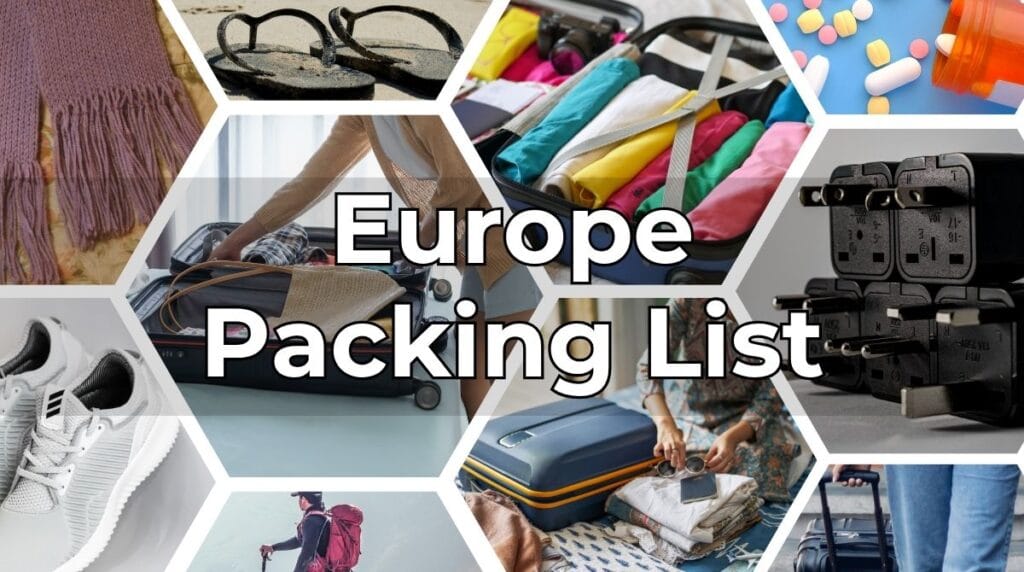
This packing list for Europe is the guide that answers the question correctly – not as a single generic list, but as a framework: a universal core list that works everywhere, season-specific additions organised by region, the complete documents and technology checklist including the new ETIAS pre-authorisation launching in Q4 2026, the church dress code guide that saves you from being turned away at the Vatican and the Sagrada Família, and the What Not to Pack table that saves you from carrying 15kg across cobblestones for two weeks.
Leslie Nics, TravelValueFinder.com | Updated April 2026 | Written for American travelers | Covers all four seasons, all major European regions, carry-on-only strategies, church dress codes, ETIAS 2026, and the most common packing mistakes
The Universal Europe Packing List (Season-Adjustable)
| Category | Core Items (all seasons) | Seasonal Adjustment |
|---|---|---|
| Clothing (bottom half) | 2 pairs trousers/jeans; 1 pair comfortable walking shorts | Summer: swap 1 trouser for lightweight linen. Winter: replace shorts with thermal underlayer |
| Clothing (top half) | 3–4 tops (mix and match neutral colours); 1 light cardigan/jumper | Summer: prioritise linen/moisture-wicking. Winter: add 1 merino wool base layer + 1 mid-weight fleece |
| Outerwear | 1 packable waterproof rain jacket (year-round essential – never skip) | Spring/Autumn: add packable puffer. Winter: heavyweight waterproof coat replaces rain jacket |
| Footwear | 1 pair broken-in walking shoes (NOT new); 1 pair versatile sandals or casual shoes | Winter: swap sandals for ankle boots or waterproof boots. Cobblestone rule: no heels |
| Documents | Passport; travel insurance docs; digital + physical copies of bookings; credit card (no foreign transaction fees) | 2026 addition: ETIAS authorisation (Q4 2026 launch – see below) |
| Technology | Universal travel adapter (Type C + G); portable power bank; unlocked phone; eSIM or local SIM plan | All seasons identical – European electrical standards do not change by season |
| Toiletries | All liquids in 100ml / 3.4oz containers (European flights: same as TSA rule); sunscreen (all seasons in southern Europe); prescription medications in hand luggage always | Summer: add after-sun. Winter: add lip balm, hand cream for heating-dried air |
The single biggest mistake Americans make with their Europe packing list is treating Europe as one place with one climate. It is not. Southern Spain in July reaches 38°C (100°F). Scotland in July reaches 14°C (57°F) with horizontal rain. Venice in November is cold, damp, and bone-chilling by 4pm. Portugal in October is 23°C with sunshine and warm enough to swim. What to pack for Europe depends enormously on which Europe you are visiting and which season you are going.
Europe’s streets are the great equaliser. On Day 1, everyone arrives with different bags. By Day 3, everyone who packed heels is limping, everyone who packed a checked suitcase is paying for left-luggage at every train station, and everyone who brought the right shoes and a rain jacket is still walking happily at 8pm. Pack for the streets, not for the mirror. Leslie Nics, TravelValueFinder.com
Planning your Europe trip? Find the best flights and hotels through our trusted partner: Search Europe Flights and Hotels – TravelValueFinder. Real-time prices, hundreds of providers, secure booking.
Europe’s Climate Zones: Why Your Packing List Depends on Where You’re Going
Before building your packing list for Europe, you need to know which climatic zone your destinations fall into. Getting this wrong is the root cause of most packing failures on European trips:
| Region | Summer (Jun–Aug) | Spring/Autumn | Winter (Dec–Feb) | The Packing Implication |
|---|---|---|---|---|
| Southern Europe (Spain, Portugal, S. Italy, Greece) | 28–40°C (82–104°F) | 15–25°C (59–77°F) | 8–15°C (46–59°F) | Linen and breathable fabrics essential in summer; church modesty cover-ups required; sunscreen every day regardless of season |
| Western Europe (France, UK, Netherlands, Belgium) | 15–25°C (59–77°F); rain always possible | 8–18°C (46–64°F); frequent rain | 3–10°C (37–50°F); rain and wind | A waterproof jacket is non-negotiable year-round. Layering is the strategy, not heavy clothing. Scotland in any month: treat as winter |
| Central Europe (Germany, Austria, Switzerland, Czech Republic) | 20–30°C (68–86°F) | 8–18°C (46–64°F) | -5–5°C (23–41°F); snow possible | Summer: comfortable and warm. Winter: proper winter coat, gloves, and boots – not just a light jacket. Christmas market season requires genuine cold-weather gear |
| Northern Europe (Scandinavia, Iceland, Baltics) | 12–20°C (54–68°F); long daylight | 5–12°C (41–54°F); dark early | -10–0°C (14–32°F); ice, snow | Even in summer: pack a puffer and a warm layer. Eye mask essential for Scandinavia’s 22-hour summer daylight. Winter: full Arctic kit if going above 60th parallel |
| Eastern Europe (Poland, Hungary, Romania, Bulgaria, Balkans) | 22–32°C (72–90°F) | 8–20°C (46–68°F) | -5–5°C (23–41°F); cold and grey | Underrated summer heat – similar layering needs to southern Europe in peak summer. Winter can be genuinely cold (Warsaw, Budapest, Bucharest all get proper winters) |
The lesson: Your Europe packing list for a Portugal-only trip in July is completely different from your list for a Germany – Netherlands – Scotland trip in October. Build your list from the region and season, not from a generic ‘Europe packing list.’ This guide provides both.
What to Pack for Europe by Season: The Complete Clothing Guide
Summer Europe Packing List (June, July, August)
Core rule: Pack for heat in the south (up to 40°C / 104°F) and layers in the north (12–25°C / 54–77°F). Church modesty requirements apply everywhere regardless of temperature.
| Item | Quantity | Notes |
|---|---|---|
| Lightweight breathable tops (linen, bamboo, or moisture-wicking) | 4 | Neutral colours that mix and match. Linen wrinkles but breathes; bamboo wrinkles less. Avoid white – shows sweat and see-through when wet |
| Lightweight trousers (linen or light cotton) | 2 | One pair should be able to cover knees for churches. Convertible zip-off trousers are functional if not stylish |
| Comfortable shorts | 1–2 | Knee-length preferred for versatility – can be worn into some (not all) churches and mosques with a modesty layer over |
| Light dress or skirt (women) / Smart casual shirt (men) | 1 | For evening dining in France, Italy, or Spain where a slightly elevated dress standard applies. Europeans dress up for dinner; a clean shirt or dress makes a difference |
| Light cardigan or thin long-sleeved layer | 1 | The most underrated summer Europe packing list item. Air conditioning in southern European restaurants, museums, and transport is aggressively cold. You will need this indoors in July |
| Packable waterproof rain jacket | 1 | Non-negotiable even in summer. A 20-minute afternoon thunderstorm in Rome, a grey week in Paris, or perpetual drizzle in Scotland will happen. The packable jacket weighs 300g and compresses to fist-size. There is no reason not to bring it |
| Modesty cover-up (scarf or shawl) | 1 | Required for entry to all Catholic churches, Greek Orthodox churches, and mosques across Europe. A lightweight scarf weighing 80g covers shoulders and knees simultaneously. The Vatican and Sagrada Família strictly enforce this rule and will turn you away without one |
| Swimwear | 1 | If visiting coastal southern Europe (Greece, Croatia, Portugal Algarve, Spanish coast). Takes minimal space; bring it |
| Comfortable broken-in walking shoes | 1 pair | The most important item on any Europe packing list. European cities average 15,000–25,000 steps per day on cobblestones. Blisters on Day 2 ruin trips. Break shoes in before departure – at least 3–4 full-day walks. Trainers (sneakers) are universally accepted in 2026 across all European cities |
| Sandals or second casual shoe | 1 pair | For evenings, beach days, or hostel showers. Keep this lightweight – flip-flops or a packable sandal. Do not bring multiple pairs of shoes |
Spring and Autumn Europe Packing List (March–May, September–November)
Core rule: Layering is everything. Mornings can be 8°C; afternoons 20°C; evenings back to 10°C. The same day can require a t-shirt at noon and a warm jacket at 6pm. Pack layers, not single heavy items.
| Item | Quantity | Notes |
|---|---|---|
| Long-sleeved tops (cotton or bamboo) | 3 | Replace 1–2 summer short-sleeved tops with long-sleeved versions |
| Mid-weight jumper or fleece | 1 | A merino wool crew neck or a lightweight fleece. Merino regulates temperature, resists odours, and packs small. Worth the investment if you travel Europe regularly |
| Packable waterproof jacket (with hood) | 1 | Even more critical in spring and autumn than summer. October in Paris, March in Amsterdam, or September in Edinburgh are legitimately rainy. The jacket with hood is the most important item for shoulder-season Europe travel |
| Full-length trousers (2 pairs) | 2 | Jeans work but are heavy and slow to dry. Lightweight travel trousers (Uniqlo, M&S, Banana Republic Travel) dry overnight and pack at 25% of the volume of denim |
| Packable lightweight puffer jacket | 1 | For cold evenings in northern Europe, mountain areas, or surprisingly cold October nights in Rome (temperatures drop fast after dark). Compresses to a small stuff sack |
| Light scarf (doubles as modesty cover-up) | 1 | Wool or cashmere-blend provides warmth AND serves as church modesty layer. The Swiss army knife of spring/autumn European travel accessories |
| Ankle boots or waterproof walking shoes | 1 pair | Replace summer sandals with ankle boots or waterproof trail shoes. Your walking shoe remains the same – just ensure it has some water resistance for wet cobblestones |
Winter Europe Packing List (December, January, February)
Core rule: Winter in Europe is genuinely cold across most of the continent. Pack actual winter gear – not a light jacket and hope. The exception is southern Portugal, the Canary Islands, and Malta, which stay mild (12–18°C). Everywhere else requires proper cold-weather kit.
| Item | Quantity | Notes |
|---|---|---|
| Heavyweight waterproof winter coat | 1 | Do not rely on a packable puffer for winter in northern or central Europe. A proper coat rated to 0°C / 32°F or lower. Your coat is the single heaviest and most important winter item – wear it on the plane to avoid it taking up half your bag |
| Merino wool base layer (top and bottom) | 2 sets | The most compact warm layer possible. Two sets allows one to wash and dry overnight. Merino does not smell after 2–3 days of wear – a genuine advantage for winter backpacking |
| Thick warm jumper / knit sweater | 1 | Over the base layer, under the coat. A chunky knit takes space; a medium-weight wool or synthetic fleece is more packable and equally warm |
| Warm waterproof gloves | 1 pair | Fingerless gloves for phone use + a thin inner liner glove is the practical travel solution. Full gloves for Scandinavia or the Alps |
| Warm hat (beanie) | 1 | Packs flat. Essential from October in Scandinavia, November in central Europe, December everywhere |
| Waterproof ankle boots or winter boots | 1 pair | Wear these on the plane. Wet, cold feet end European winter trips. Waterproofing is non-negotiable for wet cobblestones in Amsterdam, Paris, Prague, or Edinburgh |
| Warm socks (merino wool) | 3–4 pairs | Merino wool socks dry faster than cotton, regulate temperature better, and are significantly more comfortable on long walking days |
| Hand warmers (disposable) | 4–6 packets | For outdoor Christmas markets, long walking days, and Scandinavian winter. Available in Europe but cheap and compact from the US. Optional but transformative on cold days |
Documents and Technology: The Complete 2026 Europe Packing List
2026 Update: ETIAS Pre-Authorisation for American Travelers
One new item on the packing list for Europe in 2026 that most guides have not yet updated for: ETIAS – the European Travel Information and Authorisation System – is scheduled to launch in Q4 2026 for Schengen Area countries. For American travelers, ETIAS works like the US ESTA for foreign visitors: a pre-travel online authorisation costing €20 (approximately $22), valid for 3 years or until your passport expires, processed online before travel. It is not a visa and does not affect your 90-day visa-free allowance – it simply adds a pre-approval step. Apply at the official EU ETIAS portal before departure. Third-party ‘ETIAS services’ that charge more than €20 are unnecessary.
Important: ETIAS applies to Schengen countries only. The UK (post-Brexit) has its own Electronic Travel Authorisation (ETA) – also pre-departure, also separate from a visa, launched 2025 for US citizens. Neither the ETA nor ETIAS replace the passport or change entry rights; they are electronic pre-approvals linked to your passport number.
Documents Checklist
| Document | 2026 Notes |
|---|---|
| Passport (6+ months remaining) | Check your expiry date now. Most European countries require 3 months minimum validity beyond your travel dates; some require 6 months. A passport renewed within the last year may have a different number – update any pre-booked tickets |
| ETIAS (Schengen countries, Q4 2026 launch) | Apply online at the official EU ETIAS website once the system launches. €20. Required from Q4 2026 for Americans entering Schengen countries. Check eu-etias.com for launch date updates |
| UK ETA (for UK visits) | Required from 2025 for US citizens visiting the UK. Apply at gov.uk/apply-electronic-travel-authorisation. £10. Approved within minutes to 72 hours. Linked to your passport |
| Travel insurance documents | Non-negotiable. Screenshot and print your policy number and emergency claims number. European medical care is excellent; being uninsured is genuinely expensive. See: Travel Insurance Guide: What It Covers and Best Options |
| Credit card with no foreign transaction fees | Chase Sapphire, Capital One Venture, Schwab, and most premium travel cards charge no foreign transaction fees. A standard US bank card adds 3% to every transaction – $60 extra on a $2,000 trip. Get a no-fee card before departure |
| Digital and physical copies of everything | Upload passport, insurance, hotel confirmations, and flight tickets to a secure cloud folder (Google Drive or iCloud). Email copies to yourself. Print one set and leave another with someone at home |
| International driving permit (if renting a car) | Required in several European countries (Germany, Austria, Italy, Greece, Spain). Obtained at any AAA office or online for $20. Takes minutes to get; is required at many European rental desks |
Technology Essentials
| Tech Item | Cost Estimate | What You Need to Know |
|---|---|---|
| Universal travel adapter | $15–$30 | Essential without exception. European outlets are 220–240V (vs. 110V in the US) and use Type C, E, F (continental Europe) and Type G (UK) plugs. A universal adapter covering all types costs $15–$30 and handles every country. Get one with USB-A and USB-C ports built in for simultaneous charging |
| eSIM or international data plan | $7–$25 for 7–15 days | The roaming fee problem: Standard US carrier roaming in Europe costs $10–$12 per line per day. Two people, two weeks, two phones = $280–$336 in data fees before a single meal. The solution: Airalo eSIMs ($7–$15 for 7 days across multiple European countries) or a European SIM card purchased on arrival. Both deliver full data at a fraction of roaming cost |
| Portable power bank (20,000mAh) | $25–$50 | European cities require 15,000–25,000 steps per day of navigation, photography, translation, and communication. A high-capacity power bank keeps your phone alive through a full day without hunting for outlets at cafés |
| USB-C charging cable (2x) | $8–$15 each | Most modern devices (including recent iPhones) use USB-C. Bring two – one for the power bank, one for the adapter. Cable failure happens; a backup prevents a miserable day |
| Laptop or tablet (if needed) | N/A (existing device) | For trips under 2 weeks where you are not working remotely, a smartphone handles all navigation, translation, booking, and entertainment needs. A tablet is lighter than a laptop and covers 95% of laptop use cases. Bring a laptop only if your work specifically requires it |
The Church Dress Code Guide: What to Wear at Europe’s Major Religious Sites
This section of the Europe packing list is the most commonly underestimated requirement – and the most commonly enforced. European churches, cathedrals, and mosques have specific dress codes that apply regardless of temperature, season, or how long the queue is outside. Visitors who do not meet the dress code are denied entry – no exceptions at the Vatican, the Sagrada Família, Hagia Sophia, and most major sites.
| Site / Country | Requirements | Enforcement | Solution |
|---|---|---|---|
| Vatican / St. Peter’s Basilica (Rome) | Shoulders covered; knees covered; no sleeveless tops; no shorts; no hats inside | Strict – guards turn people away | Carry a lightweight scarf. Wrap around shoulders and tie around waist. Takes 30 seconds. Never fails inspection |
| Sistine Chapel (Vatican Museums) | Same as St. Peter’s; additionally no photography | Strict | Same solution. Photography ban is enforced by guards in the room – comply fully |
| Sagrada Família (Barcelona) | Shoulders covered; knees covered; no hats | Strict | Scarf or cardigan. This church enforces its code consistently despite the queue |
| Most Greek Orthodox churches (Greece) | Shoulders and knees covered for women; men: no shorts at some sites | Usually enforced; sarongs available at entrance | Scarf + knee-length dress or trousers for women. Smart casual for men |
| Blue Mosque / Hagia Sophia (Istanbul) | Women: head covering + cover shoulders and knees. Men: cover knees | Very strict | Bring a headscarf (women) and remove shoes at entrance. Disposable coverings available but bring your own |
| Notre-Dame Cathedral (Paris, reopening 2025) | Respectful dress; no sleeveless in sanctuary | Moderate | A cardigan over a sleeveless top is sufficient |
| Most Italian churches generally | Shoulders and knees covered – enforced at major sites | Varies by site | Scarf or cardigan solution works universally. Disposable wraps sometimes sold outside for €2–€3 |
The universal solution: One lightweight scarf or shawl (80–100g; compresses to nothing) addresses every church dress code requirement on the Europe packing list simultaneously. Wrap around shoulders for the upper body requirement. Tie loosely around the waist for the knee coverage requirement. This single item enables spontaneous visits to any religious site in Europe without planning ahead.
What Not to Pack for Europe: The Mistake Table
This is the section that makes the most practical difference to your Europe packing list. Every item on this list is commonly packed by first-time visitors and commonly regretted by Day 3:
| What to Leave Behind | Why People Pack It | Why You Should Not + What to Do Instead |
|---|---|---|
| Stiletto heels or fashion heels | To dress up for evenings | Cobblestones + heels = rolled ankles and misery. Every European city’s ‘nice area’ has cobblestones. Pack one pair of leather trainers or ankle boots that look smart and walk on anything. You will look better than the limping tourist |
| A full-sized suitcase for a 1–2 week trip | To bring more options | Checked luggage adds $50–$100 each way on budget European airlines; takes 30–45 min at baggage claim; is incompatible with overnight trains and small boutique hotels. A 40L carry-on backpack covers 2 weeks comfortably with the right packing strategy |
| Multiple pairs of shoes | Different shoes for different occasions | Two pairs maximum, always. Walking shoe + smart casual shoe or sandal. Shoes are the heaviest, bulkiest item in any bag. Three pairs of shoes for a 10-day trip is the most common weight mistake |
| Full-sized toiletries | Favourite products | Pharmacies (farmacia in Italy, pharmacie in France, Apotheke in Germany) are common in every European city and sell international brands. Decant into 100ml containers or buy travel sizes. European flights enforce the same 100ml / 1L bag liquids rule as US TSA for carry-on bags |
| Printed guidebooks | Reference and planning | A single Rick Steves or DK guide is 500–800g. Google Maps offline, TripAdvisor, and this website’s destination guides cover everything a printed book does, weigh nothing, and are updated. If you must bring a book, rip out only the pages for your specific destinations |
| Lots of cash (USD or Euros) | To feel secure | Most of Europe is effectively cashless in 2026. Cards and contactless payment (Apple Pay, Google Pay) work in 90%+ of establishments across Western and Central Europe. Carry €50–€100 maximum as backup. Withdraw from ATMs as needed (€2–€3 fee). Carrying large amounts of cash creates theft risk with zero benefit |
| Gym clothes and workout gear (excessive) | To exercise during the trip | One set of workout clothes is sufficient. European cities provide 15,000–25,000 steps of walking per day – you are already exercising more than you do at home. Hotel gyms in Europe are small and often closed. Pack one technical t-shirt and shorts; skip the rest |
| Plug converters instead of adapters | Thinking they are the same thing | Critical distinction: an adapter changes the plug shape but not the voltage. A converter changes the voltage. Most modern US devices (phones, laptops, cameras) are dual-voltage (110–240V) and only need an adapter. Older appliances (hair dryers, straighteners) may need a voltage converter or will break. Check the label on any device before plugging in |

The Carry-On Only Europe Packing List: How to Pack 2 Weeks in a 40L Bag
Carry-on-only travel transforms a European trip – no checked luggage fees ($50–$100 each way on Ryanair, EasyJet, and Wizz Air), no 30-minute wait at baggage claim, no lost luggage risk, seamless overnight train travel. Here is how to make it work for a 2-week Europe trip packing list:
The Carry-On Only Clothing Formula
| Category | Carry-On Formula (2 weeks) |
|---|---|
| Tops | 3 tops + 1 smart/elevated top = 4 total. Roll, do not fold. Pack in a packing cube. Wash 1–2 items in the sink every 3–4 nights (merino and bamboo dry in 4–6 hours hanging in a warm room) |
| Bottoms | 2 trousers + 1 shorts = 3 total. Wear the heaviest/thickest pair on the plane. Travel trousers (Uniqlo, M&S, Patagonia) weigh 30–40% of denim jeans |
| Underwear | 5–6 pairs. Merino wool or ExOfficio underwear dries overnight and can be re-worn 2 days. A 7-day supply in any case; wash as you go |
| Socks | 4–5 pairs. Merino wool walking socks. Two pairs of thick walking socks + 2 pairs light casual. Wear the bulkiest pair on the plane |
| Shoes | 2 pairs maximum. Wear the heaviest on the plane (never pack shoes that could be worn – wearing them saves bag space and weight). Pack the lighter pair in a shoe bag inside the main compartment |
| Outerwear | Wear the coat on the plane. A packable jacket goes inside the bag. Never check these – if your bag is lost, you need your coat |
| Toiletries | All in one 1-litre clear TSA/European-standard ziplock. 100ml maximum per container. Total bag weight: 300–500g. Buy full-size locally if staying 2+ weeks in one city |
- The 40L bag recommendation: Osprey Farpoint 40, Nomatic Travel Pack 40L, or Cotopaxi Allpa 42L are the most recommended 40L carry-on backpacks by the travel community. All fit within Ryanair’s 40x20x25cm personal item dimensions (check airline specifics) or are accepted as cabin bags on most carriers
- European liquids rule: Identical to US TSA rules for carry-on – 100ml (3.4oz) per container, all liquids in a single 1-litre clear bag, one bag per person. Note: Some European airports and return flights apply this rule more strictly than US departure airports – do not assume lenience on departure from European hubs. Put your liquids bag in the most accessible part of your carry-on
- Laundry strategy: Self-service laundromats are available in all European cities for €5–€10 per wash+dry. Most hostels have laundry facilities. Sink-washing merino and technical fabrics overnight covers short intervals between laundromat visits. Plan one proper laundry day per week on long trips
Money and Payments in Europe: What to Pack and What to Know
The financial component of the Europe packing list is frequently overlooked – and it is where many American travelers pay unnecessary fees:
| Topic | What You Need to Know |
|---|---|
| Credit cards | Pack a no-foreign-transaction-fee card – Chase Sapphire Preferred, Capital One Venture, or the Charles Schwab Visa Debit are the most recommended. A standard US credit card charges 3% on every overseas transaction – $60 on a $2,000 trip for doing nothing different. Contactless (tap-to-pay) works in 95%+ of European establishments. Bring 2 cards: one Visa, one Mastercard – they cover different networks |
| Cash | Carry maximum €100 for markets, smaller cafés, and small towns. Europe is not entirely cashless – rural France, smaller Spanish towns, Albanian markets, and some Eastern European destinations still prefer or require cash. Withdraw from ATMs in destination currency (never use the ATM’s ‘dynamic currency conversion’ to charge in USD – it adds 3–7% to your transaction). European ATMs charge €2–€3 per withdrawal |
| Wise or Revolut card | Either works brilliantly in Europe – mid-market exchange rates, low fees, instant notifications. Wise is better for sending money; Revolut is better for travel. Both can hold Euros (and other currencies) and are accepted wherever Mastercard is accepted. A useful supplement to your main travel credit card |
| Do NOT use dynamic currency conversion | The single most common financial mistake in Europe. When a card machine or ATM asks ‘Do you want to pay in USD?’ – always say NO and pay in local currency. The ‘conversion’ they offer adds 3–7% to the transaction. Your no-fee travel card handles the conversion at the real rate |
| VAT refund | EU shops are required to offer VAT refunds to non-EU visitors on purchases over €175 at participating stores. Present your passport at time of purchase, get the refund form stamped at the airport before departure. UK has its own scheme. Worth doing for major purchases (clothing, luxury goods); not worth the paperwork for small amounts |
Plan Your Europe Trip: Essential Resources on TravelValueFinder
- How to Travel Europe on a Budget: The Complete Guide
- Essential Travel Packing List: What to Bring (and What to Leave)
- Eastern Europe on a Budget: Cheapest Countries and Top Tips
- Free Walking Tours Around the World: A City-by-City Guide
- Best Places to Retire in Europe on a Small Budget
- Travel Insurance Guide: What It Covers and Best Options
- How to Find Cheap Flights: 12 Proven Strategies That Actually Work
- How to Save Money on Hotels: The Budget Traveler’s Complete Guide
- Budget Travel Tips: 30 Strategies to Travel More for Less
- Solo Travel Tips for First-Timers: How to Travel Alone Safely
- Best Free Things to Do When Traveling (No Matter Where You Go)
- Free AI Trip Planner: Get a Day-by-Day Itinerary in Seconds
Find the best flights and hotels for your Europe trip. Our trusted partner searches hundreds of providers in real-time: Search Europe Flights and Hotels – TravelValueFinder. We earn a small commission at no extra cost to you – helping keep all our guides completely free.
Frequently Asked Questions: Packing List for Europe
What should I pack for Europe?
The core Europe packing list for any season covers: (1) clothing in neutral, mix-and-match colours (3–4 tops, 2 bottoms, 1 layer, 1 outerwear); (2) one pair of broken-in comfortable walking shoes; (3) a packable waterproof rain jacket; (4) a lightweight scarf (for church dress codes); (5) a universal travel adapter (Type C + G); (6) documents including passport, ETIAS or UK ETA authorisation, and travel insurance; (7) a no-foreign-transaction-fee credit card; (8) an eSIM or international data plan. The season determines what you add – merino base layers for winter, linen tops and swimwear for southern Europe in summer. See the full seasonal checklists above for the complete breakdown.
What not to pack for Europe?
The items most commonly packed and most consistently regretted on Europe trips: stiletto or fashion heels (cobblestones make these unwearable and injury-causing); a full-sized checked suitcase for trips under 2 weeks (budget airlines charge $50–$100 each way; a 40L carry-on avoids this entirely); multiple pairs of shoes (two pairs maximum – heavy shoes are the single biggest weight mistake); full-sized toiletries (European pharmacies stock everything; bring 100ml travel sizes); excessive cash (Europe is largely cashless – carry €50–€100 maximum and withdraw as needed from ATMs); and a heavy printed guidebook (your phone handles everything a guidebook does, weighs nothing, and has current information).
What shoes should I pack for Europe?
Pack a maximum of two pairs of shoes for Europe – and make this decision carefully because shoes are the heaviest, bulkiest items in any travel bag. Pair 1: a comfortable, broken-in walking shoe rated for 15,000–25,000 daily steps on cobblestones. Trainers (sneakers) are universally accepted across all European cities and countries in 2026 – white leather sneakers, in particular, are worn extensively by Europeans themselves. Pair 2: a versatile second shoe – sandals or flip-flops for summer, smart casual shoes or ankle boots for spring/autumn/winter. Stiletto heels, platform heels, and thin-soled dress shoes should not be packed for Europe. Cobblestone streets exist in every historic European city and make any narrow or high heel impractical and genuinely injury-risking.
Do I need a power adapter for Europe?
Yes – without exception. American plugs do not fit European outlets. European countries use Type C (standard continental Europe), Type E and F (France, Germany, Austria, Belgium, Netherlands, Eastern Europe), and Type G (UK, Ireland, Malta, Cyprus) plugs at 220–240V. A universal adapter covering all plug types costs $15–$30 and is available on Amazon or at any travel store. Important distinction: an adapter changes the plug shape; a voltage converter changes the voltage. Most modern US devices (phones, laptops, cameras, tablets) are dual-voltage (110–240V) and only need an adapter – check the small text on your device’s power brick to confirm. Older US appliances (hairdryers, certain straighteners) rated only for 110V will need a voltage converter or will break or catch fire.
What is ETIAS and do Americans need it?
ETIAS – the European Travel Information and Authorisation System – is a pre-travel online authorisation for visa-exempt visitors to Schengen Area countries. It is scheduled to launch in Q4 2026. For Americans: ETIAS costs €20, is valid for 3 years (or until your passport expires), is applied for online before travel, and is linked to your passport number. It is not a visa and does not change your 90-day visa-free allowance. It is conceptually identical to the US ESTA that foreign visitors use to enter the United States. A separate system – the UK Electronic Travel Authorisation (ETA) – applies specifically to the UK and launched in 2025 for US citizens. Apply through official government channels only; third-party ‘ETIAS services’ charging more than €20 are unnecessary and should be avoided.
What is the liquids rule for European flights?
European flights apply the same liquids rule as US TSA for carry-on baggage: 100ml (3.4oz) maximum per container; all liquids in a single 1-litre (1-quart) clear resealable bag; one bag per passenger. This rule applies to liquids, gels, pastes, and aerosols. The practical implication: toiletries must be in travel-sized containers (maximum 100ml), and your liquids bag must be separate and accessible for security screening. Some European airports apply this rule more strictly than US airports on departure – do not assume the same level of enforcement variation that exists at some US airports. Ensure all liquids are compliant before your return flight from Europe. Duty-free purchases made after security are exempt and can be carried in sealed bags with receipts.
How many outfits should I pack for Europe?
For a European trip packing list of 1–2 weeks, pack: 3–4 tops, 2 bottoms (trousers or skirts), 1 elevated/smart outfit for dinners or special occasions, 5–6 pairs of underwear, 4–5 pairs of socks, 1 layer (cardigan or mid-weight jumper), and 1 outerwear piece appropriate to your season. This totals 7–10 outfit combinations – more than enough for 2 weeks when you choose neutral colours that mix and match. Roll items rather than folding; use packing cubes to compress; wash 1–2 items per sink session every 3–4 days for longer trips. The key is neutrals and versatility: grey, navy, white, black, and khaki all combine. A patterned item does not.
Should I pack a money belt for Europe?
A money belt is the classic travel security advice – a flat pouch worn against the skin under clothing, holding your passport, emergency cash, and backup cards. The practical 2026 reality: most experienced Europe travelers use either a money belt (Rick Steves’ recommended approach) or a well-chosen anti-theft crossbody bag with RFID-blocking lining and slash-resistant straps. In major tourist cities (Rome, Paris, Barcelona, Amsterdam), pickpocketing is the most common tourist crime – particularly on crowded public transport and at major tourist attractions. Whichever security solution you choose, the key rules are: never put your phone in a back pocket; keep your bag on your lap (not on the back of a chair) in restaurants; be aware in crowds. For most low-crime European cities, a crossbody with a zip is sufficient. For Italy, Spain, and France in peak season, a money belt under your clothes provides genuine security for passport and emergency funds.
Final Thoughts: The Best Packing List for Europe Is the Lightest One
The best packing list for Europe is not the most comprehensive one – it is the lightest one that covers every situation you will actually encounter. The seasoned European traveler does not pack more things; they pack better things: a rain jacket instead of an umbrella; merino wool instead of cotton; one versatile pair of walking shoes instead of four pairs of occasion shoes; a scarf instead of a specific church-visit outfit.
Europe’s cities reward the light traveler specifically. Overnight trains are transformative when you are not dragging 25kg through a narrow sleeper compartment. Walking 20,000 steps through Rome is joyful when you are not carrying a loaded backpack. Spontaneous decisions – an extra night in Florence, a last-minute train to the coast – are possible when your life fits in a 40L bag and you are not tied to a checked suitcase schedule.
Pack the rain jacket. Bring the scarf. Leave the heels. Europe will do the rest.
Every trip I’ve taken to Europe, I’ve come home with unworn items in my bag. Not because I didn’t plan well enough – but because the temptation to pack ‘just in case’ always exceeds the reality of what you actually need. The scarf I worried was too casual worked everywhere. The cardigan I nearly left behind saved me in every air-conditioned museum in July. The heels I left at home stayed unworn in my imagination too. Pack less. Walk more. Europe is better that way. Leslie Nics, TravelValueFinder.com
Book your Europe trip at the best prices. Our trusted partner searches hundreds of providers: Find Europe Flights and Hotels – TravelValueFinder. We earn a small commission at no extra cost to you.