Travel Value Finder


Your Ultimate France Travel Guide: Must-See Sights in Paris, Nice, and Lyon
Planning a trip to France? This France Travel Guide is your ultimate resource for exploring three of the country’s most iconic cities: Paris, Nice, and Lyon. Whether you’re drawn to the art and history of Paris, the Mediterranean charm of Nice, or the culinary delights of Lyon, this guide will help you navigate the best attractions, hidden gems, and local experiences. With expert tips on sightseeing, dining, and getting around, you’ll have everything you need to plan the perfect French getaway.
Discover the best of France from the iconic Eiffel Tower in Paris to the Mediterranean beaches of Nice and the culinary capital of Lyon. Explore top attractions, hidden gems, and practical travel tips in our comprehensive guide to France.
Our comprehensive infographic highlights the top attractions, must-try experiences, and essential travel tips for each city. From iconic landmarks like the Eiffel Tower to the vibrant markets of Lyon and the Mediterranean charm of Nice, this visual guide will help you plan the perfect French getaway. Explore Paris, Nice, and Lyon with ease and make the most out of your trip with our expert recommendations!
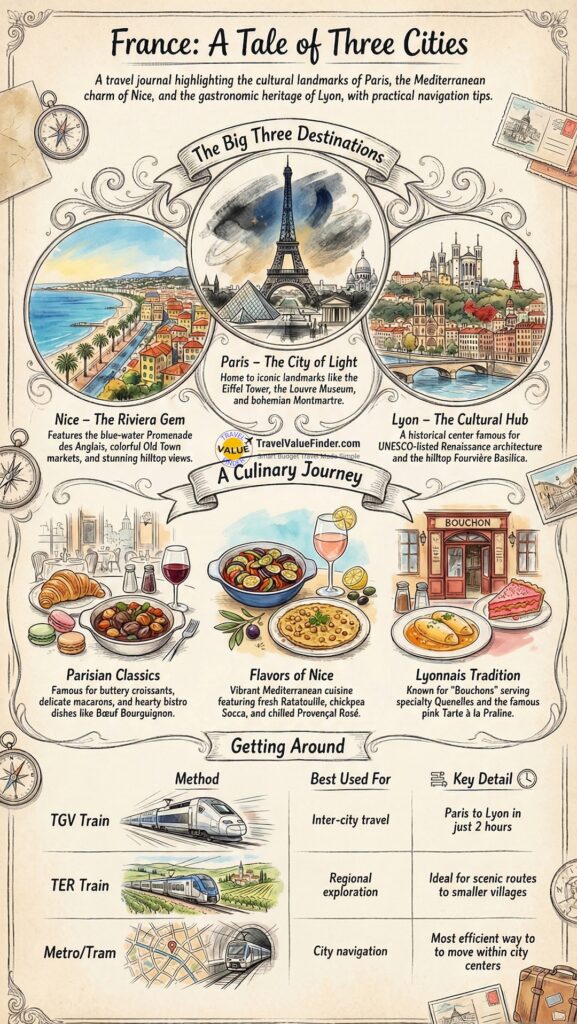
This France travel guide will cover the best attractions, hidden gems, where to stay, best times to visit, and much more to help you plan your perfect French getaway. Along the way, I’ll link to my in-depth guides on Paris, Nice, and Lyon to give you even more details, including day trips, itineraries, hotels, and unique experiences.
Table of Contents
France feels like many different trips hidden inside one country.
Why Visit France?
France is a country of incredible diversity, from the bustling streets of Paris to the charming villages of Provence and the glamorous French Riviera. Whether you’re looking for art, culture, food, history, or just a romantic getaway, France offers it all. You’ll find famous landmarks, but also a wealth of hidden gems waiting to be explored. It’s a place that combines the best of old-world charm with modern sophistication.
In this guide, I’ll focus on three cities that are must-visits in France: Paris, Nice, and Lyon. These cities each have a unique identity but share the same unmistakable French charm. So, grab your croissant and a cup of coffee, and let’s dive in!
1. Paris – The City of Light
Paris is undoubtedly one of the most famous cities in the world, and for good reason. From the iconic Eiffel Tower to the Louvre Museum, Paris is a hub of art, history, and culture. But beyond the major attractions, Paris also offers charming neighborhoods, hidden cafés, and quaint streets that will steal your heart.
Top Attractions in Paris:
- Eiffel Tower: The symbol of France. Whether you choose to climb or take the elevator to the top, the views are spectacular.
- Louvre Museum: Home to the Mona Lisa and countless masterpieces, it’s a must-see for art lovers.
- Notre-Dame Cathedral: Though it’s still undergoing restoration, this stunning Gothic cathedral is iconic.
- Montmartre: A bohemian district full of artists, cafés, and the breathtaking Sacré-Cœur Basilica.
For more detailed tips, check out my full guide on the Top 10 Things to Do in Paris, which covers not just the main attractions but also hidden gems, local neighborhoods, and best times to visit.
Where to Stay in Paris:
Whether you’re seeking a luxury stay or a budget-friendly hotel, Paris offers a wide range of options. Some of my favorites include:
- Luxury stays: Hotel Le Meurice and The Ritz Paris.
- Budget-friendly options: Generator Paris and The 3 Ducks Hostel.
Find more accommodation recommendations in my detailed post on Where to Stay in Paris: Hotels for Every Budget.
2. Nice – The Gem of the French Riviera
Nice is the beating heart of the French Riviera (also called the Côte d’Azur) and is known for its beautiful beaches, Mediterranean climate, and charming old town. Whether you’re lounging on the Promenade des Anglais, exploring the Old Town (Vieux Nice), or visiting the Matisse Museum, Nice offers something for everyone.
Top Attractions in Nice:
- Promenade des Anglais: This famous promenade runs along the blue waters of the Mediterranean and is perfect for a leisurely stroll.
- Old Town (Vieux Nice): Full of narrow streets, colorful markets, and charming squares, this is where you’ll find the true heart of Nice.
- Colline du Château: For the best views of Nice, hike up to this hilltop park overlooking the city.
- Cimiez Gardens and Matisse Museum: A quiet place to explore Nice’s cultural side and enjoy some of Matisse’s most famous works.
If you’re planning a trip to Nice, make sure to read my Complete Guide to Visiting Nice for more details, including the best neighborhoods to stay in, hidden gems, and day trips to take from the city.
Where to Stay in Nice:
Nice has a wide range of options, from luxurious hotels to affordable stays. Some recommendations:
- Luxury stays: Hotel Negresco and Palais de la Méditerranée.
- Budget hotel options: Hotel Rossetti and Hotel de Flore.
3. Lyon – The Culinary Capital of France
Lyon is known for its food scene, often hailed as the gastronomic capital of the world. If you’re a foodie, Lyon should definitely be on your radar. It’s also a historical hub with its UNESCO-listed old town, the Basilica of Notre-Dame de Fourvière, and Roman ruins. If you’re into shopping, culture, and local experiences, Lyon is a hidden gem that deserves to be explored.
Top Attractions in Lyon:
- Vieux Lyon (Old Town): A UNESCO World Heritage Site full of medieval and Renaissance architecture.
- Basilica of Notre-Dame de Fourvière: Perched on a hilltop, this iconic church offers stunning city views.
- Parc de la Tête d’Or: One of the largest urban parks in France, complete with a zoo, botanical garden, and lake.
- Lyon’s Food Scene: Visit traditional bouchons, explore local markets like Les Halles de Lyon, and indulge in Lyon’s signature dishes like quenelles and salmon à la Lyonnaise.
For more insights on exploring Lyon, check out my post on Lyon Itinerary for First-Time Visitors to help plan your trip.
Where to Stay in Lyon:
Lyon also has a mix of luxury and budget accommodations to fit any budget:
- Luxury stays: Villa Florentine and Cour des Loges.
- Budget stays: Sofitel Lyon Bellecour and Mama Shelter Lyon.
Explore all the best places to stay in Lyon in my post on Where to Stay in Lyon: Hotels for Every Budget.
4. Tips for Traveling in France
Best Time to Visit:
Paris: Spring (April-June) and Fall (September-November) offer pleasant weather and fewer crowds.
Nice: Visit in Spring or Autumn for mild weather and fewer tourists, but Summer is perfect for beach lovers.
Lyon: The best times are Spring and Autumn when the weather is ideal for walking and sightseeing.
Language: While French is the official language, you’ll find that many people in Paris and Nice speak English, especially in tourist areas. However, knowing a few basic French phrases can enhance your experience.
Getting Around:
- Paris has an efficient metro system, so getting around is easy.
- Nice is compact, and you can easily walk around or take trams.
- Lyon has both metro and tram systems for easy access to the city.
5. Practical Travel Information for Visiting France
While France is a dream destination for many travelers, there are a few important practical tips that will help you navigate the country smoothly and make the most of your time there. From transportation to currency, health care, and cultural etiquette, here are some essential travel tips for your trip to France.
A. Do I need a visa to visit France?
For travelers from most European Union (EU) and European Economic Area (EEA) countries, no visa is required to enter France. However, if you are traveling from outside the EU, a visa may be necessary depending on your nationality and the length of your stay.
Schengen Area: France is part of the Schengen Zone, which allows visitors to move freely between participating countries. A short-stay Schengen visa generally allows stays of up to 90 days within a 180-day period.
Visa Types: Depending on the purpose of your visit (tourism, business, study, etc.), you may need to apply for a specific visa. You can apply for a visa online or through your local French consulate.
Entry Requirements: Travelers should also ensure their passport is valid for at least three months beyond their planned departure date from France.
For further details, please check the French government website for the latest visa and entry requirements and the France visa wizard for more information.
B. Currency and Payments
France’s official currency is the Euro (€), and you will find plenty of ATMs in major cities like Paris, Nice, and Lyon, as well as in smaller towns. Here are some important things to know about currency and payments:
Credit Cards: Most major credit cards (Visa, MasterCard, American Express) are accepted at hotels, restaurants, and shops. However, always carry some cash for smaller establishments, local markets, or places that don’t accept cards.
ATMs: ATMs are widespread, and you can withdraw cash using your debit card. Be mindful of any foreign transaction fees from your bank.
Currency Exchange: If you need to exchange currency, avoid doing so at airports or tourist areas, as they tend to have high fees. Instead, use local banks or exchange offices for better rates.
Tipping: In France, tipping is not mandatory as a service charge is included in restaurant bills (usually 15%). However, it’s customary to leave small change (about 5-10%) for exceptional service.
6. How to Get Around in France: Exploring Paris, Nice, and Lyon
Traveling around France is relatively easy, thanks to the country’s well-developed transportation networks. Whether you’re hopping between iconic cities like Paris, Nice, and Lyon, or venturing into the picturesque countryside, France offers a variety of ways to get around. Whether you prefer high-speed trains, local buses, or the freedom of a rental car, there’s an option for every traveler.
Here’s a comprehensive guide to help you navigate the French transportation system and decide which method works best for your trip.
6. 1. High-Speed Trains (TGV) – The Fast and Comfortable Way to Travel Between Cities
If you’re planning to travel between major cities in France, such as Paris, Lyon, and Nice, the TGV (Train à Grande Vitesse) is the way to go. The TGV is France’s high-speed train network, and it’s one of the best in the world for fast and comfortable travel. Here’s everything you need to know about the TGV:
Paris to Lyon by TGV
Travel Time: The journey between Paris and Lyon takes around 2 hours. The trains depart frequently, making it an easy and quick way to move between these two major cities.
Departure Stations: In Paris, TGVs to Lyon depart from Gare de Lyon, one of the city’s main train stations. In Lyon, trains arrive at Lyon Part-Dieu station.
Ticket Prices: TGV tickets can vary depending on how early you book and whether you choose first-class or second-class seating. Booking in advance usually guarantees better rates, starting around €25-40 for second class.
Paris to Nice by TGV
Travel Time: The journey between Paris and Nice takes about 5 hours and 30 minutes, depending on the specific train route.
Departure Stations: TGV trains to Nice leave from Gare de Lyon in Paris and arrive at Gare de Nice-Ville.
Ticket Prices: Similar to Paris-Lyon routes, tickets range from €40-80, depending on when you book and whether you’re traveling in the high season.
Booking TGV Tickets
You can book TGV tickets online via the SNCF website or through third-party sites like Trainline or Omio. Advance booking is recommended, especially during the summer months when trains can get busy.
Why Take the TGV?
Speed and Comfort: The TGV is fast, and you can relax during your journey with spacious seats, free Wi-Fi on some routes, and convenient onboard services.
Sustainability: Trains are more environmentally friendly than flying or driving, making it a great choice for eco-conscious travelers.
6. 2. Regional Trains (TER) – Ideal for Exploring Smaller Destinations
While the TGV is great for long-distance journeys, France’s regional trains (called TER – Transport Express Régional) are ideal for exploring smaller cities, towns, and even picturesque villages.
Paris to Nice via Regional Trains
Travel Time: Although slower than the TGV, a regional train from Paris to Nice would take approximately 7 to 9 hours and often involves one or more transfers. It’s less expensive but less efficient.
Ticket Prices: Prices typically start around €30-50, depending on the route and time of booking. If you’re not in a rush and want to experience scenic views, regional trains are a great option.
Using Regional Trains Within Cities
Regional trains are also useful for exploring areas within the city’s surrounding regions. For example, a regional train from Lyon could take you to Vienne, Beaujolais, or Grenoble, allowing you to easily visit nearby towns and attractions.
6. 3. Trams and Buses – Convenient for Getting Around Cities
Once you’ve arrived in Paris, Nice, or Lyon, public transportation is the best way to get around the city and its surroundings. The metro, bus, and tram systems are well-organized and fairly easy to use.
Paris: Metro and Buses
Paris Metro: Paris has one of the most famous and extensive metro systems in the world. With 16 lines covering most of the city and suburbs, it’s fast, frequent, and cheap. You can buy single tickets, or if you’re staying for a few days, consider a Navigo pass for unlimited travel.
Bus: The Paris bus system is also reliable, especially for travel on surface-level routes. It’s a bit slower than the metro due to traffic, but it’s a nice way to see the city above ground.
Ticket Prices: A single metro or bus ride costs about €1.90. Consider buying carnets (a pack of 10 tickets) or a Navigo Day Pass for unlimited travel.
Nice: Trams and Buses
Nice Tram System: The tram in Nice is modern and well-connected, making it easy to get from the Nice Ville train station to the Promenade des Anglais and other key spots.
Buses: Nice’s buses cover a wider area of the city and surrounding areas. If you’re staying near the beaches or in Vieux Nice (Old Town), buses are an excellent option for local travel.
Ticket Prices: A single ticket costs around €1.50, with unlimited daily passes available for €5.
Lyon: Metro, Trams, and Buses
Metro: Lyon’s metro system consists of four lines and is one of the most convenient ways to navigate the city. It’s a fast and reliable way to travel between key areas such as Vieux Lyon and La Part-Dieu.
Trams: Lyon also has an extensive tram network that connects various parts of the city and the suburbs, especially useful for those staying outside the city center.
Buses: The bus system in Lyon is comprehensive, covering not only the city but the nearby towns and hills like La Croix-Rousse. Lyon’s buses are also eco-friendly and easy to use.
Ticket Prices: A single metro or tram ride costs around €2, or you can purchase a Lyon City Card for unlimited travel within the city for a set number of days.
6. 4. Renting a Car – For Flexibility and Exploring Hidden Gems
If you prefer flexibility and want to explore off-the-beaten-path destinations in France, renting a car is a great option. France’s road network is well-maintained, and it’s one of the best ways to reach remote villages, vineyards, and natural attractions that might not be easily accessible by public transport.
Renting a Car in France
Rental Companies: Major car rental agencies like Europcar, Hertz, Sixt, and Avis are available at airports, train stations, and in most large cities. It’s advisable to book your car in advance, especially during the busy summer months.
Driving License: If you’re traveling from outside the EU, make sure you have an International Driver’s Permit (IDP) in addition to your regular driver’s license.
Roads and Traffic: French highways (autoroutes) are excellent, but they can have tolls, so be prepared for toll costs when driving between cities. You can also enjoy scenic routes through Provence or along the French Riviera.
Parking: Parking in cities like Paris can be challenging. Use parking garages or park-and-ride services to avoid expensive city-center parking. In Nice and Lyon, there are usually more street parking options, but it’s essential to check the parking signs for restrictions.
Why Rent a Car?
Access Hidden Gems: Renting a car gives you the freedom to explore charming villages like Saint-Paul-de-Vence near Nice or Beaujolais vineyards near Lyon.
Explore the Countryside: Discover the beauty of France’s countryside, including the Provence lavender fields or the Loire Valley castles.
Flexibility: With a rental car, you’re not tied to train schedules or bus routes, giving you more control over your itinerary.
6. 5. Flights – For Long-Distance Travel or Quick Getaways
If you’re traveling between Paris, Nice, and Lyon, you might also consider flying. While the train is often more convenient for these cities, budget airlines like EasyJet and Air France operate short domestic flights.
Flight Duration: A flight from Paris to Nice takes about 1 hour 30 minutes, and flights from Paris to Lyon are approximately 1 hour.
Booking Flights: For budget options, consider flying with low-cost airlines well in advance to secure cheaper tickets.
France is a breeze, thanks to its well-organized transportation network. Whether you’re riding the TGV to reach the heart of Paris, hopping on a tram in Nice, or renting a car to discover the countryside, you’ll have no trouble exploring everything this beautiful country has to offer. From fast trains to charming buses, public transport in France is not only efficient but also an experience in itself. And if you have the time and inclination, a rental car allows you the freedom to dive deep into the hidden gems and local cultures of France’s diverse regions.
So, get ready to pack your bags and hit the road — France awaits!
7. Health and Safety Tips
While France is generally a safe country for travelers, it’s important to keep a few health and safety tips in mind:
Travel Insurance: It’s always recommended to have travel insurance that covers healthcare and emergency evacuation in case of illness or accidents.
Healthcare: France has an excellent healthcare system. In case you need medical attention, you can visit a local pharmacy, general practitioner, or hospital. Emergency number: In case of emergency, dial 112 for an ambulance.
Vaccinations: No mandatory vaccinations are required for travelers to France, but it’s recommended to be up to date with routine vaccinations.
Safety: France is generally safe, but like in any major tourist destination, be cautious about pickpockets, especially in crowded places like Paris’ metro or Nice’s Promenade des Anglais.
8. Cultural Etiquette in France
Understanding French customs and etiquette will help you feel more comfortable while traveling. Here are a few tips to make your trip even more enjoyable:
Greetings: The French are known for their politeness, so always greet people with a “Bonjour” (good day) when entering a shop or café. “Merci” (thank you) and “Au revoir” (goodbye) are important expressions to know.
Dining Etiquette: When eating, keep your hands on the table (but not your elbows). It’s also customary to wait for the host to begin before you start eating.
Dress Code: The French are known for their fashion sense. While casual clothes are fine, it’s a good idea to dress smartly when dining out or visiting more formal places like museums or churches.
9. Food and Drink Culture in France: A Culinary Journey Through Paris, Nice, and Lyon
When you think of France, food is likely one of the first things that comes to mind. Whether you’re sipping a glass of Bordeaux wine, nibbling on a buttery croissant, or savoring a hearty bouillabaisse, French cuisine is an experience that excites all your senses. Each city in France offers unique culinary experiences that showcase the region’s history, geography, and cultural influences.
9.1. Paris: A Haven for Bistros, Pastries, and Classic French Cuisine
Paris is the gastronomic capital of the world, and its culinary scene is just as legendary as the Eiffel Tower. From traditional French bistros to upscale Michelin-starred restaurants, the city offers something for every type of food lover. French pastries, cheese, and wine are an essential part of the Parisian food experience.
Parisian Bistros and Brasseries
Paris is home to iconic bistros and brasseries where you can sample classic French dishes that have been perfected over centuries. Bistro-style dining is typically casual and focuses on simple, hearty fare, often made with fresh, local ingredients.
Bœuf Bourguignon:
A slow-cooked beef stew from Burgundy, made with red wine, onions, carrots, and mushrooms.
Coq au Vin:
A chicken dish cooked in red wine, onions, garlic, and herbs — a rich, savory French classic.
Duck Confit:
Duck cooked in its own fat until it’s tender, crispy, and utterly delicious.
Many of the best bistros are located in neighborhoods like Le Marais, Saint-Germain-des-Prés, and Montmartre. For a true Parisian experience, enjoy a meal at a local brasserie, where you can pair your food with a glass of French wine — whether it’s a Bordeaux, Burgundy, or a Côtes du Rhône.
French Pastries: A Sweet Parisian Delight
No visit to Paris is complete without indulging in the world-famous French pastries. Some must-try pastries include:
Croissant:
The flaky, buttery croissant is a quintessential French breakfast item, best enjoyed with a cup of coffee at a Parisian café.
Éclair:
A delicate pastry filled with cream and glazed with chocolate, perfect for satisfying your sweet tooth.
Macaron:
These colorful, delicate almond meringue cookies, filled with buttercream, are a true French treat.
The pâtisseries in Paris are an art form, and some of the most famous establishments like Ladurée and Pierre Hermé offer a wide selection of pastries that are as much a treat for the eyes as they are for the taste buds.
Cheese and Wine in Paris
Cheese and wine are integral parts of the French dining experience, and Paris is the ideal city to indulge in both. There are more than 400 types of French cheese, including varieties like Brie, Camembert, Roquefort, and Comté. Pair your cheese with a glass of French wine, such as Chardonnay from Burgundy or Cabernet Sauvignon from Bordeaux.
9.2. Nice: A Mediterranean Feast of Fresh Flavors
Located on the French Riviera, Nice offers a completely different food experience from the rest of France, influenced by its Mediterranean climate and proximity to Italy. The food in Nice is vibrant, fresh, and full of Mediterranean flavors, using local produce, olive oil, seafood, and herbs.
Ratatouille: A Flavorful Vegetable Medley
No dish is more synonymous with Nice than ratatouille. This vegetable stew is made with eggplant, zucchini, tomatoes, onions, and bell peppers, all simmered together in olive oil and seasoned with herbs like thyme and basil. It’s a healthy and hearty dish that perfectly captures the fresh flavors of the Mediterranean.
Socca: A Local Delicacy
Another must-try in Nice is socca, a type of chickpea pancake that’s crispy on the outside and soft on the inside. Made from chickpea flour, olive oil, and water, it’s a delicious street food that you can often find being served in the local markets of Cours Saleya. It’s perfect for a quick bite while you explore the city.
Seafood: Fresh from the Mediterranean
Given Nice’s location on the Mediterranean coast, seafood plays a significant role in the local cuisine. Try the famous bouillabaisse, a rich fish stew made with a variety of local fish, shellfish, and herbs. Alternatively, enjoy freshly caught fish, mussels, or seafood platters, all of which are commonly served in the local restaurants along the Promenade des Anglais or in Vieux Nice (Old Town).
Provençal Wines
Nice is also known for its Provençal wines, which are lighter and fresher compared to other regions of France. The Côtes de Provence wine, particularly its rosé, is ideal for sipping on a warm afternoon while enjoying the Mediterranean breeze. Pair it with a tapenade (a paste made from olives, capers, and anchovies) for a true taste of Nice.
9.3. Lyon: The Culinary Capital of France
If there’s one city in France that is synonymous with food, it’s Lyon. Often referred to as the “food capital of the world,” Lyon has a rich culinary history that dates back to the Renaissance. The city is famous for its bouchons, which are traditional Lyonnais restaurants serving hearty, local dishes in a rustic setting.
Bouchons: Traditional Lyonnais Dining
In Lyon, the term bouchon refers not only to a type of restaurant but also to the regional cuisine that is served. Bouchons are typically small, family-run establishments that serve simple, rustic food made with locally sourced ingredients. The atmosphere is cozy, and the food is comfortingly delicious.
Quenelles: These are delicate dumplings made with fish or meat, typically served in a creamy sauce. It’s a Lyonnais specialty that is both indulgent and satisfying.
Lyonnaise Salad: This dish combines frisée lettuce, crispy bacon, poached egg, and croutons, all drizzled with a tangy mustard vinaigrette. It’s a great way to enjoy the fresh ingredients that are abundant in the region.
Andouillette: A traditional Lyonnais sausage made from pork and offals (particularly tripe), it’s a dish that’s beloved by locals but might be a bit adventurous for those unfamiliar with offal.
9.4 Lyon’s Market Culture: Les Halles de Lyon
A visit to Les Halles de Lyon Paul Bocuse, one of France’s most famous food markets, is a must for food lovers. Here, you can sample some of the finest cheeses, charcuterie, and local specialties. The market is also home to top-notch restaurants where you can enjoy some of the best dishes in Lyon.
Lyon’s Pastry and Sweets
While Paris is famous for its elaborate pastries, Lyon has its own delightful treats. Tarte à la Praline is a signature dessert of the city, made from a buttery tart shell filled with a rich, sweet almond and pink praline mixture. Another Lyonnais favorite is les bugnes, a type of fried dough, similar to donuts, that’s often served during the Carnival season.
Lyon’s Wine and Beverages
Lyon is located in the heart of the Beaujolais wine region, and it’s famous for its Beaujolais Nouveau (a fresh, fruity red wine). The Côtes du Rhône is another important wine region near Lyon, offering a wide range of wines, from robust reds to refreshing whites. When dining in Lyon, be sure to pair your meal with one of these exceptional local wines.
France Travel Guide: Final Tips & Recommendations
No matter which city you visit in France, you’ll be immersed in a food culture that celebrates fresh ingredients, local flavors, and a deep appreciation for tradition. Whether you’re savoring a simple croissant in Paris, a vibrant socca in Nice, or a rich quenelle in Lyon, each city offers a unique culinary adventure. So, pack your appetite and get ready to enjoy the flavors of France — bon appétit!
By following these practical travel tips, you’ll be better equipped to enjoy your France trip to the fullest. From knowing the best transportation options to understanding cultural norms and keeping health and safety in mind, this section has covered everything you need to know to have a smooth journey.
France offers an incredible range of experiences—from the hustle and bustle of Paris to the charm of Lyon’s food scene and the Mediterranean vibe of Nice. Armed with these tips, I’m sure you’ll be well-prepared to explore all that this beautiful country has to offer. Whether you’re enjoying the romantic streets of Paris, relaxing along the beaches of Nice, or indulging in the gastronomic delights of Lyon, France offers an unforgettable experience for all types of travelers.
Take the time to explore these cities, discover their hidden gems, and enjoy the rich culture, history, and flavors that make France one of the world’s most beloved destinations. And remember, whether you’re staying in luxury hotels or budget-friendly accommodations, France will always leave you wanting more.
For more information on each city, check out my Top 10 things to do in Paris, A Complete Guide to Visiting Lyon France, and A Complete Guide to Visiting Nice France. Safe travels, and I hope you have an amazing trip to France!
France Travel Guide Related Pages
- Top Ten Things To Do In Paris
- A Complete Guide to Visiting Lyon France (2026 Travel Guide)
- A Complete Guide to Visiting Nice France (2026 Travel Tips)
- Best Time To Visit Paris
- Paris Itinerary for First-Time Visitors
- Paris Hidden Gems You Should Not Miss
- Paris on a Budget – How to Save Money
- Getting Around Paris – Metro, Buses, and Walking
- Best Budget Hotels in Paris
- Luxury Stays in Paris– Top Hotels for 5-Star Experience