Travel Value Finder

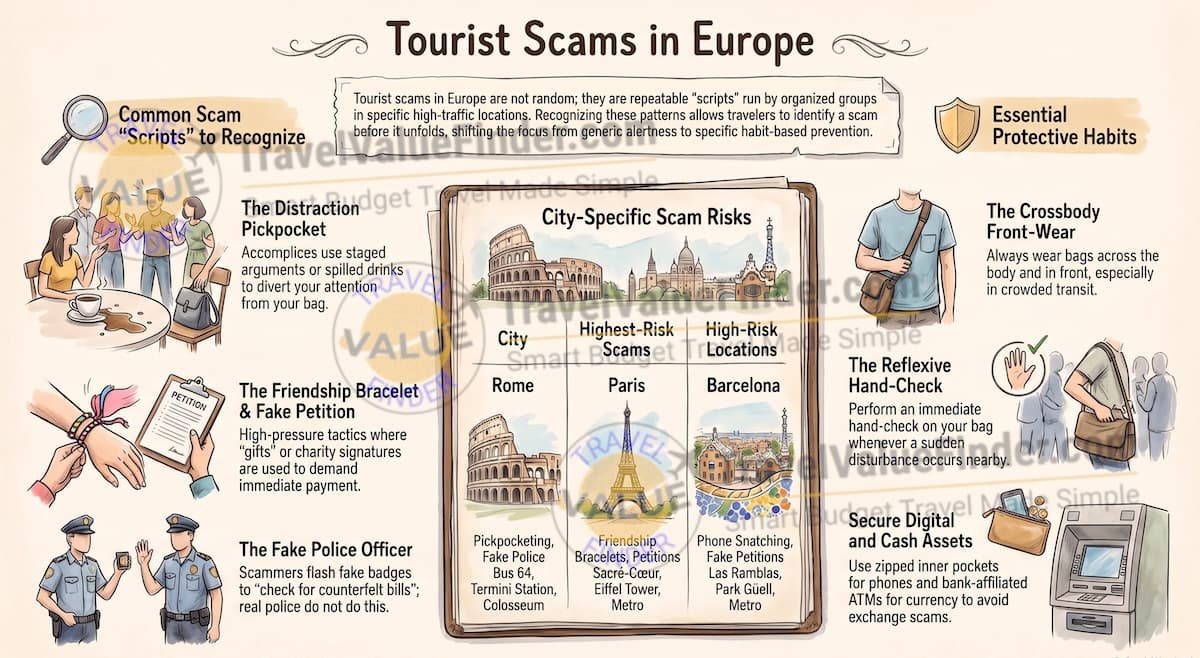
Tourist scams in Europe cluster around a small set of repeatable tactics:
- distraction pickpocketing on crowded public transport,
- the friendship bracelet and fake petition scams near major landmarks,
- taxi overcharging, and
- restaurant menu switches, concentrated in Rome, Barcelona, Paris, and Prague specifically.
The U.S. State Department rates Italy, France, and Spain all Level 2 for pickpocketing risk in crowded tourist areas and public transport, the same specific pattern behind most of the scams below.
Leslie Nics, TravelValueFinder.com | Last updated: Aug 2026 | Based on first-hand experience and current government advisory research
Every list of tourist scams in Europe reads the same way: a bullet-point list of tactics with no real account of how they actually happen.
I got caught by one : the classic Rome Bus 64 distraction pickpocketing move, and the gap between reading about a scam and actually walking into one taught me more than any warning list ever did.
This guide is built around that gap: the specific mechanics of each scam, exactly how it unfolds in real time, and because most warning lists stop at ‘be careful’ but what actually stops it.
Here’s what most scam-warning content gets backwards: it treats every scam as equally random, when in practice these are repeatable, well-documented tactics run by organized groups in the same handful of locations, over and over, on thousands of tourists a year.
That’s actually good news for prevention. A scam that follows a script can be recognized before it finishes playing out, which is a very different task than staying generically “alert” for eight hours a day on vacation.
Table of Contents
Tourist Scams in Europe: What the Official Advisories Actually Say
Before the specific scams, it’s worth grounding this in something other than blog-post anecdotes.
The U.S. Department of State rates Italy, France, and Spain all Level 2: “Exercise Increased Caution”, and pickpocketing is named as the primary, specific concern in all three advisories, concentrated in crowded tourist areas and public transport.
| Country | Advisory Level | Specific Pickpocketing Notes |
| Italy | Level 2 | Organized groups operate at major tourist sites, train stations, bars, and cafes; thieves on scooters snatch bags from pedestrians |
| France | Level 2 | Pickpocketing and phone theft common in airports, subways, tourist attractions, and train stations |
| Spain | Level 2 | Pickpocketing concentrated in the most crowded tourist areas of major cities |
That’s not a warning specific to any one city. It’s the same structural pattern across three of Europe’s most-visited countries, which is exactly why the scams below repeat with such consistency from Rome to Barcelona to Paris.
What Actually Happened on Bus 64
Rome’s Bus 64, running from Termini station to St. Peter’s Basilica, has such a reputation among pickpockets it’s nicknamed the “Wallet Eater” locally.
Here’s the mechanics, from the inside: the bus gets genuinely packed at midday, tourist bags pressed against strangers on all sides.
One person creates a small disturbance, and in my case, an apparent argument breaking out a few feet away, and in the three or four seconds everyone’s attention shifts toward it, a second person works the crowd from behind.
I felt a hand brush my bag and assumed it was just the crowd. It wasn’t until I checked ten minutes later that I realized the outer pocket zipper was open and my phone was gone. The distraction wasn’t an accident, it was the whole scam. – Leslie Nics, Founder & Lead Travel Writer, TravelValueFinder.com
The lesson isn’t “avoid Bus 64”. It’s a legitimate, useful route to St. Peter’s. The lesson is recognizing that any sudden disturbance in a crowded space is worth a reflexive hand-check on your own bag, every single time, not just when something feels obviously wrong.
The Scams: What They Actually Look Like
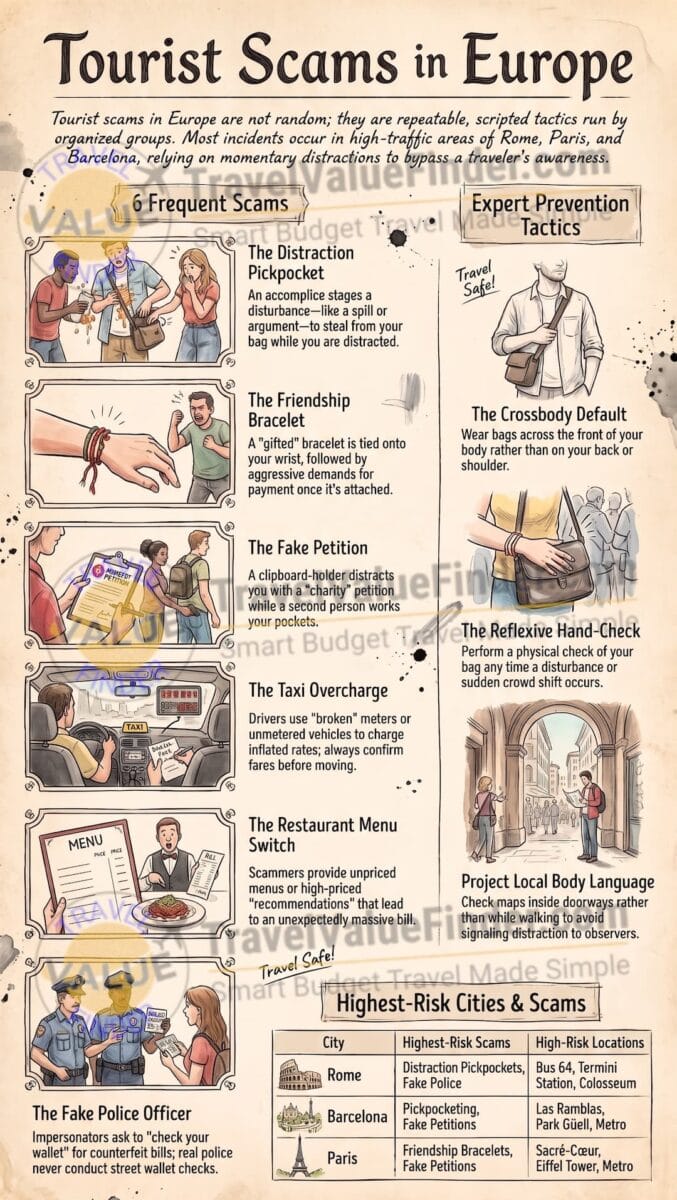
The Distraction Pickpocket (Rome, Barcelona, Paris – crowded transit)
A staged argument, a spilled drink, someone “helping” you with a stuck subway gate, or a street performance drawing a crowd, all created specifically to get your hand off your bag for a few seconds while a second person works the crowd.
The Friendship Bracelet (Paris — Sacré-Cœur, major landmarks)
Someone ties a bracelet onto your wrist “as a gift” before you can decline, then demands payment once it’s on: a classic bait-and-guilt tactic concentrated specifically around Montmartre and Sacré-Cœur.
The Fake Petition (Paris, Barcelona – near major attractions)
A clipboard-holder asks you to sign a petition for a charitable cause; while you’re distracted signing, an accomplice works your bag or pockets, or the “charity” itself is fake and the signature becomes a donation demand.
The Taxi Overcharge (most major cities)
An unmetered or “broken meter” taxi, or a driver taking a deliberately long route from the airport; Always confirm the meter is running before the car moves, or use an app-based rideshare with a fixed, visible fare instead.
The Restaurant Menu Switch (tourist-zone restaurants, most cities)
A different, unpriced menu appears for tourists, or a “recommended” off-menu dish arrives with a wildly inflated bill: Always confirm prices verbally before ordering anything not clearly priced on a physical menu.
The Fake Police Officer (Barcelona, Rome – near tourist sites)
Someone flashing a fake badge asks to “check your wallet for counterfeit bills”: A real police in these countries do not conduct wallet checks on the street. Ask to see ID, offer to walk to the nearest police station instead, and never hand over your wallet directly.
City-by-City: Where Each Scam Concentrates
| City | Highest-Risk Scams | Highest-Risk Locations |
| Rome | Distraction pickpocketing, fake police | Bus 64, Termini station, the Colosseum area |
| Barcelona | Distraction pickpocketing, fake police, fake petitions | Las Ramblas, Park Güell, the metro |
| Paris | Friendship bracelets, fake petitions, phone snatching | Sacré-Cœur/Montmartre, the metro, Eiffel Tower area |
| Prague | Currency exchange scams, taxi overcharging | Wenceslas Square, Old Town Square exchange booths |
The Currency Exchange Bait-and-Switch (Prague especially)
A currency exchange booth advertises an eye-catching rate in large letters, but the fine print reveals a steep commission or a much worse effective rate once you’re at the counter — a pattern concentrated specifically around Prague’s Old Town Square and Wenceslas Square exchange booths.
Use a bank-affiliated ATM or a booth with a clearly posted, no-commission rate instead, and always confirm the exact amount you’ll receive before handing over cash. It is a good idea to carry a WISE card with you with low international exchange rate, and fees.
How Scammers Actually Pick Their Targets
This is worth understanding, because it changes what “being careful” actually means in practice.
Pickpockets and scam operators aren’t targeting tourists randomly.
They’re reading specific, visible signals: a phone held loosely while checking a map, a bag worn on the back in a crowd, distracted body language while looking up at a landmark, or an open, unattended purse pocket.
Confident, aware body language is itself a real deterrent, not just a feeling.
- A phone or map checked while walking, rather than stopped safely against a wall or in a doorway, signals distraction.
- A bag worn on the back, rather than crossbody in front, is a visible, low-effort target.
- Standing still, looking up at a landmark with a bag unattended at your side, is a common moment operators specifically watch for.
I’ve since noticed how much of this comes down to reading a crowd the way a local does, not a tourist — where a scam operator stands, how they watch entrances rather than the landmark everyone else is looking at. – Leslie Nics, Founder & Lead Travel Writer, TravelValueFinder.com
What Actually Stops These Scams
- A crossbody bag worn in front of your body, not on your back or shoulder. This is the single most effective, lowest-effort change you can make.
- A reflexive hand-check on your bag any time a disturbance happens near you in a crowd, staged or genuine.
- Keeping your phone in a zipped inner pocket rather than a back pocket or open bag pouch, especially on public transport.
- Declining any unsolicited physical contact: a bracelet, a “free” flower, a hand on your arm before it’s already happened, not after.
- Confirming a taxi meter is running, or booking through a rideshare app with a fixed fare, before the car leaves the curb.
- Carrying a card with no or low foreign transaction fees as backup, so a lost or stolen wallet isn’t also an expensive currency-conversion problem.
How I Would Travel The Next Time
I’d wear my bag crossbody and in front by default on any crowded bus or metro, not just when I consciously remember to think about it. The whole point of these scams is that they work in the moments you’re not actively on guard.
The mistake I’d flag loudest isn’t riding Bus 64. It’s assuming a busy, ordinary-feeling crowd is automatically a safe one. The crowd is the scam’s cover, not an accident of timing.” Leslie Nics, Founder & Lead Travel Writer, TravelValueFinder.com
The Newer Scams: Digital and QR Code Tactics
Scam tactics evolve, and a few newer patterns are worth knowing specifically because most older warning content doesn’t cover them yet.
Fake public Wi-Fi networks named to look official (“Airport_Free_WiFi” instead of the real network name) can intercept unencrypted traffic: stick to networks confirmed by staff, or use a VPN as a backup.
Fake QR codes placed over legitimate ones on restaurant tables or parking meters redirect to a fraudulent payment page. Check that a QR code sticker isn’t visibly placed over another one before scanning, and verify the URL it opens before entering any payment details.
- Confirm a Wi-Fi network name directly with staff rather than joining whatever looks closest to the venue’s name.
- Inspect QR codes for signs of a sticker placed over an original: a slightly different texture or a crooked placement are both red flags.
- Never enter card details on a payment page reached via a scanned QR code without checking the URL matches the venue’s actual name.
If It Happens to You Anyway
- File a police report immediately, even for a minor theft: most travel insurance claims require one, and it’s needed for a replacement passport if that was taken.
- Cancel and freeze cards immediately through your bank’s app or a call: most major US banks have 24/7 international fraud lines.
- Contact the nearest U.S. embassy or consulate if your passport was stolen: they can issue an emergency replacement, typically within a day or two.
- File a claim with your travel insurance provider promptly: most require documentation (the police report) within a specific window, often 24-72 hours.
Lastly, I don’t think you should be deterred from visiting Europe. It is certainly worth exploring, but as with anywhere else, it’s important to remain cautious and know how to recognize and avoid scams.
Find Out More About Visiting These Cities
- Rome Travel Guide
- Transportation in Rome
- Barcelona Travel Guide
- Getting Around Paris
- Paris Itinerary for First-Time Visitors
- What to Do in Athens, Greece
- Travel Insurance Guide
- No Foreign Transaction Fee Credit Card
You May Be Interested In
- Barcelona vs Madrid
- Best Greek Islands to Visit
- Find out how My Bag Didn’t Make It to Lisbon : What I Actually Got Back Under the Montreal Convention
- I Got Altitude Sick on My First Night in Mexico City: Here’s What I Wish I’d Known
People Also Ask
What are the most common tourist scams in Europe?
Distraction pickpocketing on crowded transit, the friendship bracelet scam, fake petitions, taxi overcharging, and restaurant menu switches account for the large majority of tourist-targeted scams across Rome, Barcelona, Paris, and Prague.
Is Rome’s Bus 64 really known for pickpocketing?
Yes, it’s a well-documented route between Termini station and St. Peter’s Basilica with a longstanding local reputation for organized pickpocketing, particularly when crowded at midday.
How do I avoid pickpockets in Europe?
Wear a crossbody bag in front of your body, keep your phone in a zipped inner pocket, and do a reflexive bag-check any time a disturbance happens near you in a crowd.
What should I do if I get pickpocketed in Europe?
File a police report immediately, cancel and freeze your cards, contact the nearest U.S. embassy if your passport was taken, and file a travel insurance claim promptly with the police report as documentation.
FAQ
Are fake police officers a real scam in Europe?
Yes, particularly in Barcelona and Rome. A real police do not conduct wallet checks on the street. Ask to see ID and offer to walk to the nearest police station instead of handing over your wallet.
Is the friendship bracelet scam dangerous?
Not physically, but it’s a real financial scam. Someone ties a bracelet on your wrist before you can decline, then aggressively demands payment. Firmly declining before contact happens is the most effective response.
Should I avoid public transport in Rome, Paris, and Barcelona because of scams?
No, public transport is safe and practical in all three cities. The risk is specific and manageable with basic precautions (crossbody bag, awareness during crowding), not a reason to avoid transit entirely.
Do travel credit cards help if I’m scammed?
Yes, cards with no foreign transaction fees avoid extra costs on replacement purchases, and many travel cards include purchase protection or travel insurance that can help with a stolen-item claim.
What is the fake petition scam?
Someone asks you to sign a clipboard petition near a major attraction; while you’re distracted, an accomplice works your bag, or the “petition” itself becomes a high-pressure donation demand.
Sources
- U.S. Department of State, Italy Travel Advisory
- U.S. Department of State, France Travel Advisory
- U.S. Department of State, Spain Travel Advisory
Disclaimer: This article is for general informational purposes only and does not constitute financial, investment, tax, legal, immigration, or other professional advice. Costs and other figures are estimates and can change. Always verify current information and consult a qualified professional before making significant financial or retirement decisions.