Travel Value Finder

The best Greek islands to visit depend on what you’re after: Santorini for the caldera views and sunsets (but expect crowds and premium prices), Naxos for real sandy beaches and the most laid-back all-around island, and Milos for dramatic lunar-looking coastline with a fraction of Santorini’s crowds. A realistic first-timer itinerary is 3 islands in 9β10 days, connected by ferry – trying to cover more usually means spending more time in transit than on any single island.
Leslie Nics, TravelValueFinder.com | Last updated: July 2026 | Based on first-hand island-hopping research across the Cyclades
Everyone asks the same question before a Greece trip: what are the best Greek islands to visit? I asked it too, then spent 9 days actually island-hopping across the Cyclades – Santorini, Naxos, and Milos – to find out which islands earned their reputation and which ones are mostly Instagram.
Most “best Greek islands” lists are written by people ranking islands from a spreadsheet of photos, or by a single very experienced writer who’s visited them all but rarely tells you what a specific route actually costs or how the ferry logistics really work. This guide does both: a real comparison of three islands I visited back to back, plus the ferry math and daily costs most lists skip entirely.
Here’s what nobody tells you going in: picking “the best” Greek islands isn’t really a ranking problem, it’s a routing problem. Greece has well over 200 inhabited islands, and the honest answer to “which are the best” depends entirely on how many days you have, which port you’re flying into, and how much ferry time you’re willing to trade for how much time actually on a beach.
A list of the 15 prettiest islands in the country is not the same thing as a workable itinerary, and conflating the two is where most first-time trips go sideways
.
Best Greek Islands to Visit: My 9-Day Itinerary and What I’d Change
Here’s the route: 3 nights Santorini, 3 nights Naxos, 3 nights Milos, connected entirely by ferry out of Piraeus and between islands. Greece has more than 200 inhabited islands, so picking 3 out of that number is really the entire challenge – and it’s the part almost no list actually walks you through.
Island-by-Island Breakdown
| Santorini | Naxos | Milos | |
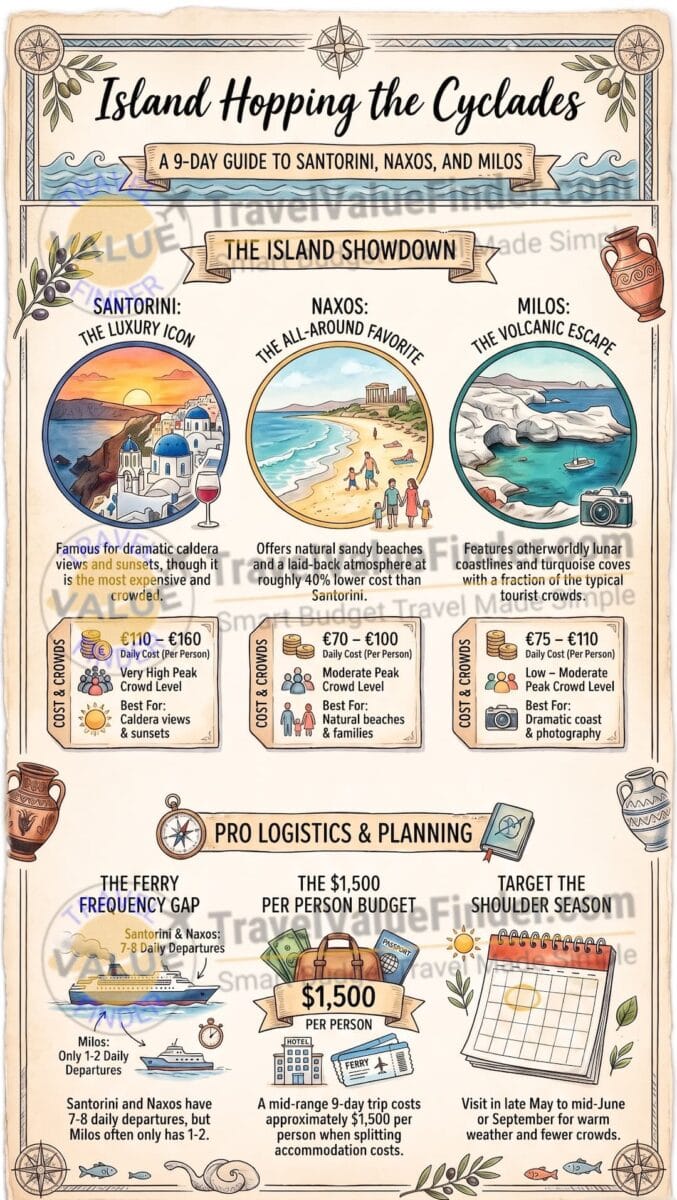
| Est. daily cost (mid-range, per person) | β¬110ββ¬160 | β¬70ββ¬100 | β¬75ββ¬110 |
| Crowd level (peak summer) | Very high | Moderate | Lowβmoderate |
| Ferry frequency from Piraeus | Up to 8/day in summer | Up to 7/day in summer | Only 1β2/day, even in summer |
| Best for | Caldera views, sunsets, honeymoons | Real beaches, families, all-around ease | Dramatic coastline, fewer crowds, photography |
Why Each Island Made the Cut
Santorini earns its reputation honestly – the caldera views really are that dramatic, and watching the sunset from a cliffside terrace in Oia is one of those rare travel moments that lives up to the photos. What the photos don’t show is the crowd standing shoulder to shoulder with you to watch it, or the taxi line afterward. It’s worth one visit; it’s not the island to build an entire trip’s pacing around.
Naxos was the biggest surprise of the trip. It has real, wide, natural sand beaches – genuinely rare in a region better known for pebble coves and cliffside views – a walkable, low-key main town, and a slower rhythm than Santorini or Mykonos. It’s also the least “Instagram famous” of the three, which is exactly why it doesn’t feel overrun.
Milos looks almost otherworldly – lunar-white rock formations, turquoise coves you mostly reach by boat, and a fraction of Santorini’s tourist traffic. The trade-off, covered in detail below, is that getting there and away takes real planning because of how infrequently ferries run.
Santorini is beautiful and it’s also the most expensive, most crowded island on this list by a wide margin. Nobody tells you that going in – they just show you the sunset photo. – Leslie Nics, Founder & Lead Travel Writer, TravelValueFinder.com
The Ferry Logistics Nobody Actually Breaks Down
This is the section I think matters most and see covered least. Every “best Greek islands” list assumes you already know how to get between them. In practice, ferry frequency varies enormously by island, and that variance should genuinely shape your itinerary – not just your budget.
| Route | Conventional Ferry | High-Speed Ferry | Notes |
| Piraeus β Santorini | β¬46.50+, 5β11 hrs | Seajets only, ~5 hrs | Up to 8 daily departures in summer |
| Piraeus β Naxos | β¬52.50+, ~5.5 hrs | β¬62.70ββ¬67.70+, ~4 hrs | Up to 7 daily departures in summer |
| Piraeus β Milos | β¬42+, ~7 hrs direct (varies by routing) | Limited | Only 1β2 daily departures – book ahead |
Milos is the one that catches people off guard. Santorini and Naxos both run up to 7β8 direct departures a day from Piraeus in peak summer, which means real flexibility if plans shift. Milos runs 1β2 a day, even in August – miss it, and you’re not getting there same-day. That single fact should influence whether Milos goes early or late in your route, not just whether it’s on the list at all.
Reality Check Ferry schedules for the upcoming season are typically announced by operators in March each year, and can shift closer to departure. Book flexible or refundable fares if your itinerary depends on a specific island with limited daily service, and always add a buffer day before a flight home rather than scheduling a same-day connection.
Booking Tips That Actually Matter
- Book Milos-bound ferries as early as your dates are confirmed – with only 1β2 daily departures, the convenient time slots sell out first, not last.
- Conventional (slower) ferries are meaningfully cheaper than high-speed ones on the same route, and the extra hour or two on deck watching the Aegean go by is, honestly, part of the experience rather than a cost to minimize.
- Arrive at Piraeus at least an hour before departure in summer – the port gets genuinely crowded, and boarding for popular routes starts well before the posted departure time.
- Pack light enough to carry your own bags up a gangway – porter help isn’t guaranteed at every port, and cobblestone streets in most island towns aren’t wheeled-luggage-friendly.
Real Daily Spend by Island
| Category | Santorini | Naxos | Milos |
| Mid-range double room | β¬180ββ¬280/night | β¬90ββ¬140/night | β¬100ββ¬150/night |
| Casual taverna dinner for two | β¬45ββ¬70 | β¬30ββ¬45 | β¬30ββ¬45 |
| Beach/day activity | β¬25ββ¬60 (boat tours common) | Freeββ¬20 (mostly natural beaches) | β¬15ββ¬40 (boat tour to see coastline) |
| Local transport (bus/ATV rental) | β¬20ββ¬35/day | β¬15ββ¬25/day | β¬15ββ¬25/day |
Santorini’s premium isn’t really about better quality – it’s about paying for the view and the reputation. Naxos delivers a genuinely comparable island experience, real sandy beaches included, at roughly 40% less across the board.
What the Full 9-Day Trip Actually Cost
Putting the per-island numbers together into one real trip total, for a mid-range single traveler and a couple splitting hotel costs:
| Category | Single Traveler | Couple (total) |
| Ferries (Piraeus β Santorini β Naxos β Milos β Piraeus) | β¬210 | β¬420 |
| Accommodation, 9 nights (mid-range, 3 islands) | β¬1,080 | β¬1,350 |
| Food (all meals, 9 days) | β¬360 | β¬620 |
| Activities, tours, local transport | β¬250 | β¬400 |
| Total | β β¬1,900 | β β¬2,790 |
That’s roughly $2,050 per person solo, or $1,500 per person traveling as a couple – genuinely comparable to, and often cheaper than, a week in a major US or Western European city once flights are excluded, which is worth knowing before assuming Greek island hopping is automatically a splurge trip.
Ready to book? Compare real-time flight and hotel prices through our trusted search partner. We earn a small commission at no extra cost to you, which helps keep guides like this one free.

Common Mistakes First-Timers Make
- Front-loading the itinerary with Santorini and Mykonos, then treating the quieter islands as an afterthought – the reverse pacing usually makes for a more relaxing trip.
- Booking the cheapest, latest possible ferry to Milos on the last day of the trip, with a flight the next morning – the single riskiest scheduling decision on a Cyclades itinerary given how few daily departures exist.
- Assuming every island has walkable, wheeled-luggage-friendly streets the way Naxos Town mostly does – several island towns, including parts of Santorini’s cliffside villages, involve stairs and cobblestones that make large suitcases a real liability.
- Skipping travel insurance on a multi-island ferry itinerary, where a single weather delay can cascade into missed onward connections.
Which Islands to Skip on a First Trip
Not skip forever – skip on a first trip, when time and ferry connections are already tight:
- Mykonos, if budget or a quieter pace matters more than nightlife and beach clubs – it’s a genuinely different island experience than the Cyclades’ quieter side, and mixing the two in one short trip usually shortchanges both.
- Crete, on a first Cyclades-focused trip – it’s less an island stop than its own week-long destination, with a different ferry network and character entirely.
- Any island reachable only by a single weekly ferry, unless it’s the anchor of your whole trip – the schedule risk isn’t worth it for a 1β2 night stop.
If You Have More Time: Other Islands Worth Knowing About
Three islands is a realistic pace for a first 9β10 day trip, but Greece rewards a second and third visit with an entirely different itinerary. A few worth knowing about for next time:
| Island | Known For | Best For |
| Paros | Naoussa’s harbor town, windsurfing | A quieter Mykonos alternative with easy ferry access |
| Mykonos | Nightlife, beach clubs, design hotels | Travelers prioritizing nightlife and shopping over budget |
| Crete | Minoan history, Samaria Gorge, diverse regions | A full week-plus trip on its own, not a quick add-on |
| Rhodes | Medieval Old Town, castle architecture | History-focused travelers, easy Dodecanese access |
| Hydra | Car-free island, artistic stone architecture | A calm day trip or overnight near Athens |
Crete deserves a specific callout here: it’s frequently lumped into “best Greek islands” lists alongside Cyclades stops like Santorini and Naxos, but it’s genuinely closer to its own country in scale – different regions, different ferry network, different pace entirely. Treat it as its own trip rather than a stop to squeeze into a Cyclades itinerary.
Packing and Practical Tips for Island Hopping
- A soft-sided duffel or backpack beats a hard-shell suitcase for cobblestone streets and ferry gangways – this cluster’s Europe Packing List covers the specifics.
- Bring a portable phone charger; port wait times and ferry boarding can eat battery fast right when you need your e-ticket pulled up.
- Pack a light layer even in summer – Aegean ferry decks get genuinely windy and cooler than the island heat suggests.
- Comfortable, closed-toe walking shoes matter more than sandals for the steep, sometimes uneven paths in Santorini’s cliffside villages and Milos’s coastal trails.
Starting Point: Why Athens Deserves More Than a Layover
Almost every island-hopping itinerary starts and ends in Athens, and almost every list treats it as a place to sleep off jet lag before the “real” trip begins. That undersells it. Piraeus, the port most Cyclades ferries depart from, sits close enough to central Athens that a day or two in the city before island-hopping is a genuinely easy add rather than a detour.
Practically, it also solves a real logistics problem: flights from the US land in Athens, not directly on the islands, so building in a night or two before your first ferry gives you a buffer against delayed luggage or a late arrival – exactly the kind of buffer this guide’s ferry logistics section recommends building in on the other end of the trip too.
Best Time to Island Hop
Late May through mid-June, and September through early October, hit the sweet spot: warm enough to swim, meaningfully fewer crowds than JulyβAugust, and ferry schedules still running near their full summer frequency.
July and August bring the highest prices, the fullest ferries, and the longest lines – worth it if those are your only dates, but not the trip to plan around if your schedule has any flexibility at all.
| Season | Weather | Crowds & Prices | Ferry Frequency |
| Late Mayβmid June | Warm, reliably swimmable | Noticeably lower than peak | Near-full summer schedule |
| JulyβAugust | Hot, peak Aegean sun | Highest of the year on both counts | Maximum daily departures |
| Septemberβearly October | Still warm, sea still warm from summer | Dropping fast after early September | Near-full summer schedule |
| NovemberβApril | Cool, often rainy, some islands quiet down | Lowest, but many businesses close for the season | Reduced – some routes drop to a few times weekly |
Money-Saving Tips That Don’t Cost You the Experience
- Choose Naxos or Milos over Santorini or Mykonos as your primary base, and treat the pricier island as a shorter 2-night stop rather than the anchor of the trip.
- Book conventional ferries instead of high-speed where the schedule allows – the price difference is real and the extra time on deck is genuinely part of the experience, not a downside.
- Eat where the ferry crews and locals eat, generally a short walk from the harbor-front strip built for cruise-ship day-trippers – the price difference between the two is often 30β40% for a comparable meal.
- Travel shoulder season (late Mayβmid June or September) for meaningfully lower accommodation rates without giving up swimmable weather.
- Split accommodation costs by traveling as a couple or small group – Greek island rentals price by the room or apartment, not per person, so the savings compound quickly.
What I’d Do Differently
I’d put Milos second in the route, not last – its limited ferry frequency makes it the riskiest island to leave for the end of a trip with a flight to catch. I’d also book one extra buffer night in Athens before flying home rather than a same-day ferry-to-flight connection, given how easily Aegean crossings can run late in choppy weather.
The mistake I’d flag loudest isn’t which islands I picked – it’s scheduling Milos last with only one ferry a day standing between me and my flight home. – Leslie Nics, Founder & Lead Travel Writer, TravelValueFinder.com
Find Out More About Visiting Greece
- Greece Travel Guide
- What to Do in Santorini, Greece
- Where to Stay in Santorini: Best Areas for First-Time Visitors
- What to Do in Athens, Greece
- Where to Stay in Athens
- Cheap Hotels in Santorini Under $150
- Cheap Hotels in Athens Under $100
- How Much Does a Greece Trip Cost?
- Europe Packing List
- How to Travel Europe on a Budget
- Travel Insurance Guide
You May Be Interested In
- Best Caribbean Islands to Visit
- Best Travel Credit Cards
- Solo Travel Tips
- What Nobody Tells You About Retiring in Greece
People Also Ask
What is the best Greek island to visit for the first time?
Naxos is the easiest all-around first Greek island – real sandy beaches, a walkable main town, and lower costs than Santorini or Mykonos, without sacrificing the classic Cycladic look.
How many Greek islands should I visit in one trip?
3 islands in 9β10 days is a realistic pace that leaves time to actually enjoy each stop. Adding more islands usually means more time spent in ferry terminals than on any single beach.
Is it better to fly or take a ferry between Greek islands?
Ferries are cheaper, more frequent, and the more traditional way to island-hop; flights (mainly to/from Athens, Santorini, and Mykonos) make sense mainly to save time on a tight schedule or to reach islands with limited ferry service.
Which Greek island is cheapest to visit?
Naxos and Milos both run roughly 30β40% cheaper than Santorini for comparable mid-range accommodations and dining, without a major drop in scenery or beach quality.
FAQ
How many days do I need for Greek island hopping?
At least 9β10 days for 3 islands, including ferry transit time. Shorter trips are better spent on 1β2 islands rather than rushing between three.
What is the best way to travel between Greek islands?
Ferry, almost always – Blue Star Ferries and Seajets are the two main operators serving the Cyclades, with conventional (cheaper, slower) and high-speed (pricier, faster) options on most routes.
Is Santorini worth the hype?
Yes, for the caldera views and sunsets specifically – but go in expecting the highest prices and largest crowds of any island on a typical Cyclades itinerary, and consider pairing it with a quieter island like Naxos or Milos to balance the trip.
What is the best month to visit the Greek islands?
Late May to mid-June, or September to early October – warm enough to swim, meaningfully fewer crowds than peak summer, and ferry schedules still running near full frequency.
Can you island hop in Greece on a budget?
Yes, choosing Naxos and Milos over Santorini and Mykonos, booking conventional rather than high-speed ferries, and traveling in shoulder season can cut a typical island-hopping budget by 30β40%.
Sources
- Visit Greece – Official Greek National Tourism Organisation
- U.S. Department of State – Greece Travel Advisory
About the Author
Leslie Nics is the founder and lead researcher at TravelValueFinder.com, where the focus is always on what things actually cost – not what the brochure says they cost. Read more on the About page or see the site’s Trust & Transparency Policy.