Travel Value Finder

This guide on how to travel Europe on a budget covers everything you need;
- the cheapest countries to visit,
- how to find affordable flights and accommodation,
- how to eat well without overspending, and
- how to get around using budget rail and bus passes.
Whether you are a first-time backpacker or a retiree looking to stretch your pension across Europe, these strategies work.
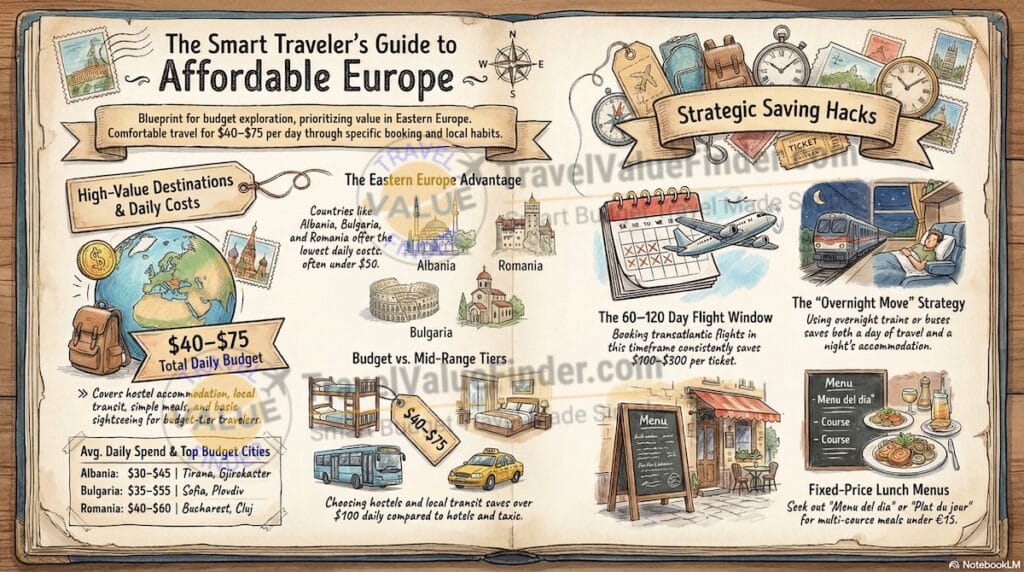
I can tell you with confidence that with the right strategy, you can explore Europe comfortably for as little as $50 – $80 per day.
I have spent considerable time traveling through Western and Eastern Europe on a tight budget. I have stayed from hostels in Lisbon to overnight trains through the Balkans.
Disclaimer: This article is for general informational purposes only and does not constitute financial, investment, tax, legal, immigration, or other professional advice. Costs and other figures are estimates and can change. Always verify current information and consult a qualified professional before making significant financial, travel, or retirement decisions.
Leslie Nics, TravelValueFinder.com | Last updated: September 2026 | Based on first-hand research across 15+ European countries
Looking for cheap flights to get to Europe? Read our companion guide: How to Find Cheap Flights: 12 Proven Strategies That Actually Work.
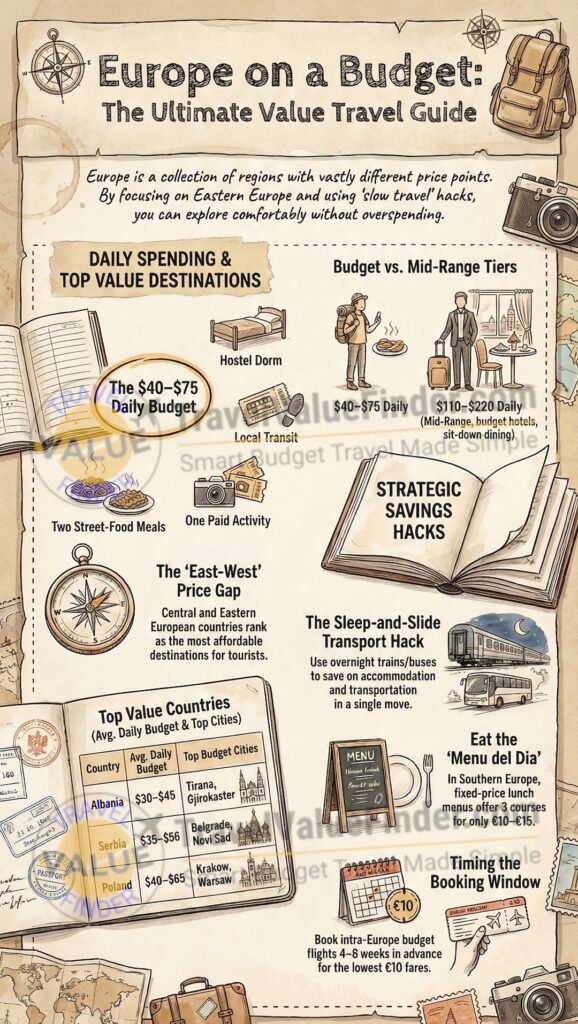
Europe is not one destination. It is dozens of them, each with its own price tag. The secret is knowing which ones offer the best value for money. Leslie Nics, TravelValueFinder.com
Table of Contents
Travel Europe on a Budget: Key Facts at a Glance
| Category | Budget Tier | Mid-Range Tier |
| Daily accommodation | $15 – $35 (hostel dorm) | $60 – $120 (budget hotel) |
| Daily food | $15 – $25 | $30 – $60 |
| Transport (per day avg.) | $5 – $15 (local transit) | $20 – $40 |
| Activities | $5 – $15 (free sights + 1 paid) | $20 – $40 |
| Total per day | $40 – $75 (budget) | $110 – $220 (mid-range) |
Cheapest Countries to Visit in Europe (2026 Rankings)
Not all of Europe costs the same.
Western Europe (France, Switzerland, Norway, the UK) is significantly more expensive than Central and Eastern Europe.
According to Numbeo’s Cost of Living Index 2026, Eastern European countries consistently rank among the world’s most affordable destinations for tourists.
| Country | Avg. Daily Budget | Best Budget Cities | Why It’s Cheap |
| Albania | $30 – $45/day | Tirana, Gjirokaster | Undiscovered, very low prices |
| North Macedonia | $30 – $50/day | Skopje, Ohrid | Off the tourist trail |
| Serbia | $35 – $55/day | Belgrade, Novi Sad | Vibrant nightlife, cheap food |
| Bulgaria | $35 – $55/day | Sofia, Plovdiv | Low cost of living |
| Romania | $40 – $60/day | Bucharest, Cluj | Incredible food and history |
| Hungary | $45 – $70/day | Budapest | Great thermal baths and food |
| Poland | $40 – $65/day | Krakow, Warsaw | Rich culture, low prices |
| Portugal | $50 – $75/day | Lisbon, Porto | Affordable by Western standards |
| Greece | $55 – $80/day | Athens, Thessaloniki | Cheap outside the islands |
| Spain | $60 – $90/day | Madrid, Seville | Cheap tapas and hostels |
Costs are estimates for a budget traveller staying in hostels, using public transport, and eating a mix of self-catered and local restaurant meals. Source: Numbeo Cost of Living Index 2026.
How to Find Cheap Flights to Europe
Getting to Europe is often the single biggest expense of your trip, but it does not have to be.
We have a full dedicated guide to booking cheap flights, but here are the key principles that apply specifically to European routes.
Use the Right Search Tools
For Europe flights, these are the most reliable tools:
- Google Flights: Use the Date Grid view and Price Calendar to see fares across an entire month at a glance.
- Skyscanner: Use ‘Whole Month’ search and ‘Search Everywhere’ to find the cheapest European entry point.
- Kiwi.com: Best for combining budget airlines into one itinerary, including self-transfer routes
- Momondo: Often surfaces fares that Google Flights misses. Worth a cross-check.
Book at the Right Time
For transatlantic flights from North America to Europe, the optimal booking window is 60 – 120 days ahead.
For flights within Europe, budget carriers release their cheapest seats 4 – 8 weeks before departure.
According to research by CheapAir’s Annual Airfare Study, the average saving from booking in the prime window versus too early or too late is $100 – $300 on international routes.
Use Budget Airlines Within Europe
Once in Europe, budget carriers make internal travel extremely affordable:
- Ryanair: Largest European budget network; fares from €10 one-way. Check baggage rules carefully before booking
- EasyJet: Strong for UK, France, Spain, Italy and Switzerland routes
- Wizz Air: Dominant in Central and Eastern Europe; excellent for Balkans routes
- Transavia: Good for Portugal, Morocco and French domestic routes
For the complete flight-booking system with 12 strategies including error fares, price alerts, and points and miles, see our full guide: How to Find Cheap Flights: 12 Proven Strategies That Actually Work.
Shifting a Friday flight to Tuesday consistently saves me more than any other single change I make when booking Europe trips. Date flexibility is the most powerful tool a budget traveller has. Leslie Nics, TravelValueFinder.com
Budget Accommodation in Europe: Your Best Options
Hostels
Hostels remain the gold standard for budget travelers.
A dorm bed in Western Europe typically costs $20 – $40 per night. In Eastern Europe, quality dorms run $10 – $20.
Modern hostels in cities like Lisbon, Budapest, and Krakow often have private rooms at rates that rival budget hotels, and the social atmosphere is unmatched.
What to look for in a hostel:
- Free breakfast; can save $8 – $12 per day,
- Lockers with your own padlock.
- A communal kitchen for self-catering.
- Central location to reduce transport costs.
- Strong recent reviews on Hotels.com or Booking.com.
Where to Stay and Budget Hotels in Europe
For solo travelers or couples who prefer a private room, budget hotels in Eastern and Southern Europe frequently come in under €80 per night outside peak season.
Our where to stay hotel guides list hand-picked affordable options in every major city:
- Where to stay in Paris
- Where to stay in Rome
- Where to stay in Florence
- Cheap Hotels in Amsterdam
- Cheap Hotels in Barcelona
- Best Budget Hotels in London
- Where to stay in Budapest
- Where to stay in Athens
Alternative Accommodation
- Couchsurfing: Free stays with locals. Requires planning ahead and a verified profile
- Airbnb: Cost-effective for groups of 3+ splitting a flat. Compare nightly rate vs. hostel beds
- Workaway: Work a few hours per day in exchange for free room and board. Excellent for slow travelers
- HelpX: Similar to Workaway. Strong in rural Europe and for farm stays
Getting Around Europe: Rail Passes, Buses and More
Is the Eurail Pass Worth It?
The Eurail Global Pass provides unlimited train travel across 33 European countries.
It makes financial sense if you are covering a lot of ground quickly. Particularly if you include high-speed rail routes that would otherwise cost $60 – $150 per trip.
For slower travel (fewer than 4 countries in 3 weeks), individual point-to-point tickets are usually cheaper.
| Travel Method | Best For | Approx. Cost |
| Eurail Global Pass | Multi-country, fast travel | From $600 (15-day) |
| Point-to-point train | 1 – 2 country trips | $20 – $150 per route |
| FlixBus / Eurolines | Budget, flexible routes | $5 – $40 per route |
| Budget airline | Long distances quickly | $10 – $80 per flight |
| Overnight train/bus | Saves a night’s accommodation | $30 – $90 |
Key Transport Resources
- Eurail: Official rail pass site; compare pass types and check coverage maps
- Trainline: Book individual European train tickets across 45+ countries in one place
- FlixBus: Europe’s largest budget bus network; extensive Eastern European routes
- Rome2Rio: Compares all transport options (train, bus, fly, ferry) between any two points in Europe with prices
- Omio: Books trains, buses and flights across Europe in one place; good price comparison
How to Eat Well in Europe on a Budget
Food can be one of the most flexible parts of your travel budget, or one of the most expensive if you eat in tourist traps.
Here is how to eat like a local without spending like one:
- Shop at local supermarkets for breakfast and lunch; Lidl, Aldi, Mercadona (Spain), and Biedronka (Poland) are everywhere.
- Eat the ‘menu del dia’ or ‘plat du jour’. Fixed-price lunch menus in Spain, France, and Portugal offer 2 – 3 courses for €10 – €15.
- Street food and local market stalls are almost always better value than sit-down restaurants near tourist attractions.
- Cook in your hostel kitchen. Even one self-catered meal per day saves $10 – $15.
- Avoid restaurants on main tourist squares. Walk one or two streets away for dramatically lower prices
Average Meal Costs by Region
| Region | Budget Meal (café/street) | Sit-down Restaurant |
| Western Europe (Paris, London, Zurich) | $8 – $15 | $20 – $45 |
| Southern Europe (Spain, Portugal, Greece) | $5 – $12 | $12 – $30 |
| Eastern Europe (Poland, Romania, Bulgaria) | $3 – $8 | $8 – $18 |
For specific food guides at our covered destinations:
- Paris on a Budget: How to Save Money Without Missing Out
- Lisbon on a Budget: Cheap Things to Do, Eat and Stay
- What to Eat in Lyon: Must-Try Foods in France’s Food Capital
- Rome Food Guide: What to Eat, Where to Eat and Local Dishes
- Florence Food Guide: What to Eat for First-Time Visitors
- Lisbon Food: Cheap Eats and Affordable Dining Guide
- Travel for Food
Free and Cheap Things to Do in Europe
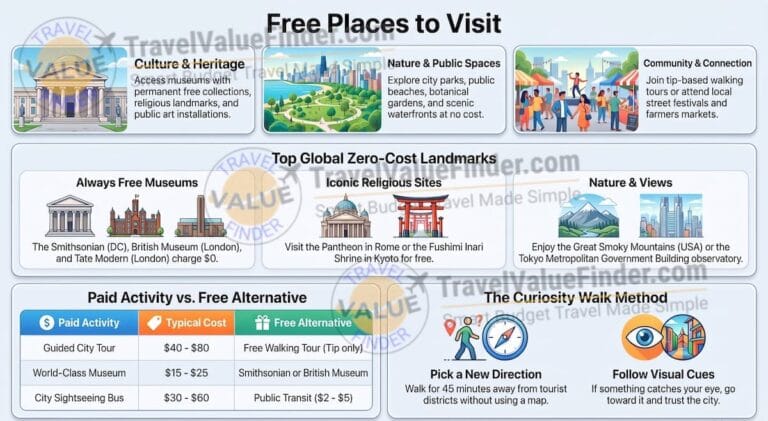
Europe’s best experiences are overwhelmingly free. Explore the Free Places to Visit: The Complete Guide for Every Destination.
The continent’s history, architecture, and public spaces are available to everyone. You do not need expensive tours to enjoy them.
- Free walking tours: available in virtually every major city. Guides work for tips. Search “free walking tour [city name]” or use GuruWalk or Free Tours by Foot to find them.
- Free museums: many major museums offer free entry on the first Sunday of the month. The British Museum and Tate Modern in London are permanently free.
- Public beaches: Southern and Eastern Europe have stunning coastlines with zero entry cost.
- Hiking and national parks: from Portugal’s Sintra to Romania’s Carpathians, use AllTrails to find free hiking routes near any city.
- Markets: food markets, flea markets, and Christmas markets are free to explore and offer authentic local culture
- City tourist cards: many cities offer combined transport and museum passes that provide good value if you plan to visit multiple paid attractions. Check Sightseeing Pass for comparisons
For things to do in specific cities:
- Top 10 Things to Do in Paris
- Top 10 Things to Do in Rome
- Best Things to Do in Nice, France
- Best Things to Do in Lyon, France
- What to Do in Athens, Greece
- What to Do in Santorini, Greece
- Top Things to Do in Florence
- Best Places to Visit in Venice
Getting Around Cities on a Budget
Transport within cities is one of the easiest costs to control.
Here is the general hierarchy from cheapest to most expensive:
- Walking: free, and often the best way to discover a city. European city centers are typically very walkable
- Public transport (metro, tram, bus): almost always the best value. Buy multi-day passes where available. Check our transport guides:
- Getting Around Paris: Metro, Buses and Walking.
- Transportation in Rome: Metro, Buses, Taxis and Airport Transfers.
- Transportation in Florence: How to Get Around.
- Lime and Bolt e-scooters are widely available across European cities. They are often cheaper than the metro for short trips.
- BlaBlaCar: Carpooling between cities; often cheaper than trains for medium-distance routes
Europe on a Budget Travel for Retirees and Over-50s
Europe is one of the most accessible and rewarding destinations for retiree travelers.
Many attractions offer senior discounts (typically for 60+ or 65+).
Public transport is often discounted, and the slower pace of ‘slow travel’. Spending a week or more in one place dramatically reduces daily costs.
- Senior rail discounts: most European rail operators offer 25 – 30% off for travelers 60+
- Museum senior rates: consistently 30 – 50% cheaper than adult tickets.
- Shoulder season travel (April – May, September – October) offers lower prices and more pleasant weather than peak summer.
- Renting a flat short-term is often cheaper than a hotel for stays of one week or more.
- Portugal, Spain, and Greece are particularly retiree-friendly with good healthcare, warm climates, and English widely spoken.
- See our article on how to travel by EURAIL for retirees.
Essential Budget Travel Tips for Europe: Quick Reference
- Always book accommodation in advance for peak season (June – August). Last-minute hostels fill fast and prices surge
- Get a no-foreign-transaction-fee credit card before you travel. Cards like the Chase Sapphire Preferred or Capital One Venture save the typical 3% foreign transaction fee on every purchase
- Use ATMs at banks, not tourist-area standalone ATMs. Check Wise for fee-free international money transfers and a borderless card
- Buy a local SIM card on arrival or use Airalo eSIMs for affordable data across Europe without swapping physical cards
- Download offline maps: Maps.me and Google Maps offline mode work well; data roaming costs can surprise you
- Pack a padlock for hostel lockers: most hostels provide lockers but not locks
- Pack carry-on only whenever possible: saves baggage fees on every budget airline flight. See Ryanair’s baggage policy before booking
- Get travel insurance: the cost of a medical emergency in Europe without it can run into thousands of euros. SafetyWing, World Nomads, and Hey Mondo are all reliable options for budget travelers
- Find out more about What Croatia Actually Costs: A Week in Dubrovnik and Split, Broken Down
Sample Itineraries for Europe on a Budget
2-Week Eastern Europe Budget Trip: ~$700 – $900 Total (excl. flights)
| Day Range | Destination | Estimated Daily Cost |
| Days 1 – 3 | Warsaw, Poland | $40 – $55/day |
| Days 4 – 6 | Krakow, Poland | $38 – $52/day |
| Days 7 – 9 | Budapest, Hungary | $45 – $65/day |
| Days 10 – 11 | Belgrade, Serbia | $35 – $50/day |
| Days 12 – 14 | Bucharest, Romania | $40 – $58/day |
Travel between cities by FlixBus or regional train. Stay in hostel dorms throughout. Budget approx. $50 – $65/day all-in.
Want a personalised day-by-day itinerary? Use our Free AI Trip Planner to generate a custom plan for any European destination in seconds.
3-Week Western Europe Budget Trip: ~$1,500 – $2,000 Total (excl. flights)
| Day Range | Destination | Estimated Daily Cost |
| Days 1 – 4 | Lisbon, Portugal | $55 – $70/day |
| Days 5 – 8 | Madrid, Spain | $60 – $80/day |
| Days 9 – 12 | Barcelona, Spain | $65 – $85/day |
| Days 13 – 15 | Nice / French Riviera | $70 – $95/day |
| Days 16 – 21 | Rome, Italy | $65 – $90/day |
Travel by budget airline and overnight trains. Mix of hostels and budget hotels. Budget approx. $70 – $95/day all-in.
The biggest mistake first-time Europe travelers make is overplanning. Budget two or three fewer countries than you think you can manage. You will spend less, stress less, and see far more. Leslie Nics, TravelValueFinder.com
Final Thoughts: Travel Europe on a Budget Is Entirely Achievable
Europe remains one of the most rewarding regions in the world to explore, and it does not have to cost a fortune.
With smart choices around when you go, where you stay, how you travel between cities, and where you eat, a daily budget of $50 – $80 is entirely realistic even in Western Europe.
The key is to approach Europe not as a single expensive destination, but as a continent full of wildly different price points.
Mix expensive cities like Paris or Rome with cheaper neighbors like Lisbon or Budapest.
Use overnight transport to save on accommodation. Eat where the locals eat.
Take advantage of the extraordinary wealth of free public spaces, beaches, and cultural sites.
Frequently Asked Questions on How to Travel Europe on a Budget
How much money do I need to travel Europe for 2 weeks?
For a budget traveler staying in hostels and using public transport, plan for $700 – $1,000 for Eastern Europe or $1,200 – $1,800 for Western Europe excluding flights. Add return flights from North America at $400 – $800 if booked 2 – 4 months ahead.
What is the cheapest country in Europe to visit?
Albania, North Macedonia, and Serbia consistently rank as the cheapest European countries for tourists, with daily budgets possible under $40 all-in. Eastern Europe as a whole (Poland, Romania, Bulgaria, Hungary) offers excellent value compared to its Western counterparts.
Is a Eurail pass worth it for budget travelers?
It depends on your itinerary. If you are visiting 4+ countries and plan to take high-speed trains, a Eurail Global Pass can be cost-effective.
When is the cheapest time to visit Europe?
The cheapest periods are shoulder season: April to mid-June and September to October. November through March (excluding Christmas and New Year) is the cheapest of all.
Can I travel Europe cheaply as a solo traveller?
Solo travel in Europe is very common and well-supported. Hostels, free walking tours, and solo-friendly cities like Lisbon, Budapest, and Prague make it straightforward.
How do I find cheap flights within Europe?
Use Ryanair, EasyJet, or Wizz Air booked 4 – 8 weeks ahead, directly on the airline’s own website. For a full 12-strategy system for finding the cheapest possible fares, see our guide: How to Find Cheap Flights: 12 Proven Strategies.
What travel insurance do I need for Europe?
At minimum, get coverage for medical emergencies, trip cancellation, and lost/stolen baggage.
Plan smart. Travel slow. Spend less. See more.
Budget Travel: Our Full Country and City Guides
For comprehensive destination guides with costs, itineraries, transport, food, and best things to do:
| Destination | Full Guide on TravelValueFinder |
| France | A Complete France Travel Guide: Paris, Nice and Lyon |
| Italy | Italy Travel Guide for First-Time Visitors (2026) |
| Spain | Spain Travel Guide: Everything You Need to Know |
| Greece | Greece Travel Guide: Best Time, Costs, Transport & Top Places |
| Portugal (Lisbon) | Lisbon Travel Guide: Attractions, Food and Budget Tips |