Travel Value Finder

The right Europe packing list depends on two things: which region you are visiting and which season you are traveling in. Southern Spain in July and Scotland in July call for almost opposite bags.
This guide breaks Europe into its real climate zones, then gives you the seasonal, cultural, and entry rule details a general packing list leaves out.
Leslie Nics, TravelValueFinder.com | Last updated: September 2026 | Based on first hand trip research across Western, Southern, and Central Europe
This guide covers what changes by region and season only. For the universal items every trip needs, such as documents, tech, and toiletries, see our full travel packing list.
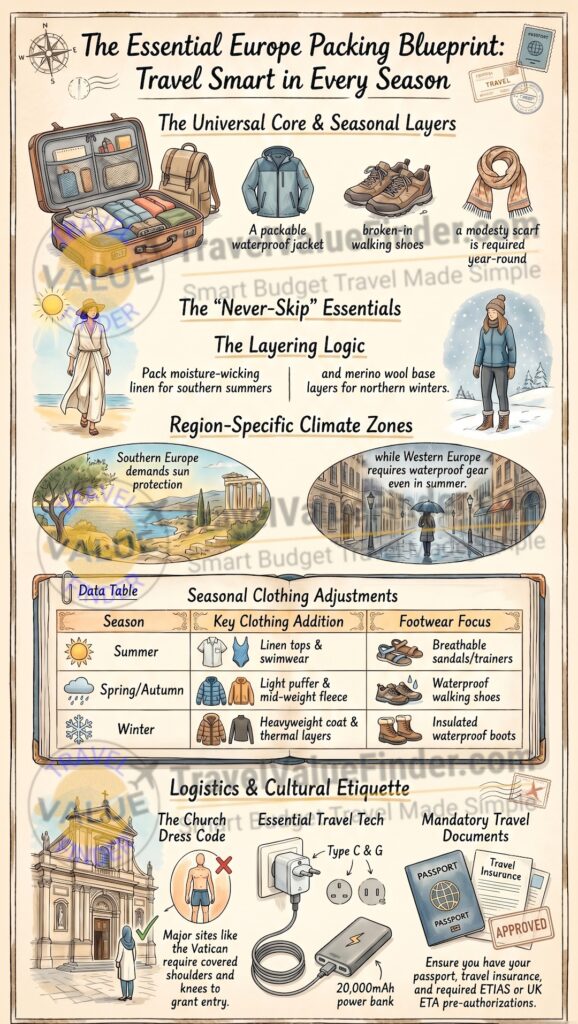
Table of Contents
Europe Packing List at a Glance
Start here, then use the detailed tables below for your exact season and region.
| Season | Key Addition | Skip |
| Summer, June to August | Linen tops, a modesty scarf, swimwear | Heavy layers in southern Europe |
| Spring and autumn | A mid weight jumper, a hooded rain shell | Shorts as your only bottom option |
| Winter, December to February | A waterproof coat, merino base layers | A light packable jacket alone |
Europe’s streets are the great equalizer. By day three, the traveler in the right shoes and a rain jacket is still walking happily at 8pm. Leslie Nics, TravelValueFinder.com
Northern, Southern, and Western Europe: What Changes
Treating Europe as one climate is the single biggest packing mistake Americans make. A Portugal trip in July needs a completely different bag than a Germany trip in October.
| Region | Summer Reality | Packing Priority |
| Southern Europe, Spain, Portugal, Greece, S. Italy | Up to 100°F, intense sun | Linen fabrics, sunscreen daily, a modesty scarf |
| Western Europe, France, UK, Netherlands | 59 to 77°F, rain likely | A waterproof jacket, worn as a daily layer |
| Central and Northern Europe, Germany, Scandinavia | Warm days, cold nights | A packable puffer for evenings, even in July |
Winter flips this pattern almost completely. Southern Portugal and Malta stay mild near 60°F, while Central and Northern Europe drop well below freezing with real snow.
A multi country itinerary makes this harder, not easier. A trip through Portugal, France, and the Netherlands in the same month needs a bag built for three different climates at once.
What to Pack for Europe by Season
Layering is the strategy in every season except deep summer in the south. Build from this single table rather than packing separate outfits for every possible temperature.
| Season | Typical Range | Core Additions |
| Summer, Jun to Aug | 59°F to 100°F depending on region | Linen tops, 1 light cardigan for cold A/C, swimwear |
| Spring, Mar to May | 46°F to 68°F, frequent rain | A hooded rain shell, 1 mid weight jumper |
| Autumn, Sep to Nov | 46°F to 68°F, frequent rain | Same as spring, plus a packable puffer for evenings |
| Winter, Dec to Feb | 23°F to 46°F, snow possible inland | A waterproof coat, merino base layers, warm boots |
The cardigan is the most underrated item on any Europe packing list. Restaurants, museums, and trains run their air conditioning cold, even during a July heatwave.
Shoulder season, spring and autumn, is the hardest to pack for. Mornings near 46°F can turn into 68°F afternoons, then drop again once the sun sets.
Church and Religious Site Dress Codes in Europe
Major European churches enforce dress codes without exception, regardless of the weather or how long the line is outside. Visitors who arrive in shorts or a tank top are simply turned away at the door.
| Site | Requirement | Fix |
| Vatican and St. Peter’s Basilica, Rome | Shoulders and knees covered, no hats | Wrap a scarf over shoulders, tie it at the waist |
| Sagrada Familia, Barcelona | Shoulders and knees covered | Same scarf solution works here too |
| Greek Orthodox churches, Greece | Shoulders and knees covered for women | Scarf plus knee length trousers or a dress |
| Notre Dame, Paris | No sleeveless tops in the sanctuary | A light cardigan over a sleeveless top is enough |
One lightweight scarf solves every dress code on this list. It weighs almost nothing and packs down to the size of a fist.
ETIAS and UK Entry Rules for Americans in 2026
Two new online authorizations affect US travelers to Europe in 2026. Neither is a visa, and neither changes how long you can stay. Both link directly to your passport number.
| Authorization | Applies To | Cost and Details |
| ETIAS | Schengen Area countries | About $22, valid 3 years, applied for online before travel |
| UK ETA | United Kingdom entry | About $13, approved within minutes to 72 hours |
ETIAS works like a US ESTA for foreign visitors. Apply only through the official EU ETIAS portal or the official gov.uk site. Third party services charging more than the official fee are unnecessary.
European Plug Types and Data for Your Trip
European outlets run at 220 to 240 volts, roughly double the US standard. Most modern phones and laptops handle this automatically, but check your device first.
| Region | Plug Type | Voltage |
| Continental Europe, France, Germany, Italy, Spain | Type C, E, or F | 220 to 240V |
| United Kingdom and Ireland | Type G | 230V |
| Switzerland | Type J | 230V |
Roaming with a US carrier in Europe can run $10 to $12 per day. An eSIM bought before you fly typically costs $7 to $15 for a week and avoids that fee entirely.
Money in Europe: Cards, Cash, and VAT
Europe runs largely on cards in 2026, but a small amount of cash still matters in smaller towns and markets. Rural France, small Spanish towns, and parts of Eastern Europe still prefer it.
| Topic | What to Know |
| Best card to bring | A no foreign transaction fee card, plus one backup from a different bank |
| Cash to carry | €50 to €100 maximum, for markets and small cafes |
| Dynamic currency conversion | Always decline it and pay in local currency at checkout |
| VAT refund | Available on purchases over €175 at participating stores for non EU visitors |
Carry On Strategy for a European Trip
Budget airlines dominate short haul routes across Europe, and their checked bag fees add up fast.
| Airline Type | Checked Bag Fee | Carry On Size Limit |
| Full service, e.g. Lufthansa, Air France | Often included | Standard cabin size, roughly 22x14x9in |
| Budget, e.g. Ryanair, EasyJet, Wizz Air | $30 to $100 each way | Stricter, often 16x8x10in for the free bag |
A 40 liter backpack clears most budget airline limits and avoids checked fees entirely. It also makes overnight trains and narrow guesthouse stairs far easier to manage.
Overnight trains in particular reward a light bag. A rolling suitcase is awkward in a narrow sleeper compartment, while a backpack tucks under the bunk with no trouble.
The Two Week Carry On Formula for Europe
Two weeks is the sweet spot for carry on only travel in Europe. Here is a formula that fits a 40 liter bag with room to spare.
| Category | Quantity | Note |
| Tops | 4 | Roll them, do not fold, to save the most space |
| Bottoms | 3 | Wear the heaviest pair on your travel day |
| Underwear and socks | 5 to 6 pairs each | Merino wool versions dry overnight in a sink |
| Shoes | 2 pairs | Wear the heavier pair, pack the lighter one |
| Outerwear | 1 piece, worn on the plane | Never pack a coat you might need on arrival |
Laundry in Europe: Planning Around It
A single laundry day replaces half the clothing on most packing lists. Self service laundromats are common across European cities and cost little.
| Option | Typical Cost | Best For |
| Self service laundromat | €5 to €10 per wash and dry | Cities with a stay of 3+ nights |
| Hostel laundry facilities | Often included or a few euros | Budget travelers on longer routes |
| Sink washing merino or synthetics | Free | Quick tops and underwear between stops |
Plan one proper laundry day per week on longer trips. Sink washing technical fabrics overnight covers the shorter gaps between stops.
I have never once returned from Europe wishing I had packed more. I have returned wishing I had packed less, every single time. Leslie Nics, TravelValueFinder.com
Packing for a Multi Country Europe Trip
Crossing several countries in one trip adds complexity beyond climate. A few adjustments keep the same carry on bag working across borders.
- Pack one universal adapter rather than country specific ones, since plug types change at nearly every border.
- Keep a printed copy of your first night’s hotel confirmation, since some border checks still ask for it.
- Carry a small amount of two currencies if your route crosses in and out of the Eurozone.
- Build your wardrobe around the coldest region on your route, then remove layers as needed further south.
A trip through Italy, Switzerland, and Germany in October, for example, needs the same waterproof layer for all three stops. Only the temperature underneath that layer actually changes.
What Not to Pack for Europe
These items show up in nearly every first time visitor’s bag, and nearly every one of them gets regretted by day three. Each has a lighter alternative that does the same job better.
| Item | Why to Skip It |
| Stiletto or fashion heels | Cobblestones make them genuinely unsafe to walk on |
| A full sized checked suitcase | Adds $30 to $100 each way on budget European flights |
| More than two pairs of shoes | Shoes are the heaviest item in any bag by far |
| Full sized toiletries | European pharmacies stock every major brand you already use |
| A printed guidebook | Offline maps and this site’s destination guides cover the same ground |
| Large amounts of cash | Most of Europe runs on contactless cards in 2026 |
Gear for a European Trip
These comparisons cover the specific items that come up most often on a European itinerary.
- Best Travel Adapter for International Travel
- Best Travel Neck Pillow for Flights
- Best Carry-On Travel Backpack
- Best Luggage Tracker for Travel
- Best Anti-Theft Crossbody Bag for Travel
People Also Ask
What shoes should I pack for Europe?
Pack a maximum of two pairs. A broken in walking shoe handles cobblestones, and a light second pair covers evenings or warmer days.
Do I need a power adapter for Europe?
Yes, without exception. American plugs do not fit European outlets, which run at 220 to 240 volts on Type C, E, F, or G plugs depending on the country.
What is ETIAS and do Americans need it?
ETIAS is a pre travel online authorization for Schengen Area countries. It costs about $22, lasts 3 years, and is not a visa.
What is the liquids rule for European flights?
European airports apply the same rule as the US. Containers must be 100ml or less, packed inside a single clear resealable bag.
Frequently Asked Questions
What should I pack for a first trip to Europe?
Bring neutral clothing that layers well, one pair of broken in walking shoes, a packable rain jacket, and a lightweight scarf for church visits.
How many outfits do I need for two weeks in Europe?
Pack 4 tops, 2 bottoms, and one smarter outfit for dinners. Wash once mid trip and you will have more than enough combinations.
Is Europe cash or card in 2026?
Mostly card. Contactless payment works in the large majority of shops, restaurants, and transit systems across Western and Central Europe.
What should women wear to visit churches in Europe?
Cover both shoulders and knees. A lightweight scarf worn as a wrap satisfies the dress code at nearly every major site.
Do I need travel insurance for a Europe trip?
Yes. European medical care is excellent but not free for visitors, and insurance also covers flight delays and lost luggage.
Can I pack for Europe in a carry on only?
Yes, for most 1 to 2 week trips. A 40 liter backpack, one laundry wash, and a two shoe limit make carry on only realistic.
What is the weather like in Europe by season?
Summer runs 59°F to 100°F depending on region. Winter ranges from mild in southern Portugal to well below freezing in central and northern Europe.
Do European hotels require a specific plug type?
It depends on the country. Continental Europe mostly uses Type C, E, or F, while the UK and Ireland use Type G, so a universal adapter is the safest choice.
Pack for the Streets, Not the Suitcase
The best Europe packing list is the lightest one that still covers every situation you will actually meet. A rain jacket beats an umbrella, and one good scarf beats a whole outfit built around church visits.
Overnight trains, spontaneous side trips, and long walking days all reward the traveler who packed light. Build your list from the region and season you are actually visiting, not a generic version of Europe.
Check your itinerary against the region table above before you pack a single bag. It takes five minutes and prevents the single biggest packing mistake on this entire list.
Planning your Europe trip? Search flights and hotels through our trusted partner. We earn a small commission at no extra cost to you.
Sources and References
- Official EU ETIAS Information Portal, European Commission
- GOV.UK, Apply for an Electronic Travel Authorisation (ETA)
- US Department of State, Travel.State.Gov, Europe Country Pages
- TSA.gov, Security Screening, What Can I Bring
Affiliate Disclaimer: Some links in this article are affiliate links. We may earn a referral commission on qualifying bookings at no additional cost to you