Travel Value Finder


The retirement travel bucket list in 2026 is built around five categories:
- Natural Wonders,
- Cultural Pilgrimages,
- River & Rail Journeys,
- Culinary & Immersion, and
- Slow Travel Retreats.
Leslie Nics, TravelValueFinder.com | Last updated: June 2026 | Last Reviewed: June 04 2026
Disclaimer: This article is for general informational purposes only and does not constitute financial, investment, tax, legal, immigration, or other professional advice. Costs and other figures are estimates and can change. Always verify current information and consult a qualified professional before making significant financial, travel, or retirement decisions.
The retirement travel bucket list should be built around moments that genuinely change how you see yourself and the world, not checkboxes.
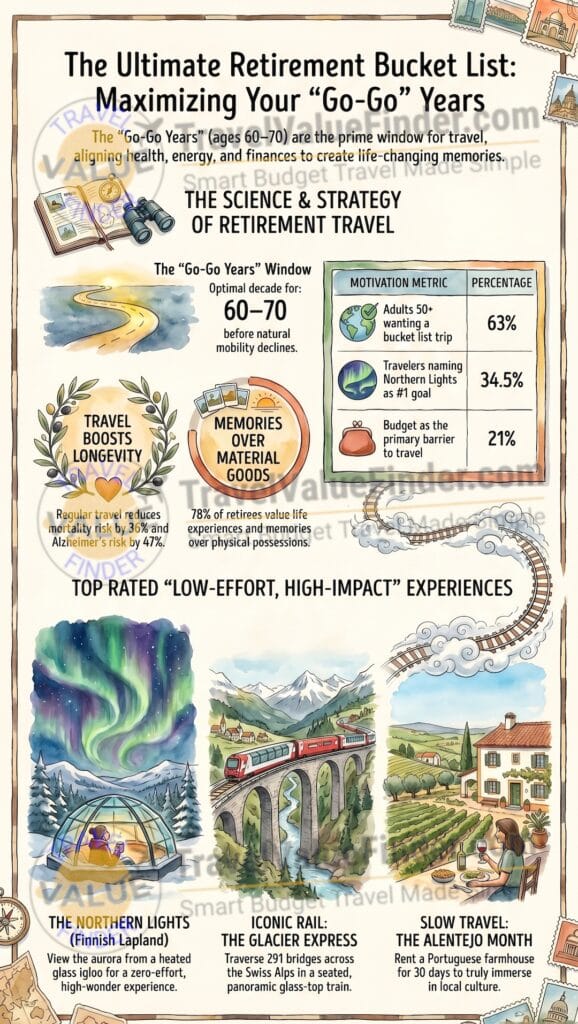
The data backs this up. A 2026 survey by Icelandair found 34.5% of Americans name the Northern Lights as their #1 bucket list experience, and 43% plan to tick off a bucket list experience in 2026.
According to AARP’s 2026 Travel Trends Survey, bucket list experiences now make up 20% of all international trips planned by adults 50+.
The Senior List reports 63% of adults 50+ want to take a bucket list trip . That is a 24% increase since pre-pandemic.
And TRAVELSAVERS named bucket list travel the #1 emerging travel trend of 2026. Find more about 50 Best Places to Visit in Retirement.
Table of Contents
Why 2026 Is the Year to Start Your Retirement Travel Bucket List
Financial planners call ages 60–70 the ‘go-go years’ when health, mobility, and desire align simultaneously. 43% of Americans plan to check off a bucket list experience in 2026.
Bucket list travel is the #1 emerging trend of 2026. 78% of travelers now value memories over material possessions.
Cultural data reinforces the urgency. TRAVELSAVERS and NEST advisors named bucket list travel as the #1 emerging travel trend of 2026.
Retirees also hold a structural advantage over working-age bucket list travelers.
- You can see the Northern Lights in January (cheapest, darkest, best aurora.
- Do Machu Picchu on a Tuesday in April instead of peak August crowds, and
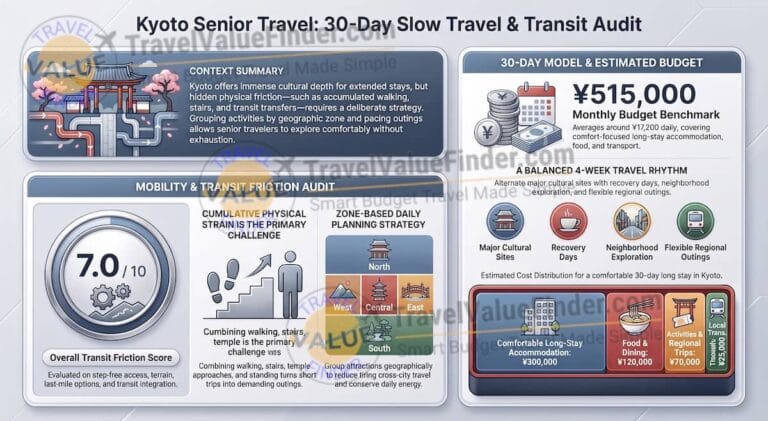
- Spend two weeks in Kyoto instead of four frantic days.
- Time is your superpower.
These 50 experiences are selected to help you use it.
All 50 Retirement Travel Bucket List Experiences at a Glance
50 experiences in 5 categories:
- Natural Wonders (#1–10),
- Cultural Pilgrimages (#11–20),
- River & Rail Journeys (#21–30),
- Culinary & Immersion (#31–40), and
- Slow Travel Retreats (#41–50).
Each rated by effort (Gentle/Moderate/Active), cost per person, and best season.
| # | Experience | Where | Effort | Cost (pp) | Best Season |
|---|---|---|---|---|---|
| 1 | See Northern Lights from a glass igloo | Finnish Lapland / Iceland | Gentle | $300–800/night | Nov–Mar |
| 2 | Witness the Serengeti Great Migration | Tanzania | Gentle–Moderate | $4,000–8,000 | Jun–Oct |
| 3 | Sail Norway’s fjords (Hurtigruten or cruise) | Norway | Gentle | $2,000–4,000 | May–Sep |
| 4 | Watch sunrise over Santorini’s caldera | Greece | Gentle | $150–400/night | Apr–Jun, Sep |
| 5 | Visit Machu Picchu by train (no hike required) | Peru | Moderate / Gentle | $500–2,000 | Apr–Oct |
| 6 | Patagonia: glacier walk or glamping lodge | Chile / Argentina | Moderate | $3,000–6,000 | Nov–Mar |
| 7 | Snorkel Great Barrier Reef (glass-bottom option) | Australia | Gentle | $2,500–5,000 | Jun–Oct |
| 8 | Small-ship cruise the Galápagos Islands | Ecuador | Gentle–Moderate | $4,000–8,000 | Year-round |
| 9 | See cherry blossoms bloom in Japan (sakura) | Japan | Gentle | $3,000–5,000 | Late Mar–Apr |
| 10 | See mountain gorillas in Uganda or Rwanda | East Africa | Moderate | $5,000–10,000+ | Jun–Sep, Dec–Feb |
| 11 | Kyoto’s Arashiyama bamboo grove at 5:30am | Japan | Gentle | $200–400/night | Mar–May, Sep–Nov |
| 12 | Angkor Wat at sunrise (golf cart tours available) | Cambodia | Gentle–Moderate | $1,500–3,000 | Nov–Apr |
| 13 | Stand inside the Colosseum, Rome | Italy | Gentle (skip-the-line) | $150–350/night | Apr–Jun, Sep–Oct |
| 14 | Walk Petra by candlelight (Petra by Night) | Jordan | Gentle | $2,000–4,000 | Oct–Apr |
| 15 | Watch Holy Week processions in Seville | Spain | Gentle | $100–250/night | Semana Santa |
| 16 | Experience Varanasi’s Ganga Aarti by boat | India | Moderate | $1,500–3,000 | Oct–Mar |
| 17 | See the Acropolis at golden hour, Athens | Greece | Moderate (steps) | $100–300/night | Apr–Jun, Sep–Oct |
| 18 | Visit the Alhambra Palace at twilight, Granada | Spain | Gentle | $100–250/night | Mar–May, Sep–Nov |
| 19 | See the Taj Mahal at sunrise, Agra | India | Gentle | $1,500–3,000 | Oct–Mar |
| 20 | Sacred Valley, Peru by guided vehicle tour | Peru | Moderate / Vehicle | $1,000–2,500 | Apr–Oct |
| 21 | Ride the Glacier Express, Zermatt–St. Moritz | Switzerland | Gentle | $2,000–4,000 | May–Oct |
| 22 | Douro Valley river cruise, Portugal | Portugal | Gentle | $3,000–6,000 | May–Jun, Sep–Oct |
| 23 | Danube river cruise: Budapest to Passau | Central Europe | Gentle | $2,000–4,000 | Apr–Oct |
| 24 | Bernina Express (UNESCO), Switzerland–Italy | Switzerland/Italy | Gentle | $1,500–3,000 | May–Oct |
| 25 | Flåm Railway + Nærøyfjord cruise, Norway | Norway | Gentle | $150–250 | May–Sep |
| 26 | Greek islands by gulet sailing yacht | Greece | Gentle | $3,000–6,000 | May–Oct |
| 27 | Mekong river cruise: Vietnam to Cambodia | SE Asia | Gentle | $3,000–6,000 | Nov–Apr |
| 28 | Venice Simplon-Orient-Express | Europe | Gentle (seated) | $4,000–12,000+ | Mar–Nov |
| 29 | Alaska Inside Passage cruise (Medicare applies) | Alaska, USA | Gentle | $2,000–5,000 | May–Sep |
| 30 | Rhine river cruise: Amsterdam to Basel | Western Europe | Gentle | $2,000–4,000 | Apr–Oct |
| 31 | Week-long cooking class in Tuscany | Italy | Gentle | $2,500–5,000 | Apr–Jun, Sep–Oct |
| 32 | Truffle-hunting in Périgord, France | France | Gentle | $150–400 | Oct–Feb |
| 33 | Traditional Japanese tea ceremony, Kyoto | Japan | Gentle | $20–60 per session | Year-round |
| 34 | Market-to-table cooking class in Oaxaca | Mexico | Gentle | $50–150 per class | Oct–Apr |
| 35 | Wine masterclass in Bordeaux or Burgundy | France | Gentle | $1,500–3,000 | May–Oct |
| 36 | Learn pasta-making from a Bolognese nonna | Italy | Gentle | $80–200 per class | Year-round |
| 37 | Port wine tasting tour, Douro Valley | Portugal | Gentle | $100–300 | May–Oct |
| 38 | Traditional Fado dinner in Lisbon | Portugal | Gentle | $50–150 per person | Year-round |
| 39 | Spice market tour + tagine class, Marrakech | Morocco | Moderate | $100–200 | Oct–Apr |
| 40 | Kaiseki multi-course dinner in Kyoto | Japan | Gentle (seated) | $80–300 per person | Year-round |
| 41 | Month on a Portuguese farmhouse, Alentejo | Portugal | Gentle | $800–2,000/month | Apr–Jun, Sep–Nov |
| 42 | Rent a Lisbon apartment for a month | Portugal | Gentle | $1,200–2,500/month | Apr–Jun, Sep–Oct |
| 43 | Two weeks on Milos or Naxos, Greece | Greece | Gentle | $800–1,800/week | May–Jun, Sep–Oct |
| 44 | Traditional ryokan stay in rural Japan | Japan | Gentle | $200–600/night | Mar–May, Sep–Nov |
| 45 | House-sit in Tuscany (TrustedHousesitters) | Italy | Gentle | Free ($150/yr membership) | Apr–Jun, Sep–Oct |
| 46 | Two weeks in Cartagena’s walled city, Colombia | Colombia | Gentle | $60–120/day | Dec–Apr |
| 47 | Coast Starlight train: Seattle to LA (sleeper car) | USA (Amtrak) | Gentle | $200–500 | Year-round |
| 48 | Week on a lavender farm in Provence | France | Gentle | $1,500–3,000 | Jun–Jul |
| 49 | Week-long meditation retreat in Thailand | Thailand | Gentle | $300–1,000 | Nov–Apr |
| 50 | New Year’s Eve in Sydney Harbour | Australia | Gentle | $3,000―6,000 | December 31 |
Category 1: Natural Wonders Experiences #1–10
1. See the Northern Lights from a Glass Igloo
Finnish Lapland / Iceland | Effort: Gentle | Cost: $300–800/night | Best Time: November–March
The Northern Lights are now the #1 bucket list item in America at 34.5% (Icelandair 2026 survey), and 2026 is one of the best years in a decade to see them.
We’re near solar maximum, meaning aurora activity is at peak intensity.
Finnish Lapland offers the definitive retiree aurora experience: a heated glass igloo where you lie in bed and watch the aurora overhead with a private sauna and room service.
The Kakslauttanen Arctic Resort and Levin Iglut are the gold standards. Iceland’s Reykjanes Peninsula and Norway’s Lofoten Islands are strong alternatives across a wider budget range.
Similarly, Northern Lights in Greenland: Best Time, Places & Tips (2026) may be worth exploring.
Tip:
- Book glass igloo rooms 10–12 months in advance.
- February is the sweet spot for peak aurora plus snowmobiling, reindeer sleigh rides, and husky safaris.
- Rovaniemi (Finnish Lapland) is 1 hour from Helsinki by plane.
2. Witness the Serengeti Great Migration
Tanzania | Effort: Gentle–Moderate | Cost: $4,000–8,000 per person | Best Time: June–October
The Serengeti Great Migration is one of the seven natural wonders of the world.
There are 1.5 million wildebeest, 200,000 zebras, and 300,000 Thomson’s gazelles in an 800km annual circuit. There are Nile crocodile river crossings that are among the most dramatic wildlife events on earth.
The good news for retirees: a safari is fundamentally sedentary.
You sit in a vehicle and the world’s greatest wildlife show comes to you. Most luxury safari camps offer accessible tented suites with proper beds, flush toilets, and hot showers.
Tip:
- Book a mobile camp that moves with the migration for best positioning.
- Road Scholar offers guided group safari programs designed for travelers 50+ with accessibility considerations.
- Porters are available at almost all camps for any mobility assistance.
3. Sail Norway’s Fjords by Cruise or Hurtigruten
Norway | Effort: Gentle | Cost: $2,000–4,000 per person | Best Time: May–September
Norway’s fjords, and particularly the Geirangerfjord and Nærøyfjord (both UNESCO World Heritage Sites), offer vertical rock walls rising 1,000+ meters from near-freezing emerald water with waterfalls cascading down cliff faces.
The Hurtigruten coastal voyage (Bergen to Kirkenes, 12 days) is one of the world’s most celebrated itineraries.
The ‘Norway in a Nutshell’ circuit (Bergen – Flåm Railway – Nærøyfjord cruise – return) can be done in a single day. It is the perfect first-time fjord experience for retirees.
Tip:
- The Norway in a Nutshell circuit from Bergen covers the essential fjord experience in one day.
- For full immersion, the Hurtigruten voyage gives you the entire Norwegian coast.
- Our companion Europe Rail guide covers the Flåm Railway connection in depth.
4. Watch Sunrise over Santorini’s Caldera
Santorini, Greece | Effort: Gentle | Cost: $150–400/night | Best Time: April–June, September–October
Santorini’s caldera views, whitewashed villages, and Aegean light are as extraordinary in person as in every photograph.
The retiree-smart approach:
- stay in Oia or Imerovigli for 3–5 nights in shoulder season,
- wake before dawn for the sunrise from your terrace, walk the village paths at 7am before cruise-ship day-trippers arrive,
- spend afternoons at clifftop tavernas, and
- avoid July–August because there are up to 7,000 daily cruise visitors and 95°F+ heat make the village paths genuinely difficult.
Tip:
- The Oia-to-Fira clifftop walk (10km, mostly paved) is one of the Mediterranean’s great short walks with caldera views throughout.
- Do it early morning in April or October.
- Greek ferries connect Santorini to Crete, Mykonos, and Athens year-round.
5. Visit Machu Picchu by Train (No Hike Required)
Cusco & Aguas Calientes, Peru | Effort: Moderate / Gentle | Cost: $500–2,000 per person | Best Time: April–October
Machu Picchu is fully accessible without hiking the Inca Trail.
Peru Rail’s Vistadome train from Cusco winds through the Sacred Valley with panoramic windows. Buses then switchback up to the ruins.
Altitude is the primary consideration: Cusco sits at 3,400m and requires 2–3 days of acclimatization.
Spend those days exploring Cusco’s markets and extraordinary cuisine.
At Machu Picchu itself (2,430m), the terrain involves stone paths and some uneven paving, but the main viewpoints are accessible with reasonable mobility.
Tip:
- Purchase Machu Picchu entry tickets ($62–$78) and train tickets months in advance where daily capacity is strictly capped.
- Arrive in Cusco 2–3 days early for altitude adjustment.
- Diamox (acetazolamide) can help with altitude sickness. Consult your doctor before departure.
6. Patagonia: Glamping Lodge with Guided Day Hikes
Chile / Argentina | Effort: Moderate | Cost: $3,000–6,000 per person | Best Time: November–March
Patagonia’s Torres del Paine National Park offers granite towers, cobalt lakes, and the Perito Moreno Glacier in a landscape that feels like the edge of the earth.
The retiree-best approach is a glamping lodge itinerary. EcoCamp Patagonia and Awasi Patagonia offer guided day hikes calibrated to your fitness level each day.
Short guided walks to glacier viewpoints and lake overlooks are available for travelers who prefer moderate exertion. No multi-day camping required.
Tip:
- Book 12+ months ahead for EcoCamp or Awasi because capacity is limited.
- November and March (shoulder season) give fewer crowds and lower prices vs. January peak.
- Punta Arenas is the fly-in point from Santiago.
7. Snorkel the Great Barrier Reef (or Glass-Bottom Boat)
Cairns, Queensland, Australia | Effort: Gentle to Moderate | Cost: $2,500–5,000 per person | Best Time: June–October
The Great Barrier Reef is among the natural world’s most urgent bucket list priorities.
Glass-bottom boat tours are the most accessible format for retirees. You sit on a flat-bottomed boat and observe the coral world through sealed windows.
For confident swimmers, snorkel tours from anchored pontoon platforms offer face-to-face encounters with sea turtles and parrotfish.
The Cairns-to-Port Douglas strip has the most developed accessible reef infrastructure.
Tip:
- The Outer Reef (1.5 hours from Cairns by catamaran) has the healthiest coral and clearest water.
- June–October is best with dry season, cooler temperatures, no cyclone risk.
- Quicksilver Cruises and Silversonic are the most reputable operators for senior-accessible tours.
8. Small-Ship Cruise the Galápagos Islands
Ecuador | Effort: Gentle–Moderate | Cost: $4,000–8,000 per person | Best Time: Year-round
The Galápagos Islands are the most retiree-friendly wildlife destination on earth.
The animals have no fear of humans. As a result, you watch blue-footed boobies court each other, walk past sea lion colonies, and observe giant tortoises grazing at close range without demanding hikes.
Small-ship Galápagos cruises (8–16 passengers) visit multiple islands following a National Park ranger on walks rated by difficulty.
Itineraries include snorkeling options and glass-bottom dinghies for non-swimmers.
Tip:
- Book 6–12 months ahead for best vessel and itinerary selection.
- National Park permits are allocated through licensed operators only.
- Quito is the fly-in point. A brief internal flight connects to the islands.
- Choose small-ship over large for access to remote sites.
9. Watch Japan’s Cherry Blossoms Bloom
Japan (Tokyo, Kyoto) | Effort: Gentle | Cost: $3,000–5,000 per person | Best Time: Late March–Early April
Japan’s sakura season is one of the world’s great seasonal spectacles.
Hundreds of millions of cherry trees bloom simultaneously, and picnic blankets spread under blossom-laden branches in parks from Kyoto to Tokyo.
The exact bloom timing varies by year. Japan Meteorological Corporation issues forecasts from January onward.
Kyoto’s Maruyama Park, Philosopher’s Path, and Arashiyama are the finest sakura sites. Discover the 25 Best Things to Do in Tokyo.
Tip:
- Book flights and accommodation 6–9 months ahead.
- Sakura season is Japan’s busiest period and prices spike 30–50%.
- For early blooms, Okinawa and Kyushu are 2–3 weeks ahead of Tokyo.
- Hokkaido blooms in late April to early May for late-season viewing.
10. See Mountain Gorillas in Uganda or Rwanda
Bwindi (Uganda) / Volcanoes National Park (Rwanda) | Effort: Moderate | Cost: $5,000–10,000+ per person | Best Time: June–September, December–February
Gorilla trekking is among the most profound wildlife encounters available.
You follow a guide through forest for 30 minutes to several hours depending on the gorilla family’s movement.
Then spend one permitted hour within feet of a habituated mountain gorilla family while they completely ignore you.
Rwanda’s Volcanoes National Park is easier for older travelers. These are better trail infrastructure, closer to Kigali, and shorter average trek distances.
Tip:
- Rwanda permits cost $1,500/person, whereas Uganda cost $700/person.
- Porters are available at all sites and is strongly recommended. They carry your pack and can provide a steadying hand on steep sections.
- Physical requirement; expect walking 30 min to 3 hours on uneven forest trails.
Category 2: Cultural Pilgrimages Experiences #11–20
Cultural pilgrimages engage deep history, living tradition, and human artistry.
11. Walk Kyoto’s Bamboo Grove at Dawn (5:30am)
Kyoto, Japan | Effort: Gentle | Cost: $200–400/night | Best Time: March–May, September–November
The Arashiyama Bamboo Grove at 10am in July looks like a 50-person selfie session.
At 5:30am when it opens, the bamboo sound a papery whisper in any breeze. It is the only noise and the light is extraordinary.
The nearby Tenryū-ji temple garden (UNESCO) opens at 8am.
The full Arashiyama circuit grove, temple, Okochi Sanso villa, bamboo path to the monkey park is a gentle half-day on mostly flat, paved surfaces.
Tip:
- Stay in the Arashiyama district itself (Hoshinoya Kyoto) to walk to the grove before tourists arrive.
- A rickshaw ride through the grove provides a seated, relaxed pace experience for any fitness level.
12. Angkor Wat at Sunrise by Private Tuk-Tuk
Siem Reap, Cambodia | Effort: Gentle–Moderate | Cost: $1,500–3,000 per person | Best Time: November–April
Angkor Wat is the largest religious monument ever built. It is a 12th-century Khmer complex covering 400 acres.
At sunrise, the five towers reflect in the moat as the sky shifts from indigo to gold.
Golf cart tours are available for the full Angkor complex for travelers who can’t walk the distances.
The main Angkor Wat galleries are ground-level and accessible, while the upper galleries involve steep steps and are entirely optional.
Tip:
- Arrive at the reflection pond by 5am for the best sunrise position.
- The Angkor Archaeological Park pass ($37/day, $72/3-day) is best spread over 2 days.
- Cambodia has world-class, affordable private hospitals in Siem Reap and Phnom Penh.
13. Stand Inside the Colosseum, Rome
Rome, Italy | Effort: Gentle (skip-the-line tickets) | Cost: $150–350/night | Best Time: April–June, September–October
Book the Arena Floor + Underground experience for access to the subterranean passages where gladiators waited.
The Roman Forum requires comfortable shoes for uneven ancient paving. Explore the Top 10 Things to Do in Rome.
Tip:
- The Palatine Hill–Colosseum combined ticket ($30) is valid for two consecutive days.
- Avoid midday in summer.
- The Colosseum has wheelchair-accessible elevator access to upper tiers.
14. Walk Petra by Candlelight (Petra by Night)
Wadi Musa, Jordan | Effort: Gentle | Cost: $2,000–4,000 per person | Best Time: Year-round (Oct–Apr ideal)
Petra by Night transforms the 900m Siq gorge and Treasury facade with over 1,500 candles in paper bags. Traditional music echoes off the sandstone walls.
The walk in (the Siq) is mostly flat and takes about 20 minutes each way.
One of the most atmospheric experiences anywhere on earth. Runs Monday, Wednesday, and Thursday evenings.
Tip:
- Petra by Night tickets ($17) are purchased separately from general admission ($75/day).
- Stay 2–3 days minimum because the full Petra archaeological site covers 264 sq km.
- Donkey rides are available to the Monastery for those who can’t climb the 800 steps.
15. Watch Seville’s Holy Week Processions
Seville, Spain | Effort: Gentle | Cost: $100–250/night | Best Time: Semana Santa (week before Easter)
Seville’s Semana Santa is the most extraordinary street festival in the world.
There are 60+ processions in which brotherhoods carry 300-year-old floats through ancient streets. These are accompanied by marching bands, incense, candlelight, and live saeta flamenco prayer songs.
Completely free to attend. Stand anywhere along the route. The combination creates an atmosphere unlike anything else in European culture.
Tip:
- Book accommodation 6–9 months ahead. The city fills completely.
- The Thursday night processions of Gran Poder and Esperanza Macarena (midnight–4am) are the most revered.
- The entire daytime route is manageable for any mobility level.
16. Varanasi’s Ganga Aarti Ceremony by River Boat
Varanasi, India | Effort: Moderate | Cost: $1,500–3,000 per person | Best Time: October–March
Varanasi’s Ganga Aarti at dawn is when priests in saffron robes perform synchronized fire worship on the Ganges ghats as devotional lamps float downstream.
It is one of India’s most sacred and visually overwhelming rituals.
Book a private boat on the river for the ceremony. It is quieter, better perspective, and avoids the most crowded ghat sections.
Varanasi is intense and confronting but one of the world’s genuinely irreplaceable human experiences.
Tip:
- Stay at the Taj Ganges or BrijRama Palace hotel for dedicated ghat access and organized private boat viewing.
- Book a private guide for the Varanasi experience. The city’s complexity rewards expert navigation.
- October–March is the most comfortable temperature window.
17. See the Acropolis at Golden Hour, Athens
Athens, Greece | Effort: Moderate (steps involved) | Cost: $100–300/night | Best Time: April–June, September–October
The Acropolis is the physical embodiment of Western civilization’s foundations.
The climb involves steps but is manageable for most retirees with reasonable fitness. The path is paved and the gradient gradual.
Best time is 7am when it opens in summer before heat and crowds, or the final entry in late afternoon when the marble turns gold.
The Acropolis Museum at the base is world-class and almost entirely step-free.
Refer to What to Do in Athens for more detailed information.
Tip:
- The multi-site Athens ticket ($30) covers 5 sites over 5 days.
- The Acropolis has wheelchair-accessible elevator access to the upper areas.
- Avoid midday in summer (temperature and crowds simultaneously peak).
18. The Alhambra Palace at Twilight, Granada
Granada, Spain | Effort: Gentle | Cost: $100–250/night | Best Time: March–May, September–November
The 14th-century Nasrid Palaces of the Alhambra with intricate plasterwork, geometric tiles, and garden fountains are one of the world’s finest surviving medieval palace complexes.
Evening visits (Nasrid Palaces at night) run Tuesday through Saturday, There will be lit chambers with only a few hundred other visitors vs. the daytime crowds.
The Generalife gardens (mostly flat) are the most accessible part of the complex.
Tip:
- Buy tickets at alhambra-patronato.es 3+ months ahead. Daily capacity is strictly limited.
- Stay in the Albáicín neighborhood for walking-distance access and extraordinary views back toward the Alhambra.
19. The Taj Mahal at Sunrise, Agra
Agra, India | Effort: Gentle (with guide) | Cost: $1,500–3,000 per person | Best Time: October–March
At sunrise, the Taj Mahal’s white marble takes on pink, gold, and then brilliant white tones shifting every 15 minutes.
Arrive at the East Gate when it opens (30 minutes before official sunrise) to be among the first inside, before tour buses arrive.
The Taj is simultaneously the world’s most recognized building and, in person, far larger and more luminous than photographs convey.
Tip:
- Stay one night in Agra to see the Taj at both sunrise and sunset. Don’t squeeze it into a day trip from Delhi.
- The Gatimaan Express train (1hr 40min from Delhi) is the best transport option.
- The ITC Mughal Hotel opposite the Taj gardens is the finest property with Taj views.
20. Sacred Valley, Peru by Guided Vehicle Tour
Cusco Region, Peru | Effort: Moderate / Vehicle | Cost: $1,000–2,500 per person | Best Time: April–October
The Sacred Valley between Cusco and Machu Picchu holds;
- Pisac’s ruins and market,
- Ollantaytambo’s Inca fortress (where the Incas defeated the Spanish in battle), and
- Moray’s mysterious circular agricultural terraces.
A private guided vehicle day tour from Cusco is the most comfortable and flexible format for retirees. This is covering all three sites with an English-speaking guide for $80–$150 all-in.
Tip:
- Combine a Sacred Valley vehicle tour with the Vistadome train from Ollantaytambo to Aguas Calientes for the logical Machu Picchu extension.
- Private vehicle tours are flexible on timing and pace. Essential at altitude when you may need unplanned rest stops.
Category 3: River & Rail Journeys Experiences #21–30
River and rail journeys are the most retiree-friendly bucket list category;
- seated throughout,
- scenery comes to you, and
- logistics are handled.
The Glacier Express (CHF54 mandatory reservation, 7hrs) and Danube river cruise (8 days Budapest–Passau) are the most popular.
The Venice Simplon-Orient-Express (from £3,900/person) is the ultimate rail splurge. Alaska’s Inside Passage cruise is the top domestic option.
River and rail journeys are where the scenery moves while you remain comfortably seated.
For full details on each, see our companion guides: Europe Rail for Retirees and Best River Cruises for Retirees.
| # | Journey | Duration | From (pp) | Effort | What Makes It Bucket List |
|---|---|---|---|---|---|
| 21 | Glacier Express: Zermatt–St. Moritz | 7–8 hrs | $400–600 | Gentle | 291 bridges, 91 tunnels, Matterhorn, Oberalp Pass |
| 22 | Douro Valley river cruise, Portugal | 7–8 days | $1,500–3,000 | Gentle | Terraced vineyards, 5 locks, port wine cellars |
| 23 | Danube cruise: Budapest to Passau | 8 days | $1,000–2,500 | Gentle | Budapest, Vienna, Bratislava: Central Europe’s greatest cities |
| 24 | Bernina Express (UNESCO) Switzerland–Italy | 4 hrs | $200–400 | Gentle | 2,253m Alpine pass, Brusio Circular Viaduct, UNESCO status |
| 25 | Flåm Railway + Nærøyfjord cruise | Full day | $150–250 | Gentle | World’s steepest railway + UNESCO fjord cruise in one day |
| 26 | Greek islands by gulet sailing yacht | 7–14 days | $1,500–3,500 | Gentle | Cyclades islands, hidden coves, deck dining under stars |
| 27 | Mekong cruise: Vietnam to Cambodia | 10–15 days | $1,500–3,000 | Gentle | Floating markets, Angkor Wat, French colonial history |
| 28 | Venice Simplon-Orient-Express | 2 nights | $4,000–12,000+ | Gentle | 1920s Art Deco carriages, dining car, golden age of travel |
| 29 | Alaska Inside Passage cruise (Medicare applies) | 7–14 days | $1,000–2,500 | Gentle | Glaciers, humpback whales, orcas, grizzlies – domestic |
| 30 | Rhine cruise: Amsterdam–Basel | 7–8 days | $1,000–2,500 | Gentle | 40 castles, medieval wine towns, most popular river cruise |
Category 4: Culinary & Immersion Experiences #31–40
Culinary travel is the fastest-growing experiential category among retirees in 2026. Highlights include;
- A Tuscany cooking week costs $2,500–$5,000 all-in.
- An Oaxacan market-to-table class costs $50–$150.
- Japanese tea ceremonies run $20–$60.
- Bordeaux wine masterclasses from $150/session.
These experiences deliver both cultural depth and social connection. These are two of the most documented mental health benefits of travel for older adults.
31. Week-Long Cooking Class in Tuscany
Tuscany, Italy | Effort: Gentle | Cost: $2,500–5,000 per person | Best Time: April–June, September–October
A Tuscany cooking week means morning market visits foraging for ingredients. Then a 3–4 hour hands-on session making pasta, sauces, and desserts. You will end it with a sit-down lunch of everything you’ve cooked with paired wines.
Programs like Villa Delia in Chianti are designed for small groups of adult travelers and move at an unhurried pace.
The best programs are residential at the cooking villa. You stay where you cook, surrounded by vineyards and olive groves.
Tip:
- Tenuta di Spannocchia, Villa Campestri, and Badia a Coltibuono offer farm-to-table residential cooking weeks in extraordinary settings.
- Book 6 months ahead for the most popular spring and autumn sessions.
32. Truffle-Hunting in Périgord, France
Dordogne, France | Effort: Gentle | Cost: $150–400 for experience | Best Time: October–February (truffle season)
A guided truffle-hunting morning takes you through oak woodland with a hunter and his dog. You will learn to watch the dog signal, which then reveals the truffle hidden beneath the leaf litter.
You take your find to a farmhouse kitchen for a truffle-infused lunch.
No physical exertion beyond gentle woodland walking is required.
The black Périgord truffle season runs November–March, and the Sarlat Saturday market is France’s most atmospheric.
Tip:
- Book through Périgord Noir Tourism.
- The Dordogne valley is one of France’s most beautiful and least-touristy regions.
- Combine with a stay in the medieval village of Sarlat-la-Canéda for the complete southwest France experience.
33. Traditional Japanese Tea Ceremony, Kyoto
Kyoto, Japan | Effort: Gentle | Cost: $20–60 per session | Best Time: Year-round
A traditional chadō ceremony in a historic Kyoto teahouse. You enter through a low door requiring bowing, sitting in a tatami room overlooking a moss garden, and receiving bitter matcha made with slow silent intention.
It is an encounter with a profoundly different relationship to time. That is 45–60 minutes total with no special fitness or cultural knowledge required.
Urasenke, En, and Camellia Tea Experience are the most reputable English-language providers.
Tip:
- Dress modestly. You’ll sit on the floor or low cushions.
- Combine with a visit to Daitoku-ji temple complex for a complete morning of contemplative Japanese culture.
34. Market-to-Table Cooking Class in Oaxaca
Oaxaca City, Mexico | Effort: Gentle | Cost: $50–150 per class | Best Time: October–April
Oaxacan cuisine is UNESCO-recognized. It is built on 35 varieties of corn, 7 signature mole sauces, and ingredients cultivated for 10,000 years.
A market-to-table class starts at Mercado de Abastos. It guides you through ingredients with a local instructor, then returns to the kitchen where you spend 2–3 hours making mole negro (a 30-ingredient sauce requiring 2+ hours of attention), tlayudas, and agua de jamaica.
Tip:
- La Cocina de la Abuela, Casa de los Sabores, and Seasons of My Heart cooking school are the top operators.
- Classes are 6–8 people maximum.
- Oaxaca city is fully walkable, safe, and at a pleasant altitude (1,550m).
35. Wine Masterclass in Bordeaux or Burgundy
France | Effort: Gentle | Cost: $1,500–3,000 per person | Best Time: May–October
Bordeaux is accessible by TGV from Paris in just over 2 hours. It offers the world’s most respected wine education in chateau settings of extraordinary beauty.
A classified Médoc or Saint-Émilion château masterclass where tasting through Left and Right Bank wines with a sommelier explaining terroir and vintage variation.
It is both educational and deeply pleasurable.
The Cíté du Vin museum in Bordeaux is a world-class wine introduction before any château visits.
Tip:
- Château Smith Haut Lafitte (with its spa, Les Sources de Caudélie) combines wine country and wellness beautifully for retirees.
- For Burgundy, the Route des Grands Crus between Dijon and Beaune is the world’s most celebrated wine road.
36. Learn Pasta from a Bolognese Nonna
Bologna, Italy | Effort: Gentle | Cost: $80–200 per class | Best Time: Year-round
Bologna is Italy’s food capital. A pasta-making lesson with a local nonna in her home kitchen is one of Italy’s most intimate culinary experiences.
You hand-roll tagliatelle to the precise width specified by the Bologna Chamber of Commerce (a golden tagliatelle strand is deposited there as the official standard).
Then you eat everything at a family-style lunch with local wine.
Cesarine.com matches travelers with home cooks across Italy, and is the most reliable platform.
Tip:
- Limit the group to 4–6 people for the most personal experience.
- Combine with a guided tour of Bologna’s Quadrilatero food market for a complete morning.
- Bologna is 35 minutes from Florence by high-speed train.
37. Port Wine Tasting Tour, Douro Valley
Porto & Douro Valley, Portugal | Effort: Gentle | Cost: $100–300 for experience | Best Time: May–June, September–October
The Douro Valley is the world’s oldest demarcated wine region (established 1756 by Portugal’s Pombal).
The terraced schist hillsides has 700+ registered quintas. The extraordinary landscape of the river dropping 1,200m from Spain to the Atlantic make this both a world-class wine destination and one of Portugal’s most beautiful landscapes.
A porto wine tasting at Graham’s or Sandeman in Vila Nova de Gaia (across the Douro from Porto) is the entry-level version.
An overnight quinta stay in the Upper Douro is the bucket list version.
Tip:
- Quinta da Pacheca (with wine barrel guest rooms) and Quinta do Crasto are among the finest overnight quinta experiences.
- The N222 river road (named the world’s most beautiful road by the BBC) is as memorable as any tasting.
- Combine with a Douro river cruise.
38. Traditional Fado Dinner in Lisbon
Lisbon, Portugal | Effort: Gentle | Cost: $50–150 per person | Best Time: Year-round
Fado, the uniquely Portuguese musical genre of longing and beauty is Lisbon’s soul.
An intimate fado dinner in Mouraria or Alfama in a small whitewashed tavern (30 other diners, candlelit) where a solo fadista performs between courses while the room falls to perfect silence mid-bite is one of Europe’s most emotionally resonant experiences.
UNESCO inscribed Fado as an Intangible Cultural Heritage in 2011.
Best houses perform from 8pm and ideal timing for retirees.
For Lisbon food guide, refer to the Lisbon Food | Cheap Eats & Affordable Dining Guide.
Tip:
- Casa de Linhares, Clube de Fado, and A Tabacaria are among Lisbon’s most respected fado houses.
- Book in advance and arrive for dinner rather than just drinks.
- The full dinner experience gets the best seats.
39. Spice Market Tour + Tagine Class, Marrakech
Marrakech, Morocco | Effort: Moderate | Cost: $100–200 | Best Time: October–April
Marrakech’s Djemaa el-Fna and its surrounding souks have operated continuously for 1,000 years.
A guided morning through the spice souks transforms the overwhelming into navigable. You learn which stalls are reliable, what argan oil and ras el hanout should smell like.
A tagine cooking class in the afternoon makes everything you’ve smelled come alive in slow-cooked lamb with preserved lemon and saffron.
Tip:
- Stay inside the medina in a riad (Maison Arabe or El Fenn).
- The Jardin Majorelle (Yves Saint Laurent’s garden) is flat, peaceful, and a perfect counterpoint to the medina’s intensity.
40. Kaiseki Multi-Course Dinner in Kyoto
Kyoto, Japan | Effort: Gentle (seated) | Cost: $80–300 per person | Best Time: Year-round
Kaiseki is Japan’s culinary pinnacle. There are 8–14 meticulously prepared seasonal courses in a Kyoto machiya (wooden townhouse) restaurant.
Each course is a different preparation technique, and each ingredient at absolute peak.
You don’t need any prior knowledge. Simply eat slowly and pay attention.
Kikunoi, Nakamura, and Mizai are the most celebrated kaiseki restaurants. Reservations must be made months ahead through your hotel concierge.
Tip:
- Budget $150–$300/person for the food alone at a top Kyoto kaiseki restaurant.
- Your hotel concierge is essential for reservations.
- Many top restaurants accept bookings only through trusted intermediaries.
Category 5: Slow Travel Retreats Experiences #41–50
Slow travel retreats means staying 2–4 weeks in one place. This is where you are living rather than sightseeing.
This is the fastest-growing bucket list category for retirees in 2026.
41. Month in a Portuguese Farmhouse, Alentejo
Alentejo, Portugal | Effort: Gentle | Cost: $800–2,000/month | Best Time: April–June, September–November
The Alentejo is Portugal’s interior heartland. There are cork oak forest, ancient olive groves, white-washed hilltop villages, and a pace of life that feels like a separate century.
A month in an Alentejo farmhouse is when you shop at the weekly market in Évora or Beja. Cook what you buy, explore megalithic stone circles (some older than Stonehenge) on gentle morning walks, and gradually feel the world’s pace shift to something more human.
Total cost: $800–2,000/month including accommodation and food. This is one of Europe’s finest-value extended stays.
Tip:
- Évora (UNESCO Roman city) is the ideal base town.
- Quinta da Prata is among the finest farm-stay properties for retirees.
- Portugal’s D7 Passive Income Visa allows stays beyond 90 days if you’re considering longer-term time abroad.
42. Rent a Lisbon Apartment for a Month
Lisbon, Portugal | Effort: Gentle | Cost: $1,200–2,500/month | Best Time: April–June, September–October
Lisbon is the world’s safest retirement country capital (#1, International Living 2026).
It offers a mild Atlantic climate, a UNESCO historic center, and rented by the month on Airbnb. It is one of the most affordable long-stay costs of any Western European capital.
A one-bedroom apartment in Chiado or Príncipe Real rents for $1,200–2,500/month with a weekly discount of 20–40% vs. nightly rates.
You’ll discover your café, market vendor, and wine shop within the first week.
Tip:
- The Príncipe Real neighborhood is the most walkable, flat, and residential of Lisbon’s central quarters.
- Combine with a week in Porto before or after.
- Book via Airbnb using the long-stay filter for the best monthly rates.
43. Two Weeks on Milos or Naxos, Greece
Cyclades, Greece | Effort: Gentle | Cost: $800–1,800/week | Best Time: May–June, September–October
Santorini and Mykonos have been so overwhelmed by tourism that the slow-travel Greek island life they once embodied has largely left them.
Milos and Naxos are where it now lives.
Milos, with 72 beaches on a single volcanic island and minimal mass tourism, rewards extended stays.
Naxos (the Cyclades’ largest island) offers authentic local food, mountain walking, and Venetian architecture alongside ancient archaeological sites.
Tip:
- Milos by daily ferry from Piraeus (Athens) or direct summer flights.
- Rent a small car ($25–40/day) for complete freedom to explore new beaches every morning.
- For Naxos, the ferry is 5–6 hours – a pleasant crossing in calm Aegean conditions.
44. Traditional Ryokan Stay in Rural Japan
Hakone or Kinosaki, Japan | Effort: Gentle | Cost: $200–600/night | Best Time: March–May, September–November
A Japanese ryokan organizes your day around ritual, meal, and seasonal pleasure.
It offers private tatami room, yukata (cotton robe), an elaborate kaiseki dinner brought to your room course by course. There is an outdoor onsen (hot spring baths) in a garden setting open from dawn until late evening.
Hakone (90 minutes from Tokyo by Romancecar train) is the most accessible international entry point.
Gora Kadan and Hakone Ginyu are among the finest accessible ryokan in Japan.
Tip:
- Book directly with the ryokan for best room selection and accessibility requirements.
- Most ryokans have step-free bathrooms and can accommodate mobility aids on request.
- The Romancecar train from Tokyo’s Shinjuku station is comfortable and scenic.
45. House-Sit in Tuscany (TrustedHousesitters)
Tuscany, Italy | Effort: Gentle | Cost: Free accommodation ($150/yr membership) | Best Time: April–June, September–October
TrustedHousesitters matches vetted travelers with homeowners who need someone to care for their home (and typically pets) in exchange for free accommodation, often in extraordinary locations.
Tuscany regularly features farmhouses in the Chianti hills, villas outside Siena, and apartments in Florence.
For retirees with flexibility and comfort with pets, house-sitting is one of Europe’s finest slow travel experiences. You live in a real home with no hotel-checkout pressure.
Tip:
- Create a TrustedHousesitters profile highlighting reliability, pet care experience, and references.
- Apply for multiple offers simultaneously.
- April–May and September–October fill fastest. Plan 6+ months ahead.
46. Two Weeks in Cartagena’s Walled City, Colombia
Cartagena de Indias, Colombia | Effort: Gentle | Cost: $60–120/day | Best Time: December–April
Cartagena is one of the Americas’ best-preserved colonial cities.
This is a 16th-century UNESCO walled city of pastel mansions and bougainvillea-draped balconies.
The historic Ciudad Amurallada is small enough to walk entirely in a day but rich enough for two weeks.
Visit the Rosario Islands by speedboat, the hilltop Fortress of San Felipe, and the legendary Hotel Santa Clara (a converted 17th-century convent).
Daily cost $60–$120 for two in comfortable mid-range accommodation with all meals and activities.
Tip:
- Stay inside the walled city or in Getsemaní (more affordable and vibrant).
- December–April is the dry season with 80°F, low humidity, and blue sky.
- Colombia’s Pensionado visa allows extended stays for retirees with pension income from $750/month.
47. Ride the Coast Starlight: Seattle to Los Angeles
Pacific Coast, USA (Amtrak) | Effort: Gentle | Cost: $200–500 (sleeper car) | Best Time: Year-round
The Coast Starlight is America’s most scenic long-distance train route.
Travel 35 hours from Seattle to Los Angeles through the Cascade Mountains, Shasta Volcanic Range, and the California Coast.
The Superliner sleeper car includes a private room with convertible bed, large picture window, and meals in the dining car.
Amtrak’s 15% senior discount for travelers 62+ applies.
Medicare covers everything on this domestic journey. Find the best places for where to stay in Los Angeles
Tip:
- Book the Deluxe Bedroom (private toilet and shower included).
- The southbound trip on a clear January day offers unobstructed Mount Shasta views from the Sightseer Lounge.
- Book window tables in the dining car for the California coast section.
48. Week on a Lavender Farm in Provence
Provence, France | Effort: Gentle (light farm work optional) | Cost: $1,500–3,000 per person | Best Time: June–July (peak bloom)
Provence’s lavender fields on the Valensole Plateau bloom for a brief glorious 4–6 week window in late June and early July.
A lavender farm stay places you inside this landscape at its most extraordinary moment. There is an option to participate in the harvest (gentle, aromatic morning activity) or simply photograph, walk, and breathe the fragrance of 50 acres of flowering lavender.
The nearby Luberon villages (Gordes, Roussillon) are among France’s most beautiful.
Tip:
- Château du Bois in Lagarde-d’Apt is one of the finest lavender farm stays in Provence.
- Book 6 months ahead for the peak bloom window.
- Exact peak timing varies by year and altitude. Early June at lower elevations, and early July at the highest plateau.
49. Week-Long Meditation Retreat in Thailand
Chiang Mai or Koh Phangan, Thailand | Effort: Gentle | Cost: $300–1,000 per person | Best Time: November–April
Thailand offers some of the world’s finest meditation retreat programs in monastery and wellness settings that combine Buddhist tradition with modern comfort.
A 5–7 day silent or semi-silent retreat provides something most retirees have never experienced;
- structured space to be still,
- without agenda,
- without digital distraction.
Vipassana, metta (loving-kindness), and mindful walking practices are widely documented for benefits to cognitive health, sleep quality, and emotional regulation in older adults.
Tip:
- Wat Suan Dok Buddhist Meditation in Chiang Mai offers free monk-chat sessions and 1–3 day introductory programs.
- Dhamma Kamala Vipassana center near Chiang Mai offers structured 10-day residential programs including accommodation and vegetarian meals.
50. New Year’s Eve in Sydney Harbour
Sydney, Australia | Effort: Gentle | Cost: $3,000―6,000 per person | Best Time: December 31
Sydney’s New Year’s Eve fireworks display is acknowledged as the world’s finest New Year celebration.
There is 12 minutes of extraordinary pyrotechnics launched from the Harbour Bridge, reflected across one of the world’s most beautiful natural harbors.
The Opera House is lit on one side, the Harbour Bridge arches above.
The retiree-smart approach;
- book a harbor-view restaurant package ($300–$600/person), or
- a harbor dinner cruise that positions you directly beneath the fireworks.
Tip:
- Book harbor restaurant New Year’s Eve packages 6–9 months ahead.
- The best seats sell out by June.
- Quay, aria, and Bennelong (inside the Opera House) are the three finest options with direct harbor views.
- December 31 is summer in Sydney (75–85°F).
How to Fund Your Retirement Travel Bucket List on a Fixed Income
The #1 barrier to bucket list travel among retirees is cost – not health or mobility.
The Senior List reports 21% of adults 50+ cite rising travel costs as their primary reason for not yet taking a bucket list trip.
Here’s the framework to overcome that:
- Build a dedicated bucket list travel fund: Open a separate high-yield savings account labeled ‘Bucket List Travel.’ Even $200/month compounds to $2,400/year. This is enough for one meaningful experience with smart planning.
- Use travel rewards credit cards for flights: A sign-up bonus (60,000–75,000 points) can cover a round-trip international flight. Chase Sapphire Preferred and Citi Strata Premier are the strongest options.
- Prioritize depth over breadth: A well-planned 10-day Japan cherry blossom trip is more memorable than three rushed European city-breaks.
- Travel shoulder season always: April–May and September–October for Europe; November–March for Southeast Asia. Saves 20–40% vs. peak.
- TrustedHousesitters for free accommodation: ~$150/year membership. Free accommodation in extraordinary locations. Especially powerful for slow travel experiences #41–50.
For every experience on this list, compare hotel rates across these three platforms before booking: Booking.com, Agoda, and Expedia.com. Prices vary 15–25% for the same room. 5 minutes of comparison saves $20–60/night.
Frequently Asked Questions: Retirement Travel Bucket List
What are the most popular bucket list travel experiences for retirees in 2026?
AARP’s 2026 Travel Trends Survey reports bucket list experiences now make up 20% of all international trips planned by adults 50+. The most popular by category: Natural Wonders (Northern Lights, Serengeti, Norwegian fjords), Cultural Pilgrimages (Kyoto, Machu Picchu, Santorini), River & Rail (Rhine/Danube cruises, Glacier Express), and Slow Travel (Lisbon or Alentejo month-stay, Greek island two weeks).
How do retirees fund a bucket list trip on a fixed income?
Most effective strategies: a dedicated travel fund (automatic monthly transfer to a separate savings account), travel rewards credit cards for everyday spending (sign-up bonuses can cover international round-trips), shoulder season travel (20–40% savings), TrustedHousesitters for free accommodation, and prioritizing one or two meaningful experiences per year over many smaller trips.
What bucket list experiences are best for retirees with limited mobility?
The gentlest experiences on this list: Northern Lights from a glass igloo (no physical activity), Galápagos small-ship cruise (animals come to you), Danube or Rhine river cruise (seated throughout), Glacier Express (seated panoramic train), Fado dinner in Lisbon, kaiseki dinner in Kyoto, and an Alentejo farmhouse month. All are rated Gentle and require minimal walking or physical exertion.
Is it too late to start a retirement travel bucket list at 70 or 75?
No. The research is clear that starting earlier expands your options. Many experiences (gorilla trekking, glacier walks, Machu Picchu) have moderate physical requirements more manageable in your 60s. But travel at any age delivers documented health benefits: the GCOA/Transamerica 2025 study links regular travel to a 36% reduction in mortality risk and 47% lower Alzheimer’s risk regardless of starting age. Start with a Gentle-rated experience from this list and build from there.
What is the best single first bucket list experience for a retiree?
The two most universally recommended first experiences: (1) a Rhine or Danube river cruise, and (2) a week in Kyoto, Japan. Both are rated Gentle on this list.
Sources:
- AARP 2026 Travel Trends Survey
- AARP Press Release March 10 2026 |
- The Senior List: Senior Travel Statistics 2026
- The Manual: Northern Lights Top 2026 Bucket List
- TravelTourister: Top 20 Bucket List Destinations 2026
- GOBankingRates: Top Retirement Bucket List Vacations
- Jacada Travel: 2026 Bucket List Experiences
- Tinggly: Once in a Lifetime Experiences
- GCOA / Transamerica Institute: Travel & Longevity 2025
- Annuity.org: 200+ Bucket List Ideas for Retirement