Travel Value Finder

Leslie Nics, TravelValueFinder.com | Last updated: September 2026 |
Senior travel doesn’t have to mean joining a tour group, following a rigid sightseeing schedule, or staying close to home.
In fact, one of the biggest advantages of traveling after 55 or 60 is that you can often travel more slowly, more independently, and with more control over your money and your time.
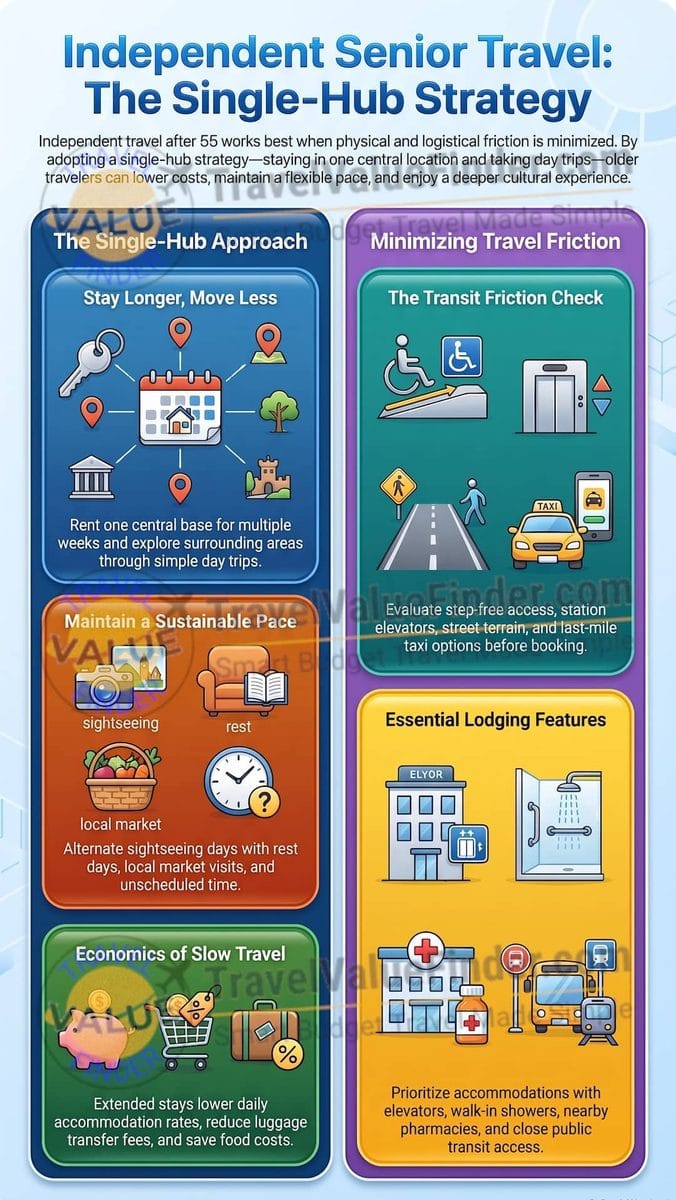
You don’t necessarily need to see five cities in seven days. You might be happier staying in one apartment for three or four weeks, shopping at the local market, taking the train to a nearby city for the day, and returning to the same comfortable bed every night.
That is the approach I call single-hub slow travel.
The idea is simple:
Stay longer. Move less. Explore more.
At Travel Value Finder, I look at senior travel from a practical perspective. A destination isn’t necessarily a good fit simply because it is beautiful or popular. For an independent older traveler, the questions are different.
- How much walking is involved?
- How easy is public transportation?
- What happens when your knees are tired?
- Can you get a comfortable apartment with a kitchen?
- Is there a supermarket nearby?
- Can you take a train somewhere interesting without changing three times?
And perhaps most importantly:
What does the trip actually cost when you stay long enough to live a little rather than rush through?
This guide explains how to think about those questions and how to use the Travel Value Finder destination audits to compare individual places.
Table of Contents
What Is Senior Travel?
Senior travel means traveling in a way that takes the needs, preferences, budget, and pace of older travelers into account. That doesn’t mean every senior traveler has the same requirements.
A healthy 58-year-old who loves hiking may travel very differently from a 78-year-old who prefers museums, cafés and short walks.
Rather than defining senior travel by age alone, I prefer to think about travel friction: the unnecessary physical, financial, and logistical problems that can make a trip harder than it needs to be.
- Excessive hotel changes
- Long airport transfers
- Steep hills
- Difficult stairs
- Unreliable transportation
- Uncomfortable accommodation
- Expensive short-term lodging
- Repeated luggage handling
- Long distances between everyday necessities
- Complicated connections
- Overly rushed itineraries
Reducing those problems doesn’t make travel boring. The less unnecessary friction a trip creates, the more enjoyable independent travel can become.
Why Slow Travel Often Makes More Sense After 55
When you’re working, a two-week vacation can encourage a certain type of travel: fly somewhere, see the major attractions, move to another city, and squeeze as much as possible into the available time.
Retirement can change that equation. If you have more flexibility, you can stay somewhere for three or four weeks rather than three or four nights.
The single-hub approach
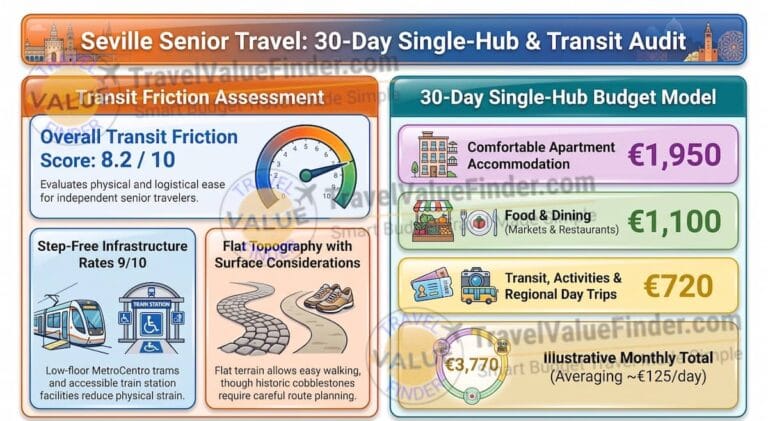
Imagine staying in Seville for 30 days. Rather than changing hotels every few days, you have one apartment, learn your neighborhood, find the supermarket, become familiar with local transportation, and take occasional day trips.
Córdoba one day. Jerez another. Cádiz another. You return to the same accommodation each evening.
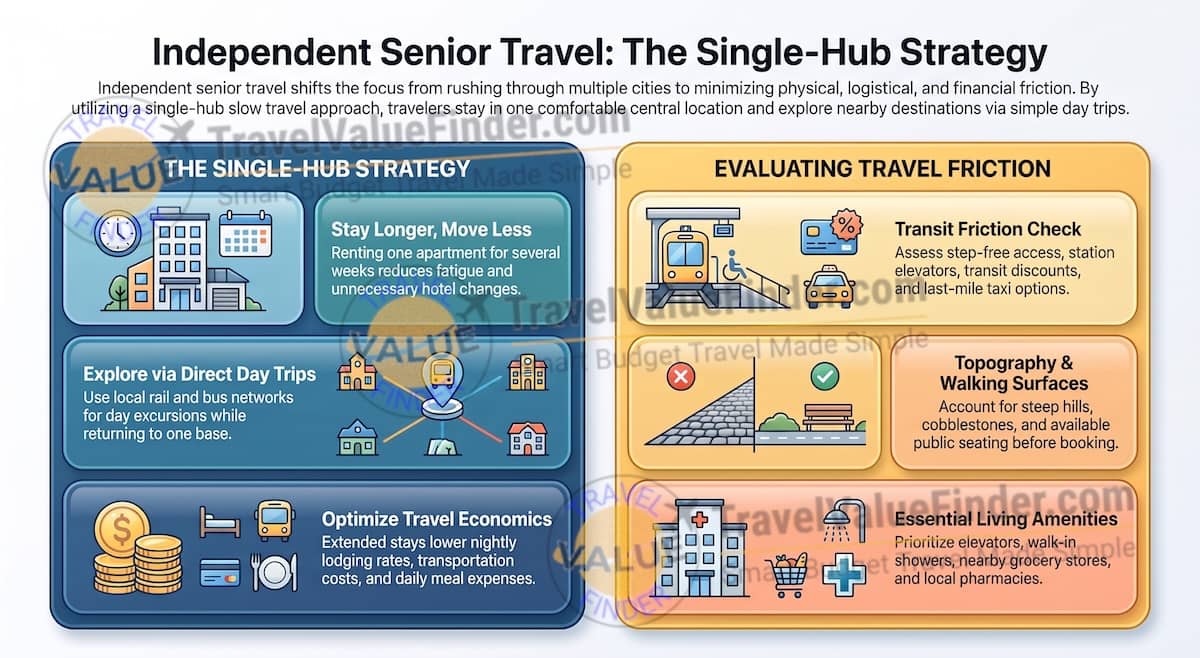
That is the basic idea behind the single-hub strategy. For a senior traveler, the ability to choose your pace can be just as important as the number of attractions available.
For a destination-specific example, see the Seville Senior Travel 30-Day Audit.
Senior Travel Is About More Than Finding a Beautiful Destination
A destination can look wonderful in photographs and still be difficult for an independent older traveler. Start by asking practical questions.
1. How easy is it to get around?
Look at trains, buses, trams, metro systems, taxis, rideshare availability, airport transfers, walking distances, elevators, and step-free access.
2. What is the terrain like?
Look at hills, uneven paving, cobblestones, long staircases, limited seating, and difficult crossings. These details can determine whether you spend the afternoon exploring or return to your hotel exhausted.
3. What happens when you get tired?
A good destination gives you alternatives. Can you take a taxi? Is there nearby public transportation? Can you shorten your walking route? Can you sit somewhere comfortably?
The Travel Value Finder Transit Friction Check
The Travel Value Finder destination audits use a Transit Friction framework.
The idea is straightforward: instead of simply saying that a city is “senior friendly,” examine the practical elements that create or reduce friction.
| Step-free infrastructure | Elevators, ramps, low-floor transit, and station access |
| Topography & surfaces | Hills, cobblestones, pavement, and walking conditions |
| Last-mile options | Taxis, rideshare, and alternatives when walking becomes difficult |
| Senior transit integration | Discounts, concessions, and ease of using public transportation |
This is a Travel Value Finder planning framework designed to help independent travelers ask better questions. It is not a medical accessibility rating or a universal scientific measurement.
Accommodation Matters Just as Much as Transportation
A senior-friendly trip can be ruined by the wrong hotel. For longer stays especially, I would look beyond the headline room rate.
Before booking, consider:
- Is there an elevator?
- Is the bathroom easy to use?
- Is there a walk-in shower?
- Is the bed comfortable?
- Is air conditioning or heating available when needed?
- Is there a supermarket nearby?
- Is there a pharmacy nearby?
- Is there a washing machine?
- Is there a kitchen?
- Is the neighborhood reasonably quiet at night?
- How far is the nearest public transportation?
- How far will you have to walk with luggage?
- Is there a nearby taxi stand?
- Does the accommodation offer weekly or monthly pricing?
For a three-night city break, some of these details may be minor. For a 30-day stay, they become major factors.
The Economics of Slow Senior Travel
Senior travel doesn’t automatically mean cheap travel. But having more time can create opportunities to reduce certain costs.
A longer stay can potentially reduce:
- nightly accommodation costs
- repeated transportation costs
- luggage-moving costs
- airport transfers
- restaurant spending
- attraction-hopping expenses
A kitchen can also provide flexibility. You don’t need to cook every meal; even breakfast, snacks, or an occasional simple dinner can change how you manage a longer trip.
How to Choose a Senior Travel Destination
Do you prefer cities or nature?
A well-connected city may suit travelers who enjoy museums, restaurants, markets, and public transportation. Beaches, mountains, and countryside create different transportation requirements.
How much walking are you comfortable with?
Travel involves more standing, unfamiliar streets, stairs, luggage, and navigation than a normal day at home. Build some margin into your plans.
Do you want one base or several?
If you enjoy unpacking once and settling in, look for cities that work well as regional hubs. If you enjoy moving frequently, a multi-city itinerary may still suit you.
How important is public transportation?
If you don’t want to rent a car, investigate the full chain from airport to accommodation, attractions, and regional destinations.
What is your preferred travel budget?
Calculate the whole trip: accommodation, food, local transportation, regional transportation, activities, and transfers.
Independent Senior Travel vs. Group Tours
Group tours can be a good choice for travelers who value organized transportation, guides, structured sightseeing, and social interaction.
Independent travel offers something different. You control your schedule, accommodation, pace, meals, sightseeing days, rest days, and transportation choices.
Independent travel doesn’t mean doing everything yourself. You can still use guided tours, taxis, trains, local guides, travel insurance, hotel assistance, and organized day trips.
The difference is that you build the trip around yourself rather than fitting yourself into somebody else’s timetable.
The important point is that independent travel doesn’t mean doing everything yourself.
A Better Senior Travel Pace
One of my favorite rules for independent travel is: Don’t confuse seeing more with experiencing more.
A three-week trip with six hotel changes may give you more destination names on your itinerary. A three-week trip with one or two bases may give you more time to actually experience the places.
Try building a week like this:
Day 1: Arrival and recovery
Day 2: Easy neighborhood exploration
Day 3: Major attraction
Day 4: Rest / local market / café
Day 5: Day trip
Day 6: Free day
Day 7: Optional activity
You don’t have to follow that exact schedule. The principle is what matters. Leave space in the itinerary.
Senior Travel After 55, 60 and 70
Age by itself doesn’t determine what type of travel you can enjoy. Your mobility, health, confidence, budget and interests matter much more.
But your priorities may change over time.
- At 55, you might be comfortable with a packed itinerary.
- At 65, you may decide that three nights in each city is enough.
- At 75, you might prefer one comfortable apartment for a month and occasional day trips.
None of these approaches is inherently better.
The objective is to build the trip around your current abilities and preferences rather than the way you traveled 20 years ago.
Slow Travel for Seniors
Slow travel means spending more time in fewer places rather than constantly changing hotels.
Instead of asking, ‘How many places can I see?’ try asking, ‘How long can I stay in one place and still have things I want to experience?’
A good slow-travel destination should ideally provide interesting neighborhoods, everyday shopping, restaurants and cafés, cultural attractions, reliable transportation, nearby day trips, comfortable accommodation, and reasonable long-stay options.
Senior Travel and Day Trips
The single-hub approach works particularly well when the surrounding region has good rail or bus connections.
- Easy departure from your base
- Direct or simple transportation
- Manageable walking
- Several hours of worthwhile sightseeing
- Easy return
- Your own bed waiting for you at night
Seville provides a useful example: it can serve as a base for regional excursions such as Córdoba, Jerez de la Frontera, and Cádiz.
See the Seville Senior Travel Audit for the detailed destination analysis.
How Travel Value Finder Evaluates Senior Travel Destinations
Rather than simply asking, ‘Is this city worth visiting?’ the destination audits ask, ‘How practical is this city as a comfortable independent base for an older traveler?’
| Accommodation value | Longer-stay options, comfort, convenience, and practical amenities |
| Transportation | Local transportation, taxis, regional connections, and ease of use |
| Physical friction | Terrain, surfaces, stairs, and walking distances |
| Last-mile options | What happens when walking is no longer practical |
| Regional access | Potential for convenient day trips |
| Food & everyday life | Shopping, dining, markets, and ordinary neighborhood needs |
| Overall travel value | The balance of comfort, convenience, experiences, and cost |
This approach is why the destination pages are not simply lists of attractions. They are destination audits for independent senior travel.
Senior Travel Destinations: Start With the Right Question
There is no universal list of the “best” senior travel destinations. The right destination depends on what you need. If you value:
Flat terrain
Investigate topography and walking surfaces.
Rail travel
Investigate station access and regional connections.
Long stays
Investigate apartment availability and monthly pricing.
Food and markets
Investigate neighborhood life rather than just tourist restaurants.
Warm weather
Investigate the season, not just the annual climate.
Independent travel
Investigate how easy it is to recover when something doesn’t go according to plan.
That’s the difference between choosing a destination because it looks good and choosing one because it fits the way you actually travel.
Senior-Friendly Travel Doesn’t Mean Perfectly Accessible Travel
Very few destinations are perfect. A city can have excellent public transportation but difficult historic sidewalks. Another can have flat terrain but poor rail connections. Another may be easy to walk around but expensive for long stays.
The objective is not to find a perfect destination. It is to understand the trade-offs before you book.
Build Your Own Senior Travel Checklist
Before booking a longer independent trip, I would check these areas.
Accommodation
- Elevator
- Comfortable bathroom
- Walk-in shower where possible
- Kitchen or kitchenette
- Laundry
- Quiet sleeping environment
- Supermarket nearby
- Pharmacy nearby
Transportation
- Airport transfer
- Local public transportation
- Taxi/rideshare alternatives
- Regional trains or buses
- Station accessibility
- Senior discounts where applicable
Physical comfort
- Terrain
- Pavement
- Cobblestones
- Hills
- Stairs
- Seating
- Walking distances
Financial planning
- Accommodation
- Food
- Local transportation
- Regional trips
- Attractions
- Travel insurance
- Emergency allowance
Medical and practical needs
- Access to pharmacies
- Nearby healthcare facilities
- Prescription requirements
- Travel insurance coverage
- Emergency contacts
Explore the Travel Value Finder Senior Travel Audits
This Senior Travel pillar is the starting point. The destination articles take the framework and apply it to individual cities.
Seville, Spain
Our Seville audit looks at Seville as a 30-day single-hub base, including accommodation economics, transportation, physical friction, and regional day-trip potential.
Read the complete Seville Senior Travel Audit →
More destination audits
The same approach will be applied to destinations such as:
- Porto
- Vienna
- Singapore
- Kyoto
- Chiang Mai
- San Antonio
The Bottom Line: Travel Differently, Not Less
Getting older doesn’t have to mean giving up independent travel. It may simply mean becoming more deliberate about how you travel.
- Fewer hotel changes
- Longer stays
- Better accommodation
- Slower mornings
- More rest days
- Comfortable transportation
- Regional day trips
- Local markets
- Fewer rushed attractions
- More time in one neighborhood
The goal isn’t to squeeze as many destinations as possible into a trip. It’s to create a trip that you still enjoy when the sightseeing ends and real life begins.
Stay longer. Move less. Explore more.
That’s the foundation of senior travel at Travel Value Finder.
Frequently Asked Questions About Senior Travel
What is senior travel?
Senior travel is travel planned around the practical needs and preferences of older travelers, including comfort, transportation, walking distances, accommodation, budget, health considerations, and pace.
Is independent travel safe for seniors?
Independent travel can be practical for many older travelers when the itinerary is matched to their abilities and includes sensible planning for accommodation, transportation, insurance, medication and emergencies. The appropriate level of independence varies from person to person.
What is slow travel for seniors?
Slow travel means spending more time in fewer places rather than constantly changing hotels. A senior traveler might use one city as a base for several weeks and take occasional day trips from there.
What is a single-hub travel strategy?
A single-hub strategy means choosing one destination as your base for an extended stay and exploring the surrounding region through day trips. It can reduce packing, hotel changes and transportation friction.
How should seniors choose a travel destination?
Consider more than attractions. Look at terrain, walking surfaces, public transportation, accommodation, healthcare access, food costs, long-stay accommodation, regional day trips and the availability of taxis or other last-mile transportation.
Is slow travel cheaper for seniors?
It can be, but it isn’t automatically cheaper. Longer stays may reduce some accommodation and transportation costs, while apartments with kitchens can provide additional flexibility. Actual savings depend on destination, season, accommodation and travel style.
What makes a city senior friendly?
There is no single definition. Useful characteristics can include practical public transportation, manageable terrain, comfortable accommodation, accessible stations, reliable taxis, nearby everyday services and convenient access to attractions and regional destinations.
Can seniors travel without joining a tour?
Yes. Many older travelers travel independently, although the appropriate level of independence depends on individual circumstances. Independent travelers can still use trains, taxis, local guides and organized day trips when useful.
What is the Travel Value Finder Transit Friction Score?
It is a planning framework used in destination audits to examine practical travel friction, including step-free infrastructure, terrain and surfaces, last-mile transportation and senior transit benefits. It is intended as a travel-planning tool rather than a medical or universal accessibility rating.
Sources
- US Department of State, Age 65+ Travelers
- US Department of State, Personal Travel Needs