Travel Value Finder

Why slow travel in retirement?
- slow travel is cheaper (weekly/monthly rentals save 20–50% vs. nightly hotel rates),
- healthier (less travel stress, more walking, deeper cultural engagement), and
- more meaningful.
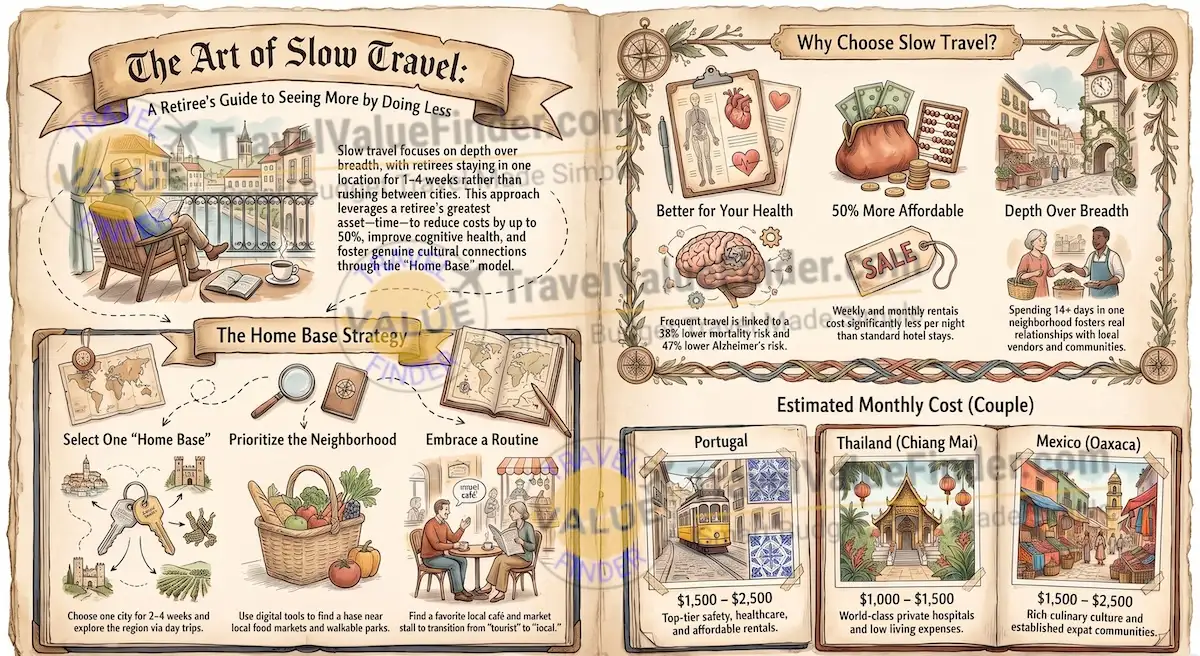
What is slow travel in retirement? It means staying in one place for 1–4 weeks instead of rushing between multiple destinations in a week.
Disclaimer: This article is for general informational purposes only and does not constitute financial, investment, tax, legal, immigration, or other professional advice. Costs and other figures are estimates and can change. Always verify current information and consult a qualified professional before making significant financial, travel, or retirement decisions.
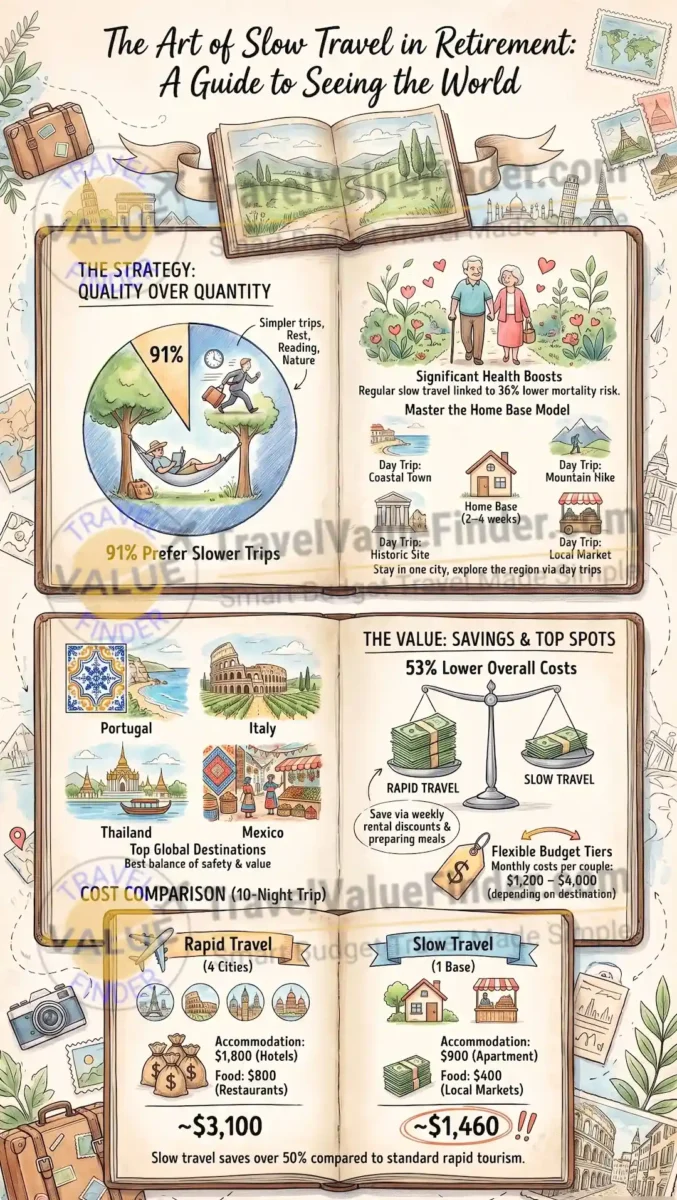
In 2026, 91% of travelers say they want slower, simpler trips (Vrbo), and slow travel has been named a defining trend of the year.
The home base model, one city or town as your base, day trips for variety is the gold standard.
Top slow travel destinations for retirees:
- Portugal (Lisbon, Alentejo),
- Italy (Tuscany, Puglia),
- Thailand (Chiang Mai),
- Mexico (Oaxaca, San Miguel de Allende),
- Greece (Peloponnese, lesser islands), and
- Colombia (Medellín).
Slow travel pairs perfectly with the retiree’s biggest asset, that is unlimited time flexibility.
Leslie Nics | TravelValueFinder.com | June, 2026 | Last reviewed: July 01, 2026
Table of Contents
What Is Slow Travel in Retirement? A Clear Definition
Slow travel means spending an extended period (typically 1–4 weeks or more) in one location rather than rushing between multiple destinations.
It emerged from the Slow Food movement and prioritizes depth over breadth, local connection over tourist checklists, and experience quality over quantity.
In 2026, 91% of travelers report interest in slow travel (Vrbo). The ‘Year of Slow Travel’ 2026 has been named by multiple travel industry trend reports.
Slow travel is the practice of spending an extended period in one location. Typically 1 to 4 weeks or longer rather than rushing between multiple cities or countries within a short trip.
It means living in a place rather than visiting it.
The concept emerged from the Slow Food movement founded in Italy in 1989, which was itself a reaction against fast food and globalized uniformity.
Just as Slow Food advocates savoring locally grown, traditionally prepared food over convenience, Slow Travel advocates savoring locally experienced places over a checklist of famous sites.
As Wellabe’s senior wellness guide summarizes:
“Slow travel seeks to eliminate the stress, both physical and mental, associated with taking a vacation. You choose quality over quantity by spending extended time in one location.”
In practical terms, slow travel retirement might look like:
- A month in a Lisbon apartment where you’ve found your café, your market vendor, your wine shop, and your walking route by day three.
- Two weeks in a Tuscany farmhouse where your day includes a morning cooking class, afternoon wine tasting, and dinner made from what you bought at the village market.
- Six weeks in Chiang Mai where the daily rhythm of morning market visits, afternoon temple exploring, and evening street food has become genuinely your rhythm.
- A full season in the Greek Peloponnese where you know the taverna owner’s name and he has your table.
The opposite of slow travel, rapid multi-city tourism, is what most people picture when they imagine a vacation. This is usually seven countries in eight days. Fourteen cities in three weeks. The cruise with fourteen ports.
For retirees who have spent decades rushing, slow travel offers something most working travelers never experience. It is the chance to actually know a place, even briefly, rather than just pass through it.
Why Slow Travel in Retirement Is a Natural Fit: 7 Reasons
Seven reasons slow travel suits retirees:
- Time flexibility enables mid-week travel and off-season stays saving 20–40%;
- Weekly/monthly rentals cost 20–50% less per night than hotels;
- Cooking 50% of meals saves $20–40/day per person;
- Reduced flight frequency cuts CO₂ emissions;
- Lower physical stress vs. daily packing and moving;
- Deeper cultural immersion delivers documented cognitive health benefits;
- Greater social connection through community building in one place.
Here is why slow travel and retirement are designed for each other in ways that most travel guides don’t fully explain:
| Reason | What It Means in Practice | The Financial / Health Payoff |
|---|---|---|
| 1. Time flexibility | You can always fly mid-week and in shoulder season | 20–40% savings on flights and accommodation vs. peak |
| 2. Weekly rental discounts | Airbnb/VRBO weekly rates vs. nightly hotel rates | 20–50% cheaper per night for 7+ night stays |
| 3. Home cooking savings | Apartment with kitchen – cook breakfast and lunch | Saves $20–40/day per person vs. restaurant every meal |
| 4. Fewer flights | One destination = fewer airports, fewer connections | Lower cost, lower CO₂, dramatically lower travel stress |
| 5. Less physical stress | No daily packing, unpacking, hotel check-in queues | More energy for the experiences that matter |
| 6. Cognitive health benefits | Deep cultural immersion stimulates brain differently than sightseeing | Linked to lower Alzheimer’s risk and mortality reduction |
| 7. Social connection | Build real relationships with locals and fellow travelers | The #1 predictor of well-being in retirement (Harvard) |
The financial case alone is compelling.
Kiplinger’s 2024 slow travel retirement guide notes that long-term rental options through Airbnb and VRBO “are often cheaper per night than hotels,”.
Cooking locally-sourced meals “cuts down on dining out costs but also deepens your connection to the area’s food culture.”
Real-world data from budget slow travelers bears this out:
- Earth Vagabonds, a couple who retired early and slow-traveled for 10 years, documented total spending of $306,824 for two people across a decade.
- An average of just over $30,000 per year for two people living and traveling full-time.
The health case is equally strong.
Retirement.media’s 2025 analysis cites research showing “reduced stress, regular movement, and exposure to new environments can support cognitive health and emotional resilience in older adults.”
Slow travel’s daily rhythm of gentle walking, cultural discovery, and social engagement delivers these benefits far more consistently than rushed tourism.
The Home Base Model: The #1 Slow Travel Strategy for Retirees
The home base model means choosing one city or town as your base for 2–4 weeks and taking day trips and overnight excursions from there, rather than constant relocation.
It eliminates daily packing stress, qualifies for weekly/monthly rental discounts, and builds the local connection that makes slow travel meaningful.
Ideal home base cities for retirees:
- Lisbon (D7 visa, safest globally),
- Porto,
- Chiang Mai (~$1,000/month),
- Oaxaca (~$1,200/month),
- Medellín (eternal spring), and
- Puglia’s smaller towns.
The most practical application of slow travel for retirees is what travel writers call the home base model:
- choosing one city or town as your primary base for 2–4 weeks (or longer) and using day trips, overnight excursions, and
- occasional short trains or buses to experience the wider region without relocating your accommodation every 2–3 days.
Here is why the home base model works so well for retirement travelers specifically:
- Eliminates daily packing stress: Your things stay in one place. You leave your suitcase behind and explore with a day bag. This single change reduces travel fatigue dramatically.
- Qualifies for weekly and monthly rental discounts: Airbnb, VRBO, and direct-book rentals all offer 7-night and 30-night price breaks. A 7-night stay at $80/night becomes $56–60/night with the weekly discount. A 30-night stay can drop another 20–30% on top.
- Builds genuine local connection: By day 5, you know the neighborhood. By day 10, people recognize you. By day 21, you’re having conversations that working tourists never have.
- Enables authentic food discovery: A kitchen + a local market = complete creative freedom. You cook what you found at the market yesterday and eat when you’re hungry, not when restaurants are open.
- Supports extended stays without visa issues: Many countries allow 90-day stays for Americans visa-free.
- With one home base, you maximize your time in that visa window without bureaucratic interruption.
How to Choose Your Home Base City
The best home base for a slow travel retirement trip has five qualities:
- it’s safe, it has good healthcare access,
- it has a flat or navigable neighborhood for daily walking,
- it has a local market within reasonable distance, and
- it’s interesting enough to reward 2–4 weeks of exploration.
Here are the criteria:
| What to Look For | Safety Score | Daily Cost | Healthcare | English | Best Neighborhood for Base |
|---|---|---|---|---|---|
| Walkable flat center | High | $70–110/day | Excellent | Widely spoken | Baixa-Chiado (Lisbon) |
| Local market within 15 min | High | $60–100/day | Good | Moderate | Ribeira or Boavista (Porto) |
| Residential (not tourist) zone | Moderate | $40–70/day | Excellent pvt | Good in expat areas | Nimman or Santitham (Chiang Mai) |
| Cultural richness for 3+ weeks | High | $50–80/day | Good | Good | Centro Histórico (Oaxaca) |
| Day trip network from base | High | $40–70/day | Good pvt | Good | El Poblado (Medellín) |
| Visa-friendly for 60+ days | High | $80–130/day | Excellent | Moderate | Lecce or Ostuni (Puglia) |
Home Base Rule:
- Choose a neighborhood, not just a city.
- The best home base is the one where the grocery store is around the corner, there’s a café you’ll love by day 3, and you can walk to a park.
- Spend 30 minutes on Google Street View before booking. Look for flat streets, a nearby market, and local restaurants all visible.
Best Slow Travel Destinations for Retirees in 2026
Top slow travel retirement destinations for 2026:
- Portugal (#1 consistently for affordability, safety, D7 visa),
- Italy’s Puglia and Tuscany (slower pace, lower cost than Rome/Milan),
- Thailand’s Chiang Mai (~$1,000/month, large expat community, world-class healthcare),
- Mexico’s Oaxaca and San Miguel (~$1,200–1,800/month, large US expat community),
- Greece’s Peloponnese and lesser Cyclades (Milos, Naxos),
- Colombia’s Medellín (eternal spring, $40–70/day).
Road Scholar confirms Portugal as consistently the top slow travel destination for its affordability, healthcare, and welcoming attitude.
The best slow travel destinations for retirees share a common profile:
- affordable enough for an extended stay,
- interesting enough to sustain 2–4 weeks of daily discovery,
- safe, and accessible to English-speaking travelers.
Here are the top destinations for 2026, with specific slow-travel insights beyond what general travel guides provide:
Portugal: The #1 Slow Travel Retirement Destination in 2026
Portugal has held the top spot in slow travel retirement recommendations for three consecutive years, and 2026 is no different.
Road Scholar’s slow travel retirement guide confirms: “Portugal consistently ranks among the best slow travel destinations for its affordability, excellent healthcare system, and welcoming attitude toward foreigners. The country’s compact size allows for thorough exploration without the need for constant relocation.”
What makes Portugal exceptional for the home base model:
- Lisbon and Porto are the ideal urban bases,
- while the Alentejo and Algarve regions offer rural alternatives.
A month-long apartment rental in Lisbon’s Príncipe Real or Chiado neighborhoods runs $1,200–2,500.
The D7 Passive Income Visa allows stays beyond 90 days for retirees with passive income from $760/month.
The country ranks #1 globally as the safest retirement country (International Living 2026) and #7 on the Global Peace Index.
- Lisbon home base (Príncipe Real/Chiado): Flat, walkable, surrounded by food markets, trams, and miradouros. Day trips: Sintra (40 min by train), Setúbal coast, Évora, and Cascais.
- Porto home base (Boavista/Ribeira): More affordable than Lisbon, smaller scale, extraordinary food scene. Day trips: Douro Valley wine country (1 hour), Braga, Guimarães, and the Minho coast.
- Alentejo farmhouse (Évora region): The ultimate rural slow travel base – cork oak forest, megalithic stone circles, ancient hilltop villages. Monthly farmhouse rentals from $800–1,500. Weekly markets and artisan food producers within 20 minutes of most properties.
Italy: Puglia and Tuscany for Authentic Slow Travel
Most slow travel guides recommend Rome or Florence as Italian bases. That’s a mistake.
Rome and Florence are tourist machines in peak season; Puglia and Tuscany’s smaller towns are where slow travel in Italy actually works. The slow food movement began in Italy, and nowhere is it more alive than in the towns that founded it.
Puglia home base (Lecce or Ostuni):
- Baroque architecture, flat historic centers, extraordinary local cuisine (burrata, orecchiette, taralli), and a pace of life that genuinely stops at 1pm for lunch and resumes at 5pm.
- Lecce is called the ‘Florence of the South’ for its Baroque architecture. Daily cost: $80–$130 for two in shoulder season.
- Day trips: Alberobello’s trulli, the Adriatic coast, Matera (1.5 hrs).
Tuscany home base (Montepulciano, Arezzo, or Cortona):
- Skip Florence and Siena as bases (too crowded, too expensive). The smaller hilltop towns offer the Tuscany of the imagination at a fraction of the cost.
- Cortona (Frances Mayes’ ‘Under the Tuscan Sun’) has a growing expat community, a flat main piazza, and a weekly market that is the neighborhood social event.
- Weekly villa rentals from $1,200–2,500.
Thailand: Chiang Mai for Asia’s Best Value Slow Travel Base
For retirees considering a longer-duration slow travel experience in Southeast Asia, Chiang Mai is the unrivaled choice.
Michele Ponte’s 2026 slow travel analysis notes that Chiang Mai “hosts thousands of remote workers, with monthly costs around $1,000 USD and widespread high-speed internet.”
For retirees, the arithmetic is even better:
- a couple can live comfortably in Chiang Mai for $1,500–2,100/month, including accommodation, all meals, activities, and local transport.
- The city has a world-class private hospital (Chiang Mai Ram), a well-established English-speaking expat and retiree community, and 300+ Buddhist temples to slowly explore.
- Thailand Retirement Visa (Non-OA): Available to travelers 50+ with approximately $25,000 in a Thai bank account. Renewable annually. Unlocks longer stays beyond the standard 30-60 day tourist visa.
- Best neighborhood for home base: Nimman (modern, coffee shops, flat streets) or Santitham (residential, quieter, close to local markets). Avoid the Old City as a home base – too touristy for extended living.
- Day trips from Chiang Mai: Doi Inthanon National Park (Thailand’s highest peak), Mae Rim elephant sanctuaries, Lamphun ancient temples, and the scenic Mae Hong Son Loop for longer excursions.
Mexico: Oaxaca and San Miguel de Allende
Mexico’s two standout slow travel retirement destinations, Oaxaca City and San Miguel de Allende offer:
- large, established American expat communities,
- UNESCO-listed historic centers,
- extraordinary food cultures, and proximity to the United States (direct flights from most major U.S. cities) that reduces both cost and logistical complexity.
Oaxaca City:
- UNESCO-listed city of pre-Columbian architecture, mezcal distilleries, 35 varieties of corn, and the most complex regional cuisine in Mexico.
- Monthly apartment rental in the Centro Histórico: $700–1,500. Daily cost for two: $60–90.
- Large and active expat retiree community with organized social events and English-speaking medical providers.
San Miguel de Allende:
- The most popular American retiree destination in Mexico, with an estimated 10,000+ U.S. expats.
- The historic center is a UNESCO World Heritage Site.
- Monthly cost for a couple: $1,500–2,500.
- The city is walkable (though hilly in parts), has a world-class culinary scene, and a social calendar rivaling any American city for English-speaking cultural events.
Greece: The Peloponnese and Lesser-Known Islands
Greece has been crowned the #1 retirement destination globally by International Living in 2026, but the smart slow traveler doesn’t base themselves in Santorini or Mykonos.
The Peloponnese peninsula and the lesser Cyclades islands (Milos, Naxos, Syros, Folegandros) offer the authentic Greek lifestyle that mass tourism has displaced from the famous islands.
Peloponnese home base (Nafplio or Kardamyli):
- Nafplio is Greece’s most romantic city. A fortified Venetian port town with a flat waterfront promenade, excellent restaurants, and Byzantine and Ottoman layers of history.
- Kardamyli (Patrick Leigh Fermor’s adopted village) is the Mani coast at its most authentic and beautiful.
- Both are within day-trip distance of Sparta, Mystras (a Byzantine ghost city), and the Voidokilia beach (arguably Greece’s finest).
Milos for island slow travel:
- 72 beaches on a single volcanic island, almost no mass tourism, extraordinary geology, and a fishing-village pace that rewards 2-week stays.
- Monthly apartment rental from the local market: $800–1,500.
- Daily cost for two: $80–$120.
Colombia: Medellín for Value and Eternal Spring
Medellín’s “eternal spring” climate (averaging 72°F year-round) and daily costs of $40–70 per person make it the most affordable quality slow travel destination in the Americas for retirees.
The El Poblado and Laureles neighborhoods are the most expat-friendly, with English-speaking services, reliable Wi-Fi, and internationally accredited private hospitals.
The city’s remarkable transformation from its troubled past to a 21st-century cultural center has been documented in major publications. It was named the world’s most innovative city in 2013 by the Urban Land Institute and has only improved since.
A month in Medellín runs $1,200–1,600 for a couple all-in.
The Pensionado visa allows extended stays for retirees with pension income from $750/month. Direct flights from Miami (3.5 hrs), New York (5 hrs), and Atlanta.
What Slow Travel Actually Costs: Real 2026 Budget Comparisons
Slow travel is consistently cheaper than standard tourism for extended trips.
Let’s compare the real numbers.
Here is a 10-night trip to Lisbon in two formats; standard rapid tourism vs. slow travel using actual 2026 prices:
| Cost Category | Standard Rapid Tourism (10 nights, 4 cities) | Slow Travel (10 nights, 1 Lisbon base) |
|---|---|---|
| Accommodation | $180/night × 10 = $1,800 (hotel) | $90/night Airbnb apt (weekly rate) = $900 |
| Meals (all restaurants) | $80/day × 10 = $800 | $40/day (50% home cooking) × 10 = $400 |
| Internal transport (trains/flights) | $300 (3 inter-city trains/flights) | $60 (day trips by metro/regional train) |
| Tours and activities | $200 (rushed, tourist-priced) | $100 (local, unhurried) |
| Stress cost (health impact) | High (daily packing, airports, check-ins) | Very low |
| TOTAL for 2 people | ~$3,100 | ~$1,460 |
| Savings with slow travel | ~$1,640 (53% cheaper) |
Key drivers of slow travel savings:
- Weekly rental discount: A 7-night Airbnb booking saves 20–40% vs. the equivalent nightly rate. A 30-night booking saves another 20–30% on top.
- Home cooking: A kitchen allows you to buy breakfast and lunch ingredients at a local market for $5–8/person vs. $15–25 at a café. Over a month, this saves $600–1,200 for a couple.
- Fewer flights: One destination = one round-trip flight. Four cities in two weeks = one round-trip plus 3–6 internal flights or train connections, each adding $50–$300 and 3–8 hours of transit stress.
- Off-peak access: With no fixed school-holiday schedule, retirees can always travel in shoulder season (20–40% below peak pricing) and on mid-week dates (20–30% cheaper on flights).
How to Plan Your First Slow Travel Retirement Trip: A Step-by-Step Guide
Steps to planning a first slow travel retirement trip:
- Choose a destination with a 7–21 day minimum stay goal;
- Find your neighborhood before booking (Google Street View + Airbnb neighborhood filter);
- Book a 7-night stay with option to extend;
- Research the local market within 15 minutes walking;
- Buy travel insurance within 14–21 days of first deposit;
- Arrive with no fixed agenda for the first 2–3 days;
- Let routine develop naturally.
The biggest mistake is over-planning the days instead of letting the destination unfold.
Step 1: Choose Your Destination and Minimum Stay Length
The minimum effective slow travel stay is 7 nights. This is enough to get past tourist mode and into a rhythm.
The ideal first slow travel trip for retirees is 10–14 nights in a single location. This gives you:
- Days 1–2: Orientation and jet lag adjustment. No pressure. Explore the neighborhood.
- Days 3–5: You find your café, your market, your daily walk. The place starts to feel familiar.
- Days 6–9: You’re comfortable enough to go deeper. The hidden restaurant. The quiet garden. The conversation with a local.
- Days 10–14: You know this place. You’ll miss it. This is slow travel working.
Create your own itinerary with our Trip Planner to your chosen destination. Free PDF download. No account sign-in required.
Step 2: Research the Neighborhood, Not Just the City
The most common slow travel planning mistake is choosing a city without thinking about which neighborhood to base yourself in.
In Google Maps, search for the city then use Google Street View to virtually walk the streets around any rental before booking.
Look for:
- a food market or grocery store within 10–15 minutes walk;
- local (not tourist) restaurants on the adjacent streets;
- flat terrain or manageable hills;
- visible park or green space for morning walks.
Step 3: Book a 7-Night Stay and Plan to Extend
Book accommodation for your first week. Don’t book all four weeks in advance especially for your first slow travel trip.
The host may have additional availability later. The city may surprise you and make you want to move to a different neighborhood;
Or you may discover a completely different part of the country you’d rather explore.
Arrive with a loose plan and give yourself the flexibility that retirement makes possible.
On Airbnb and VRBO, look for the ‘long-stay discount’ feature. Most hosts set 7-night and 30-night automatic discount tiers.
The weekly rate is usually 15–25% below the nightly rate; the monthly rate is often 30–50% below.
Ready to book? Compare real-time flight and hotel prices through our trusted search partner. We earn a small commission at no extra cost to you, which helps keep guides like this one free.
Step 4: Plan Your Market Before You Plan Your Itinerary
Before you research museums, restaurants, and tours at your destination, research the local food market.
Knowing when it operates (most European markets are Saturday mornings; Mediterranean markets run daily or 3x/week) and how to get there organizes your week in a way that no tourist itinerary can.
The market is where you buy breakfast for the week. You will discover local ingredients, interact with vendors, and understand what the city actually eats.
It’s the single most powerful acculturation ritual in slow travel.
Step 5: Buy Travel Insurance Within 14–21 Days of Your First Deposit
Important: Medicare provides zero coverage outside the United States. This is non-negotiable for any international slow travel.
Purchase comprehensive travel insurance with emergency medical ($100,000+ minimum) and medical evacuation ($250,000+) within 14–21 days of your first trip deposit to qualify for the pre-existing conditions waiver.
For extended stays (4+ weeks), consider an annual multi-trip policy (~$300–500/year) which often proves cheaper than per-trip policies.
Step 6: Arrive With No Agenda for the First Two Days
This is the hardest instruction for retirees who’ve spent decades being productive.
Your first two days are for getting over jet lag, finding your bearing, and discovering the neighborhood organically.
Walk without a destination. Eat wherever looks good. Sit in the nearest park for an hour. Let the place come to you rather than forcing yourself through it.
The itinerary can wait. The slow travel experience begins the moment you stop treating arrival as the start of a checklist.
Step 7: Build a Local Routine as Fast as Possible
The sign that slow travel is working is when you have a routine;
- A morning walk route.
- A café where they know your order.
- A specific market stall where the vendor expects you on Saturday.
- A favorite dinner spot where they don’t bring you the tourist menu.
These routines don’t happen on rushed trips.
They are the exclusive reward of slow travel. They are what you will remember about a place long after you’ve forgotten the museum.
Frequently Asked Questions: Slow Travel in Retirement
What is slow travel in retirement?
Slow travel in retirement means spending an extended period. This is typically 1 to 4 weeks or longer in one location rather than rushing between multiple cities or countries. It prioritizes depth over breadth. Living in a place rather than visiting it.
Is slow travel cheaper than regular vacation travel?
Yes, significantly, especially for extended trips. The financial advantages compound. For weekly and monthly rental discounts save 20–50% vs. nightly hotel rates. Home cooking saves $20–40/day per person vs. every meal in a restaurant. Fewer flights eliminate internal transport costs, and off-peak travel is always possible since retirees have no fixed schedule.
How long should a slow travel trip be?
The minimum effective slow travel stay is 7 nights in one location. The ideal for a first-time retiree slow traveler is 10–14 nights.
What are the best slow travel destinations for retirees in 2026?
The top slow travel retirement destinations in 2026: Portugal (Lisbon, Porto, or Alentejo, safest globally, D7 visa, affordable), Italy (Puglia or Tuscany hill towns, not Rome or Florence), Thailand (Chiang Mai – ~$1,000–1,500/month, world-class private healthcare), Mexico (Oaxaca or San Miguel de Allende – direct U.S. flights, large expat communities), Greece (Peloponnese or Milos – authentic vs. overtouristed), and Colombia (Medellín – eternal spring climate, $40–70/day).
How does slow travel affect your health as a retiree?
Positively, and dramatically so. The GCOA/Transamerica 2025 study links regular travel to a 36% reduction in mortality risk and 47% lower Alzheimer’s risk.
Do you need a visa for slow travel stays longer than 90 days?
For most popular slow travel destinations, Americans can stay 90 days visa-free (Schengen zone Europe, Thailand, Mexico, Colombia). For longer stays: Portugal’s D7 Passive Income Visa (from ~€760/month income), Panama’s Pensionado Visa ($1,000/month pension), Thailand’s Non-OA Retirement Visa (50+, ~$25,000 in Thai bank), and Mexico’s Temporary Resident Visa (~$2,300/month) are the most practical options for American retirees wanting extended slow travel stays.
Sources
- Money.com: Slow Travel Retirement Cut Costs, April 2026
- Kiplinger: Five Benefits of Slow Travel in Retirement
- Road Scholar: Why Slow Travel Retirement Is a Growing Trend
- Retirement.media: The Rise of Slow Travel 2025
- AOL Finance: 91% of Travelers Want Slow Travel 2026
- Michele Ponte: Slow Travel Tips Americans 2026
- ednandt.com: The 2026 Travel Trend – Fewer Places, Longer Stays
- Earth Vagabonds: 10 Years of Budget Slow Travel Cost
- Wellabe: Older Adults Use Slow Travel to Turn Trips into Experiences |
- GCOA / Transamerica Institute: Travel & Longevity 2025
- AARP 2026 Travel Trends Survey
- IPX1031: 2026 Americans Travel Report