Travel Value Finder

The best travel tips for retirees in 2026 focus on four pillars;
- saving money (mid-week flights, shoulder season, senior discounts),
- staying safe (travel insurance, STEP enrollment, TSA Cares),
- staying healthy (medication management, jet lag strategies, rest days), and
- traveling smarter (slow travel, group tours, booking platform comparison).
This guide covers all 20. Each one actionable, specific, and tested.
Disclaimer: This article is for general informational purposes only and does not constitute financial, investment, tax, legal, immigration, or other professional advice. Costs and other figures are estimates and can change. Always verify current information and consult a qualified professional before making significant financial, travel, or retirement decisions.
Leslie Nics, TravelValueFinder.com | Last updated: May 2026 | Last Reviewed: May 27 2026
I’m Leslie Nics, a retiree who has traveled to 30+ countries on a fixed income and built TravelValueFinder.com to share what actually works. These 20 tips are the ones I use personally, and the ones I recommend to every retiree who asks me where to start.
Table of Contents
All 20 Senior Travel Tips at a Glance
| # | Category | Tip | Key Benefit |
|---|---|---|---|
| 1 | Money | Fly mid-week (Tue/Wed) | Save 20-30% on flights |
| 2 | Money | Travel shoulder season | Save 20-40%, fewer crowds |
| 3 | Money | Compare 3 booking platforms | Save 15-25% on hotels |
| 4 | Money | No-FX-fee travel credit card | Eliminate 2-3% transaction fees |
| 5 | Money | Use points & miles | Free or heavily discounted flights |
| 6 | Safety | Buy travel insurance every trip | Medicare doesn’t cover abroad |
| 7 | Experience | Embrace slow travel | Save money, gain depth |
| 8 | Comfort | Request wheelchair assistance | Less fatigue, priority boarding |
| 9 | Safety | Get REAL ID compliant | Required for all U.S. domestic flights |
| 10 | Safety | Call TSA Cares 72hr before | Specialist help through security |
| 11 | Health | Pack meds in carry-on only | Protect against lost luggage |
| 12 | Health | Manage jet lag proactively | Arrive ready to enjoy Day 1 |
| 13 | Money | Ask for senior discounts everywhere | Rarely advertised, always available |
| 14 | Money | Use memberships for free entry | 225+ free museums (BofA card) |
| 15 | Comfort | Enroll in TSA PreCheck/Global Entry | Faster security & re-entry |
| 16 | Safety | Register with STEP (Embassy) | Emergency alerts & evacuation help |
| 17 | Comfort | Choose accessible accommodation | Comfort & mobility assurance |
| 18 | Connectivity | Get international SIM / eSIM | Stay safe, navigated & connected |
| 19 | Health | Build in rest days | Prevents fatigue, sustains enjoyment |
| 20 | Experience | Try guided tours or group travel | Support, connection & logistics ease |
Discover How to Travel Europe by Rail as a Retiree: Passes, Tips & Routes. Explore The Best River Cruises for Retirees in 2026 (Value & Comfort Compared).
Money-Saving Travel Tips for Retirees (Tips 1-5)
These five tips alone could save you $500-2,000 on a typical two-week international trip.
They are also where the retiree time advantage pays off most directly.
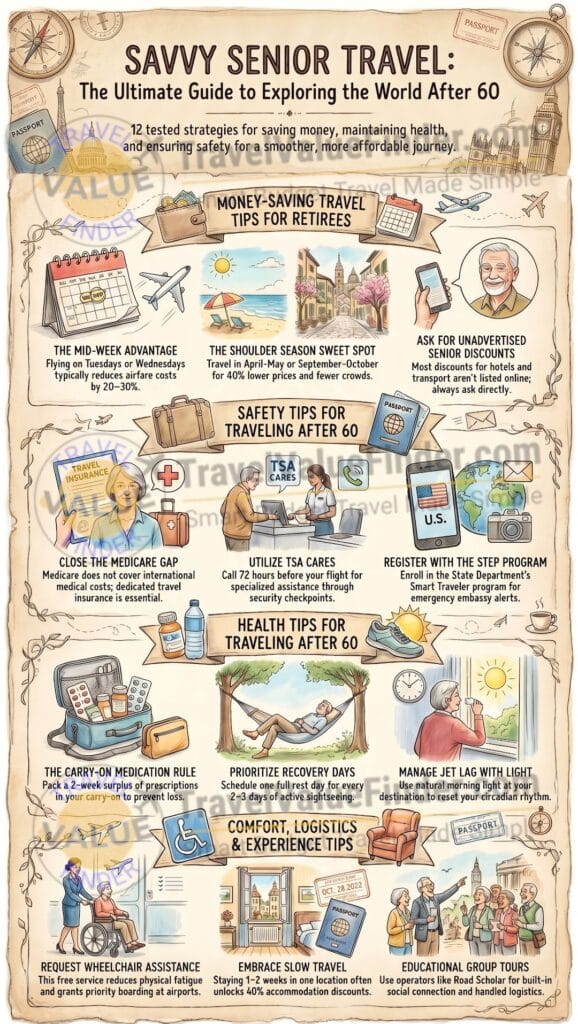
Tip #1: Travel Mid-Week to Save Up to 30% on Flights
One of the greatest perks of retirement is that Tuesday and Wednesday are no different from Saturday.
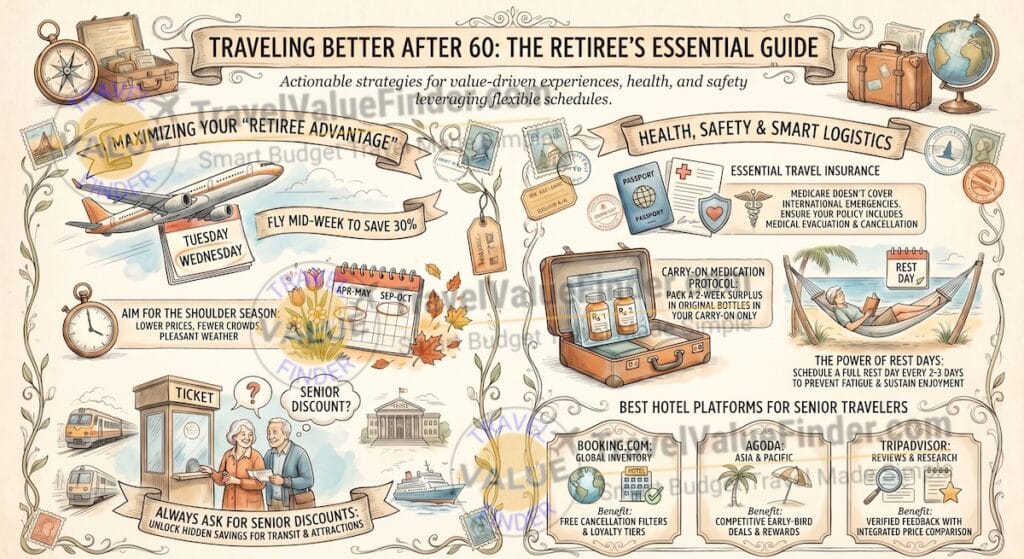
Airlines price Tuesday and Wednesday departures 20-30% lower than weekend flights on the same routes.
As a retiree, you can always fly on the cheapest day, not the most convenient one. Set this as your default and the savings stack up fast.
Pro Tip: Use Google Flights’ “Flexible Dates” grid to see the whole month at once. The cheapest days light up instantly.
Tip #2: Travel Shoulder Season, Not Peak, Not Off-Peak
Peak season means crowds and inflated prices.
True off-season can bring closed attractions and bad weather.
Shoulder seasons are;
- April-May and September-October for Europe;
- February-March for Southeast Asia.
These hit the sweet spot with good weather, thinner crowds, and prices 20-40% below summer highs. Retirees have the flexibility to hit this window every time.
Pro Tip:
Portugal in April is arguably the finest travel value in Europe with;
- mild weather,
- near-empty tourist sites, and
- hotel rates well below June pricing.
Tip #3: Always Compare Hotels Across Multiple Booking Platforms
The same room can vary by 15-25% depending on which site you check.
Booking.com, Agoda, and Hotels.com each have exclusive inventory and pricing.
Never book the first price you see. Checking three platforms before confirming is the single habit that saves most retirees hundreds of dollars per trip.
Search via Booking.com, Agoda, and Hotels.com before every booking. It takes 5 extra minutes and consistently pays off.
Tip #4: Get a No-Foreign-Transaction-Fee Travel Credit Card
If you’re paying foreign transaction fees (typically 2-3% per purchase) on international trips, you’re leaving real money behind.
Travel credit cards like the Chase Sapphire Preferred, Citi Strata Premier, and AARP’s own travel card eliminate these fees entirely.
Many also offer travel protections, airport lounge access, and points worth 1.5-2x cents toward future travel.
Pro Tip:
- Always pay in local currency when prompted at international payment terminals.
- “Dynamic Currency Conversion” to USD always uses a worse exchange rate.
Tip #5: Use Points and Miles to Dramatically Reduce Flight Costs
Travel rewards programs are one of the most underused tools for retirees on fixed incomes.
Credit card sign-up bonuses alone, often 60,000-75,000 points, can cover a round-trip international flight.
Delta SkyMiles, Chase Ultimate Rewards, and Marriott Bonvoy points can be accumulated through everyday spending and redeemed for flights, hotel stays, and upgrades.
Pro Tip:
AARP members get access to exclusive travel deals and reward programs via the AARP Travel Center. Start there if you’re an AARP member.
Safety Tips for Traveling After 60 (Tips 6, 9, 10, 16)
Safety planning is not pessimism. It’s the thing that lets you travel confidently.
These four tips form the non-negotiable safety foundation for every senior traveler.
Tip #6: Always Buy Travel Insurance – Every Single Trip
Medicare does not cover you internationally.
An air ambulance evacuation from Europe or Asia can cost $50,000-$100,000+ out of pocket.
For retirees, travel insurance is not optional, it’s essential.
Ensure your policy covers: emergency medical ($100,000+ minimum), medical evacuation ($250,000+), trip cancellation, and pre-existing conditions.
Purchase within 14-21 days of your initial trip deposit to qualify for the pre-existing conditions waiver.
Pro Tip:
- Average cost in 2026: around $307 for a 15-day trip (SquareMouth data).
- Compare plans at SquareMouth.com or InsureMyTrip.com.
Tip #9: Secure Your REAL ID Before Any Domestic U.S. Flight
As of May 7, 2025, REAL ID is required for all domestic U.S. flights.
Your driver’s license must display a gold or black star in the upper corner to be compliant.
If you no longer drive regularly or have an older license, check compliance now.
A U.S. passport is always an acceptable alternative and doubles as international ID.
Pro Tip:
- Check your state DMV’s website for REAL ID application requirements.
- Processing times vary. Apply at least 4-6 weeks before travel.
Tip #10: Call TSA Cares 72 Hours Before Any Flight
TSA Cares (855-787-2227) is a free helpline that connects you with a Passenger Support Specialist who assists you through security screening.
This is especially valuable if you have metal implants, a pacemaker, portable oxygen equipment, or mobility limitations.
You can also request a private screening room if you prefer. This service is specifically designed for older and disabled travelers.
Pro Tip:
- Call weekdays 8am-11pm ET, weekends 9am-8pm ET.
- Call exactly 72 hours ahead for best coordination.
Tip #16: Register Your Trip with the U.S. Embassy (STEP Program)
The Smart Traveler Enrollment Program (STEP) at step.state.gov is a free U.S. State Department service that registers your international trip.
It also provides emergency alerts, safety notifications, and a way for the embassy to contact you in a crisis. It also makes it easier for family members to locate you in an emergency.
Takes 5 minutes to enroll. Do it for every international trip.
Pro Tip:
- While enrolled in STEP, also share your itinerary with one trusted person at home.
- A simple email with hotel names, dates, and a copy of your passport is helpful.
Health Tips for Traveling After 60 (Tips 11, 12, 19)
Health management becomes a more active part of travel after 60.
These three tips address medications, jet lag, and the single most overlooked element of senior travel; rest.
Tip #11: Pack a Comprehensive Medication Kit in Your Carry-On Only
Never put medications in checked luggage. Bags get lost, delayed, or stolen.
Carry a 2-week surplus (beyond your trip length) of all prescriptions in original bottles.
Bring a written medication list using generic names, as brand names differ internationally.
Carry a brief doctor’s summary translated into the local language for longer or more remote trips.
Keep your medication kit in an interior carry-on pocket, not your main bag.
Pro Tip:
- Use a color-coded pill organizer by day AND keep full prescription bottles as backup.
- Customs officers may ask to see original packaging.
Tip #12: Manage Jet Lag Proactively with Science-Backed Strategies
Jet lag hits harder after 60.
The CDC’s 2026 Yellow Book recommends;
- adjusting your sleep schedule 2-3 days before departure,
- staying hydrated on the flight (avoid alcohol and caffeine),
- exposing yourself to natural morning light at your destination to reset your circadian rhythm, and
- napping strategically (no more than 20 minutes to avoid deep sleep cycles).
For eastward travel (harder on the body), consider melatonin 0.5-5mg taken at your destination’s bedtime for the first 2-3 nights.
Pro Tip:
- Wearing compression socks during flights improve circulation and reduce fatigue.
- especially important for flights over 4 hours.
Tip #19: Build Rest Days Into Every Itinerary
This is the tip most retirees resist and then wish they’d followed.
After every 2-3 days of active sightseeing, schedule a complete rest day;
- to sleep in,
- visit a local café,
- do gentle walking only.
Rest days prevent the accumulated fatigue that turns the second half of a trip into an endurance event.
They also give you space to discover something unexpected like the best local restaurant, a street market, or a hidden viewpoint.
Pro Tip:
- Think of rest days not as ‘lost’ travel days but as the fuel that makes the active days sustainable.
- The best travelers after 60 are the ones who pace themselves.
Comfort, Logistics & Experience Tips (Tips 7, 8, 13-18, 20)
These tips address how to move through airports with;
- less stress,
- stay connected internationally,
- choose the right accommodation, and
- make the most of your time at your destination.
Tip #7: Embrace Slow Travel. Stay Longer, Spend Less, Enjoy More
Staying in one place for 1-2 weeks instead of moving every 2-3 days saves on transport, reduces physical fatigue, and often unlocks weekly accommodation discounts of 20-40%.
You’ll also discover neighborhoods, restaurants, and routines that brief visitors miss entirely.
The “home base” model like renting an apartment in one city and taking day trips is ideal for traveling after 60.
Pro Tip:
- Apps like Airbnb, VRBO, and Booking.com all offer weekly discount rates.
- Always look for the 7-night rate before booking nightly.
Tip #8: Request Wheelchair Assistance Even If You Don’t Use One
Airport wheelchair assistance is free, and available to anyone who requests it.
This dramatically reduces the physical stress of flying.
It means you skip the long terminal walks, get priority security screening, and board first.
If you have any joint pain, fatigue, or mobility concern or simply want to conserve energy for your destination, request it when booking your flight.
There’s no eligibility requirement.
Pro Tip:
- Request it during online check-in or by calling your airline directly.
- Most carriers ask for 48-hour notice for the best service.
Tip #13: Ask for Senior Discounts Everywhere – They’re Rarely Advertised
Senior discounts exist at airlines, hotels, car rental companies, museums, national parks, trains, and restaurants.
The vast majority are never displayed on websites or menus.
The America the Beautiful Senior Pass gives lifetime access to all U.S. National Parks for just $80 (free for those 80+).
Amtrak offers 15% off for travelers 62+. Always ask. The worst answer is no.
Pro Tip:
- AARP membership ($16/year) unlocks discounts at Avis, Budget, IHG, and hundreds of other travel-related businesses.
- It pays for itself on a single rental.
Tip #14: Use Memberships to Get Free Museum and Attraction Entry
Bank of America’s Museums on Us program offers free admission to 225+ museums on the first full weekend of every month.
Just show your card. Many public libraries loan museum passes.
The American Horticultural Society’s Reciprocal Garden Network grants access to 360+ gardens nationwide with a single membership.
AAA, AARP, and the Smithsonian Institution all offer reciprocal benefit networks that retirees significantly underuse.
Pro Tip:
- Before any trip, Google “[city name] free museum days” and “AAA/AARP discounts [city]”.
- You’ll often find 5-10 free or heavily discounted options.
Tip #15: Enroll in TSA PreCheck or Global Entry
TSA PreCheck ($78, valid 5 years) lets you use dedicated lanes with no shoe removal, no laptop unpacking, and no liquids bag required.
Global Entry ($100, valid 5 years) adds automatic customs clearance on re-entry to the U.S. This is priceless after a long international flight when you just want to get home.
Many travel credit cards reimburse the application fee entirely.
Pro Tip:
- Chase Sapphire Reserve, Citi Strata Premier, and several AARP-branded cards include TSA PreCheck/Global Entry fee credits.
- Check your current card first.
Tip #17: Choose Accessible Accommodations Strategically
Not all accessible rooms are created equal.
When booking, call the hotel directly (not just the website) to ask specific questions:
- Is the accessible room near the elevator?
- Does the walk-in shower have a fold-down seat?
- Is there a threshold at the entrance?
- Are the hallways wide enough for a walker or wheelchair?
Ground-floor rooms eliminate elevator dependence entirely.
Many boutique hotels in historic buildings have charm but no elevator, always confirm.
Pro Tip:
- When using Booking.com or Agoda, filter for ‘Facilities for Disabled Guests’ and then call to verify specifics.
- Filter labels are often inconsistently applied.
Tip #18: Get an International SIM Card or Global Data Plan Before You Go
Staying connected internationally no longer requires paying $15/day in roaming fees.
Options in 2026:
- Purchase a local SIM at your destination airport (cheapest, from $2-15 for ample data);
- Buy a global eSIM via apps like Airalo or Holafly before departure;
- Activate your U.S. carrier’s international plan.
Google Maps offline maps, translation apps, and emergency contact access are non-negotiable safety tools for retirees traveling after 60.
Pro Tip:
- Download offline Google Maps for your destination before departure.
- It works without any data connection and has saved countless travelers from being truly lost.
Tip #20: Travel with a Community. Guided Tours and Group Travel Work for Retirees
Solo travel is wonderful, but group travel and guided tours solve a unique set of challenges for travelers over 60;
- logistics are handled,
- you never eat alone,
- social connection is built in, and
- physical support is naturally available.
According to AARP, cruise bookings jump from 15% among travelers 50-59 to 28% among those 70 and older, reflecting a deliberate preference for supported, social travel.
Look into Road Scholar, AARP Travel, and small-group tour operators for itineraries specifically designed for active retirees.
Pro Tip:
- Road Scholar (roadscholar.org) offers 5,500+ educational travel programs in 150 countries, specifically designed for adults 50+.
- Programs include expert lectures, cultural immersion, and built-in social connection.
Where to Book Hotels for Your Retirement Travel
Applying Tip #3 in practice: here are the three platforms I compare before every hotel booking.
Each has unique inventory and pricing. The differences can be significant.
Our best hotel booking sites guide covers this in full detail, including the exact comparison process I use on every trip.
| Platform | Best For | Retiree Advantage | Search Link |
|---|---|---|---|
| Booking.com | Widest global inventory | Free cancellation filters, Genius loyalty tier | Booking.com |
| Agoda | Best rates in Asia & Pacific | Early-bird deals, loyalty rewards | Agoda |
| TripAdvisor | Reviews + booking combined | Verified reviews, price comparison | Hotels.com |
I’ve never found a magic bullet for hotel bookings but I’ve found a consistent method. Compare three sources, understand what type of deal you need, and never book the first price you see. That single discipline has saved me thousands. Leslie Nics, TravelValueFinder.com
Explore the Senior-Friendly Cities in Europe: Best Places to Visit Over 60.
Frequently Asked Questions: Travel Tips for Retirees
What is the most important travel tip for retirees over 60?
Travel insurance is non-negotiable. Medicare provides no international coverage, and a single medical evacuation can cost $50,000-$100,000+. Purchase a policy with at least $100,000 in emergency medical coverage and $250,000 in evacuation coverage, and buy it within 14-21 days of your initial trip deposit to qualify for the pre-existing conditions waiver.
How can retirees save money on travel in 2026?
The five highest-impact strategies: (1) fly mid-week for 20-30% lower fares, (2) travel shoulder season for 20-40% savings across the board, (3) always compare three hotel booking platforms before confirming, (4) ask for senior discounts everywhere, and (5) use travel credit card points to offset or eliminate flight costs.
Is traveling after 60 safe?
Yes, with the right preparation. The key steps: enroll in the STEP program before every international trip, carry comprehensive travel insurance, pack medications in carry-on with a doctor’s summary, have REAL ID or passport for U.S. domestic flights, and call TSA Cares 72 hours before departure if you need assistance through security.
What is the best travel style for seniors in 2026?
Slow travel. Staying 1-2 weeks in one location rather than moving every 2-3 days is the most universally recommended style for travelers after 60. It reduces physical fatigue, unlocks weekly accommodation discounts of 20-40%, and produces a richer, more immersive experience. The “home base” model (one city, multiple day trips) is the most practical implementation.
Should retirees use guided tours or travel independently?
Both work. The choice depends on your energy, budget, and preferences. Guided tours and group travel handle logistics, provide built-in social connection, and offer physical support when needed. Independent travel offers maximum flexibility and is often cheaper. Many retirees blend both: independent for familiar destinations, guided for complex or remote itineraries.
Sources
- AARP 2026 Travel Trends Survey
- Kiplinger: 12 Retiree Travel Tips
- Kiplinger: 15 Money-Saving Tips
- CDC Yellow Book 2026 (Jet Lag)
- TSA Cares (tsa.gov)
- SquareMouth Senior Insurance 2026
- SeniorSite: 15 Senior Travel Tips 2026
Affiliate Disclaimer: Some links in this article are affiliate links. We may earn a referral commission on qualifying bookings at no additional cost to you