Travel Value Finder


What are the best places to visit in retirement? I’ve selected 50 destinations and travel experiences across the world, organized by region, pace, budget, and the type of trip they offer. From European classics and Asian cultural cities to Latin American value destinations and unforgettable nature experiences, this list is designed to help retirees decide where to go next.
The best places to visit in retirement span six categories:
- U.S. domestic gems (Asheville, Sedona, Charleston, San Antonio, Door County),
- European classics (Santorini, the Algarve, the Dolomites, Slovenia, the Amalfi Coast),
- Asian cultural icons (Kyoto, Chiang Mai, Bali, Taipei),
- Latin American value destinations (Uruguay, Costa Rica, Mexico’s colonial cities, Patagonia),
- Africa and the Middle East (Namibia, Petra, Cape Town, Marrakech), and
- slow-travel/nature experiences (Norwegian fjord cruises, the Galápagos, national park road trips, river cruises).
Looking for more than destinations? My Retirement Travel Bucket List focuses on 50 memorable experiences to have after 60, from natural wonders and cultural journeys to slow travel retreats.
Disclaimer: This article is for general informational purposes only and does not constitute financial, investment, tax, legal, immigration, or other professional advice. Costs and other figures are estimates and can change. Always verify current information and consult a qualified professional before making significant financial, travel, or retirement decisions.
Leslie Nics | TravelValueFinder.com | June, 2026 | Last reviewed: June 21, 2026
THIS GUIDE’S 50-DESTINATION BUCKET LIST is organized into 6 regional categories with;
- accessibility ratings,
- best-season timing, and
- budget tiers for each entry –
- plus extensive review on the 10 highest-value picks.
Table of Contents
Why Retirement Is the Best Time to Build (and Actually Use) a Travel Bucket List
There’s a particular kind of freedom that arrives with retirement that almost nothing else in life replicates:
- the freedom to travel on a Tuesday in October instead of a Saturday in July,
- to spend five unhurried days in a single town instead of cramming in five cities in five days, and
- to finally visit the places you’ve been mentally filing away for decades, one folder at a time.
How We Built This List: What Makes a Destination Retirement-Friendly
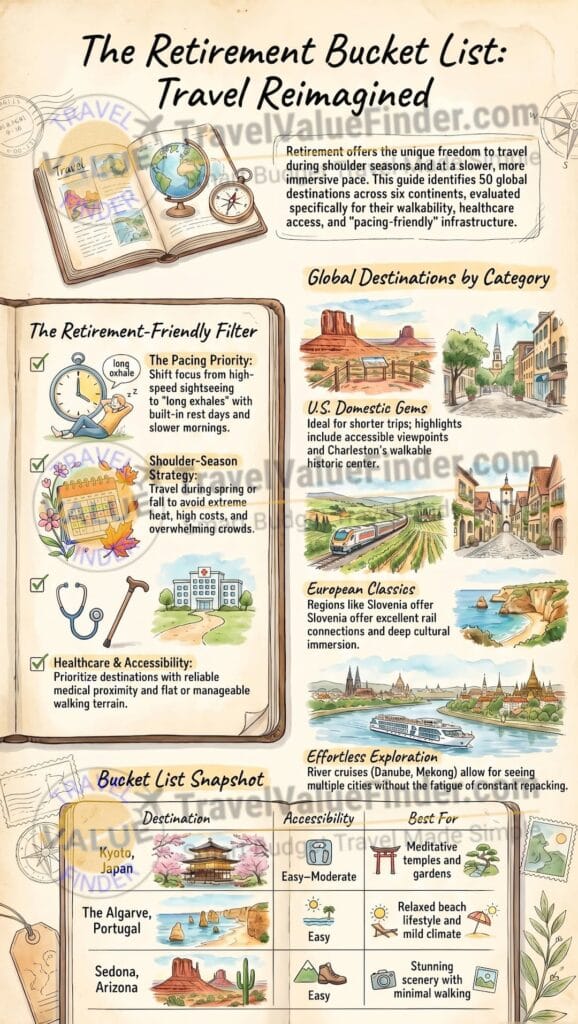
The criteria below shaped every entry on this list, and they’re worth understanding because they’ll help you evaluate any destination not covered here, too.
| Criteria | Why It Matters for Retirement Travel | What We Looked For |
|---|---|---|
| Walkability & terrain | Steep hills, long unavoidable distances, and uneven surfaces compound fatigue over a multi-day trip | Flat or manageable terrain, or destinations where terrain challenges are optional (you can choose easier routes) |
| Healthcare access | Peace of mind matters more on longer trips, and any health event is more manageable near good care | Proximity to quality clinics/hospitals, especially for destinations more than a few hours from major cities |
| Shoulder-season viability | Retirees can travel any time of year. This is one of retirement’s biggest practical advantages | Destinations with a genuinely pleasant shoulder season offering lower costs and crowds without weather extremes |
| Pacing-friendly infrastructure | The best places to visit in retirement allow you to slow down without running out of things to do | Towns and regions substantial enough to sustain a week or more without feeling rushed to ‘see everything’ in two days |
| Value for longer stays | Retirement trips often run longer than a typical vacation. | Destinations where weekly or monthly rates, local markets, and self-catering options offer real savings over time |
| English accessibility (where relevant) | Reduces friction for retirees less comfortable navigating language barriers solo | A realistic assessment of how easily English-speaking retirees can navigate daily logistics |
Category 1: U.S. Domestic Gems. 10 Best Places to Visit in Retirement Without a Passport
Retirement travel doesn’t have to mean international flights.
Some of the best places to visit in retirement are a regional drive or a short domestic flight away.
It is ideal for shorter trips, for easing into a more travel-heavy retirement lifestyle. It is also for retirees managing health considerations that make international travel more complex.
| # | Destination | Best For | Accessibility | Best Season | Budget |
|---|---|---|---|---|---|
| 1 | Asheville, North Carolina | Mountain views, arts scene, cozy cafés | Easy–Moderate | Late spring / early fall | $$ |
| 2 | San Antonio, Texas | History, culture, the Alamo, River Walk | Easy | Fall through spring (avoid summer heat) | $ |
| 3 | Sedona, Arizona | Red rock scenery with minimal-walking viewpoints | Easy (with planning) | Spring & fall | $$ |
| 4 | Charleston, South Carolina | Historic architecture, walkable downtown, coastal charm | Easy | Fall through spring | $$ |
| 5 | Monterey & Carmel, California | Calming, upscale coastal trip without nonstop activity | Easy | Spring through fall | $$$ |
| 6 | Door County, Wisconsin | Quiet lakeside towns, orchards, slow-paced charm | Easy | Summer & early fall | $$ |
| 7 | Santa Fe, New Mexico | Art, adobe architecture, high-desert culture | Moderate (elevation) | Spring & fall | $$ |
| 8 | Savannah, Georgia | Historic squares, Spanish moss, walkable charm | Easy–Moderate (some cobblestone) | Fall through spring | $$ |
| 9 | Hill Country, Texas (Fredericksburg) | Wine country, German heritage towns, gentle pace | Easy | Spring (wildflowers) & fall | $ |
| 10 | Outer Banks, North Carolina | Beach towns, lighthouses, slower coastal pace | Easy | Late spring & early fall | $$ |
Category 2: European Classics. 10 Best Places to Visit in Retirement for Slow Travel
Europe’s combination of walkable historic centers, excellent rail connections, and deep cultural offerings makes it one of the strongest regions on this entire bucket list for retirement travel.
These ten destinations reward exactly the kind of slow, immersive trip that retirement makes possible.
| # | Destination | Best For | Accessibility | Best Season | Budget |
|---|---|---|---|---|---|
| 11 | Algarve, Portugal | Relaxed beach towns, golf, mild climate | Easy | Spring, fall, mild winter | $$ |
| 12 | Santorini, Greece | Iconic caldera views, walkable whitewashed towns | Moderate (stairs/hills) | Late spring & early fall | $$$ |
| 13 | The Dolomites, Italy | Alpine scenery with options from easy to challenging | Moderate. Adventurous (scalable) | Summer (hiking) / winter (skiing) | $$ |
| 14 | Ljubljana & Slovenia | Fairytale lakes, walkable capital, uncrowded charm | Easy–Moderate | Late spring & early fall | $$ |
| 15 | Amalfi Coast, Italy | Dramatic coastal scenery, boat-based exploration option | Moderate (steep towns, boat options ease this) | Late spring & early fall (avoid August) | $$$ |
| 16 | Sardinia, Italy | Quieter alternative to mainland Italy, stunning coastline | Easy–Moderate | Late spring & early fall | $$ |
| 17 | Northern Ireland (Causeway Coast) | Dramatic coastal scenery, castles, friendly pub culture | Moderate | Late spring through early fall | $$ |
| 18 | Bruges, Belgium | Canal-side walking, chocolate, compact medieval core | Easy | Spring & fall | $$ |
| 19 | Provence, France | Lavender fields, slow village life, wine country | Easy–Moderate | Late spring & early fall | $$ |
| 20 | Azores, Portugal | Volcanic landscapes, mild climate, uncrowded nature | Moderate | Late spring through early fall | $$ |
Category 3: Asia. 8 Best Places to Visit in Retirement for Cultural Depth
Asia offers some of the richest cultural experiences on earth.
Several destinations in the region are particularly well-suited to retirement-paced travel. These are combined with affordability, calm, and depth in a way that rewards longer stays.
| # | Destination | Best For | Accessibility | Best Season | Budget |
|---|---|---|---|---|---|
| 21 | Kyoto, Japan | Temples, gardens, meditative pace, improved accessibility | Easy–Moderate | Spring (cherry blossoms) & fall (foliage) | $$ |
| 22 | Chiang Mai, Thailand | Slow pace, temples, affordable long stays | Easy | Nov–Feb (cool, dry) | $ |
| 23 | Ubud & Sanur, Bali, Indonesia | Cultural immersion with a calmer coastal alternative (Sanur) | Easy–Moderate | April–Oct (dry season) | $ |
| 24 | Taipei, Taiwan | Excellent transit, night markets, very safe for solo or couples | Easy | Oct–Dec & March–April | $ |
| 25 | Luang Prabang, Laos | Slow river town, temples, gentle pace | Easy–Moderate | Nov–Feb (dry season) | $ |
| 26 | Hoi An, Vietnam | Walkable ancient town, beach access, tailoring culture | Easy | Feb–April (before rainy season) | $ |
| 27 | Kerala, India (backwaters) | Houseboat cruises. Minimal walking, maximum scenery | Easy (boat-based) | Nov–Feb (cool, dry) | $ |
| 28 | Penang, Malaysia | UNESCO heritage city, food culture, modern healthcare | Easy | Dec–April (drier months) | $ |
Category 4: Latin America. 8 Best Places to Visit in Retirement for Value and Adventure
Latin America combines extraordinary natural diversity.
From glaciers to rainforests to colonial cities. These are with some of the strongest value in international travel.
Several of these destinations also double as serious contenders on retirement relocation lists, which means infrastructure for longer stays is often already well-developed.
| # | Destination | Best For | Accessibility | Best Season | Budget |
|---|---|---|---|---|---|
| 29 | Uruguay (Montevideo & Colonia) | Relaxed pace, wine country day trips, one of South America’s safest countries | Easy | Sept–Nov & March–May (shoulder seasons) | $$ |
| 30 | San Miguel de Allende & Oaxaca, Mexico | Colonial architecture, art, food culture, walkable centers | Easy–Moderate (cobblestones) | Oct–April (dry season) | $ |
| 31 | Costa Rica (Central Valley & Pacific Coast) | Eco-lodges, wildlife, established expat infrastructure | Easy–Moderate | Dec–April (dry season) | $$ |
| 32 | Cuenca, Ecuador | Colonial mountain city, eternal-spring climate | Moderate (altitude) | Year-round (consistent climate) | $ |
| 33 | Patagonia (Torres del Paine, Chile/Argentina) | Iconic glaciers and peaks, with options from easy to challenging | Moderate–Adventurous (scalable) | Nov–March (Southern Hemisphere summer) | $$$ |
| 34 | Cartagena, Colombia | Walkable walled city, Caribbean coast, colonial charm | Easy | Dec–March (drier season) | $$ |
| 35 | Lake Atitlán, Guatemala | Volcanic lake scenery, boat-based town-hopping | Moderate (boat-based eases terrain) | Nov–April (dry season) | $ |
| 36 | Galápagos Islands, Ecuador | Wildlife encounters, cruise-based exploration | Moderate (cruise-based, minimal walking) | June–Nov (cooler, drier) | $$$ |
Category 5: Africa & The Middle East. 6 Best Places to Visit in Retirement for the Adventurous
For retirees ready for something further afield, Africa and the Middle East offer some of the most awe-inspiring experiences on this entire bucket list.
It is often more accessible than their reputations suggest, particularly when approached with the right planning and pacing.
| # | Destination | Best For | Accessibility | Best Season | Budget |
|---|---|---|---|---|---|
| 37 | Cape Town, South Africa | World-class scenery, wine country, walkable waterfront | Easy–Moderate | Oct–April (Southern Hemisphere spring/summer) | $$ |
| 38 | Marrakech & the Atlas Mountains, Morocco | Souks, riads, dramatic mountain scenery (scalable) | Moderate | March–May & Sept–Nov | $$ |
| 39 | Petra & Wadi Rum, Jordan | Iconic ancient sites, desert landscapes (camel/jeep options) | Moderate (some walking unavoidable at Petra) | March–May & Sept–Nov | $$ |
| 40 | Namibia (self-drive or guided) | Otherworldly landscapes, exceptional safety record for the region | Moderate (vehicle-based) | May–Oct (dry season) | $$ |
| 41 | Zanzibar, Tanzania | Beach relaxation paired with Stone Town’s history | Easy–Moderate | June–Oct & Dec–Feb | $$ |
| 42 | Egypt (Nile cruise) | Ancient history with minimal walking via river cruise | Easy (cruise-based) | Oct–April (cooler months) | $$ |
Category 6: Slow Travel, Cruises & Nature. 8 Best Places to Visit in Retirement for Effortless Exploration
Some of the best places to visit in retirement aren’t single cities at all.
They’re experiences built around movement that does the work for you:
- cruises,
- scenic rail journeys, and
- road trips where the journey and the destination are the same thing.
These formats are especially well-suited to retirees who want to see a lot without the cumulative fatigue of constant packing, unpacking, and city-to-city logistics.
| # | Destination / Experience | Best For | Accessibility | Best Season | Budget |
|---|---|---|---|---|---|
| 43 | Norwegian Fjords (cruise) | Towering cliffs, waterfalls, multiple ports without re-packing | Easy (cruise-based) | May–Sept | $$$ |
| 44 | Danube River Cruise (Central Europe) | Multiple historic cities, gentle pace, minimal walking | Easy (cruise-based) | April–Oct | $$$ |
| 45 | Alaska (cruise or rail) | Glaciers, wildlife, accessible viewing from ship or train | Easy–Moderate | May–Sept | $$$ |
| 46 | American Southwest National Park Road Trip | Grand Canyon, Zion, Bryce – scalable hikes, scenic drives | Easy–Adventurous (scalable) | Spring & fall (avoid summer heat) | $$ |
| 47 | Mekong River Cruise (Vietnam/Cambodia) | Cultural immersion via slow river travel | Easy (cruise-based) | Nov–March (dry season) | $$ |
| 48 | New England Fall Foliage Road Trip | Iconic scenery, charming towns, flexible pacing | Easy | Late Sept–mid Oct | $$ |
| 49 | Antarctica (expedition cruise) | True once-in-a-lifetime wildlife and landscape experience | Moderate (some zodiac landings) | Nov–March (Southern Hemisphere summer) | $$$ |
| 50 | Camino de Santiago, Spain (Camino del Norte or partial routes) | Walking pilgrimage routes, scalable to fitness level | Moderate–Adventurous (scalable by route/segment) | May–June & Sept–Oct | $ |
Extensive Review Picks: The 10 Best Places to Visit in Retirement on This Entire List
All 50 destinations above earned their place on this bucket list.
But if you’re looking for where to start the picks that combine
- accessibility,
- value, and
- the kind of depth that rewards a longer retirement-paced stay,
these ten stand out.
| #1 | Kyoto, Japan Temples and gardens at a meditative pace | Improved accessibility | Shoulder seasons avoid both crowds and heat |
Kyoto deserves serious consideration for any retiree’s bucket list.
Known for its temples, gardens, and traditional neighborhoods, it offers a sense of calm that contrasts beautifully with Japan’s modern cities.
Walking through bamboo groves, visiting centuries-old shrines, and savoring meticulously prepared meals can feel almost meditative. It is exactly the kind of experience that retirement-paced travel is built for.
Improved tourism planning and accessibility infrastructure in recent years make Kyoto an excellent choice for travelers seeking beauty without chaos.
The city rewards a stay of five days or more. This is long enough to explore at a genuinely relaxed pace with rest days built in between temple visits, rather than racing through a checklist.
- Best season: spring (cherry blossoms, late March–early April) or fall (foliage, mid-November) – both stunning but busy; for a quieter visit, consider early December or June
- Accessibility: many major temples now offer improved pathways; Kyoto’s bus and train system is reliable and well-signed in English
- Pacing tip: base yourself in one neighborhood for several days rather than constantly relocating – Kyoto’s districts each have their own rhythm worth settling into
| #2 | The Algarve, Portugal Relaxed beach towns | Mild year-round climate | Strong infrastructure for longer stays |
The Algarve consistently appears among the best places to visit in retirement for a simple reason:
- it delivers a genuinely relaxed, beach-oriented lifestyle with a mild climate that extends the ‘best season’ window far longer than most coastal destinations.
Towns like Tavira and Lagos offer walkable centers, excellent seafood, and golf for those who want it. These are without the intensity of more crowded Mediterranean hotspots.
- Best season: the Algarve is pleasant from March through November, with even winter remaining mild by Northern European or North American standards
- Accessibility: flat coastal towns with good local transit options between them
- Value tip: longer stays (a month or more) unlock significant savings on accommodation compared to week-long bookings
| #3 | Sedona, Arizona Red rock scenery designed for minimal-walking viewpoints | No passport required | Easy to combine with a Southwest road trip |
Sedona is ideal for retirees who want natural beauty without extreme ruggedness.
Many of its most iconic experiences;
- viewpoints,
- scenic drives, and
- accessible trails – require minimal walking.
The surrounding region (Grand Canyon, Flagstaff, Phoenix) makes it an easy anchor for a broader Southwest itinerary.
- Accessibility tip: look for tours specifically advertised with an ‘easy activity level’ and request step-free transportation where available
- Best season: spring and fall avoid both summer heat and any winter precipitation at higher elevations nearby
- Pairing idea: combine with Grand Canyon viewpoints (also highly accessible) for a single Southwest trip covering two bucket-list icons
| #4 | Uruguay (Montevideo & Colonia del Sacramento) One of South America’s safest countries | Relaxed pace | Excellent value for a week-long trip |
Uruguay moves at a relaxed pace that suits retirees perfectly, and ranks as one of South America’s safest countries.
The wine country around Colonia del Sacramento makes a perfect day trip from Montevideo. The overall cost structure makes this one of the best-value entries on this entire bucket list:
- a week for two,
- including mid-range hotels,
- restaurant meals,
- local transportation, and
- wine tasting,
can come in remarkably affordable compared to similar experiences in Europe.
- Best season: September–November and March–May (Southern Hemisphere shoulder seasons) avoid both summer crowds and winter chill
- Accessibility: Montevideo and Colonia are both walkable, with Colonia’s cobblestone old town being charming but requiring supportive footwear
- Day trip value: Colonia is reachable by ferry from Buenos Aires, Argentina, making this a strong addition to a broader South American itinerary
| #5 | Charleston, South Carolina Walkable historic downtown | No passport required | Mild shoulder seasons |
Charleston combines historic architecture, a genuinely walkable downtown, and coastal charm in a package that’s hard to beat for a domestic bucket-list entry.
Horse-drawn carriage tours, historic home tours, and a renowned food scene all operate at a pace that suits retirement travel.
Charleston’s compact layout means a car often isn’t necessary once you’ve arrived.
- Best season: fall through spring avoids the most intense summer heat and humidity
- Accessibility: the historic district is highly walkable, though some sidewalks include uneven brick – supportive footwear recommended
- Pairing idea: combine with nearby Savannah, Georgia (also on this list) for a longer Southern coastal itinerary
| #6 | Cuenca, Ecuador Eternal-spring climate | Colonial architecture | U.S. dollar economy removes currency complexity |
Cuenca’s UNESCO-listed historic center is one of the best-preserved in South America.
Its high-altitude location creates a remarkably consistent, mild climate year-round.
Ecuador’s use of the U.S. dollar also removes a layer of complexity that some travelers find adds friction elsewhere in Latin America.
- Altitude note: Cuenca sits at roughly 8,400 feet. Allow a day or two to acclimatize, especially for those with cardiac or respiratory considerations
- Accessibility: the historic center is walkable, with markets offering an easy, low-key way to spend a morning
- Extended stay value: Cuenca is also a popular retirement relocation destination. It has the infrastructure for longer visits with furnished rentals, and English-speaking healthcare is well-developed
| #7 | Slovenia (Ljubljana & Lake Bled) Fairytale lakes and green valleys | Compact and easy to navigate | Less crowded than neighboring Italy or Austria |
Small yet full of surprises.
Slovenia offers fairytale lakes, green valleys, and a vibrant, walkable capital in Ljubljana.
Its compact size means a single base in Ljubljana can serve as a launching point for day trips to Lake Bled and the surrounding countryside. Ideal for retirees who prefer minimal relocation during a trip while still seeing significant variety.
- Best season: late spring and early fall offer pleasant temperatures with meaningfully fewer crowds than peak summer
- Accessibility: Ljubljana’s compact, largely pedestrianized center is very walkable. Lake Bled offers a flat lakeside path alongside more strenuous hiking options
- Value note: Slovenia remains less expensive than neighboring Italy or Austria for comparable quality
| #8 | Costa Rica (Central Valley & Pacific Coast) Eco-lodges built for slow travel | Established expat infrastructure | Wildlife without extreme adventure required |
Costa Rica’s eco-tourism infrastructure is built around small lodges and guided experiences that suit retirement-paced travel particularly well.
Many properties function as destinations in themselves, naturally encouraging the kind of slower exploration this entire bucket list is built around.
A long-standing expat and retiree community has also created robust English-language services in many areas, reducing friction for first-time visitors to Latin America.
- Best season: December through April (dry season) offers the most reliable weather for wildlife viewing and beach time
- Accessibility: varies significantly by lodge and region. Research specific properties for step-free access if mobility is a consideration
- Wildlife tip: many of Costa Rica’s best wildlife experiences (sloths, toucans, monkeys) require minimal hiking. Lodge grounds and short, well-maintained trails often suffice
| #9 | Danube River Cruise (Vienna to Budapest) Multiple historic capitals without repacking | Minimal walking required for transitions | Ideal for first international trips post-retirement |
River cruising continues to grow in popularity among retirees for good reason.
A Danube cruise through Central Europe delivers Vienna, Bratislava, and Budapest.
Visit three genuinely distinct historic capitals without the logistics of flights, train transfers, or hotel check-ins between each stop.
For retirees easing into international travel, or those who prefer their ‘home base’ to come with them, this format removes a significant amount of trip-planning friction.
- Best season: April through October; shoulder months (April-May, September-October) offer pleasant weather with fewer crowds at major sights
- Accessibility: river cruise ships are generally very accessible, with shore excursions typically offering multiple activity-level options
- Planning tip: book shore excursions with explicitly ‘gentle’ or ‘easy’ activity ratings if mobility is a consideration. Most river cruise lines offer this filtering
| #10 | American Southwest National Park Road Trip (Grand Canyon, Zion, Bryce) Iconic scenery with scalable activity levels | No passport required | Flexible, self-paced itinerary |
A Southwest national park road trip belongs on any honest list of the best places to visit in retirement specifically because of its flexibility.
The same itinerary can include a leisurely scenic drive with rim-side viewpoints for one traveler and a multi-hour canyon hike for a more adventurous companion.
This is often within the same park on the same day. Grand Canyon, Zion, and Bryce Canyon together offer some of the most photographed landscapes on earth, almost all of it viewable from accessible overlooks.
- Best season: spring and fall avoid summer heat (which can be extreme, particularly at lower elevations like the canyon floor) and winter road closures at higher elevations
- Accessibility: each park offers paved, accessible viewpoints alongside more strenuous trail options – research specific accessible trails (such as the Rim Trail at Grand Canyon) in advance
- Pacing tip: a road trip format allows you to set your own daily driving distance. Don’t over-schedule; some of the best moments come from unplanned stops at smaller overlooks
Ready to plan the trip? Use our Free AI Trip Planner to build a day-by-day food-focused itinerary for any destination.
15 Tips for Turning a Bucket List Into an Actual Retirement Travel Plan
- Sort your bucket list by physical demand, not just appeal. A list that’s all ‘adventurous’ entries front-loads burnout; mix in ‘easy’ destinations between bigger trips.
- Plan around shoulder seasons whenever your schedule allows. This is one of retirement’s single biggest practical advantages over working-life travel, which is often locked into school-calendar peak seasons.
- For any international trip, confirm whether your health insurance covers you abroad. If not, budget for dedicated travel medical insurance with evacuation coverage before anything else.
- Build at least one full rest day into every week of travel, regardless of destination. This single habit does more for trip enjoyment than almost any itinerary optimization.
- Choose ‘base and explore’ itineraries over constant relocation when possible. Staying in one location for several days and taking day trips reduces packing, transit stress, and cumulative fatigue.
- For cruise-based entries on this list (Norwegian fjords, Danube, Alaska, Antarctica), research shore excursion activity levels in advance. Most major lines now clearly label ‘easy,’ ‘moderate,’ and ‘strenuous’ options.
- Test new destinations with shorter trips first if you’re unsure about pacing, accessibility, or how a particular climate or altitude affects you. A week-long trial run to a similar-climate destination can inform planning for a longer trip later.
- For higher-altitude destinations (Cuenca, Patagonia, parts of the Dolomites), build in acclimatization time and consult a doctor in advance if you have cardiac or respiratory considerations.
- Research walking-surface conditions specifically, not just ‘walkability’ in general. Cobblestones, sand, and steep cobbled hills (common in historic European towns) affect comfort differently than flat pavement, even over short distances.
- For destinations on this list known for crowds in peak season (Santorini, Amalfi Coast, Kyoto in cherry blossom season), the shoulder-season alternative isn’t a compromise. It’s often genuinely the better experience, with better light for photos and more relaxed service.
- Keep a working ‘bucket list document’ that you actually update. Move completed destinations to an ‘experienced’ list and add new ones as recommendations come in. A bucket list that’s a static, never-revisited document tends to gather dust.
- Consider ‘anchor and branch’ planning for longer international trips. Choose one home base (like Kyoto, the Algarve, or Cuenca) and take shorter trips from there, rather than a constantly-moving itinerary.
- Don’t skip the ‘closer’ bucket-list items in favor of only ‘bigger’ international ones. Domestic gems like Asheville, Door County, or Santa Fe are genuinely some of the best places to visit in retirement precisely because they’re easy to do more often, with less planning overhead.
- For walking-based experiences like the Camino de Santiago, research shorter or less-crowded route segments rather than assuming it’s ‘all or nothing’. Partial routes and luggage-transfer services make this far more accessible than its reputation suggests.
- Revisit this list periodically. Your own pacing preferences, mobility, and interests may shift over the course of retirement, and a destination that felt ‘too adventurous’ five years ago may be exactly right now, or vice versa.
Quick Answers: FAQs
What are the best places to visit in retirement?
The best places to visit in retirement span six categories: U.S. domestic destinations like Asheville, Charleston, and Sedona (no passport required, easy accessibility); European classics like the Algarve, Santorini, and Slovenia (walkable, rich in culture, well-suited to slow travel); Asian destinations like Kyoto, Chiang Mai, and Taipei (affordable, calm, culturally deep); Latin American value picks like Uruguay, Costa Rica, and Cuenca; Africa and the Middle East destinations like Cape Town and Petra for more adventurous retirees; and slow-travel experiences like river cruises, national park road trips, and the Camino de Santiago.
How do you build a retirement bucket list?
Start by sorting destinations by physical demand and accessibility level, then plan around shoulder seasons.
What makes a destination good for retirement travel specifically?
The best places to visit in retirement combine walkable or manageable terrain, reliable healthcare access, a genuinely pleasant shoulder season for cost and crowd avoidance, infrastructure that supports longer stays (a week or more).
What are the best bucket list destinations for retirees who don’t want to fly internationally?
Strong domestic bucket-list destinations for retirement include Asheville (North Carolina), Charleston (South Carolina), Sedona (Arizona), Santa Fe (New Mexico), Door County (Wisconsin), and an American Southwest national park road trip covering the Grand Canyon, Zion, and Bryce Canyon.
What are good ‘easy’ bucket list destinations for retirees with mobility considerations?
River and ocean cruises (Danube, Norwegian fjords, Nile, Mekong) are among the most accessible bucket-list formats, since they deliver multiple destinations with minimal walking required for transitions. Sedona and Grand Canyon both offer iconic scenery from accessible, paved viewpoints. destination.
Bottom Line: Your Bucket List Should Match the Life You’re Actually Living Now
Fifty destinations is a lot, and that’s the point.
A genuinely useful list of the best places to visit in retirement shouldn’t be a single ‘top 5’ that everyone’s already seen on every other list.
It should be expansive enough that there’s something for the trip you can take next month. Something for the trip you’ll plan for three years from now, something for a long weekend and something that anchors an entire season.
Wherever you start, a weekend in Asheville or a month in the Algarve, a Danube cruise or the full Camino the same principle holds;
- this is a bucket list built for retirement destinations and the retirement pace, and both of those things are entirely on your terms now.
Travel Value Finder Articles Related to this:
- The Retirement Travel Bucket List: 50 Experiences to Have After 60
- How to Travel Europe by Rail as a Retiree: Passes, Tips & Routes
- Senior-Friendly Cities in Europe: Best Places to Visit Over 60
- Travel After 60: Everything You Need to Know (2026 Guide)
- Best Destinations for Retirees in 2026: Where to Go This Year
Sources & References (June 2026)
- RetireNet: Best U.S. Travel Destinations for Retirees in 2026: Senior-Friendly, Affordable & Accessible Getaways
- Kiplinger: The 10 Most Valuable Vacation Destinations for Retirees in 2026
- GOBankingRates: 7 Destinations That Should Be on Every Middle-Class Retiree’s Bucket List in 2026
- Retirement.media: Top Bucket List Destinations for 2026
- JoinMyTrip: Best Places to Visit in 2026: Ultimate Bucket List Destinations (Skyscanner & Hilton trend data)
- SaltyLuxe: Best Places to Visit: 2026 Travel Bucket List
- International Living: Destination and retirement-region cost and lifestyle data
- Numbeo: Cost of Living Database, May–June 2026
Affiliate Disclaimer: Some links in this article are affiliate links. We may earn a referral commission on qualifying bookings at no additional cost to you.