Travel Value Finder

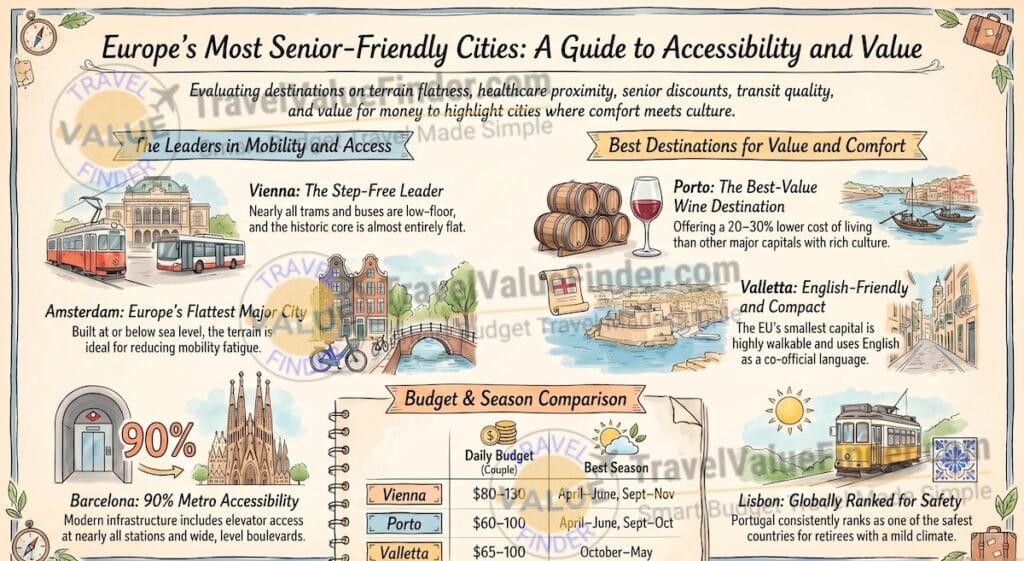
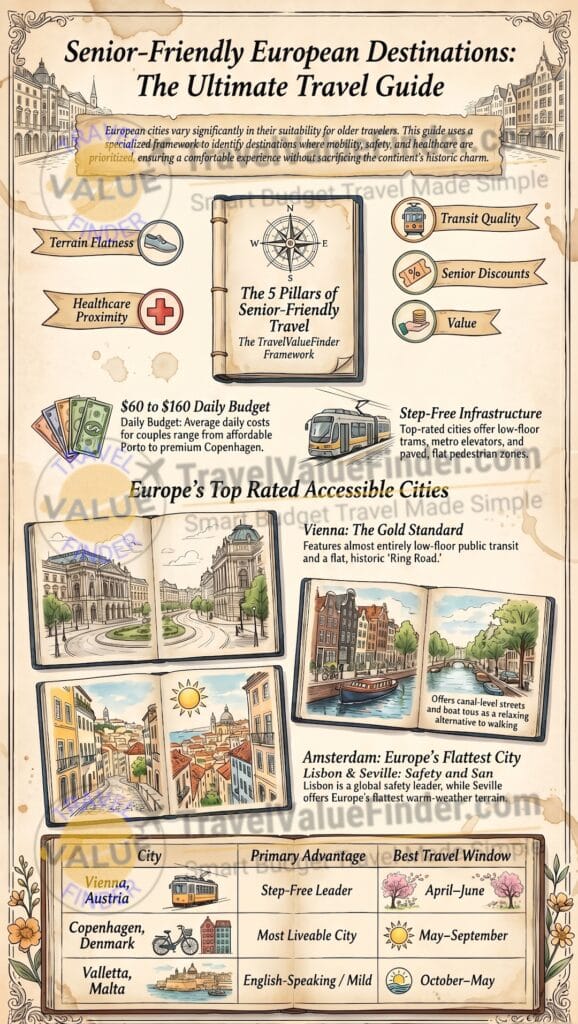
The most senior-friendly cities in Europe for 2026 are:
- Vienna (flat streets, step-free transit, world-class culture),
- Lisbon (safest country globally, mild climate, D7 visa),
- Amsterdam (flat terrain, canal access, exceptional museums),
- Copenhagen (world’s most liveable city 2025, best accessible transit),
- Barcelona (90% accessible metro stations, Mediterranean lifestyle),
- Porto (quieter than Lisbon, flat riverside, excellent value),
- Bruges (medieval beauty, flat historic core),
- Seville (warm climate, walkable, lunch culture),
- Valletta Malta (smallest capital, intimate scale, English-speaking), and
- Dubrovnik (cable car access, walled city with adapted routes).
Each is scored on accessibility, healthcare, senior discounts, transit, and value.
Disclaimer: This article is for general informational purposes only and does not constitute financial, investment, tax, legal, immigration, or other professional advice. Costs and other figures are estimates and can change. Always verify current information and consult a qualified professional before making significant financial, travel, or retirement decisions.
Leslie Nics, TravelValueFinder.com | Last updated: June 2026 | Last Reviewed: June 01 2026
Here’s a question I hear constantly from fellow travelers over 60:
- “Which senior-friendly European cities are actually worth the trip?”
- “Which ones look great in photos, but wear you out in two days?”
It’s a fair question, and most articles don’t answer it honestly.
The truth is that European cities vary wildly in how accessible and comfortable they are for travelers over 60.
- Vienna’s public trams are almost entirely step-free.
- Rome’s cobblestones can wreck your joints in an afternoon.
- Copenhagen ranked the world’s most liveable city in 2025.
- Lisbon’s hills are beautiful but brutal.
This guide doesn’t just tell you where to go.
It tells you exactly what to expect, including the honest downsides competitors don’t mention.
I’ve personally visited every city in this guide. My framework for each city is evaluated on five criteria that matter most to travelers over 60. These are;
- accessibility,
- healthcare proximity,
- transit quality,
- senior discounts, and
- real budget costs.
Table of Contents
How We Evaluate Senior-Friendly European Cities: The Travel Value Finder Framework
Cities are scored on five criteria:
- physical accessibility (terrain, transit, elevators),
- healthcare proximity,
- senior discount availability,
- transit quality, and
- value for money.
The 2026 European Commission Access City Award winner is Zaragoza, Spain.
Top step-free cities are Vienna, Amsterdam, Copenhagen, Bruges, Valencia, and Barcelona.
Most “best European cities for seniors” lists are ranked by popularity or general beauty.
Neither of which tells you whether your knees will survive the cobblestones.
This guide uses a five-pillar framework based on the factors travelers over 60 consistently identify as highest priority:
| Criterion | What We Measure | Primary Sources | Why It Matters Over 60 |
|---|---|---|---|
| Physical Accessibility | Terrain flatness, cobblestone %, elevator coverage in transit | EU Access City Award, Wheel the World, Meera.tours | Mobility challenges increase with age; flat cities reduce fatigue significantly |
| Healthcare Proximity | Hospital distance, private care quality, English-speaking doctors | AARP, International Living, WHO | Medicare doesn’t cover abroad; local healthcare proximity is a safety net |
| Senior Discounts | Museum entry, transit, attractions (age thresholds vary 60–65+) | City tourism boards, SeniorCenters.com | Fixed incomes benefit most from stacked discounts |
| Transit Quality | Low-floor buses %, metro elevator coverage, tram accessibility | EU Urban Mobility Observatory, individual city transit data | Good transit reduces reliance on taxis and walking distances |
| Value for Money | Daily budget, shoulder season pricing, free attraction days | Numbeo, AARP, TravelValueFinder cost data | Fixed-income retirees need destinations where $80–150/day goes far |
One data point worth highlighting upfront:
Zaragoza, Spain won the 2026 European Commission Access City Award for outstanding efforts in making its city accessible for persons with disabilities.
This is grounded in the UN Convention on the Rights of Persons with Disabilities;
- with comprehensive municipal accessibility rules,
- a dedicated Accessibility Office, and
- full participation in emergency preparedness planning.
While not a top tourist destination, it sets the benchmark for what senior-friendly infrastructure looks like.
And in a landmark 2026 accessibility report, Vienna joined Amsterdam, Copenhagen, Bruges, Valencia, and Barcelona as Europe’s leading step-free cities.
This includes offering
- world-class accessible transport,
- flat pedestrian streets, and
- fully wheelchair-friendly cultural attractions.
Top 10 Senior-Friendly European Cities at a Glance (2026)
- Vienna, Amsterdam, and Copenhagen lead Europe for step-free accessibility and senior discounts.
- Lisbon is the safest (Portugal #7 Global Peace Index).
- Barcelona has 90% accessible metro stations.
- Porto and Bruges offer the best value.
- Seville and Valletta are ideal for warm-weather, flat-terrain senior travel.
| # | City | Country | Daily Budget | Accessibility | Transit | Senior Discounts | Best Season | TVF Rating |
|---|---|---|---|---|---|---|---|---|
| 1 | Vienna | Austria | $80–130 | Step-free ⭐⭐⭐⭐⭐ | Low-floor trams/buses | Yes for 60/65+ (museums + transit) | Apr–Jun, Sep–Nov | ⭐⭐⭐⭐⭐ |
| 2 | Amsterdam | Netherlands | $90–140 | Flat city ⭐⭐⭐⭐⭐ | Low-floor trams + ferries | Yes for 65+ (museums, some transit) | Apr–May, Sep–Oct | ⭐⭐⭐⭐⭐ |
| 3 | Copenhagen | Denmark | $100–160 | Flat + excellent lifts ⭐⭐⭐⭐⭐ | World-class – fully step-free | Yes. Various age thresholds | May–Sep | ⭐⭐⭐⭐⭐ |
| 4 | Lisbon | Portugal | $70–110 | Hilly but lifts + trams help ⭐⭐⭐⭐ | Trams, elevators, buses | Yes. Various; ask always | Apr–Jun, Sep–Oct | ⭐⭐⭐⭐⭐ |
| 5 | Barcelona | Spain | $80–130 | 90% metro accessible ⭐⭐⭐⭐⭐ | Excellent – 90% stations lifts | Yes for 60+ (wide range) | Apr–Jun, Sep–Oct | ⭐⭐⭐⭐⭐ |
| 6 | Porto | Portugal | $60–100 | Partially hilly; flat riverside ⭐⭐⭐⭐ | Good; metro + buses | Yes. Ask at attractions | Apr–Jun, Sep–Oct | ⭐⭐⭐⭐ |
| 7 | Bruges | Belgium | $80–120 | Flat historic core ⭐⭐⭐⭐⭐ | Good; compact; walkable | Yes for 65+ (museums, sites) | Apr–May, Sep–Oct | ⭐⭐⭐⭐ |
| 8 | Seville | Spain | $70–110 | Very flat ⭐⭐⭐⭐⭐ | Excellent; flat wide boulevards | Yes for 60/65+ | Mar–May, Oct–Nov | ⭐⭐⭐⭐ |
| 9 | Valletta | Malta | $65–100 | Compact; lifts help hills ⭐⭐⭐⭐ | Mini-bus, ferry | Yes. Various | Oct–May | ⭐⭐⭐⭐ |
| 10 | Dubrovnik | Croatia | $80–130 | Walled city; cable car + adapted routes ⭐⭐⭐ | Good; cable car – lifts in walls | Yes – ask at Old City walls | Apr–Jun, Sep–Oct | ⭐⭐⭐⭐ |
Booking hotels for European cities? Always compare three platforms before confirming.
Prices vary 15–25% for the same room.
Our preferred comparison tools: Booking.com, Agoda, and Hotels.com. Detailed comparison in our hotel booking guide.
Detailed City Profiles: Senior-Friendly European Cities in 2026
1. Vienna, Austria: Best Overall for Senior Travelers in Europe
European Best Destinations top 20 | 2026 Step-Free Cities Leader | World’s #1 Classical Music Capital
| Daily Budget | Accessibility | Healthcare | Senior Discounts | Best Season |
|---|---|---|---|---|
| $80–130/day (couple) | Step-free trams, buses, and metro. European leader | Excellent; universal system + strong private sector | 60/65+ at museums, transit (check Jan 2026 changes) | April–June, September–November |
Vienna joined Amsterdam, Copenhagen, Bruges, Valencia, and Barcelona as Europe’s leading step-free cities in 2026.
- Nearly all trams and buses are low-floor.
- Many museums (Kunsthistorisches, Belvedere, Schönbrunn) offer senior discounts at 60 or 65 with ID.
- The Vienna City Card (€17–29 for 24–72hrs) covers transit.
- Spring and autumn are ideal; summer sees peak crowds and July heat.
Vienna is the closest thing to a purpose-built city for senior travel anywhere in Europe. Its public trams and buses are almost entirely low-floor vehicles. There is an electronic displays at stops showing a wheelchair symbol to indicate when a fully accessible vehicle is arriving.
The metro is modern and well-maintained. The city’s historic core is largely flat.
The Ring Road boulevard that circles the first district is perfect for long, gentle strolls between the Kunsthistorisches Museum, the Opera, the Hofburg Palace, and the Stadtpark.
Culturally, Vienna is extraordinary. The Musikverein and Vienna State Opera offer some of the world’s finest classical music in accessible, historic venues.
Schönbrunn Palace Gardens are immaculately maintained with paved paths throughout.
The famous Viennese café culture such as Café Central, Café Landtmann, and Café Prückel actively encourages you to sit for hours over a Melange and a slice of Sachertorte. These suits the retiree pace perfectly.
- Museums: Kunsthistorisches Museum, Belvedere Palace, and the Leopold Museum all offer senior discounts at 60 or 65+ with valid ID (passport recommended for proof of age).
- Step-free transit: Virtually all trams and buses are low-floor. Metro stations have elevators. The WienMobil app helps plan step-free routes.
- The Panoramabahn at Schönbrunn: A small yellow train that costs a few euros and saves the uphill walk to the Gloriette viewing deck – highly recommended.
- Free outdoor concerts: The Rathaus (City Hall) square hosts free film and music festivals in summer and a world-famous Christmas market in December.
- David Pertiller’s Public Toilets app: Maps 260 clean restrooms across Vienna, including which are wheelchair-accessible – a genuine practical tool for senior travelers.
Important: Senior transit discounts are in transition where the €1.50 reduced single ticket for travelers 65+ is being phased out as of January 2026.
The best value now is the €25.20 7-day digital pass or the Vienna City Card (€29 for 72 hours). This includes unlimited transit and attraction discounts.
Always check current pricing before departure.
Travel Tip:
- Stay in the 1st or 4th district for walking access to the major attractions.
- Book the Vienna State Opera standing room ticket ($5) for an extraordinary musical experience at a fraction of the cost.
- April–May and September–October offer ideal weather and 15–20% lower hotel rates vs. summer.
Compare cheap hotel rates across platforms before booking: Search Booking.com (rates vary 15–25% for the same property)
2. Amsterdam, Netherlands: Flattest Major City in Europe. World-Class Museums & Canals
Europe’s most walkable flat city | Rijksmuseum, Van Gogh, Anne Frank House | Canal tour alternative to walking
| Daily Budget | Accessibility | Healthcare | Senior Discounts | Best Seaso |
|---|---|---|---|---|
| $90–140/day (couple) | Flat throughout; low-floor trams; canal-level streets | Excellent with world-class university hospitals | 65+ at Rijksmuseum, Van Gogh Museum, canal tours; ask everywhere | April–May (tulips), September–October |
Amsterdam is Europe’s top step-free city for senior travelers.
- The city is flat terrain throughout, and low-floor trams with audio guides.
- Also, canal boats provide a relaxing sightseeing alternative to walking.
- The Rijksmuseum and Van Gogh Museum both offer 65+ discounts and wheelchair-accessible entrances.
- Canal cruises include covered seating and easy boarding.
- The Anne Frank House has narrow staircases.
- The Jewish Historical Museum offers similar history with better accessibility.
Amsterdam is famously flat. The entire city sits at or below sea level, which makes it one of the most physically comfortable European cities for travelers over 60.
The historic canal rings are navigated on flat streets with well-maintained paving. Low-floor trams run throughout.
And if walking gets to be too much, Amsterdam’s canal boats offer a genuine alternative to foot travel. A classic one-hour canal cruise gives you a complete orientation to the city’s 17th-century Golden Age architecture from a seated, covered position.
The museum collection here is genuinely world-class and deeply accessible.
The Rijksmuseum (Rembrandt, Vermeer, Dutch Masters) has ample seating throughout, wheelchair-friendly access, and guided tours with audio guides.
The Van Gogh Museum is fully wheelchair accessible. Even the Vondelpark, Amsterdam’s answer to Central Park, has paved paths throughout for easy walking or assisted mobility.
- Flat terrain: The entire city center is navigable without hills. Wide, flat canal-side streets run for miles.
- Canal boat alternative to walking: Hop-on, hop-off canal boats stop near major museums. Covered seating, easy boarding, no walking required between stops.
- Rijksmuseum: 65+ discounts available; extensive seating; audio guide included in entry price. One of Europe’s greatest museums in an accessible building.
- Van Gogh Museum: Fully wheelchair accessible. Sensory-friendly sessions available on request. Book in advance – entry is time-slotted.
- Vondelpark: Free, flat, beautifully maintained. Live music on weekend afternoons in summer. Perfect for a gentle rest day between museum visits.
- I amsterdam City Card: Includes transit, museum entry (including Rijksmuseum and Van Gogh), and canal cruise. Available for 24–96 hours. Value improves with each additional museum visit.
Important: The Anne Frank House involves narrow historical staircases and is not suitable for travelers with mobility limitations.
The Jewish Historical Museum (nearby) tells an equally profound story of Amsterdam’s Jewish community with full accessibility.
Don’t be put off Amsterdam’s bike culture. The canal-side streets are shared with cyclists, but pedestrians have clear lanes and the city has improved signage significantly in 2025–26.
Travel Tip:
- Visit in April for the Keukenhof tulip fields (45 minutes by bus from Amsterdam Centraal).
- It is one of the world’s great seasonal spectacles and fully accessible.
- September–October for lower hotel rates and mild weather without summer crowds.
- Book Rijksmuseum and Van Gogh tickets online 1–2 weeks in advance to avoid sellouts.
Compare cheap hotel rates: Search Agoda vs. Booking.com for the same hotel where differences of $20–40/night are common.
3. Copenhagen, Denmark: World’s Most Liveable City 2025. Top Accessible Transit in Europe
Ranked world’s most liveable city 2025 (Economist Intelligence Unit) | World’s happiest city 2025 (Happy City Index) | Fully step-free metro
| Daily Budget | Accessibility | Healthcare | Senior Discounts | Best Season |
|---|---|---|---|---|
| $100–160/day (couple) | Fully step-free metro; flat city; world-class accessible infrastructure | Excellent; universal Danish healthcare system | 65+ at National Museum, Glyptotek, various attractions; Copenhagen Card covers many | May–September |
Copenhagen ranked the world’s most liveable city (Economist Intelligence Unit 2025), and the world’s happiest city (Happy City Index 2025).
- Its metro is fully step-free at all stations.
- The Copenhagen Card covers transit and entry to 80+ attractions.
- Tivoli Gardens, one of the world’s oldest amusement parks is fully accessible.
- Canal tours, flat cycling paths, and a food scene ranked among Europe’s best make it exceptionally senior-friendly despite higher costs.
Copenhagen doesn’t just claim to be liveable. It has the rankings to prove it.
Ranked both the world’s most liveable city and its happiest city in 2025.
It is home to the world’s best restaurant (multiple times over), Copenhagen represents the Nordic ideal of high-quality public infrastructure applied to everyday life.
For travelers over 60, this translates directly where its entire metro system is fully step-free.
All buses are low-floor, and the city’s flat harbor-side design makes it genuinely comfortable to navigate without a car.
The cultural program is superb.
The National Museum of Denmark with free entry for all ages covers 14,000 years of history in a fully accessible building.
The Glyptotek (Impressionist masterpieces + ancient sculptures) is stunning and free on Tuesdays.
Tivoli Gardens, the 1843 amusement park that inspired Walt Disney, is not just for children. Its gardens, concerts, and evening illuminations are a genuine pleasure for any age.
- Fully step-free metro: Every Copenhagen metro station has elevators. A rarity in European transit systems. All buses are low-floor.
- Copenhagen Card: Covers transit + 80+ attractions including Tivoli, National Museum, and canal tours. Available for 24–72 hours. Calculates to strong value after 3–4 museum visits.
- Free entry: National Museum (always free), Glyptotek (free Tuesdays), Botanical Garden (free) – unusually generous for a high-cost city.
- Canal tours: Hop-on, hop-off canal and harbor tours run every 30–45 minutes from the Nyhavn waterfront. Covered seating, easy boarding, and a complete orientation to Copenhagen’s waterfront neighborhoods.
- Nyhavn: The iconic 17th-century colored townhouses along the canal are perfectly flat and surrounded by restaurant terraces. This one street delivers everything Copenhagen looks like in photographs – all at ground level.
Important: Copenhagen is the most expensive city on this list.
Budget $100–160/day for a couple in mid-range accommodation.
The Copenhagen Card softens attraction costs significantly, and the free entry to the National Museum, Botanical Garden, and harbor swimming helps.
Shoulder season (May and September) reduces hotel costs by 15–20% vs. July–August.
Travel Tip:
- Stay near Nørreport station for central access to both the S-train and metro.
- Visit Tivoli Gardens in the evening for the full illuminated experience while the daytime visit misses half the magic.
- Book the Noma tasting menu 3 months ahead if that’s on your bucket list.
- Otherwise, the Torvehallerne food market covers Copenhagen’s food culture beautifully at $10–15 per person.
4. Lisbon, Portugal: World’s Safest Retirement Country. Culture, Fado & Atlantic Coast
Portugal ranked #1 safest country for retirement 2026 (International Living) | #8 safest city globally (Berkshire Hathaway/GeoSure) | D7 Visa available
| Daily Budget | Accessibility | Healthcare | Senior Discounts | Best Season |
|---|---|---|---|---|
| $70–110/day (couple) | Hilly historic core; excellent trams + elevators; flat riverfront | Universal public + excellent private sector; English widely spoken | Ask at every site; free on some days for 65+; Lisbon Card covers transit | April–June, September–October |
Lisbon ranks #8 safest city for travel globally (2026) and is the capital of the world’s safest retirement country (International Living 2026).
- The city is famously hilly (especially Alfama), but the riverfront Belém district, the Baixa shopping district, and the Oriente neighborhood are largely flat.
- Tram 15E reaches Belém step-free.
- The Bica and Glória funiculars connect hillside neighborhoods without climbing.
- Adapted & Senior Tours Portugal offers accessible minibuses with wheelchair lifts for retirees.
Let’s be honest upfront:
Lisbon’s hills are real, and the cobblestones in the Alfama district are among Europe’s most challenging for any traveler with joint pain or a cane.
The good news is that Lisbon is far more manageable than its reputation suggests. If you know which neighborhoods to prioritize and which to avoid on your mobility limits.
The flat Belém district along the Tagus River is the perfect base for Lisbon’s greatest UNESCO World Heritage Sites (the Jerónimos Monastery, the Belém Tower), all on flat riverfront paths.
What makes Lisbon genuinely exceptional for travelers over 60 is the combination of extraordinary safety, mild climate year-round, and an affordable cost.
Lisbon is warmth toward tourists that is authentic rather than commercial.
Portugal’s ranking as the world’s safest retirement country isn’t based on tourism marketing.
It’s grounded in the Global Peace Index (#7 globally) and crime data that consistently puts Lisbon among Europe’s safest capital cities.
- Belém district: Flat, wheelchair-accessible, UNESCO World Heritage Sites, riverside cafés. Tram 15E connects directly from the city center. Start here if you have any mobility concern.
- Funiculars: The Bica, Glória, and Lavra funiculars are iconic, cheap (€4 return), and carry you up the hills without any effort. They’re also a genuine piece of Lisbon’s living history.
- Fado music: Many Fado venues offer early evening performances (starting 7–8pm) so you don’t need to stay out late. The soulful, melancholic music is a uniquely Lisbon experience that rewards slow, attentive listening.
- Adapted & Senior Tours Portugal: A Lisbon-based operator offering fully accessible minibuses with wheelchair lifts and English-speaking guides. Reviewed positively by travelers aged 78–93.
- Sintra day trip: The fairy-tale palaces of Sintra are 40 minutes by train from Lisbon’s Rossio station. Note that the palace grounds involve steep terrain. Take the Pena Palace shuttle bus and focus on the formal gardens for a low-exertion version of the day.
Important:
Avoid the Alfama district if you have significant mobility limitations. The steep, uneven cobblestones are genuinely dangerous when wet and exhausting even on dry days.
The Baixa-Chiado flat zone and the Belém riverfront deliver 90% of Lisbon’s most memorable experiences without any of the hill climbing.
Travel Tip:
- Visit April–May for Lisbon at its best; blooming jacaranda trees, warm but not hot weather, manageable crowds, and hotel rates 25–30% below peak summer.
- Stay near the Chiado or Santos neighborhoods for flat-terrain walking access to most attractions.
- Use the Lisbon Card for transit + entry discounts.
Compare where to stay in Lisbon: Search Booking.com. Always look for hotels near the Baixa or Belém districts for flat-terrain access.
5. Barcelona, Spain: Best Mediterranean City for Seniors. 90% Accessible Metro
Ranked 2nd by European Commission Access City Award 2026 (Valencia) | 96% urban accessibility (Valencia model) | Barcelona: 90% metro stations with elevator access
| Daily Budget | Accessibility | Healthcare | Senior Discounts | Best Season |
|---|---|---|---|---|
| $80–130/day (couple) | 90% metro stations have lifts; flat Eixample district; wide boulevards | Excellent public + private; English spoken widely in tourist areas | 60+ at many sites; Barcelona Card for transit + museums | April–June, September–October |
Barcelona’s metro has 90% of stations with elevator access as of 2026 (Meera.tours).
- All buses are low-floor with ramps.
- The Eixample district is the 19th-century planned grid that houses the Sagrada Família, and most boutique hotels.
- It is perfectly flat with wide, tree-lined pavements.
- The Gothic Quarter has been adapted with ramps and accessible routes to major attractions.
- The Sagrada Família offers accessible entrances and elevator access to the towers.
Barcelona is one of Europe’s most impressive accessibility stories.
A city that was not historically accessible has invested substantially over the past decade, and by 2026, 90% of metro stations have elevator access (up from a fraction of that a decade ago).
The Eixample, the Cerdà Grid, is among the flattest and most spacious urban environments in any European city. It is with wide boulevards, massive octagonal intersections, and tree-lined pavements that make walking comfortable for hours.
The Passeig de Gràcia, Barcelona’s grand promenade lined with Modernist masterpieces, is completely flat and features regular benches.
Gaudí’s architecture is the reason most people come to Barcelona. It is more accessible than you might expect.
The Sagrada Família now offers accessible entrances, elevators to the towers, and audio guide devices.
Park Güell’s main terrace (free and open to all) is accessible and the ticketed monumental zone requires more varied terrain.
The Gothic Quarter, while medieval, has been adapted with ramps and accessible routes to the Cathedral and major squares.
- Eixample district: Flat, modern, with the Sagrada Família, best boutique hotels, and finest restaurants. This is where to base yourself for a senior-friendly Barcelona experience.
- Las Ramblas: The famous pedestrian boulevard from Plaça de Catalunya to the waterfront is completely flat with frequent benches and café terraces.
- Barceloneta beach: Barcelona’s main beach is flat and has a wheelchair-accessible beach service. The boardwalk runs flat for miles.
- Hop-on, hop-off bus: Two routes cover all major sites with fully accessible buses, audio commentary in multiple languages, and the ability to spend as long as you like at each stop.
- Food culture: Barcelona’s tapas and pintxos culture. Small bites, frequent rest stops at bar stools or terraces is perfectly suited to the senior travel rhythm.
Important:
The Barceloneta and Port Olímpic neighborhoods can be very loud at night.
Not ideal for light-sleeping retirees.
Choose accommodations in the Eixample or Gràcia neighborhoods for a quieter, more residential experience.
Also: July–August in Barcelona is very hot (95°F+) and extremely crowded. April–May and September–October are dramatically better for senior visitors.
Travel Tip:
- Book the Sagrada Família tickets at least 2–3 weeks in advance.
- Daily capacity is capped and it sells out.
- Request the accessible entrance when booking.
- The hop-on, hop-off bus’s ‘Blue Route’ covers all the Modernist highlights in about 3 hours with full commentary.
6. Porto, Portugal: Best-Value Wine City in Europe for Seniors
Quieter and more affordable than Lisbon | Douro River flat riverside | World-famous port wine cellars | D7 Visa gateway
| Daily Budget | Accessibility | Healthcare | Senior Discounts | Best Season |
|---|---|---|---|---|
| $60–100/day (couple) | Hilly old town; flat riverside and Boavista area | Good; strong private hospitals; English widely spoken | 65+ at some museums; ask always; Porto Card available | April–June, September–October |
Porto is quieter, 20–30% cheaper than Lisbon, and home to the world’s finest port wine.
The Ribeira waterfront is flat and UNESCO World Heritage-listed.
The Serralves Foundation (modern art museum) and Crystal Palace Gardens are fully accessible.
The steep Vitória and Miragaia neighborhoods require careful navigation.
The Gaia cable car crosses the Douro with outstanding views for €6 return.
Porto earns its reputation as a more relaxed, more authentic, and better-value alternative to Lisbon.
For senior travelers, it has some specific advantages.
The Ribeira waterfront district is flat, beautifully preserved (UNESCO), and lined with restaurant terraces.
This is where you can spend an entire afternoon watching the Douro River and tasting port wine. The famous port wine caves are just across the river in Vila Nova de Gaia connected by the historic Dom Luís I Bridge or the Gaia cable car.
Porto’s food scene is extraordinary.
The francesinha, a cured meat and cheese sandwich in a beer-and-tomato sauce that locals eat for lunch. It is one of Portugal’s most distinctive dishes.
The Mercado do Bolhão, Porto’s 19th-century covered market, recently renovated. It is fully accessible and filled with local cheeses, wines, and pastries.
Budget $15–20/day per person for excellent meals in Porto vs. $25–30 in Lisbon.
- Port wine caves (Vila Nova de Gaia): All major houses (Graham’s, Sandeman, Taylor’s) offer guided tours with accessible entrances and English-language options. Tours + tastings run €12–25. The Gaia cable car provides stunning river views without stairs.
- Ribeira waterfront: Flat, cobbled in parts but manageable, with outdoor seating at every restaurant. A leisurely lunch here with river views is one of Europe’s great senior travel moments.
- Serralves Foundation: Portugal’s finest modern art museum set in beautiful gardens. Fully accessible. The gardens alone justify the entry price.
- Crystal Palace Gardens: Free entry. Peaceful, mostly flat, with panoramic views over the Douro. The resident peacocks are an unexpected delight.
- Livraria Lello: The world-famous bookshop (said to have inspired Harry Potter) now requires timed tickets (€8, redeemable against purchase) to manage crowds. The interior staircase is a step-free alternative via a side door – ask staff on arrival.
Important:
Porto’s Vitória, Miragaia, and Bonfim neighborhoods involve very steep hills and uneven cobblestones.
If mobility is a priority, stay in the Boavista neighborhood (flat, residential, excellent transit) or near the riverside in low Ribeira.
The metro is modern and accessible but covers mainly suburban routes; for city center access, the 22E tram and buses are better options.
Travel Tip:
- Visit in April or October when Porto has mild weather and hotel rates 20–25% below peak.
- The best tasting room for port wine without a tour is Graham’s Lodge in Gaia, accessible by cable car and offering stunning Douro views with your tasting.
- Allow 4–5 nights minimum; Porto rewards those who slow down.
Compare Porto hotel rates: Search Booking.com and filter for ‘Boavista’ or ‘Ribeira’ neighborhoods for flat-terrain access.
7. Bruges, Belgium: Best-Preserved Medieval City in Europe. Flat Historic Core
Step-free historic core | Chocolate, beer, and canal boats | Named Europe’s most senior-friendly historic city by multiple travel publications
| Daily Budget | Accessibility | Healthcare | Senior Discounts | Best Season |
|---|---|---|---|---|
| $80–120/day (couple) | Flat historic center; some cobblestones; canal boat access throughout | Good; Belgian healthcare system; English spoken | 65+ at museums; Bruges City Card covers 24 museums + canal | April–May, September–October |
Bruges is among Europe’s best-preserved medieval cities and joined Amsterdam, Copenhagen, and Barcelona on the 2026 step-free European cities list (Travel and Tour World).
- The historic center is largely flat with manageable cobblestones.
- Canal boats provide an accessible, seated sightseeing alternative.
- The Bruges City Card covers 24+ museums and a canal boat trip.
- At 35 square miles, it’s compact enough to experience fully in 2–3 days without excessive walking.
Bruges is where Europe’s medieval past survived intact while the rest of the continent was modernized.
The Gothic architecture, colorful gabled houses, and 100km of canals create a fairy-tale atmosphere that rewards slow exploration.
Slow exploration is exactly what retiree travelers do best.
Bruges made the 2026 step-free European cities list with its flat historic core, low-floor bus connections, and canal boat tours that cover most of the city from the water.
The city is also a genuine chocolate and beer destination.
Belgian chocolate is world-renowned, and Bruges has more chocolatiers per square mile than anywhere else in the country.
The city’s Belgian beer culture with over 100 varieties at most bars invites the kind of leisurely afternoon pub-sitting that is both culturally authentic and perfectly senior-paced.
- Canal boat tours: 30-minute flat-water tours departing from five jetties around the center. Covered boats, easy boarding, and the definitive Bruges viewpoint. Run March–November, €12/person.
- Bruges City Card: Covers 24 museums + 1 canal boat trip for €48 (48 hours) or €53 (72 hours). Includes the Groeningemuseum (Flemish Primitives masterpieces), Church of Our Lady (Michelangelo’s Madonna), and the Belfry.
- The Belfry: 366 steps to the top – genuinely not recommended for mobility-limited travelers. But the base of the Belfry on the Markt square is one of Europe’s great public spaces and fully accessible.
- The Markt: The central market square is the heart of Bruges and completely flat. Outdoor terraces, horse-drawn carriages, and the medieval skyline create a setting that photographs perfectly and costs nothing to enjoy.
- Ghent day trip: 35 minutes by train from Bruges, Ghent is Bruges’s slightly grittier, less touristy sister city. The Ghent Altarpiece (The Adoration of the Mystic Lamb) alone is worth the detour.
Important:
Bruges is very popular with day-trippers from Brussels and London, which means the historic center can feel crowded from 11am–3pm.
Arrive at major sites before 10am or after 3pm for a dramatically different experience.
Stay overnight to experience Bruges after the day-trippers leave, and the evening atmosphere along the candlelit canals is extraordinary.
Travel Tip:
- Stay in the city center within walking distance of the Markt for the most manageable experience.
- The bicycle culture here is less aggressive than Amsterdam.
- Pedestrians and cyclists share lanes more comfortably.
- Two full days is the ideal length for Bruges; three if you’re adding the Ghent day trip.
8. Seville, Spain: Warmest Major Senior-Friendly City in Europe
Madrid named Europe’s Best Destination 2026 (European Best Destinations) | Seville: best value warm-climate senior travel in Spain
| Daily Budget | Accessibility | Healthcare | Senior Discounts | Best Season |
|---|---|---|---|---|
| $70–110/day (couple) | Very flat; excellent bus + tram; wide boulevards | Good; university hospital; English in tourist areas | 60/65+ at Alcázar, Catedral, and most sites; Seville City Pass | March–May, October–November |
Seville is among Europe’s flattest major cities and the warmest senior-friendly European destination.
- The Eixample-style Santa Cruz quarter (Jewish Quarter), the Parque de María Luisa, and the Guadalquivir riverside promenade are all flat and accessible.
- The Real Alcázar (UNESCO) and Seville Cathedral offer accessible entrances with senior discounts 60/65+.
- Avoid June–August (temperatures regularly exceed 104°F). March–May is ideal.
Seville is the warmest and most atmospheric of Spain’s senior-friendly cities, and it’s significantly quieter and cheaper than Barcelona or Madrid.
The city’s historic center is built on flat Guadalquivir floodplain, making it one of the easiest European capitals to navigate on foot or with any mobility aid.
Wide baroque boulevards, shaded orange-tree lined streets, and an extraordinary abundance of outdoor terrace seating create a city designed for leisurely movement and long lunches in the sun.
The Real Alcázar, one of Europe’s finest examples of Mudéjar architecture, still used by the Spanish royal family.
It is wheelchair accessible and offers senior discounts.
The Seville Cathedral (the world’s largest Gothic cathedral) and the Giralda Tower offer lifts. The Giralda was designed as a ramp (not stairs) for the Moorish call to prayer, making it one of the most senior-friendly historic structures in all of Spain.
- The Giralda Tower: A 30-meter tower with 35 ramps instead of stairs. It is designed so horses could be ridden to the top. One of Europe’s great senior-friendly historic climbs with panoramic city views.
- Menu del día: Seville’s lunch menus (12–3pm) offer 3-course meals with wine for €10–15. Eating the main meal at lunch is both culturally authentic and budget-smart.
- Parque de María Luisa: Seville’s great public park – flat, shaded, gorgeous tiled fountains and pavilions. Free entry. Perfect for a post-lunch rest on a warm afternoon.
- Tablao flamenco: Seville is the birthplace of flamenco. Evening shows at traditional tablaos (Casa de la Memória, La Casa del Flamenco) start at 7pm. These are seated performances in intimate spaces, and run 60–75 minutes. Ideal for early-evening senior entertainment.
- Day trip to Córdoba: 45 minutes by AVE high-speed train. The Mosque-Cathedral (La Mezquita) is one of the world’s most breathtaking monuments and is fully accessible. The Jewish Quarter’s patios are narrow but navigable.
Important:
Seville is brutally hot June–August where temperatures regularly reach 104–10¸°F (40–43°C).
This is genuinely dangerous for older travelers.
March–May and October–November are dramatically better.
If you must visit in summer, schedule everything before 11am or after 6pm and build in extended midday rest.
Travel Tip:
- March–May is the absolute sweet spot for Seville.
- Semana Santa (Holy Week) and Feria de Abril are two of Spain’s greatest cultural events, mild temperatures (70–80°F), and the city in full bloom.
- Book accommodations in the Santa Cruz or El Arenal neighborhoods for flat-terrain access to all major sites.
9. Valletta, Malta: Smallest Capital in the EU. Most English-Friendly Senior City in Europe
English official language | Mediterranean climate year-round | UNESCO World Heritage City | Most senior-friendly capital for English speakers
| Daily Budget | Accessibility | Healthcare | Senior Discounts | Best Season |
|---|---|---|---|---|
| $65–100/day (couple) | Compact; some hills; city lifts + ferries help | English-language healthcare throughout; Malta General Hospital | 60+ at most attractions; Heritage Malta discount card | October–May |
Valletta is the EU’s smallest capital and one of its most English-friendly.
- English has been a co-official language since British rule.
- At just 0.3 square miles, the walled city is entirely walkable in a day and requires no transit once inside.
- The Barrakka Lift connects the upper and lower city step-free.
- Average winter temperature: 60°F.
- The Heritage Malta card covers entry to 26 heritage sites including Ħal Saflieni Hypogeum (book months ahead).
- Direct U.S. charter flights from major East Coast cities in 2026.
Valletta is a genuinely underrated senior travel destination that most European guides ignore entirely.
At 0.3 square miles, the entire UNESCO walled city can be explored without any transit – every major attraction is within comfortable walking distance.
More importantly for American retirees, English is a co-official language and used in every shop, restaurant, government office, and hospital.
You will never struggle to communicate, read a menu, or ask for directions.
Malta’s climate is Mediterranean at its mildest. Average January temperature of 60°F, and an average October temperature of 73°F, the island receives 300 days of sunshine per year.
It’s genuinely warm in winter when the rest of Europe is cold. This makes it a particularly compelling option for retirees who want to escape northern winters without a long-haul flight.
- Barrakka Lift: The free elevator connecting Valletta’s Upper Barrakka Gardens to the Grand Harbour below is step-free, fast (90 seconds), and delivers one of the Mediterranean’s great panoramic views at the top.
- Heritage Malta Card: Covers 26 heritage sites including Malta’s most significant Roman, Phoenician, and medieval monuments. Excellent value for a 4–5 night stay.
- Ħal Saflieni Hypogeum: A 5,000-year-old underground temple – one of the world’s most extraordinary prehistoric sites. Only 80 visitors per day; book 2–3 months in advance. The descent is manageable via guided handrailed stairs.
- Grand Harbour boat cruise: A 45-minute flat-water boat tour of Valletta’s Grand Harbour (one of the Mediterranean’s great natural harbors), lined with Baroque fortifications. Easy boarding from the Valletta waterfront.
- Mdina day trip: The medieval ‘Silent City’ of Mdina, 20 minutes from Valletta, is a completely car-free walled city. Some cobblestoned streets but largely manageable. The private villas and Baroque Cathedral are stunning.
Important:
The Valletta city center does involve some hills.
The streets that run perpendicular to the harbor drop steeply.
The Barrakka Lift solves the biggest descent.
Within the city walls, the main Republic Street and Merchants Street are flat and constitute 80% of the sightseeing.
The summer months of July–August are hot and crowded; October–May is ideal.
Travel Tip:
- October–April is the best window for Valletta. Warm enough for outdoor dining, quiet enough to experience the city authentically.
- Hotel rates 20–30% below the summer peak.
- Use the ferry across the Grand Harbour to the Three Cities for a free scenic crossing and a quieter perspective on Valletta’s famous fortifications.
10. Dubrovnik, Croatia: Most Dramatic Walled City in Europe. Cable Car Access
Best for scenic impact | City Walls Walk + cable car | Game of Thrones ‘King’s Landing’ | Adriatic coast beyond compare
| Daily Budget | Accessibility | Healthcare | Senior Discounts | Best Season |
| $80–130/day (couple) | Old City adapted routes; cable car eliminates main climb; some uneven marble | Good; Dubrovnik General Hospital; English spoken | 60+ at City Walls; student/senior rates at most museums | April–June, September–October |
Dubrovnik’s Old City walls involve marble-paved streets that are smooth but can be slippery when wet.
- The Dubrovnik cable car climbs 778 meters to Mount Srđ with panoramic views of the walled city and Adriatic. This is fully accessible (no steps).
- Adapted routes through the city avoid the steepest sections.
- The Old City is UNESCO World Heritage. Avoid July–August when 15,000+ cruise ship passengers descend daily.
- Shoulder season (May and September) is ideal.
Dubrovnik is one of Europe’s most visually dramatic destinations. A perfectly preserved medieval walled city perched on the Adriatic coast, with crystalline blue water below and the Dinaric Alps behind.
The cable car to Mount Srđ (fully accessible and no steps from the boarding station to the top) delivers a view that belongs on any travel bucket list.
And the Old City walls walk, two kilometers of marble ramparts circling the city at height, has adapted routes for travelers who cannot manage the full circuit.
The honest context: Dubrovnik’s Old City does require careful navigation.
The marble streets are beautifully smooth but become slippery in light rain. Steep stone staircases connect different levels of the city.
The key is knowing which routes are adapted and which to avoid.
The Stradun (the main marble pedestrian street) is completely flat and constitutes the city’s main artery. Every major attraction is accessible from it on one level.
- Cable car: Fully accessible boarding, 778-meter ascent, 10-minute ride, €22 return. The view of Dubrovnik’s terracotta rooftops, the Adriatic islands, and the walled city from the top is one of the finest panoramas in all of Europe.
- Old City walls: The 2km circuit involves some stair sections, but adapted partial routes along the lower sections are available. Even a partial walls walk delivers extraordinary views.
- The Stradun: Flat marble pedestrian street running the length of the Old City. Every major church, palace, and café opens onto it. The evening korzo (stroll) tradition here – locals promenading at dusk – is one of the Mediterranean’s great social rituals.
- Island day trips: Lopud and Koločep islands (30–45 minutes by ferry) are car-free and largely flat, with clear Adriatic water and very few tourists. Lopud’s sandy Sunj Beach is one of the Dalmatian coast’s best.
- Sea kayaking (gentle version): Calm water sit-on-top kayaking around the Old City walls is available at any fitness level and provides a perspective on the fortifications unavailable from land.
Important:
- Dubrovnik is overwhelmed by cruise ship visitors July–August with up to 15,000 per day descend on a city of 40,000 residents.
- The marble streets become genuinely dangerous with crowds that size, and prices spike 30–50% during those months.
- Visiting in May or September gives you 80% of the experience with 20% of the crowds and significantly lower costs.
Travel Tip:
- Stay outside the Old City walls in the Lapad or Babin Kuk peninsula neighborhoods for quieter, more affordable accommodation with regular bus service to the Old City.
- The 6am morning light on the Stradun before any other tourists are awake is the most atmospheric single hour in Dubrovnik.
Compare Dubrovnik hotel rates: Search Booking.com and filter by Lapad or Babin Kuk areas for value and quiet.
Find out more about What Croatia Actually Costs: A Week in Dubrovnik and Split, Broken Down
How to Book Hotels for Senior-Friendly European Cities
- Compare hotel prices across three platforms before booking any European city hotel.
- Prices vary 15–25% for the same room.
- Always filter for Free Cancellation when rates are good.
- Choose central neighborhoods with flat terrain.
Hotel location is especially important for senior travelers in European cities.
A well-located 3-star in the flat city center is dramatically better value than a cheap 4-star 3km away that requires taxis for every outing.
Here’s how to find and compare the best rates:
| Platform | Best For | Senior Travel Advantage | Search Now |
|---|---|---|---|
| Booking.com | Widest European inventory | Free cancellation filter; Genius tier discounts; accessibility filters | Search Booking.com |
| Agoda | Best rates; strong European coverage | Early-bird deals up to 30% off; loyalty pricing | Search Agoda |
| TripAdvisor | Reviews + booking comparison | Traveler accessibility notes in verified reviews | Search Hotels.com |
Full methodology in our best hotel booking sites guide.
Our companion guides covering the broader financial picture: how to afford travel in retirement and the complete travel tips for retirees guide.
Senior Discounts Across Europe: What to Expect City by City
European senior discounts at museums and attractions typically start at age 60 or 65 and require valid photo ID (passport recommended).
City tourist cards;
- Vienna City Card,
- Copenhagen Card,
- I amsterdam City Card,
- Bruges City Card
often offer the best cumulative value.
EU residents over 65 often get deeper discounts than non-EU visitors.
| City | Age | What’s Discounted | City Card Option | Practical Notes |
|---|---|---|---|---|
| Vienna | 60/65+ | Most major museums; some transit (check Jan 2026 changes) | Vienna City Card €29 (72hr) – transit + discounts | Bring passport for age verification; senior transit fare changing Jan 2026 |
| Amsterdam | 65+ | Rijksmuseum, Van Gogh Museum, canal cruises | I amsterdam City Card – covers 80+ attractions + transit | Always ask; many discounts not advertised online |
| Copenhagen | Varies | National Museum (free all ages), Glyptotek (free Tue) | Copenhagen Card – 80+ attractions + all transit | Most generous free admission policy of all cities on this list |
| Lisbon | 65+ | Many museums; some transit; ask everywhere | Lisbon Card – transit + 27 museums + discounts | Free entry to many national museums first Sunday of month |
| Barcelona | 60+ | Sagrada Família, MNAC, most city museums | Barcelona Card – transit + museums | Book online for best prices; senior rate often requires in-person purchase |
| Porto | 65+ | Municipal museums; ask at all private sites | Porto Card – transit + attractions | Less standardized than other cities; always ask individually |
| Bruges | 65+ | Groeningemuseum, Memling Museum, most historic sites | Bruges City Card – 24 museums + canal trip | City Card pays for itself with 3+ museum visits |
| Seville | 60–65+ | Real Alcázar, Cathedral/Giralda, Archaeological Museum | Seville City Pass – covers major sites | Menu del día culture gives de facto food discount at lunch |
| Valletta | 60+ | Most Heritage Malta sites; Barrakka Lift is free | Heritage Malta Card – 26 sites | English-language service everywhere; ask at every site |
| Dubrovnik | 60+ | City Walls; most museums | City Walls discount 60+ | Avoid Jul–Aug – crowds negate any discount savings experience |
The best discount in Europe is the one nobody advertises. Always carry your passport, always ask for the senior rate, and always look for the city’s tourist card before buying individual attraction tickets. – Leslie Nics, TravelValueFinder.com
Health & Travel Insurance for Europe: What Seniors Must Know
- Medicare provides zero coverage in Europe.
- All 10 cities in this guide have excellent private hospital access.
- Travel insurance with emergency medical ($100,000+) and medical evacuation ($250,000+) is required.
- Purchase within 14–21 days of first trip deposit for pre-existing conditions waiver.
Important:
Medicare provides zero coverage anywhere in Europe.
A single air ambulance evacuation can cost $50,000–$100,000+.
All 10 cities in this guide have excellent healthcare access, but you must have travel insurance before departure.
The good news: all 10 cities in this guide are in countries with excellent healthcare systems, with strong private hospital sectors that serve international travelers.
English-speaking doctors are available in all major tourist cities.
The cost of healthcare in Europe is dramatically lower than the U.S., but only if you’re insured and can access it.
Compare comprehensive travel insurance policies at SquareMouth.com or InsureMyTrip.com.
For the full insurance checklist, see our senior travel guide.
Explore How to Travel Europe by Rail as a Retiree: Passes, Tips & Routes.
Find out more about The Retirement Travel Bucket List: 50 Experiences to Have After 60 to plan your adventure.
Find more about 50 Best Places to Visit in Retirement (The Definitive Bucket List).
Frequently Asked Questions: Senior-Friendly European Cities
What is the most senior-friendly city in Europe?
Vienna consistently ranks as Europe’s most senior-friendly city overall, combining step-free transit (nearly all trams and buses are low-floor), flat city center, world-class healthcare, cultural depth (museums, opera, cafés), and senior discounts at most major attractions.
What is the most accessible European city for seniors with mobility limitations?
For wheelchair users and travelers with significant mobility needs, Amsterdam and Copenhagen lead the rankings: both are completely flat, have fully accessible transit systems, and have extensively adapted cultural attractions. Valencia, Spain earned second place in the 2026 European Commission Access City Award with 96% urban accessibility and a fully low-floor bus fleet with automatic ramps.
Which European cities are best for senior travelers on a budget?
Porto (Portugal) and Bruges (Belgium) offer the best value: $60–100/day for a couple in Porto, extraordinary culture, and 20–30% lower costs than Lisbon. Seville and Valletta also deliver exceptional value. City tourist cards in every city on this list provide the best cumulative discount for travelers visiting 3+ attractions.
What European city has the best weather for senior travelers?
Seville offers the warmest climate but must be avoided in summer (40°C+). Valletta, Malta has the most consistent mild weather: 60°F in January, 73°F in October, and 300+ days of sunshine per year. Lisbon and Porto in shoulder season (April–May, September–October) offer the best balance of warm weather and manageable temperatures.
Is Europe safe for senior travelers in 2026?
Yes. All 10 cities in this guide have strong safety records for tourists. Portugal ranked #1 globally as the safest country for retirement in 2026 (International Living), and Lisbon ranked #8 safest city globally (Berkshire Hathaway/GeoSure 2026). Northern European cities (Copenhagen, Amsterdam) consistently rank among the world’s safest. Always: purchase travel insurance, register with the U.S. Embassy via step.state.gov, and carry your emergency contact card.
What is the best time of year for seniors to visit Europe?
April–May and September–October (shoulder season) are the optimal windows for senior travel across most European cities: mild temperatures (65–80°F), 20–40% lower prices than summer, and significantly smaller crowds at major attractions. Avoid July–August for any Southern European city (Seville, Barcelona, Dubrovnik) where temperatures regularly exceed 95°F and tourist density makes accessible sites very difficult to navigate.
Sources
- European Commission Access City Award 2026
- EU Urban Mobility Observatory: Zaragoza 2026 Award
- Wheel the World: Best Accessible Cities Europe 2026
- Meera.tours: 10 Most Accessible Cities Europe 2026
- Travel and Tour World: Vienna Step-Free Cities 2026
- Travel and Tour World: Vienna Senior-Friendly Cities
- Travel and Tour World: Lisbon Safest City 2026
- VisitCity Vienna Senior Travel Guide 2026
- International Living 2026 Global Retirement Index
- AARP 2026 Travel Trends Survey
- Euronews: Madrid Best Destination Europe 2026
- Hotel Agio Senior Travel Statistics 2026
- SquareMouth Senior Travel Insurance 2026
Affiliate Disclaimer: Some links in this article are affiliate links. We may earn a referral commission on qualifying bookings at no additional cost to you.