Travel Value Finder

TSA PreCheck vs Global Entry – which is worth paying for? Global Entry, for most travelers. At about $120 for five years, it includes full TSA PreCheck benefits plus expedited U.S. customs on international arrival, for roughly $35β42 more than TSA PreCheck alone over the same five years – a small premium for anyone who flies internationally even occasionally.
Leslie Nics, TravelValueFinder.com | Last updated: July 2026 | Last Reviewed: July 19 2026
When people ask me about TSA PreCheck vs Global Entry, they expect a long comparison. I don’t think this one actually needs to be long: if you fly internationally even occasionally, Global Entry is the one I’d pay for, every time.
It costs about $120 for five years, it automatically includes TSA PreCheck, and the price gap between the two programs is small enough that the extra cost stops mattering the first time you clear customs in ten minutes instead of forty-five.
Here’s the real comparison, the actual current pricing, and the specific situations where I’d tell you to get PreCheck alone instead.
TSA PreCheck vs Global Entry: The One I’d Actually Pay For
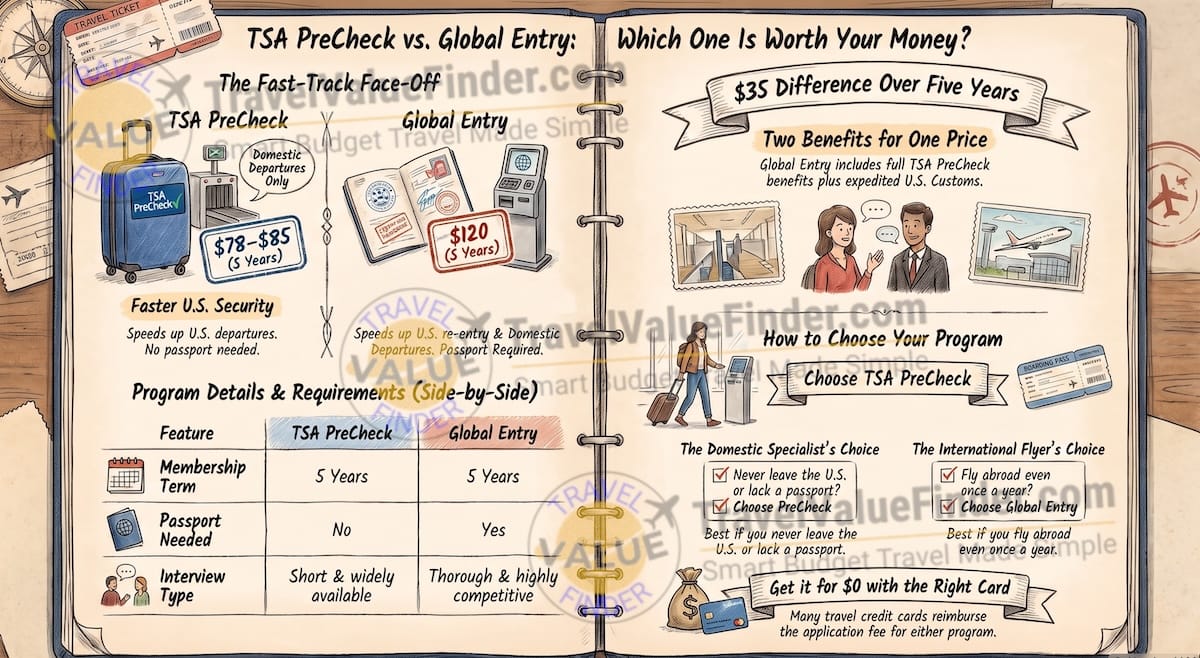
Before the full breakdown, the short answer: for most travelers who fly internationally even a few times, Global Entry is the better $120 to spend, because it includes TSA PreCheck automatically – you’re not choosing between the two so much as choosing whether to pay a small premium for the international benefit on top of the domestic one.
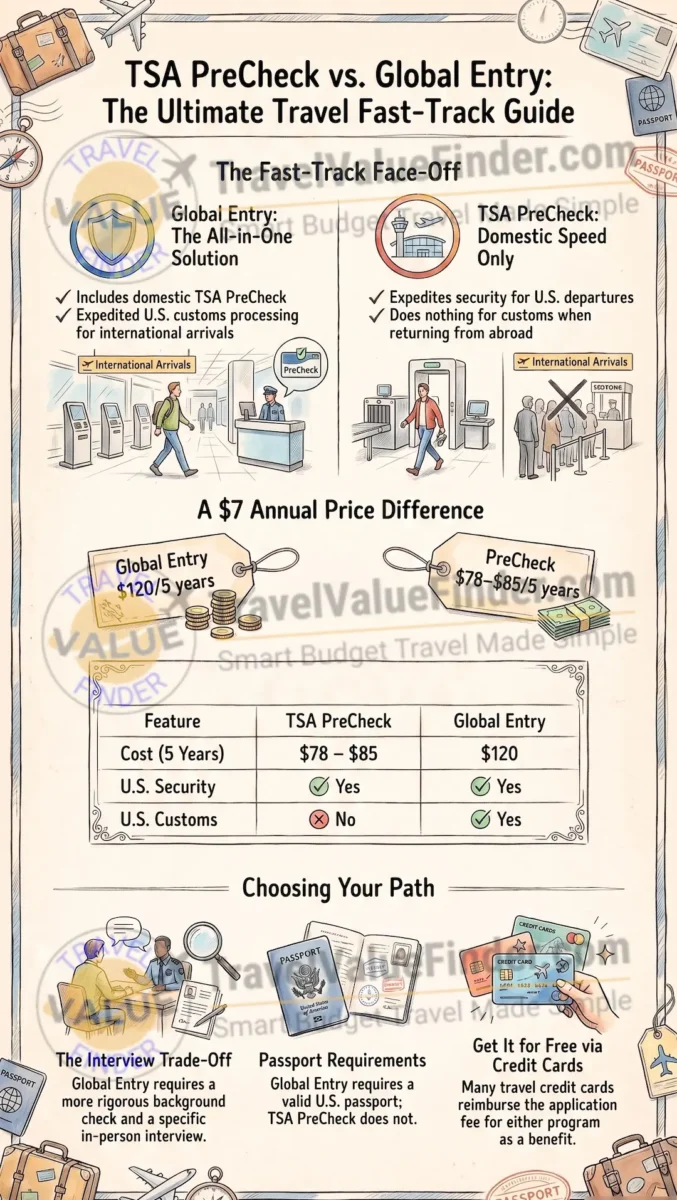
| TSA PreCheck | Global Entry | |
| Cost (5 years) | $78 β $85 (varies by provider) | $120 |
| What it speeds up | Domestic airport security | U.S. customs on international arrival + includes PreCheck |
| Application | Online + in-person visit (~10 min) | Online + background check + in-person interview |
| Best for | Travelers who rarely fly internationally | Anyone who flies internationally even occasionally |
People treat this like it’s a hard choice. It mostly isn’t – Global Entry already includes the thing PreCheck does, for about $7 a year more. The real question is whether you ever leave the country, not which program is ‘better’. – Leslie Nics, Founder & Lead Travel Writer, TravelValueFinder.com
Why the Price Gap Barely Matters
Global Entry costs $120 for five years – about $24 a year. TSA PreCheck runs $78 to $85 for the same five years depending on which enrollment provider you choose, or roughly $16 a year. That’s a gap of about $35 to $42 total across five years, less than $10 a year, for a program that also gets you through customs in a fraction of the time after an international flight.
Compare that to the cost of literally any international trip on this site – a single night’s hotel almost anywhere covers the entire price difference. This is confirmed directly by TSA’s own guidance: if you travel internationally four or more times a year, they recommend Global Entry over PreCheck alone – and even below that threshold, the math rarely favors saving the $35.
What You Actually Get With Each Program
TSA PreCheck gets you into a dedicated security lane at over 200 U.S. airports, where you typically keep your shoes, belt, and light jacket on, and don’t need to remove laptops or approved liquids from your bag. It only applies to security screening for flights departing U.S. airports – it does nothing for the customs line when you land back in the U.S. from abroad.
Global Entry does everything TSA PreCheck does, plus expedited customs processing at over 70 major airports when you re-enter the U.S. after international travel – often a kiosk or a short dedicated line instead of the standard customs queue, which can run 30β60+ minutes at busy airports during peak travel periods.
The Interview Is the Real Trade-Off, Not the Price
The honest reason some people choose TSA PreCheck over Global Entry isn’t the $35 price difference – it’s the application process. Global Entry requires an in-person interview at an enrollment center after conditional approval, and interview slots at busy locations can book out weeks or months in advance. TSA PreCheck’s in-person step is shorter and available at more locations, including some mobile enrollment events.
If you live near a major airport with a Global Entry enrollment center, or you’re willing to use the Enrollment on Arrival option (completing your interview when you land from an upcoming international trip), this trade-off mostly disappears. If you don’t, it’s worth weighing seriously.
The application fee was never the obstacle for me. Finding an interview slot within driving distance was – and once I did, I never looked back and wondered if PreCheck alone would’ve been enough. – Leslie Nics, Founder & Lead Travel Writer, TravelValueFinder.com

When I’d Actually Recommend TSA PreCheck Instead
- You genuinely never fly internationally. If every trip on your calendar is domestic, Global Entry’s core benefit simply never activates for you.
- You don’t have a passport and don’t plan to get one soon. Global Entry requires one; TSA PreCheck doesn’t.
- You can’t reasonably get to an interview location. If the nearest enrollment center is hours away and Enrollment on Arrival isn’t a realistic option for your travel plans, the friction may not be worth it for occasional flyers.
- You’re purely budget-constrained on the $35 difference. Rare, but valid – in that case, PreCheck alone is still a meaningfully better experience than standard screening.
How to Get Either One for Free
This is the detail that makes the decision even easier: a number of travel credit cards reimburse the application fee for Global Entry or TSA PreCheck (never both) as a standard cardholder benefit, effectively making either program free if you already carry – or are considering – one of those cards.
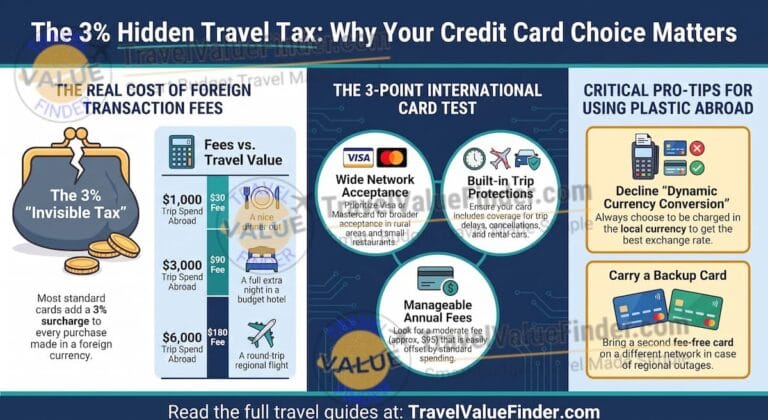
If you’re shopping for a card anyway, see our breakdown of the no foreign transaction fee credit card worth getting before your next international trip; several cards in that category bundle this exact reimbursement in with the fee-free spending benefit.
What I’d Do Differently
I put off applying for two years, telling myself the standard security and customs lines were ‘fine.’ They were fine – right up until a delayed connection turned a 40-minute customs line into the reason I missed my next flight. I’d tell my past self that the $120 was never really the cost being weighed; the actual cost was every missed-connection risk and every extra 30 minutes at security across dozens of flights in the meantime.
Plan the Rest of Your Trip
- The Only No Foreign Transaction Fee Credit Card I’d Get – several options reimburse this exact application fee
- Travel Insurance Guide – another pre-trip essential worth setting up alongside this one
- How to Find Cheap Flights: 12 Proven Strategies – booking strategies for the trips this membership will actually speed up
- Travel After 60: Ultimate 2026 Guide – includes TSA Cares and Touchless ID details specifically useful for senior travelers
People Also Ask
Is Global Entry or TSA PreCheck better?
Global Entry is the better value for most travelers who fly internationally even occasionally, since it includes full TSA PreCheck benefits for roughly $35β42 more over five years. TSA PreCheck alone makes sense mainly for travelers who fly exclusively domestic.
How much does Global Entry cost compared to TSA PreCheck?
Global Entry costs $120 for a five-year membership. TSA PreCheck costs $78β85 for the same five years, depending on the enrollment provider chosen – a total difference of about $35β42 over five years.
Does Global Entry include TSA PreCheck?
Yes. Global Entry membership automatically includes TSA PreCheck benefits for domestic flights, in addition to expedited customs processing when re-entering the U.S. from international travel.
Can I get TSA PreCheck or Global Entry reimbursed?
Yes, many travel credit cards offer a statement credit reimbursing the application fee for either program (not both) as a standard cardholder benefit, typically every four years.
Frequently Asked Questions
Do I need a passport for Global Entry?
Yes, a valid U.S. passport (or passport card) is required to apply for Global Entry. TSA PreCheck does not require one.
How long does Global Entry approval take?
Most applications are reviewed within two weeks, though it can take significantly longer depending on individual circumstances. An in-person interview is required after conditional approval before final enrollment.
Can I switch from TSA PreCheck to Global Entry?
Not directly – you can’t upgrade an existing TSA PreCheck membership into Global Entry. You’ll need to apply for Global Entry as a new applicant and pay its separate application fee, though current PreCheck members may be eligible for expedited processing.
Does TSA PreCheck work on international flights departing the U.S.?
Yes, TSA PreCheck applies to security screening for flights departing U.S. airports, including international departures, though it doesn’t speed up customs when you land in the destination country or return to the U.S.
Is Global Entry worth it if I only travel internationally once a year?
Often yes – even a single international trip a year can mean saving 20β40+ minutes at customs, which is frequently worth more than the roughly $7-a-year price difference versus TSA PreCheck alone.
Sources
- TSA – TSA PreCheck FAQ – official program details and eligibility
- U.S. Customs and Border Protection – Global Entry – official program details, current fees, and application process
Disclaimer: Program fees, eligibility requirements, and processing times are set by TSA and CBP and can change; always confirm current details at tsa.gov and cbp.gov before applying. This article reflects independent research, not an endorsement by or affiliation with TSA or CBP.
About the Author
Leslie Nics is the founder and primary travel researcher at Travel Value Finder. He specializes in budget travel, destination research, and itinerary planning, drawing on firsthand travel experience to help readers find affordable and practical travel options. Read more on the About page or see the site’s Trust & Transparency Policy.