Travel Value Finder

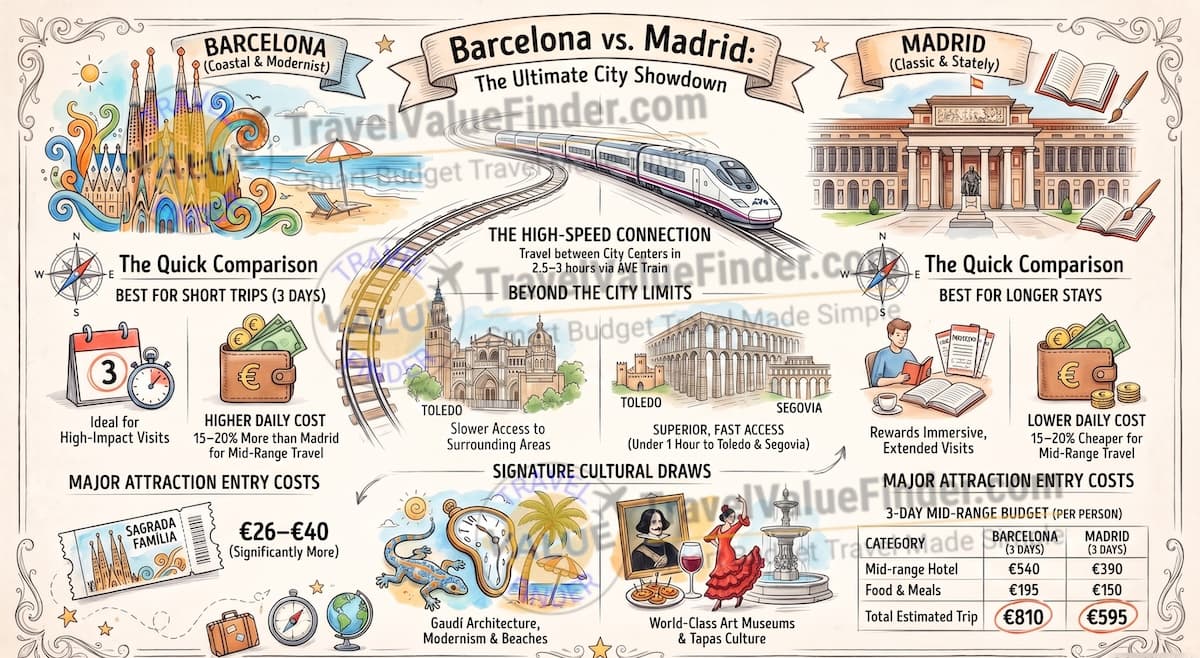
In the Barcelona vs Madrid travel decision, these cities aren’t really competing for the same trip.
- Barcelona is a compact, visually stunning coastal city built for a short, high-impact visit.
- Madrid is a larger, less obviously photogenic capital that rewards a longer stay and consistently costs less while you’re there.
Barcelona wins for a short first trip with:
- Gaudí’s architecture,
- the Gothic Quarter, and
- a city beach all sit within a small, walkable footprint.
Madrid wins on almost everything else:
- it typically runs 15–20% cheaper day to day,
- has Spain’s strongest museums (the Prado, Reina Sofía),
- better nightlife-to-crowd ratio, and
- the best base for day trips to Toledo and Segovia.
For a first Spain trip under a week, pick one city rather than splitting a short stay between both.
Leslie Nics, TravelValueFinder.com | Last updated: Aug 2026 | Based on first-hand research across both cities
Table of Contents
People Also Ask
Is Barcelona or Madrid better for first-time visitors?
Barcelona typically works better for a short first trip with Gaudí’s architecture, the Gothic Quarter, and a city beach all sit within a small, walkable area. Madrid rewards a longer stay and repeat visits.
Is Barcelona more expensive than Madrid?
Yes, consistently. Barcelona runs roughly €100–€140/day mid-range per person versus €85–€120/day in Madrid, with hotels showing the widest gap.
How many days do you need in Barcelona and Madrid?
A minimum of 3 nights per city if visiting both; fewer starts to feel rushed. A single-city trip of 4–5 days is a realistic first-timer alternative to splitting time between both.
Which is safer, Barcelona or Madrid?
Both fall under the same U.S. State Department Level 2 advisory for Spain, with pickpocketing concentrated around each city’s most crowded tourist landmarks – neither city is meaningfully safer than the other.
Barcelona vs Madrid: The Real Trade-Off
| Barcelona | Madrid | |
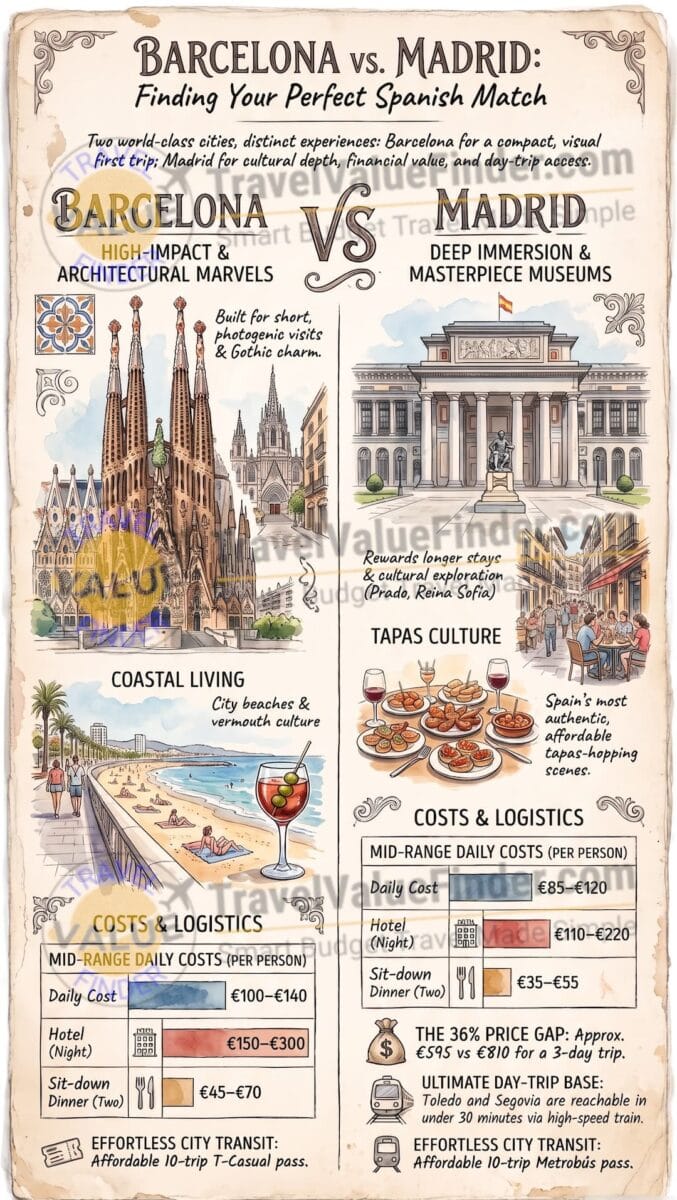
| Daily cost, mid-range (per person) | €100–€140 | €85–€120 |
| Signature draw | Gaudí architecture, Gothic Quarter, city beach | Prado & Reina Sofía museums, tapas culture, nightlife |
| Best for | First-time visitors, short trips, architecture lovers | Repeat visitors, longer stays, food and museum focus |
| Day-trip access | Limited (Girona, Montserrat, further out) | Excellent – Toledo and Segovia under an hour by train |
| Population / tourist density | 1.6M residents, very high tourist density | 3.3M residents, tourism load more spread out |
Barcelona photographs better. Madrid lives better. Neither of those is the wrong answer, they’re just answering different questions about the same trip.” Leslie Nics, Founder & Lead Travel Writer, TravelValueFinder.com
Cost Comparison: Hotels, Food, Transport
| Category | Barcelona | Madrid |
| Mid-range hotel, city center | €150–€300/night | €110–€220/night |
| Budget hotel/hostel | €50–€90/night | €40–€75/night |
| Casual sit-down dinner for two | €45–€70 | €35–€55 |
| 10-trip transit pass | €12.55 (T-Casual, zones 1) | Comparable pricing on Metrobús 10-ride |
| Major attraction ticket (Sagrada Família / Prado) | €26–€40 | €15 |
Attraction tickets are the one place the two cities land close together with the Sagrada Família actually costs more than the Prado despite Madrid’s overall lower cost of living.
Everything else, from hotels to dinner, consistently favors Madrid by a real, not marginal, margin.
A Real 3-Day Budget, Side by Side
Putting the category numbers together into an actual 3-day, single-traveler, mid-range budget for each city:
| Category | Barcelona (3 days) | Madrid (3 days) |
| Hotel, mid-range (3 nights) | €540 | €390 |
| Food (all meals, 3 days) | €195 | €150 |
| Local transport (10-trip pass + extras) | €20 | €20 |
| Attractions (Sagrada Família + 1 more) | €55 | €35 |
| Total | €810 | €595 |
That’s roughly a 36% gap for a comparable 3-day trip. Barcelona’s premium isn’t subtle once it’s added up in real numbers rather than described as “somewhat pricier.”
Neither city is objectively the wrong pick; the gap is simply worth knowing before booking, especially for a budget-conscious traveler choosing between them.
Which City for First-Timers
If this is a single short trip, 3 to 4 days, Barcelona wins for most first-time visitors.
- Sagrada Família,
- Park Güell,
- the Gothic Quarter, and
- Barceloneta beach all sit within a compact, walkable, metro-connected footprint, which means a short visit doesn’t feel rushed the way a short Madrid trip can.
Madrid’s value is less about single landmarks and more about immersion. It rewards the kind of longer stay a first, time-constrained trip usually can’t give it.
Which City for Food
This is close, and genuinely comes down to style rather than quality.
Barcelona leans Catalan and coastal offering seafood, vermouth culture, market food at La Boqueria. You may enjoy:
- La Boqueria market for a quick, affordable lunch;
- Gràcia neighborhood for the best independent, non-touristy restaurant density.
Madrid leans deeper into classic Spanish tapas culture. A bar-hopping tradition (La Latina’s Cava Baja street especially) that’s harder to replicate in Barcelona’s more spread-out dining scene.
Madrid also runs meaningfully cheaper for a comparable meal, which matters if food is a big part of the trip’s budget.
- Cava Baja street in La Latina for a genuine tapas crawl;
- Mercado de San Miguel for a higher-end market-food experience (pricier than La Boqueria, worth it once).
Both cities charge noticeably more for a table directly on a main tourist square.
Walking two or three streets back from Las Ramblas or Puerta del Sol routinely cuts the bill by 20–30% for a comparable meal.
Which City for Day Trips
This isn’t close.
Madrid sits under an hour by train from both Toledo (a walled medieval city) and Segovia (Roman aqueduct, a genuinely spectacular Alcázar).
These are two of Spain’s best day trips, both easy half-day or full-day add-ons to a Madrid base.
Barcelona’s comparable day-trip options. Girona, Montserrat are real and worthwhile, but sit further out and involve more transit time for a similar payoff.
| Day Trip | From | Travel Time | Highlight |
| Toledo | Madrid | ~30 min by high-speed train | Walled medieval old town, Cathedral, El Greco’s works |
| Segovia | Madrid | ~30 min by high-speed train | Roman aqueduct, the Alcázar castle |
| Montserrat | Barcelona | ~1 hour by train + cable car/rack railway | Mountain monastery, dramatic rock formations |
| Girona | Barcelona | ~40 min by high-speed train | Medieval old town, Game of Thrones filming locations |
Reality Check A common mistake is trying to fit Toledo or Segovia into a Barcelona-based trip via a long round-trip day, and it’s not realistic given the distance between the cities. Day trips only make sense from whichever city you’re actually based in.
Neighborhoods: Where to Actually Stay
Barcelona
- Eixample (around Passeig de Gràcia); the safest first-timer pick: wide modernist boulevards, easy metro access, walkable to Sagrada Família.
- El Born; the prettiest old-town option, cocktail bars and the Picasso Museum, but pricier.
- Gràcia; local, creative, the best independent restaurant scene, less touristy.
- Barceloneta; worth it only if a beach-adjacent stay matters more than a quiet night’s sleep.
- Find the best places and where to stay in Barcelona
Madrid
- Malasaña; bohemian, independent shops, the best brunch scene in Madrid, a 10-minute walk to Sol.
- Chueca; Madrid’s LGBTQ+ historic district, restaurant-dense, walkable to the museums.
- La Latina; medieval Madrid, the Sunday Rastro flea market, tapas-bar dense.
- Salamanca; upscale, designer shopping, Michelin restaurants, calmer at night.
- Find the best areas and where to stay in Madrid
Best Time to Visit Either City
May, late September, and October hit the sweet spot for both cities. They are long daylight hours, 18–26°C, low rainfall, and in Barcelona’s case, the sea is still swimmable well into that window while Madrid settles into crisp, golden autumn weather.
Summer brings real heat to both cities, Madrid’s landlocked climate especially, without the coastal relief Barcelona at least partially offers.
Getting Around Each City
Both cities have excellent, tourist-friendly metro systems, and neither requires a car.
Barcelona’s T-Casual 10-trip pass (€12.55, zone 1) covers metro, bus, tram, and the FGC suburban rail, though it’s non-shareable between travelers.
Madrid’s comparable Metrobús 10-ride pass runs similarly priced and covers the metro and city bus network.
Both systems are dense enough that most first-timers can skip taxis and rideshares almost entirely, aside from late-night trips or airport transfers.
- Barcelona’s Gothic Quarter and Eixample are highly walkable; expect more walking overall given the city’s compact footprint.
- Madrid’s grid is larger and less naturally walkable end to end, which makes its metro coverage more essential to a smooth trip than Barcelona’s.
- Both airports (El Prat in Barcelona, Barajas in Madrid) connect to the city center by metro or an affordable dedicated bus, making an airport taxi optional rather than necessary in either city.
Safety: What the Official Advisory Actually Says
The U.S. Department of State rates Spain Level 2 – Exercise Increased Caution nationally, as of its most recent August 2026 update.
This is largely citing terrorism risk and pickpocketing as the primary concerns for travelers a rating that applies equally to both cities, not one more than the other.
Pickpocketing specifically concentrates in the most crowded tourist areas of both cities:
- Las Ramblas and Park Güell in Barcelona,
- Puerta del Sol and the main museum district in Madrid.
Neither city is meaningfully “safer” than the other. To travel safely in any places, be mindful of your belongings.
- Keep bags zipped and in front of you in crowds, avoid displaying phones or cameras loosely.
- Stay alert specifically around major tourist landmarks and transit hubs.
Common Mistakes First-Timers Make
- Splitting a short 4-day trip evenly between both cities instead of picking one and going deeper.
- Trying to day-trip to Toledo or Segovia from a Barcelona base. The distance doesn’t support it.
- Assuming Barcelona’s higher cost buys a meaningfully better experience rather than a different one. Madrid’s lower prices reflect tourism density economics, not lower quality.
- Booking Barceloneta for the beach access without weighing the noise trade-off against a quieter Eixample stay a short metro ride from the same beach.
Getting Between Them
The AVE high-speed train connects Barcelona and Madrid city-center to city-center in about 2.5–3 hours. Fares typically running €60–€100 depending on how far in advance you book.
For a first Spain trip of 7 or more days, splitting time between both cities via this train is genuinely realistic.
The rule of thumb worth following is a minimum of 3 nights per city, since fewer than that starts to feel like commuting rather than traveling.
Find Out More About Visiting Spain
- Barcelona Travel Guide
- Spain Travel Guide
- Cheap Hotels in Barcelona Under $150
- Cheap Hotels in Madrid Under $150
- Spain vs Italy
FAQ
Is Barcelona or Madrid cheaper to visit?
Madrid, consistently, across hotels, food, and general daily spending. It is typically 15–20% cheaper than Barcelona for a comparable mid-range trip.
Can you do a day trip between Barcelona and Madrid?
Not practically, the cities are 2.5–3 hours apart by high-speed train, making a round-trip day too long to be worthwhile. Choose day trips based on whichever city you’re based in instead.
Which city has better food, Barcelona or Madrid?
It’s a style difference more than a quality one. Barcelona leans Catalan and coastal, Madrid leans into classic Spanish tapas culture. Madrid is consistently the cheaper of the two for a comparable meal.
Is Madrid or Barcelona better for beaches?
Barcelona, decisively. It’s a coastal city with a city beach at Barceloneta. Madrid is landlocked with no beach access.
How do I get between Barcelona and Madrid?
The AVE high-speed train connects both city centers in about 2.5–3 hours, with fares typically running €60–€100 depending on how far in advance you book.
Sources