Travel Value Finder

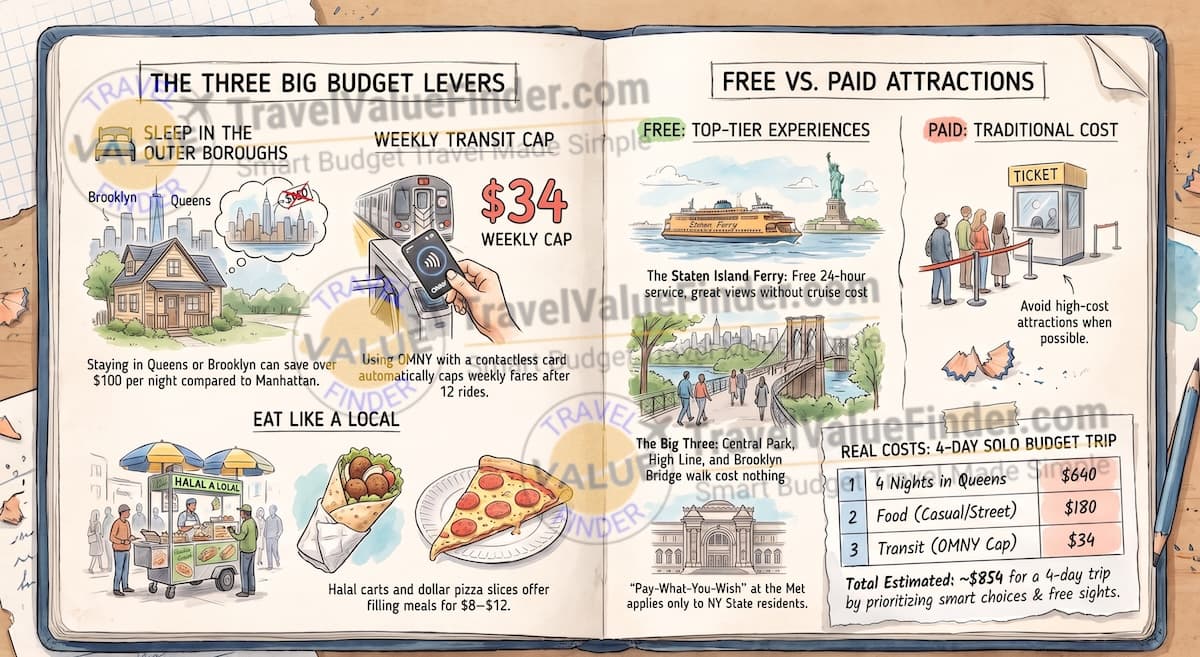
New York on a budget is genuinely achievable at $80–$130 per person, per day, covering a hostel or outer-borough hotel, mostly free attractions, and casual food.
It is well below the $235–$385/day mid-range figure most cost calculators lead with.
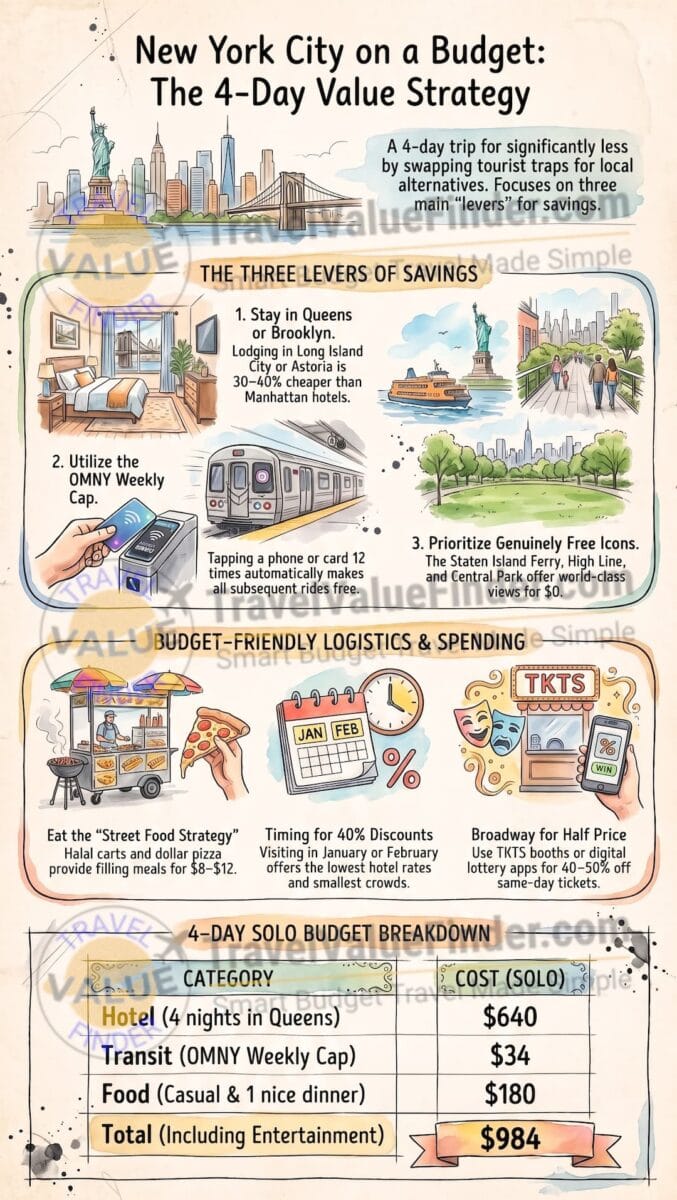
The three biggest levers are staying in Queens or Brooklyn instead of Manhattan.
Leslie Nics, TravelValueFinder.com | Last updated: Aug 2026 | Based on first-hand trip planning and current 2026 pricing research
New York has more genuinely free world-class attractions than almost any city on earth. The gap between an unplanned trip and a deliberately budget-conscious one is enormous. It often cost $500–$800 for a 4-day solo trip without giving up a single thing that actually matters.
Most NYC budget guides either lean entirely on “everything is free!” enthusiasm without pricing a real trip, or bury the useful numbers under a wall of neighborhood options.
This one does both: a real 4-day itinerary, an itemized budget, and the specific free-attraction and transit rules that actually move the number.
Here’s the thing most first-timers get backwards.
New York’s expense reputation comes almost entirely from a handful of specific decisions:
- a Times Square hotel,
- taxis instead of the subway,
- full-price museum tickets, and
- restaurant dining every meal.
Swap out those four choices for their genuinely comparable alternatives, and the same trip that “has” to cost $300/day comfortably runs under $130.
Table of Contents
People Also Ask
How much does a 4-day trip to New York cost?
A budget-conscious solo traveler, staying in Queens or Brooklyn and mostly using free attractions, can expect roughly $950–$1,000 total, or about $240–$250/day. This iswell under the $235–$385/day mid-range figure most cost calculators cite.
What are the best free things to do in New York City?
The Staten Island Ferry, Brooklyn Bridge walk, Central Park, the High Line, and the National Museum of the American Indian are all genuinely free with no restrictions, alongside MoMA’s Friday evening free hours.
Is the subway cheaper than a taxi in NYC?
Significantly, a subway ride is a flat $2.90 with an automatic weekly cap around $34. A short taxi or rideshare ride commonly runs $15–$25 depending on traffic.
What is the cheapest way to see NYC attractions?
Lean on the city’s free attractions first (Central Park, the High Line, Brooklyn Bridge). Use the TKTS booth or lottery apps for discounted Broadway, and budget the Met’s suggested $30 admission as a real cost unless you hold New York State ID.
New York on a Budget: The Three Decisions That Actually Move the Number
Before the itinerary and the free-attraction list, it’s worth naming the three levers that account for most of the swing on a trip built around New York on a budget:
- where you sleep,
- how you pay for transit, and
- how deliberately you build free and pay-what-you-wish attractions into each day instead of treating them as an afterthought.
Where to Stay: Manhattan vs. the Outer Boroughs
| Area | Typical Rate | Trade-Off |
| Manhattan hotel | $180–$300+/night; below $150 is rare and often disappointing | Walkable to major sights, highest cost |
| Queens (Long Island City, Astoria) | $140–$180/night | 2 subway stops to Midtown, 30–40% cheaper, strong food scene |
| Brooklyn (Williamsburg, Bushwick) | Comparable to Queens, sometimes lower | Stronger nightlife/dining, fast L train access |
| Hostel dorm (citywide) | $40–$80/night | Best for solo budget travelers, shared rooms |
Explore Where to Stay in New York (Best Areas & Neighborhood Guide) for more information.
Getting Around: OMNY and the Weekly Cap
New York’s subway and bus fare is a flat $2.90/ride. The detail that actually matters for a multi-day trip is the automatic weekly fare cap.
Tap a contactless card or phone through OMNY, and once you hit 12 rides in a 7-day period, every additional ride that week is free capping out around $34. No advance pass purchase required.
For a 4-day trip with typical sightseeing-level subway use, that cap usually kicks in by day 3 or 4.
- Skip buying a physical weekly MetroCard: tapping a contactless credit card or phone through OMNY applies the same rolling cap automatically.
- Walking genuinely counts as a real transit strategy in Manhattan. Many “far apart” landmarks (say, Times Square to Bryant Park) are a 10-minute walk, not a subway trip.
- The Staten Island Ferry is free, runs 24 hours, and passes close enough to the Statue of Liberty for the photo most people pay a harbor cruise for.
Free and Pay-What-You-Wish: What’s Actually Free vs. What Requires an NY ID
This is the detail a lot of budget guides get wrong, and it’s worth being precise about, since it directly affects your museum budget:
| Attraction | Cost for Visitors | Notes |
| The Met | $30 suggested admission for non-NY residents | Pay-what-you-wish applies only to New York State ID holders. Visitors are expected to pay the suggested amount |
| American Museum of Natural History | Similar suggested-admission structure | Same NY-residency-only pay-what-you-wish rule as the Met |
| MoMA | Free, Fridays 4–8 PM (UNIQLO Free Friday Nights) | Genuinely free for everyone, not residency-restricted |
| National Museum of the American Indian | Free every day, for everyone | No restrictions – a real, completely free Smithsonian-affiliated museum |
| Brooklyn Museum | Pay-what-you-wish on select days | Check current schedule – varies by day |
| The High Line, Central Park, Brooklyn Bridge walk | Free, always | No restrictions of any kind |
Reality Check: Several NYC budget articles imply the Met and AMNH are pay-what-you-wish for everyone. They’re not, that policy applies specifically to New York State residents with ID.
Out-of-state and international visitors are expected to pay the suggested admission, commonly $30. Budget for it as a real cost, not an optional donation.
A Real 4-Day Itinerary
Day 1: Downtown and the Ferry
- Start with the free Staten Island Ferry for Statue of Liberty and skyline views without a paid cruise,
- Walk the Brooklyn Bridge into DUMBO for lunch,
- then spend the afternoon in Lower Manhattan around the National Museum of the American Indian (free), and
- the 9/11 Memorial (outdoor plaza is free; museum entry is paid if you choose to add it).
Get Your New York Itinerary with the Trip Planner, and download your Free PDF, no account or sign-in needed.
Day 2: Midtown and Museums
- The Met in the morning ($30 suggested for visitors: budget it as a real cost),
- then Central Park for the afternoon,
- the Mall, Bethesda Terrace, and
- the Reservoir loop cost nothing.
If your day lands on a Friday, save MoMA for the evening free hours (4–8 PM) instead of paying full price earlier in the day.
Day 3: The High Line and Broadway
- Walk the High Line from Gansevoort Street up to 34th Street (free, elevated, and one of the best people-watching stretches in the city).
- In the evening, line up at the TKTS booth in Times Square (opens 3 PM for evening shows, 10 AM for matinees) for same-day Broadway tickets at 40–50% off face value, or
- try the digital lottery apps for a shot at $10–$40 tickets to specific shows.
Day 4: Neighborhood Exploring
Spend the last day in whichever borough you’re staying in rather than commuting back into Manhattan for one more sight;
- Astoria’s Greek food scene,
- Williamsburg’s waterfront, or
- Long Island City’s riverside park views.
All of these make for a relaxed, low-cost final day before a flight.
Food Budget: Where NYC’s Best Value Actually Is
| Style | Per Day |
| Street food/quick service (dollar pizza, halal carts, bagels) | $25–$40 |
| Mix of quick service + one sit-down meal | $50–$70 |
| Mostly restaurant dining | $80–$120+ |
- A dollar pizza slice or a halal cart platter both routinely run $8–$12 for a genuinely filling meal. NYC’s street food scene is a real budget strategy, not a compromise.
- Chinatown and the outer-borough neighborhoods (Flushing, Sunset Park, Jackson Heights) consistently offer the best value-to-quality ratio in the city. This is often at half the price of a comparable Manhattan restaurant meal.
- Food halls (Chelsea Market, Time Out Market) let a group order different price points from the same stop. Useful for mixed budgets traveling together.
- Save one “real” sit-down dinner for a specific splurge rather than spreading restaurant meals across every night. It stretches a food budget considerably further without feeling deprived.
What the Full 4-Day Trip Actually Cost
| Category | Cost |
| Hotel, 4 nights in Queens (Long Island City) | $640 |
| Transit (OMNY weekly cap reached by day 3) | $34 |
| Food (mostly casual : halal carts, pizza, food halls, one nicer dinner) | $180 |
| The Met admission | $30 |
| Broadway lottery ticket | $40 |
| Miscellaneous (coffee, snacks, small souvenirs) | $60 |
| Total | $984 |
That’s roughly $246/day for a solo traveler.
Comfortably inside the $80–$130/day “budget traveler” range once split appropriately, and well under the $235–$385/day mid-range figure most NYC cost calculators cite as the default.
Traveling as a couple splitting the hotel room brings the per-person daily cost down further, closer to $180–$200/day.
The number that actually shrank our budget wasn’t a discount code. It was two decisions; sleeping two subway stops outside Manhattan, and treating the Central Park and High Line afternoons as the main event instead of the free filler between paid attractions.” Leslie Nics, Founder & Lead Travel Writer, TravelValueFinder.com
Best Time to Visit for Lower Prices
| Season | Hotel Rates | Weather | Crowds |
| January–February | 30–40% below peak | Cold, sometimes harsh | Lowest of the year, uncrowded Central Park |
| Late August | Dipping before Labor Day | Hot, humid | Lower than summer peak |
| September | Can spike to record highs (~$417/night average) | Mild, pleasant | High. A genuinely expensive month despite good weather |
| November–December | Peak (holiday season) | Cold, festive | Very high. Avoid if budget matters |
January and February are the clear budget winners when hotel rates drop 30–40% and Central Park empties out.
However, these come at the cost of genuinely cold weather that requires real winter gear, not a light jacket.
Packing and Practical Tips
- Comfortable walking shoes matter more than anything else you pack: expect to walk far more than a typical trip, even with heavy subway use.
- A portable phone charger earns its space; navigating, checking transit apps, and mobile Broadway lottery entries all drain battery fast.
- Layer for changeable weather regardless of season: subway platforms and cars run notably colder or hotter than street level.
- A downloaded offline subway map is worth having: cell service is spotty in some stations, and knowing your transfer before you lose signal saves real time.
Common Mistakes First-Timers Make
- Booking a Times Square-area hotel for convenience, without pricing the 30-minute-subway-stop alternative that can save $100+/night.
- Assuming the Met and AMNH are pay-what-you-wish for everyone. That policy is New York State resident-only; out-of-state visitors should budget the suggested admission as a real cost.
- Buying a physical weekly MetroCard when a contactless card or phone tapped through OMNY applies the same weekly fare cap automatically, with no upfront purchase.
- Overloading the itinerary with paid attractions instead of treating Central Park, the High Line, and neighborhood walking as full sightseeing days in their own right.
- Skipping the TKTS booth or lottery apps. Paying full price for Broadway, when a 40–50% discount is genuinely available same-day for most shows.
FAQ
How much should I budget per day in New York City?
$80–$130/day for a genuinely budget-focused solo trip covering a hostel or outer-borough hotel, casual food, and mostly free attractions, $235–$385/day for a mid-range trip with paid museum visits and casual restaurant dining.
What is the cheapest way to get around NYC?
The subway and bus, tapped via OMNY with a contactless card or phone. The automatic weekly fare cap (around $34) makes it cheaper than any pass you’d need to buy in advance.
Are there free museum days in New York?
Yes, MoMA is free Friday evenings 4–8 PM, and the National Museum of the American Indian is free every day for everyone. The Met and AMNH’s pay-what-you-wish policy applies only to New York State residents with ID.
Is New York expensive for tourists?
It can be, but it doesn’t have to be. New York has an unusually large number of genuinely free world-class attractions, and choosing an outer-borough hotel over Manhattan is the single biggest lever for cutting costs.
What is the best budget-friendly time to visit NYC?
January and February, when hotel rates drop 30–40% below peak and Central Park empties out and the trade-off is genuinely cold winter weather.
Sources