Travel Value Finder

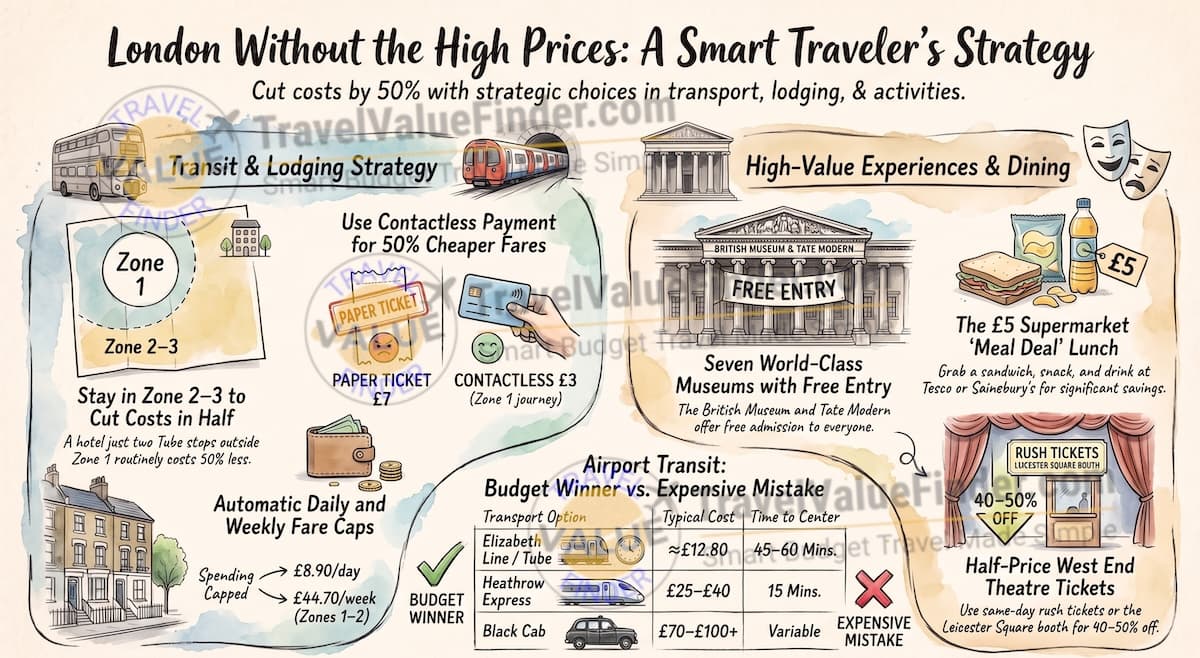
London on a budget is genuinely realistic at £54–£95 per person, per day, covering a hostel or Zone 2–3 hotel, free world-class museums, and casual food, all well under the £160–£275/day mid-range figure most cost calculators lead with.
The two biggest levers are London’s national museums, which are completely free for everyone (no residency restriction, unlike comparable New York museums), and using contactless payment on the Tube instead of paper tickets, which cuts transport costs by more than half automatically.
Leslie Nics, TravelValueFinder.com | Last updated: Aug 2026 | Based on first-hand trip planning and current 2026 pricing research
Ask most people about London on a budget and they picture £7 pints and £20 sandwiches and both of those are real.
What most people don’t realize is that London also has one of the largest collections of completely free world-class museums anywhere in the world, and a transit system that automatically caps what you pay no matter how much you ride.
The gap between an unplanned London trip and a deliberately budget-conscious one is enormous, often £400–£600 for a 5-day solo trip, without cutting a single museum or neighborhood that actually matters.
Most London budget guides either lean entirely on the free-museums angle without pricing a real trip, or bury the transit math under confusing Oyster-vs-contactless debates. This one does both: a real 5-day itinerary, an itemized budget, and the specific fare and museum rules that actually move the number.
Here’s what surprised me most going in: London’s expensive reputation comes almost entirely from a handful of specific decisions. A Zone 1 hotel, paper Tube tickets, full-price West End theatre, and restaurant dining every meal.
Swap those four for their genuinely comparable alternatives, and the same trip that “has” to run £275/day comfortably drops under £100.
Table of Contents
London on a Budget: The Two Decisions That Actually Move the Number
Before the itinerary and the free-museum list, it’s worth naming the two levers that account for most of the swing on a trip built around London on a budget: how you pay for the Tube, and how deliberately you build London’s free national museums into each day instead of treating them as a fallback.
Where to Stay: Zone 1 vs. Zone 2–3
| Option | Typical Rate | Trade-Off |
| Zone 1 hotel (Westminster, Soho, Covent Garden) | £180–£280/night mid-range; £400–£750+ luxury | Walkable to major sights, highest cost |
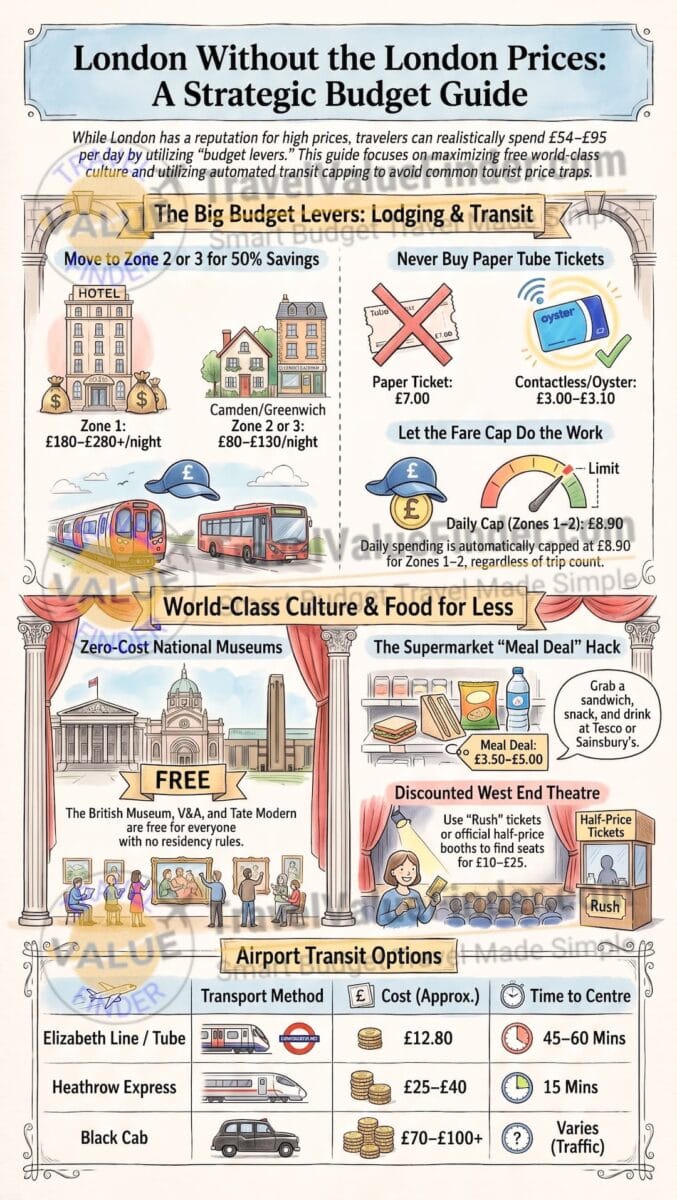
| Zone 2–3 hotel (Camden, Greenwich, Shepherd’s Bush) | £80–£130/night | One extra Tube stop or two, meaningfully cheaper |
| Hostel dorm (citywide) | £25–£45/night | Best for solo budget travelers, shared rooms |
A hotel two Tube stops outside Zone 1 routinely costs half of an equivalent Zone 1 room, and the Tube ride to make up the difference costs about £3. That math should win almost every time. – Leslie Nics, Founder & Lead Travel Writer, TravelValueFinder.com
Find the best places and Where to Stay in London, or if you prefer, find the Best Budget Hotels in London, UK. Check on Luxury Hotels in London for current promotional prices, if any.
Getting Around: Contactless, the Daily Cap, and the One Rule That Matters Most
A Zone 1 Tube journey costs £3.00 off-peak / £3.10 peak on contactless or Oyster, versus £7.00 for a paper single ticket more than double, for the exact same journey. Both contactless and Oyster automatically cap your spending: £8.90/day for Zones 1–2, and £44.70/week for the same zones (both frozen through at least March 2027), no advance pass purchase required.
| Fare Type | Cost | Notes |
| Paper single ticket, Zone 1 | £7.00 | Avoid entirely : more than double the contactless fare |
| Contactless/Oyster single, Zone 1 | £3.00 off-peak / £3.10 peak | Peak: weekdays 6:30–9:30 AM and 4–7 PM |
| Daily cap, Zones 1–2 | £8.90 | You’ll never pay more than this in a single day, however many trips you take |
| Weekly cap, Zones 1–2 | £44.70 | Runs Monday–Sunday; best value if your trip starts on a Monday |
| Bus (flat fare, any distance) | £1.75, with £5.25 daily cap | The Hopper fare gives unlimited bus transfers within 1 hour of first tap |
Reality Check: The daily and weekly caps only work if you tap in and out with the exact same card or device every time.
Switching between a phone and a physical card mid-trip makes the system treat you as two separate travelers, and you’ll lose the automatic capping. Pick one payment method for the whole trip and stick to it.
London’s Free Museums: A Genuine Advantage Over Most Major Cities
This is London’s biggest structural advantage over a lot of comparably expensive cities like New York include. In London, the
- British Museum,
- National Gallery,
- Tate Modern,
- Tate Britain,
- Natural History Museum,
- Science Museum, and
- the V&A
all offer completely free general admission for everyone, with no residency requirement or ID check.
Unlike New York’s Met and American Museum of Natural History, where the pay-what-you-wish policy applies only to New York State residents and out-of-state visitors are expected to pay a suggested $30.
Six of the world’s best museums, genuinely free, no ID check, no residency rule. Compare that to what a New York museum day costs a visitor, and London’s reputation as an expensive city starts to look incomplete. – Leslie Nics, Founder & Lead Travel Writer, TravelValueFinder.com
| Museum | Cost | Notes |
| British Museum | Free | Book a free timed entry slot online to skip the queue |
| National Gallery | Free | Special/temporary exhibitions are ticketed separately |
| Tate Modern / Tate Britain | Free | Special exhibitions ticketed separately |
| Natural History Museum | Free | The Hintze Hall blue whale skeleton is free to see |
| Science Museum | Free | Great for a family day; some interactive exhibits ticketed |
| Victoria and Albert Museum (V&A) | Free | One of the world’s great design and decorative arts collections |
Food Budget: Where London’s Real Value Is
| Style | Per Day |
| Supermarket meal-deals + casual counters (Pret, Greggs, markets) | £20–£35 |
| Mix of casual + one sit-down meal | £40–£65 |
| Mostly restaurant dining | £80–£120+ |
- UK supermarket “meal deal” combos (Tesco, Sainsbury’s, Boots) run £3.50–£5 for a sandwich, snack, and drink – a genuinely solid lunch at a fraction of a café price.
- Borough Market offers excellent quality food at street-food prices, particularly for lunch rather than dinner when the crowds thin out.
- Tap water is free almost everywhere, and asking for it at a restaurant is completely normal, that’s a real, if small, daily saving over bottled water or soft drinks.
- Curry houses around Brick Lane and the diverse food scenes in outer boroughs consistently beat central London restaurant pricing for comparable quality.
West End Theatre on a Budget
London’s theatre scene is every bit as good as Broadway’s, and considerably easier to access at a discount.
Same-day rush tickets, day-seat lotteries, and official half-price booths (around Leicester Square, similar in spirit to New York’s TKTS) routinely cut face-value prices by 40-50%, and day seats for the most in-demand shows sometimes go for as little as £10-25 if you’re willing to queue at the box office when it opens.
| Option | Typical Discount | Notes |
| Official half-price booth (Leicester Square) | 40–50% off | Cash and card accepted; check listings the morning of |
| Day seats / rush tickets | Often £10–£25 flat | Available at the theatre’s own box office, first-come-first-served |
| Digital lottery apps | Varies, often steep discounts | Entry the day before or morning of a specific performance |
Get Your London Itinerary with the Trip Planner, and download your Free PDF, no account or sign-in needed.
A Real 5-Day Itinerary
Day 1: Westminster and the South Bank
Walk Westminster Bridge, see Big Ben and the Houses of Parliament from outside, then cross to the South Bank for the London Eye area (skip the ride itself unless it’s a priority : the view from the free Sky Garden later in the trip is a strong free alternative) and a walk to Borough Market for lunch.
Day 2: Free Museums Day
The British Museum in the morning (book a free timed slot online), then the National Gallery in the afternoon, both completely free, both genuinely full-day-worthy on their own if you have the time. Finish with a walk through Covent Garden.
Day 3: Greenwich and the River
Take the DLR or a river boat out to Greenwich (river boats aren’t covered by the daily Tube cap, so budget separately) for the Royal Observatory, the Prime Meridian line, and Greenwich Park’s hilltop skyline view, one of London’s best free photo spots.
Day 4: Tate Modern and East London
Tate Modern in the morning (free), then explore Shoreditch and Brick Lane for lunch and the street art scene, both areas run noticeably cheaper for food than the West End equivalent.
Day 5: Hyde Park and Museums Row
Kensington’s “Museums Row” : the Natural History Museum, Science Museum, and V&A, sit within a short walk of each other, all free. Finish with a walk through Hyde Park before heading to the airport or your next stop.
What the Full 5-Day Trip Actually Cost
| Category | Cost |
| Hotel, 5 nights in Zone 2 (Camden or Shepherd’s Bush) | £475 |
| Transit (weekly Zones 1–2 cap) | £44.70 |
| Food (mostly casual: meal deals, markets, one nicer dinner) | £225 |
| River boat to Greenwich (round trip, not covered by Tube cap) | £18 |
| Miscellaneous (coffee, snacks, small souvenirs) | £60 |
| Total | ≈ £823 |
That’s roughly £165/day (about $210 at typical exchange rates) for a solo traveler. This is comfortably inside the budget-to-lower-mid-range bracket, and notably lower than it could have been specifically because five of the six major sightseeing days involved zero attraction admission costs.
Best Time to Visit for Lower Prices
| Season | Hotel Rates | Weather | Crowds |
| January–February | Lowest of the year | Cold, often grey | Lowest of the year |
| Late September–October | Dropping from summer peak | Mild, crisp | Noticeably calmer than summer |
| June–August | Peak | Warmest, longest daylight | Highest of the year |
| December (holidays) | Peak | Cold, festive | Very high: Christmas lights and markets are worth it if budget allows |
Late September through October is the sweet spot for most first-time visitors: meaningfully lower prices and crowds than summer, without the depth of winter that January and February bring.
Packing and Practical Tips
- Pack for rain regardless of season. A compact umbrella or waterproof layer is close to essential year-round, not just in winter.
- Comfortable walking shoes matter as much here as in New York – London’s sights are more spread out than they look on a map, even with excellent Tube coverage.
- A portable phone charger helps for contactless transit taps and museum timed-entry bookings, both of which run through your phone.
- Reusable water bottle : most museums and many restaurants offer free tap water refills, a small but real daily saving.
Getting In From the Airport
| Option | Cost | Time |
| Heathrow Express (train) | £25–£40 one-way | 15 minutes to Paddington |
| Elizabeth line / Tube from Heathrow | Standard Tube fare (Zone 6), ≈£12.80 to Zone 1 | ≈45–60 minutes |
| Gatwick Express | £20–£25 one-way | 30 minutes to Victoria |
| Black cab | £70–£100+ | Varies with traffic, the most expensive option by far |
The Elizabeth line and standard Tube connections are the clear budget winners from either major airport : a black cab from Heathrow can cost more than an entire day’s food and transit budget combined.
Common Mistakes First-Timers Make
- Buying paper Tube tickets instead of tapping a contactless card or phone more than double the cost for the identical journey.
- Switching between a phone and a physical contactless card mid-week, which resets the automatic fare-capping the system relies on.
- Treating London’s free museums as a rainy-day backup instead of building full days around them -several are genuinely worth 3–4 hours on their own.
- Booking a Zone 1 hotel by default without pricing the Zone 2–3 alternative, where the savings routinely outweigh the extra Tube fare many times over.
- Forgetting that river boats aren’t covered by the standard Tube daily cap : a lovely trip to Greenwich, but budget it as a separate line item.
- Taking a black cab from the airport by default instead of pricing the Elizabeth line or Heathrow Express against it – the gap can run £50-80 for the same trip.
Find Out More About Visiting London
- Paris vs London Cost Comparison
- Best Budget Hotels in Manchester, England
- Budget Travel Tips
- How to Find Cheap Flights
People Also Ask
How much does a 5-day trip to London cost?
A budget-conscious solo traveler, staying in Zone 2–3 and leaning on London’s free museums, can expect roughly £820–£850 total, or about £165/day : well under the £160–£275/day mid-range figure most cost calculators cite as the starting point.
Are London museums really free?
Yes, the British Museum, National Gallery, Tate Modern, Tate Britain, Natural History Museum, Science Museum, and the V&A all offer free general admission for everyone, with no residency requirement. Special/temporary exhibitions are ticketed separately.
What is the cheapest way to get around London?
Tap a contactless card or phone on the Tube and bus network : never buy paper tickets, which cost more than double for the same journey, and let the automatic daily (£8.90) and weekly (£44.70) caps do the work.
Is London expensive for American tourists?
It can be, but its free world-class museums give it a genuine cost advantage over cities like New York, where comparable museums charge admission. Hotel choice (Zone 1 vs. Zone 2–3) is the other major lever.
FAQ
How much should I budget per day in London?
£54–£95/day for a genuinely budget-focused solo trip covering a hostel or Zone 2–3 hotel, casual food, and free museums; £160–£275/day for a mid-range trip with some restaurant dining and paid attractions.
What is the cheapest way to travel around London?
Contactless payment on the Tube and bus, never paper tickets. The automatic daily and weekly fare caps mean you never need to calculate or pre-purchase a pass.
Which London museums are free?
The British Museum, National Gallery, Tate Modern, Tate Britain, Natural History Museum, Science Museum, and the V&A all offer free general admission for everyone, no ID or residency check required.
Is it cheaper to eat at pubs or restaurants in London?
Pubs generally run cheaper than sit-down restaurants for a comparable meal, and supermarket meal-deals (£3.50–£5) beat both for a quick, solid lunch.
What is the best budget-friendly time to visit London?
Late September through October offers meaningfully lower prices and crowds than summer without the full depth of a January or February winter trip.
Sources