Travel Value Finder

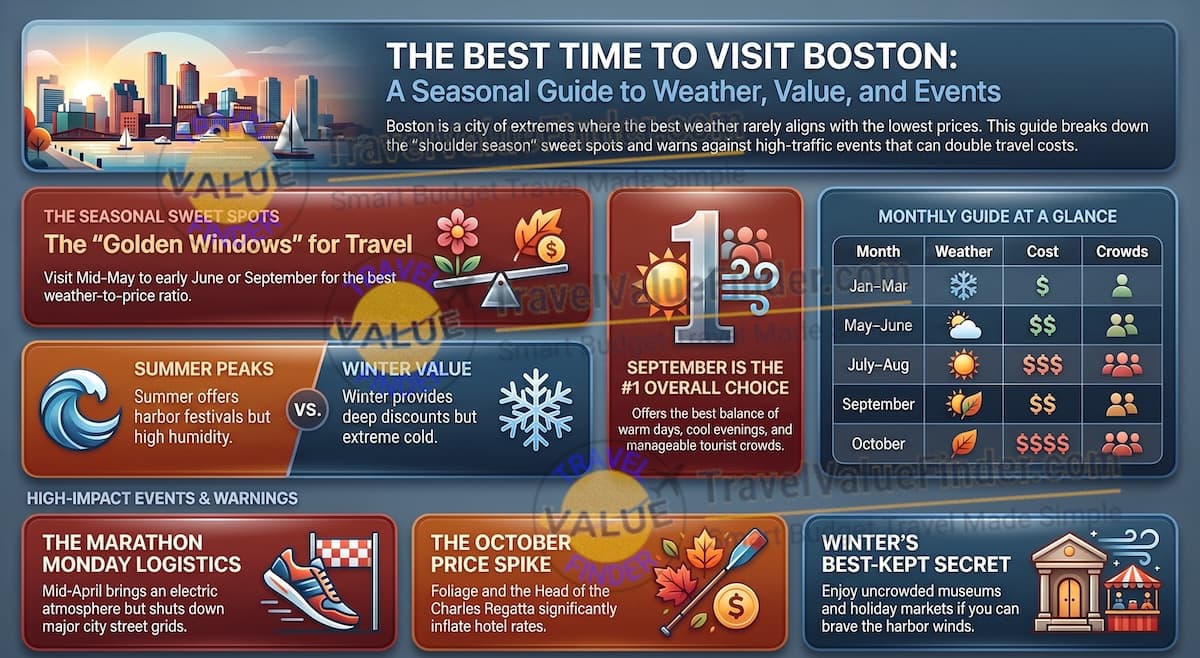
The best time to visit Boston is May or September, when the weather is mild, crowds are lighter than peak summer, and hotel rates haven’t yet spiked for foliage season.
Avoid the last two weeks of July for humidity. Expect the highest prices from late June through Labor Day and again during peak fall foliage in early October.
Leslie Nics, TravelValueFinder.com | Last updated: August 2026 | Based on first-hand Boston trip research across five seasons and current 2026 pricing for US and Canadian travelers
Table of Contents
People Also Ask
What is the cheapest month to visit Boston?
January and February are typically the cheapest months for hotels, outside of school vacation week in mid-February, which can spike rates for a week.
Is Boston nice in the summer?
Yes, though it can get humid in July and August. June tends to offer summer weather without the heaviest humidity.
When is the Boston Marathon and how does it affect visitors?
The Boston Marathon runs on Patriots’ Day, the third Monday in April, and closes major streets across the route. Plan around it if you’re not specifically there for the race.
Is October a good time to visit Boston?
Yes for foliage, but it’s also one of the most expensive and crowded months due to the Head of the Charles Regatta and Columbus Day weekend: book well ahead.
So, What’s Actually the Best Time to Visit Boston?
I get asked about the best time to visit Boston more than almost any other Boston question. The honest answer is that it depends on what you’re optimizing for.
This is mainly because the calendar month with the best weather is not the same month with the best prices, and neither of those is the same month with the most going on.
I’ve now visited in five of the twelve months. Each trip taught me something the last one didn’t:
- that Marathon Monday shuts down half the city’s street grid,
- that a “mild” Boston winter day can still mean single-digit wind chill off the harbor,
- and that the single best week I’ve had there was a random Tuesday-to-Friday in late September that nobody warned me to book.
If you want one answer: the two shoulder windows, mid-May through early June and early-to-mid September. These give you the best combination of comfortable weather, manageable crowds, and hotel rates that haven’t yet jumped for foliage season.
If price is your main constraint, winter (outside of the December holiday weeks) is dramatically cheaper.
If foliage or the Marathon is the point of the trip, you’re locked into a specific window regardless of price or crowd level. Therefore it’s worth planning around that intentionally rather than discovering it after you’ve already booked.
Boston Weather by Month
Boston’s weather swings more than a lot of first-time visitors expect for a coastal city. Summers run warm and can turn humid for stretches. Winters are genuinely cold, with the harbor wind making it feel colder than the number on the forecast.
These are typical ranges. Check the National Weather Service’s Boston forecast office for exact current-year data before you pack.
| Month | Typical Feel | Crowd Level | Notable |
| January | Cold, occasional snow | Low | Cheapest hotel rates of the year |
| February | Cold, heaviest snow risk | Low | School vacation week can spike prices mid-month |
| March | Cold, thawing, unpredictable | Low–Moderate | Shoulder pricing begins |
| April | Mild, rainy stretches | Moderate–High | Marathon Monday (mid-April) affects downtown streets |
| May | Mild, greening up | Moderate | Strong value window |
| June | Warm, humidity building | High | Prices climbing toward summer peak |
| July | Warm to hot, humid | Highest | Fourth of July Esplanade events draw big crowds |
| August | Warm, humid | Highest | Peak summer pricing |
| September | Warm days, cool evenings | Moderate | Best overall value-to-weather ratio |
| October | Crisp, foliage peak | High | Columbus Day weekend and Head of the Charles spike prices |
| November | Cold, gray | Low | Good value outside Thanksgiving week |
| December | Cold, festive | Moderate (holiday weeks) | Holiday markets and lights, but pricey around Christmas week |
Nobody told me Marathon Monday closes major streets across half the city until I was standing at a barricade trying to get to my own hotel. Check the date before you book an April trip, even if you’re not there for the race.” Leslie Nics, Founder & Lead Travel Writer, TravelValueFinder.com
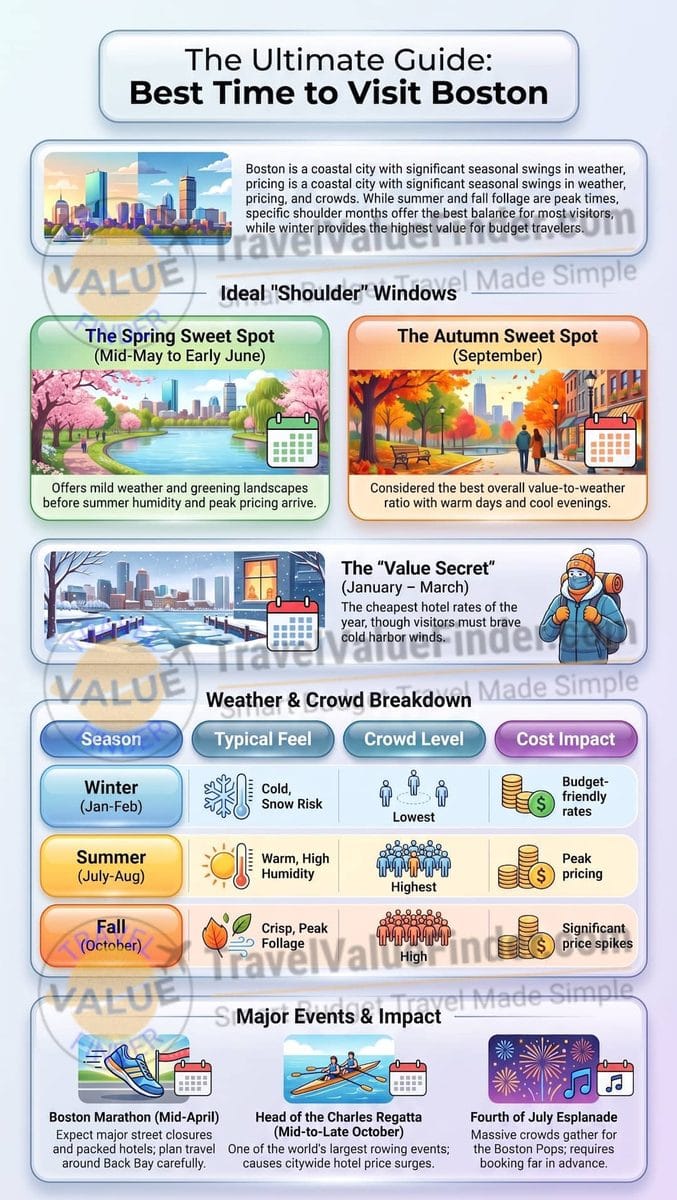
Boston by Season, in More Detail
Spring (April–May)
Spring is genuinely the trickiest season to plan around. April in particular can swing from a 70-degree afternoon to a 40-degree, rain-soaked one within the same week.
It’s also Marathon season. The Boston Marathon runs on Patriots’ Day, the third Monday in April. It affects far more than the route itself. Expect road closures, packed hotels near the finish line in Back Bay, and a genuinely electric atmosphere if you don’t mind the crowds.
May is calmer and, in my experience, the more reliable spring month to actually plan a trip around.
Summer (June–August)
This is peak season for a reason with long daylight hours.It is the Esplanade concert series, Fenway Park in full swing, and harbor-front restaurants at their best.
It’s also when the city is most crowded and most expensive. July and August can bring stretches of real humidity that make walking-heavy plans, like the Freedom Trail, more tiring than you’d expect.
If you’re set on a summer trip, June tends to be the more comfortable month before peak humidity sets in.
Fall (September–October)
September is, in my opinion, the single best month to visit Boston. Warm enough for outdoor plans, cool enough in the evenings to be comfortable, and noticeably less crowded than summer.
October brings foliage. It is genuinely beautiful, but it also brings the Head of the Charles Regatta, one of the world’s largest rowing events, and Columbus Day weekend.
Both of which spike hotel prices and crowd levels significantly, especially in the back half of the month.
Winter (November–March)
Winter is Boston’s best-kept value secret and its least comfortable season for sightseeing.
Hotel rates outside the December holiday weeks are the lowest of the year. Museums and indoor attractions are uncrowded, and the city still puts on a good show around the holidays with lights and markets at Faneuil Hall.
But snow is a real possibility from January through March. The harbor wind makes the actual temperature feel considerably colder than the forecast number.
I visited Boston in February expecting to just power through the cold for the museum discounts. I ended up enjoying it more than my summer trip with half the crowds, and I never once waited in line.” Leslie Nics, Founder & Lead Travel Writer, TravelValueFinder.com
Boston Events Calendar Worth Planning Around
| Event | Timing | Impact on Your Trip |
| Boston Marathon (Patriots’ Day) | Third Monday in April | Major street closures. Book Back Bay hotels early or avoid that week |
| Boston Pops Fourth of July | July 4 | Esplanade area extremely crowded. Book well ahead if attending |
| Head of the Charles Regatta | Mid-to-late October | Cambridge/Charles River area packed. Hotel prices spike citywide |
| School vacation weeks | Mid-February, mid-April | Family travel spikes. Book further ahead |
| Holiday markets & Faneuil Hall lights | Late Nov–Dec | Festive but pricier around Christmas week specifically |
The single best week I’ve had in Boston wasn’t planned around any event at all. It was a random Tuesday to Friday in late September I booked because flights were cheap. No lines, perfect weather, and I still think about it.” Leslie Nics, Founder & Lead Travel Writer, TravelValueFinder.com
Best Time to Visit Boston by Traveler Type
- Budget travelers: January–March (outside school vacation week) for the lowest hotel rates
- First-time sightseers: May or September for the best weather-to-crowd ratio
- Foliage seekers: first two weeks of October, booked at least two months ahead
- Baseball fans: April through September for a home Red Sox game at Fenway
- Families with school-age kids: late June, after school lets out but before peak summer pricing fully kicks in
My Timing Mistakes
The biggest timing mistake I made wasn’t a season. It was booking a Columbus Day weekend trip for foliage without realizing the Head of the Charles Regatta overlapped with it.
That meant I was competing with both foliage tourists and regatta crowds for the same hotel rooms, at nearly double the rate I’d paid two weeks earlier for a similar trip.
If foliage is the goal, I’d now target the first week of October specifically. This is before the regatta and the holiday-weekend crowd both land at once.
Related Boston Travel Guides
- Boston Travel Guide: Everything to Know Before You Go
- Best Time to Visit Boston: Weather, Crowds & Events by Season
- 3 Days in Boston: The Perfect First-Timer’s Itinerary
- Boston Cheap Eats: Best Budget Bites and Michelin Picks Worth the Splurge
Frequently Asked Questions
What month has the best weather in Boston?
September is widely considered the best combination of warm days, cool evenings, and manageable rain; better on average than the more humid peak-summer months.
Does it snow a lot in Boston?
Yes, particularly January and February, though snowfall varies year to year. Check the National Weather Service’s Boston forecast office for current-season outlooks.
Is spring a good time to visit Boston?
May is a strong choice; April is riskier due to unpredictable weather and Marathon Monday street closures.
Should I avoid Boston during the Marathon?
Not necessarily. It’s a great atmosphere if you don’t mind crowds and closures, but book Back Bay hotels early and expect significant street disruptions on race day.
What’s the least crowded time to visit Boston?
January through March, excluding school vacation week, sees the fewest tourists and the lowest hotel rates.
Sources