Travel Value Finder

Choosing the best water purification bottle for travel comes down to a distinction almost every gear list glosses over;
- a filter and a purifier are not the same thing, and
- using the wrong one in the wrong country is exactly how travelers get sick from water that looked perfectly clean.
Leslie Nics, TravelValueFinder.com | Last updated: Aug 2026 | Based on first-hand experience and on what’s the best travel gears (compared and tested) for travelers
Table of Contents
Do You Need a Water Filter or a Water Purifier?
This is the single most important thing to get right, and it’s a straight fact from the CDC’s guidance on avoiding contaminated water during travel.
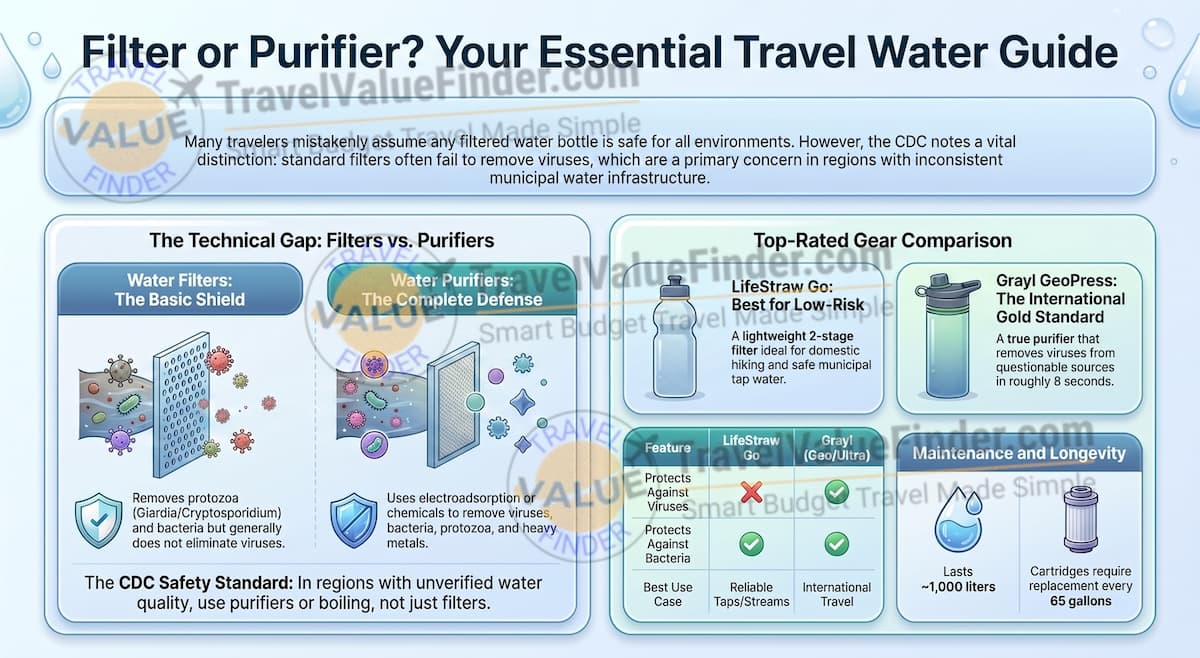
Most portable water filters remove parasites but not viruses or all bacteria.
A filter with a small enough pore size (look for NSF Standard 53 or 58 certification) will handle protozoa like Giardia and Cryptosporidium reliably.
Removing bacteria and viruses reliably requires either a reverse-osmosis filter or a true purifier. A distinct category that uses additional chemical or electrical treatment on top of physical filtration.
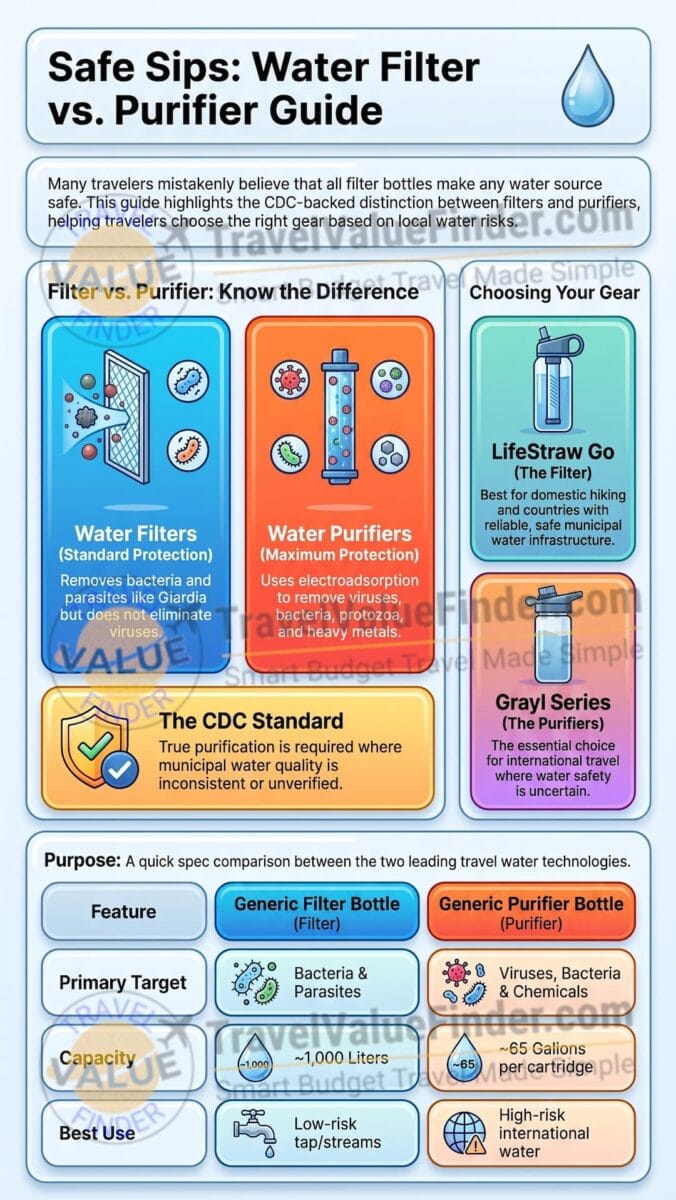
This is exactly the LifeStraw-versus-Grayl divide.
LifeStraw is a filter. It is excellent at what filters do, but not built to remove viruses.
Grayl’s press bottles are purifiers.
They add electroadsorption and activated carbon to the physical filtration step specifically to also remove viruses and a wider range of chemical contaminants.
Neither is “better” in the abstract. The right one depends entirely on where the water is coming from.
- Traveling somewhere with reliable tap water and just want backup for streams or questionable taps? LifeStraw Go is enough.
- Traveling internationally where municipal water quality is uncertain, or want the fastest all-in-one option? Get a Grayl, it’s the only one of these that also removes viruses.
Below is how the LifeStraw Go, Grayl GeoPress, and Grayl UltraPress actually compare. Plus what the CDC specifically says most portable filters can’t do.
The detail that should decide which one goes in your bag.
The 3 Best Water Purification Bottles for Travel
These three are the picks that consistently come up across EmergencyGearLab and independent Grayl-vs-LifeStraw comparisons. All three are established, well-reviewed, currently in-stock at Amazon listings:
| Product | Why It Made the List | Get It |
| LifeStraw Go Series | Best lightweight filter for low-risk water. A 2-stage hollow-fiber filter plus activated carbon removes 99.999999% of bacteria and 99.999% of parasites and microplastics. It’s a filter, not a purifier. It does not remove viruses so it’s the right pick for tap water and streams in countries with reliable sanitation infrastructure. Not for destinations with unsafe municipal water. | Check Price on Amazon |
| Grayl GeoPress | Best overall for international travel. A true purifier. Fill the outer cup, press the inner cup down like a French press, and in about 8 seconds you get 24oz of water with viruses, bacteria, protozoa, and many chemicals removed. It’s the only pick here safe for genuinely questionable water sources. Trade-off: heavier and bulkier than a straw filter. | Check Price on Amazon |
| Grayl UltraPress | Best packable purifier. Same press-filter purification technology as the GeoPress in a smaller, lighter bottle built to fit in a side pocket or bike-bottle cage. The trade-off for the lighter build is a smaller capacity per press, so heavier daily water needs may still favor the GeoPress. | Check Price on Amazon |
Where Do You Actually Need Virus Protection?
This is the practical version of the filter-vs-purifier question.
Modern water-treatment infrastructure (most of Western Europe, for instance) makes a filter alone reasonable backup for an occasional bad tap.
Where municipal water quality is inconsistent or unverified, CDC guidance points toward the higher standard. These include;
- a purifier,
- boiling, or
- reverse osmosis,
- not a filter alone.
That’s the deciding question to ask before you pack, not which bottle has the best reviews.
Why I Should Travel with a Water Purification Bottle
I now pick between a filter and a purifier based on the destination first, brand second.
The opposite order most gear lists present it in.
I traveled with a LifeStraw for years out of habit, including on one trip with genuinely uncertain tap water without registering it wasn’t rated for that situation.
Nothing went wrong, but that was luck, not the gear doing its job.
A filter bottle in the wrong country gives you false confidence, which is worse than carrying no filter and just buying sealed water. Leslie Nics, Founder & Lead Travel Writer, TravelValueFinder.com
Travel Packing & Gear Guide
- Best Travel Adapter for International Travel
- Best Carry-On Travel Backpack: Osprey vs. Nomatic
- Best Anti-Theft Crossbody Bag for Travel
- Best Tech Organizer Pouch for Travel: FYY vs. BAGSMART vs. tomtoc
FAQ: Best Water Purification Bottle for Travel
Does LifeStraw remove viruses?
No. LifeStraw is a filter, not a purifier; per CDC guidance, most portable filters remove parasites and much bacteria but not viruses. Use a true purifier like Grayl for water sources where viruses are a realistic risk.
Is boiling water better than a filter or purifier?
Boiling kills all pathogens, including viruses, and the CDC considers it the most reliable method when it’s practical. A purifier is the better choice when boiling isn’t an option, such as during a travel day with no access to a stove or kettle.
Can a Grayl bottle be used with safe tap water too?
Yes, you can use it like a normal water bottle when the local tap water is already safe, without using up a filter press, which makes it flexible across a multi-country trip.
How long do these filters last?
LifeStraw filters are rated for roughly 1,000 liters and aren’t replaceable; you replace the whole unit. Grayl cartridges are replaceable and rated for roughly 65 gallons (about 350 presses) per cartridge.
Sources
- CDC: Avoid Contaminated Water During Travel
- CDC: About Water Treatment Options When Hiking, Camping, or Traveling
Affiliate Disclosure: TravelValueFinder.com is a participant in the Amazon Services LLC Associates Program. As an Amazon Associate, we earn from qualifying purchases made through links on this page, at no additional cost to you. See our full Trust & Transparency Policy for details.