Travel Value Finder


Learning how to save money on hotels can cut a trip’s biggest expense by 30 percent or more. Accommodation usually takes the largest single share of any travel budget, larger than flights over a full trip.
Leslie Nics, TravelValueFinder.com | Last updated: September 2026 | Based on firsthand hotel booking research and current 2026 pricing for US travelers
This guide follows the actual booking journey, from the moment you start searching to the morning you check out, and shows where the real savings sit at each step.
Table of Contents
Why Hotel Costs Deserve More Attention Than Flights
A flight deal saves money once, on one trip. A hotel habit saves money every night of every trip for the rest of your traveling life.
Accommodation commonly makes up 30 to 40 percent of a total trip budget, more than food, transport, or activities combined. Small, repeatable habits here compound faster than almost any other travel savings category.
| Budget Category | Typical Share of Trip Cost |
| Accommodation | 30 to 40 percent |
| Food | 20 to 25 percent |
| Local transport and activities | 20 to 25 percent |
| Flights (amortized on longer trips) | 15 to 25 percent |
A flight is usually booked once and forgotten. A hotel decision repeats every single night, which is exactly why small habits here compound so quickly across a trip.
Over a two week trip, a $20 per night saving adds up to $280. Over a year of travel, the same habit can save well over $1,000.
Before You Book: The Decisions That Set Your Price
Most of the price is decided before you ever pick a specific hotel. Dates, season, and search habits matter more than which button you click to pay.
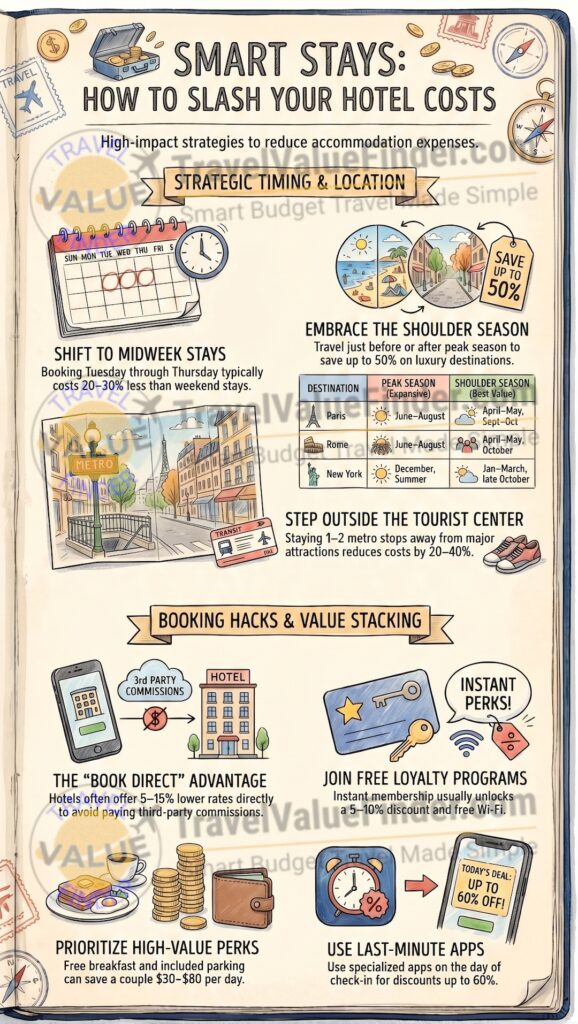
Shift off the weekend. Tuesday through Thursday stays commonly run 20 to 30 percent cheaper than Friday and Saturday nights in most city destinations. Beach and resort towns can flip this pattern, so check both.
Travel just outside peak season. Shoulder season dates, typically four to eight weeks before or after the busiest months, often save 20 to 50 percent on the same hotel.
Search with flexible dates. Shifting a trip by even two or three days can change the total price significantly. Most search tools show a full week or month at once so this takes seconds.
| Trip Type | Weekday vs Weekend Price Swing |
| Major city, business heavy | 20 to 30 percent cheaper midweek |
| Beach or resort town | Often the reverse, weekends pricier |
| Theme park or event destination | Minimal swing, demand stays steady |
| Small town or rural stay | 10 to 15 percent cheaper midweek |
How Far Ahead Should You Actually Book?
Booking timing is less about a single magic day and more about matching the window to the destination. Popular cities and peak season reward early booking.
| Trip Type | Suggested Booking Window |
| Peak season, popular city | 3 to 4 months ahead |
| Shoulder season, mid size city | 4 to 8 weeks ahead |
| Off season, flexible traveler | 1 to 2 weeks ahead, watch for drops |
| Last minute, any destination | Same day apps for unsold rooms |
Google Hotels and similar search tools display total prices including taxes and fees by default. Use one consistently so every comparison starts from the same baseline.
Matching Cancellation Policy to How Certain Your Plans Are
A refundable rate usually costs slightly more than a locked in one. That small premium buys real flexibility if plans shift.
Firm dates with no risk of change can safely take the cheaper non refundable rate. Anything still uncertain, including work trips or group plans, is worth the refundable premium.
Read the cancellation deadline carefully every time. Some listings advertise free cancellation but only up to a date far earlier than expected.
When You Book: Direct Site, Aggregator, or Both
Where you click to book can move the price by 10 to 25 percent for the exact same room. Neither direct booking nor an aggregator wins every time.
| Book Direct When | Use an Aggregator When |
| You want loyalty points and status credit | You are comparing many hotels at once |
| The property is independent or boutique | You want one all in price across sites |
| You plan to call and negotiate a stay | A flash sale or bundle beats the direct rate |
| You want the hotel’s own rate match guarantee | You need free cancellation flexibility |
A useful habit costs nothing. Book the refundable rate first, then check the price again a week before arrival, and rebook if it dropped.
The Fees the Law Now Requires Hotels to Show You
A mandatory resort fee, once buried until checkout, is now required to appear in the total price up front. The FTC’s Junk Fees Rule took effect May 12, 2025, and applies directly to short term lodging bookings nationwide.
Before the rule, mandatory resort fees had grown into roughly one sixth of total US hotel revenue, according to FTC research. Total price disclosure now makes comparison shopping far more reliable than it was a few years ago.
| Fee Type | Typical Range | Now Legally Disclosed Up Front |
| Mandatory resort fee | $20 to $75 per night | Yes, under the 2025 FTC rule |
| Parking | $20 to $60 per night | Usually, check the total price toggle |
| Wi-Fi | $10 to $25 per night | Often included free with loyalty membership |
| Breakfast | $15 to $40 per person daily | Varies, filter for included breakfast |
| City or tourist tax | 1 to 6 percent, varies by city | Sometimes added at checkout, not upfront |
City hotel taxes still sit outside most upfront totals and vary widely. Chicago charges a 4.5 percent Hotel Accommodations Tax, and the city added a 1.5 percent Tourism Improvement District charge in downtown hotels starting May 2026.
Other cities layer state, county, and city taxes separately, so the posted room rate is rarely the final number. Always check the total before comparing two hotels in different cities.
Membership discounts outside hotel loyalty programs can also help. AAA and AARP memberships, open to most adults regardless of age, often unlock 5 to 15 percent off at major chains.
People Also Ask
Is it cheaper to book direct or through a site? It depends on the stay. Direct booking usually wins on points and negotiation, while aggregators win on comparison and flash deals.
Do hotels have to show resort fees now? Yes. Since May 2025, federal law requires the total price, including mandatory fees, to appear up front.
What is the cheapest night of the week to stay? Tuesday through Thursday is usually cheapest in cities, though beach towns can be the opposite.
Are loyalty programs worth joining if I travel rarely? Yes. Membership is free and still unlocks a member rate, even without any stays yet.
Membership Value: What Free, Paid, and Elite Status Actually Unlock
Loyalty programs get complicated fast. Broken into three simple tiers, the real value becomes much easier to see.
| Tier | Cost to Access | What It Typically Unlocks |
| Free membership | $0, join in minutes | Member only rate, usually 5 to 10 percent off |
| Travel credit card | $0 to $150 a year | Welcome bonus worth 1 to 3 free nights |
| Elite status | Earned through stays or card spend | Free breakfast, upgrades, waived resort fees |
Before applying for any travel card, review the standardized disclosure table explained by the Consumer Financial Protection Bureau. A rewards card only helps if the balance is paid in full every month.
Free membership alone is worth claiming on every trip. Elite status and card bonuses are worth chasing only if you already travel often enough to earn them naturally.
A simple way to judge point value: divide the cash price of a room by the points required. Anything above one cent per point is generally a solid redemption.
Redemptions at luxury properties or during peak season usually deliver the best value per point. A cheap off season room rarely justifies spending points on it.
Family and Group Stays: Where the Math Changes
Group travel shifts the calculation. A single larger room or a connecting pair often beats two separate standard rooms.
Ask directly whether connecting rooms or a family suite are available before booking two rooms separately. Many properties do not display this option in standard search results.
Vacation rentals with kitchens can also undercut two hotel rooms for a group of four or more, especially over five nights or longer.
A Same Room, Three Prices Example
Numbers make this easier to trust than percentages alone. Here is one hypothetical $180 city hotel room, priced three different ways.
| Booking Path | Price Paid | What Changed |
| Public rate, third party site | $180 | No membership, no direct relationship |
| Direct booking, free loyalty member rate | $164 | 8 percent member discount applied |
| Direct booking plus card welcome bonus night | $0 | Redeemed a points night earned pre trip |
The room never changed. Only the booking path did, and the total spread across those three paths is the entire $180.
This is the core idea behind every strategy in this guide. Layer enough small advantages onto the same booking and the price keeps dropping without touching room quality.
None of these three paths required extra effort beyond the first one. Joining the loyalty program and applying for one card are both one time setup steps.
Bundling Flights and Hotels: When It Actually Helps
Package deals that combine a flight and a hotel sometimes beat booking each piece separately. The savings usually come from wholesale rates airlines and hotels release only to package sellers.
Always price both paths before deciding. Add up a separate flight and hotel total, then compare it against the bundled price for the exact same dates and room type.
Bundles work best for fixed, non refundable trips. They work poorly for anyone who might need to change either the flight or the hotel independently later.
At Check In: Getting More Without Paying More
The stay itself still holds a few small negotiation opportunities. None require confrontation or awkward conversation.
- Ask politely about complimentary upgrades at check in, especially on quiet nights
- Mention loyalty status even at the base tier, since agents can see it instantly
- Ask if early check in or late checkout is available at no charge
- Request a rate review if you notice a lower price after booking but before arrival
Timing the check in visit can help too. Arriving during a quieter part of the day, rather than the peak afternoon rush, gives staff more room to say yes.
None of these requests are guaranteed. Asking costs nothing, and a friendly, specific question works better than a vague one.
Calling a Hotel Directly for Longer Stays
Aggregator commissions typically run 15 to 25 percent of the room rate. A direct call can recover part of that margin for you.
This works best with independent and boutique hotels, which have more flexibility than large chains. For stays of five nights or longer, simply ask whether a longer stay rate is available.
Low occupancy periods give the most leverage. A hotel usually prefers a room filled at a modest discount over an empty room.
A simple script works well: ask whether a rate adjustment is available for a longer stay booked directly. Some properties also offer a free perk instead of a lower rate, like a late checkout or a small upgrade.
When a Hotel Is Not the Right Call
Sometimes the biggest saving is skipping the hotel entirely. For a full breakdown of hostels versus budget hotels, see our Hostels vs Budget Hotels guide. For groups and longer stays, our guide to traveling cheap covers vacation rentals and lodging alternatives in more depth.
Booking Mistakes That Quietly Raise the Bill
A handful of avoidable habits explain most of the money travelers overpay on hotels. Watching for these protects the savings from every other step.
- Comparing a non refundable rate against a flexible one without matching conditions first, which hides the real price gap
- Booking a new hotel’s opening weeks, when construction delays and missing amenities are common
- Skipping the hotel’s own website after finding a rate on an aggregator, missing a possible rate match
- Ignoring the cancellation deadline on a rate you intended to rebook later, losing the flexibility you paid for
- Assuming the lowest headline price is the lowest total price, before fees and taxes are added
Frequently Asked Questions
What is the single best way to lower hotel costs?
Combine three habits: join a free loyalty program, compare the direct rate against an aggregator, and shift dates midweek or shoulder season. Together they routinely cut 30 percent or more.
Do resort fees still exist in 2026?
Yes, but hotels must now disclose them in the total price up front under the 2025 FTC rule, making comparison shopping far more reliable.
Is a travel credit card worth it for occasional travelers?
Only if the balance is paid in full monthly. Otherwise interest charges erase the reward value quickly, even with a strong welcome bonus.
How far ahead should I book for the best price?
Book early for peak season and popular cities, but recheck prices closer to the date since discounts can still appear later on refundable rates.
Can I negotiate a hotel rate after booking?
Yes, if you booked a refundable rate. Cancel and rebook at the lower price whenever one appears before your cancellation deadline passes.
Building the Habit for Every Future Trip
The strategies in this guide work best as a repeatable checklist, not a one time effort. Save the loyalty logins and card details somewhere easy to find.
Before your next trip, run through four quick steps: check dates for midweek or shoulder season options, compare the direct rate against an aggregator, confirm the total price including fees, and apply any membership discount you already hold.
Each step takes a minute or two. Together they turn hotel savings into a habit instead of a one off lucky find.
None of these habits require sacrificing comfort. They require noticing where the price is actually decided, then acting on it.
Join one free loyalty program today and compare your next booking across two sources before paying. That single habit alone typically saves 15 to 20 percent per stay.
Sources
- Federal Trade Commission, Rule on Unfair or Deceptive Fees (2025)
- Federal Trade Commission, Unfair or Deceptive Fees Rulemaking Record
- Consumer Financial Protection Bureau, Credit Card Consumer Tools
- City of Chicago, Hotel Accommodations Tax and Tourism Improvement District
Disclaimer: This article contains affiliate links. When you book through our hotel search, TravelValueFinder may earn a small commission at no extra cost to you. This helps keep the site free to use. We only recommend products and services we genuinely believe add value to your trip.