Travel Value Finder


Knowing how free walking tours work saves you from an awkward moment at the end. There is no ticket price, only a tip you decide on. This guide covers fair tipping, top cities, and the etiquette locals wish you knew.
By Leslie Nics, TravelValueFinder.com. Last updated September 2026.
This article reflects independent research and firsthand experience. Prices, platforms, and city offerings change, so confirm current details before you book.
Quick Answers About Free Walking Tours
Here are fast answers to the questions travelers ask most.
Are free walking tours actually free?
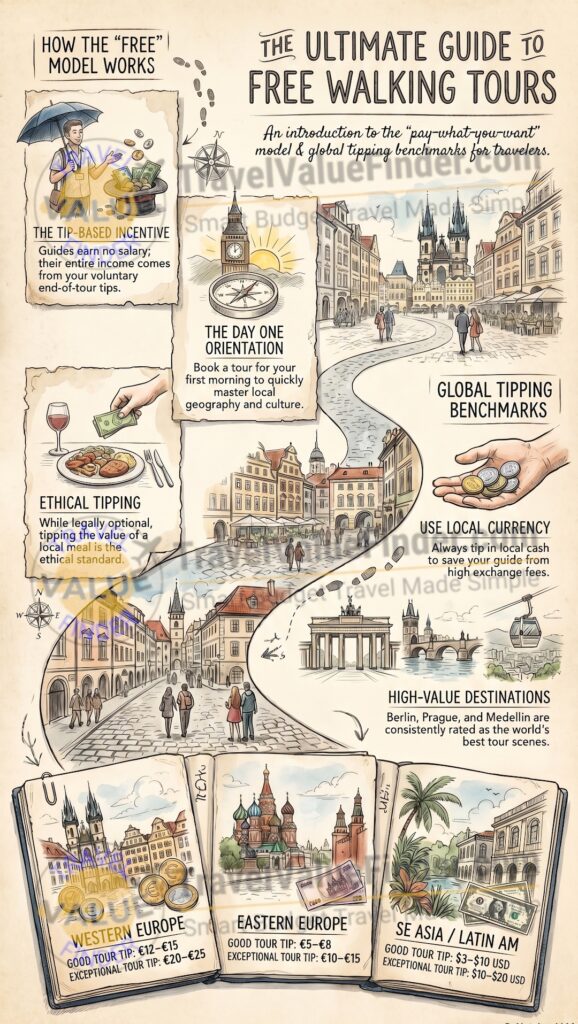
Technically yes, since no ticket is charged. The guide’s income comes entirely from tips at the end.
How much should I tip?
Roughly the price of one local meal for an average tour. Double that for an outstanding guide.
Do I need to book in advance?
Usually yes, through a free platform. It takes two minutes and secures your spot.
Can I skip the tip if the tour was bad?
Yes, legally nothing is owed. A small tip is still kind if the guide tried hard.
Do free walking tours run in bad weather?
Usually yes, tours rarely cancel for light rain. Severe weather is the main reason a tour gets called off.
How the Pay What You Want Model Works
A guide walks a group through a city for two to three hours. There is no entry fee and no fixed price. At the end, everyone tips what they feel the experience was worth.
This format works well for a first morning in any new destination. You leave with a real sense of the layout, not just a list of landmarks.
The guide keeps most of that tip, and the booking platform takes a small share. No tips means no income for the guide that day. This gives every guide a direct reason to perform well.
The format started in Berlin in the late 1990s with a tour company called Sandemans. It spread to hundreds of cities within a decade. Today it runs on platforms like GuruWalk and Freetour.com.
Guides are usually locals, students, or long term expats. Most work multiple tours a day across different companies. The best ones treat storytelling as a craft, not a script.
A typical operator takes a small percentage of tips for platform costs and marketing. The guide keeps the rest directly. A paid tour guide is usually on salary, regardless of your tip.
Who Actually Leads These Tours
Anyone can technically become a free tour guide, since the barrier to entry is low. The good operators still train guides on history, safety, and public speaking. Weak operators sometimes hand a new guide a script and a group.
This is why guide quality swings so much within one city. Two guides working for the same company can deliver very different tours. Checking individual guide ratings matters more than checking the company name.
Most guides do not do this full time forever. Many move on within a year or two for better paid roles. Three or more years of reviews is a strong sign of skill.
Free Tours Versus Paid Tours
A paid tour and a free tour solve slightly different problems. Knowing the difference helps you pick the right one for a given day.
| Factor | Free Walking Tour | Paid Tour |
| Upfront cost | None, tip based at the end | Fixed price, paid in advance |
| Group size | Often fifteen to thirty five people | Usually smaller, sometimes private |
| Flexibility | Fixed route and schedule | Can often be customized |
| Best for | First day orientation, budget travel | Niche topics, small group depth |
| Guide incentive | Directly tied to your tip | Fixed regardless of your experience |
Neither option is strictly better. A free tour is the smarter first move in a new city. A paid specialist tour makes sense once you know exactly what you want to see.
Many travelers actually do both. A free orientation tour on day one covers the basics well. A paid deep dive later covers one specific topic in more depth.
How Much to Tip by Region
The right tip tracks local cost of living, not a fixed number. A meal that costs $5 in one city might cost $20 in another. Use this table as your baseline, then adjust for tour quality.
These ranges assume a solid two to three hour tour with a competent guide. Adjust up for an exceptional experience and down slightly for an average one.
| Region | Typical Tip Per Person | Note |
| Western Europe | €12 to €20 | Higher in London, Paris, and Zurich |
| Southern and Central Europe | €8 to €15 | Spain, Italy, Portugal, Greece |
| Eastern Europe | €5 to €10 | Poland, Hungary, Czech Republic |
| North America | $10 to $20 | United States, Canada, Mexico City |
| Latin America | $5 to $10 | Tip in local currency where you can |
| Southeast Asia | $3 to $8 | Lower absolute cost, still meaningful locally |
| Middle East and Africa | $5 to $10 | Confirm the guide is tip dependent first |
Tip in local currency when possible. Guides often lose part of a foreign bill to exchange fees. Withdraw cash before the tour, since most guides cannot take cards.
Tipping Math for Groups
Group size changes the tipping decision. Each person in your party should tip individually, based on the region rate. A family of four is four separate tips, not one shared amount.
| Group Size | How to Tip |
| Solo traveler | Tip the full per person rate for your region |
| Couple | Each person tips, or combine into one slightly larger bill |
| Family with kids | Tip per adult, a smaller amount per child is fine |
| Group of friends | Tip individually so no one feels responsible for the total |
Splitting a large bill among a group can feel awkward at the end. Decide your amount before the tour finishes, not while everyone is watching.
Best Cities for a Free Walking Tour
Quality varies by city, but a handful consistently stand out. These cities combine strong guide training with genuine historical depth. Start here if you are picking your first tour.
This list spans Europe, the Americas, Asia, and Africa on purpose. A strong free walking tour scene tends to follow dense, walkable historic centers. That pattern holds across almost every continent.
| City | Typical Tip | Known For |
| Berlin | €12 to €18 | Cold War history from guides who lived it |
| Prague | €6 to €10 | Dense competition keeps guide quality high |
| Lisbon | €8 to €12 | Alfama neighborhood and fado history |
| Athens | €8 to €12 | A city run free program alongside private guides |
| Budapest | €6 to €10 | Communist history and the ruin bar district |
| Mexico City | $5 to $10 | Aztec and colonial history in one walk |
| Medellín | $5 to $10 | A transformation story told firsthand |
| Buenos Aires | $5 to $10 | Recoleta Cemetery and Evita history |
| Bangkok | $3 to $7 | Temple etiquette explained before you enter |
| Hanoi | $3 to $6 | Old Quarter history and street food context |
| Istanbul | $8 to $12 | Strong guide training and deep Ottoman history |
| Cape Town | $5 to $10 | Apartheid history handled with real care |
| Edinburgh | £10 to £15 | Scottish history and an underground vault tour |
| Amsterdam | €10 to €15 | Canal history and a powerful wartime tour |
Heading to any of these? Pair your trip with our guide to traveling Europe on a budget. Also check what travel insurance actually covers.
These twelve are a starting point, not the full list. Free tours now operate in more than two hundred cities worldwide. Search the platform for your specific destination before assuming one is not available.
How to Book a Tour That’s Actually Good
The same city can have a dozen operators of very different quality. A few minutes of checking saves you a wasted afternoon.
- Book through GuruWalk or Freetour.com, not a random flyer.
- Read reviews from the last thirty days, not the last year.
- Book the specific guide with the highest rating, not just the company.
- Screenshot the exact meeting point before you leave your hotel.
- Take your first tour on day one to orient yourself fast.
A guide with consistent, name specific praise in reviews is a strong signal. Book that person directly if the platform allows it.
Plan roughly half a day around your tour once travel time is included. Many book a tour for the morning, then rest during the afternoon heat.
Etiquette That Actually Matters
Most guides will not say these out loud. They shape the experience for the whole group, not just you.
- Arrive ten minutes early. Groups leave on time, with or without latecomers.
- Stay close enough to hear the guide over street noise and traffic.
- Put your phone away while the guide is talking, and shoot photos after.
- Never negotiate the tip. It is a gift, not a price to haggle.
- Tell the guide quietly if you must leave early, rather than vanishing.
- Leave a review that names the guide directly, since that drives future bookings.
Specialty Tours Worth Seeking Out
The standard city center walk is only the starting point. Many cities also run themed free tours worth searching for.
| Tour Type | What It Covers |
| Street art tour | Murals, graffiti culture, and the artists behind them |
| Dark history tour | Executions, plagues, and local ghost stories at night |
| Cold War tour | Living memory history in Berlin, Prague, and Budapest |
| Local neighborhood tour | Where residents actually live, eat, and shop |
| Food tour | Small tastings alongside market and culinary history |
| Heritage tour | Deep dives into a specific community’s local history |
These run on the same tip based model as the standard tour. Search your destination on the booking platform to see what is offered.
Why the Model Keeps Growing
Free walking tours now operate in over two hundred cities. Budget travel demand and easy booking platforms both drove that growth. Cities also benefit, since happy visitors tend to spend more elsewhere.
The model rewards good storytelling directly, without a corporate layer setting prices. That direct link between quality and income is rare in tourism. It is a big part of why ratings tend to stay high.
What to Pack for a Walking Tour
Tours typically cover three to six kilometers on foot. Pack light, but pack these essentials.
| Item | Why It Matters |
| Broken in walking shoes | Cobblestones and hours on foot cause blisters fast |
| Local currency in cash | Most guides cannot accept cards for tips |
| Water bottle | Two to three hours outdoors adds up quickly |
| Packable rain layer | Weather shifts and tours rarely cancel for drizzle |
| Crossbody bag with a zipper | Crowded squares attract pickpockets |
Can You Skip the Tip, and Other Model Quirks
Skipping the tip is legal, since nothing is technically owed. It is also the guide’s entire paycheck for that walk. Most travelers treat a fair tip as simply part of the deal.
Not every free tour is tip based. A few cities fund genuinely salaried guides as a tourism program. Athens and Singapore both run official versions like this, so check before assuming.
First Timer Mistakes to Avoid
- Showing up without cash, since most guides cannot take cards.
- Assuming the meeting point is the obvious landmark itself.
- Tipping in a currency the guide has to pay a fee to exchange.
- Skipping the pre booking step and hoping to walk in.
- Wearing new shoes on a route that covers several kilometers.
- Standing right at the front and blocking the view for everyone behind.
Showing Appreciation on a Tight Budget
A small tip is still welcome if your budget is genuinely tight. Even a few dollars beats walking away with nothing. Pair it with a specific, honest review.
A detailed review naming the guide often helps more than a slightly bigger tip. It drives future bookings, which is the guide’s real long term income. Both together are the ideal outcome.
If you truly cannot tip anything, that is understood. Show up, engage with questions, and thank the guide personally at the end. Genuine appreciation still counts for something.
Sources
The figures and history above draw on the following sources.
- GuruWalk and Freetour.com, global free walking tour booking platforms
- European Travel Commission, visitor behavior and tipping research
- City of Athens official tourism program, This Is My Athens
- Sandemans New Europe, company history of the free tour model
Frequently Asked Questions
What is the best platform for finding a free walking tour?
GuruWalk and Freetour.com are the two most used global platforms. Both show guide ratings and exact meeting points.
Is it rude not to tip at all?
It is not required, but it is considered poor form after a good tour. Even a small tip plus a review helps the guide.
How long does a typical tour last?
Most run two to three hours. Some specialty tours, like food walks, run shorter.
Do children need to tip separately?
No, tip as a family or group. Base the amount on the group size and tour quality.
Are free walking tours safe?
Yes, when booked through a reputable platform. Avoid unofficial guides who approach you on the street.
Can I join a free walking tour without booking ahead?
Sometimes, but booked guests get priority. Booking is free and takes two minutes.
Do free walking tours exist outside big capital cities?
Yes, in over two hundred cities worldwide, including many smaller ones. Check the platform before you assume your destination is not covered.
Is a free walking tour suitable for solo travelers?
Yes, it is one of the easiest ways to meet other travelers. Many solo travelers make same day plans with people met on the tour.
Final Thoughts
A free walking tour is one of the best value activities in any city. A good guide gives you context that no app or guidebook matches. Take one on your first morning in a new place.
Tip fairly, since the whole model depends on it. Leave a review naming the guide. It costs a few minutes and helps someone who earned it.
Bring cash, arrive early, and treat the guide like the professional they are. The rest of the experience tends to take care of itself.
Once your days are planned, make sure your travel insurance is sorted before you land.