Travel Value Finder

Field notes from Leslie Nics, TravelValueFinder.com. September 2026, based on time in Puglia, Sicily, and Tuscany.
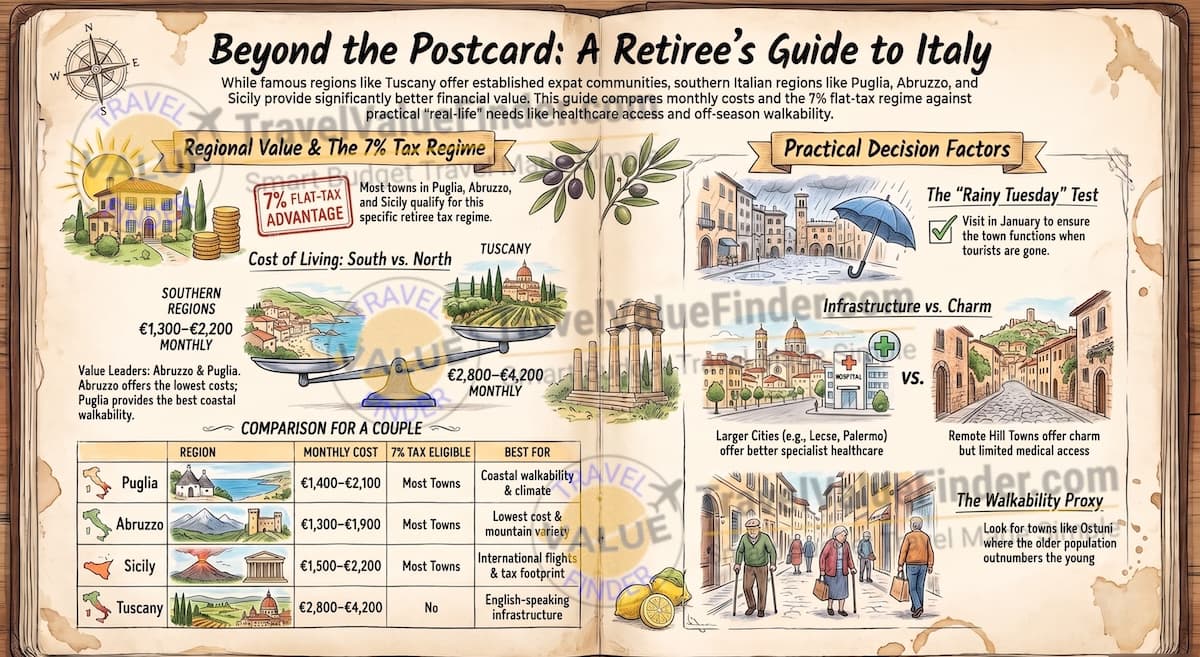
The best towns in Italy for retirement travel range from whitewashed Puglia to cave carved Matera. Puglia and Sicily offer the most walkable, warm weather towns. Tuscany and Lake Como offer the most polished, English friendly experience, and a Dordogne style quiet lives on in Abruzzo and Basilicata instead.
Italy rewards travelers who pick a region and stay with it rather than trying to see the whole country in one trip.
The south in particular changes character from province to province, and a week spent in one town teaches you more than a week spent moving between five.
This guide covers what each region actually feels like to visit and return to, not what it costs to settle there.
Table of Contents
A Region by Region Feel
Southern Italy is not one climate or one pace. Each region brings its own character, and matching that character to your travel style matters more than any single ranking.
Food culture shifts almost as much as landscape does from region to region. Puglia leans on olive oil, orecchiette, and seafood. Sicily blends Arab and Italian influences in dishes like arancini and caponata. Calabria brings serious heat, with chili peppers showing up in nearly everything. None of it tastes like the red sauce Italian food most Americans grew up with.
| Region | Character | Signature Town |
| Puglia | Whitewashed, coastal, walkable | Ostuni |
| Sicily | Larger, livelier, best flight access | Palermo or Taormina |
| Abruzzo | Mountains to coast, quiet | Sulmona |
| Calabria | Least developed, dramatic coastline | Tropea |
| Tuscany and Lake Como | Polished, English friendly | Lucca |
| Basilicata | Quiet, architecturally unlike anywhere else | Matera |
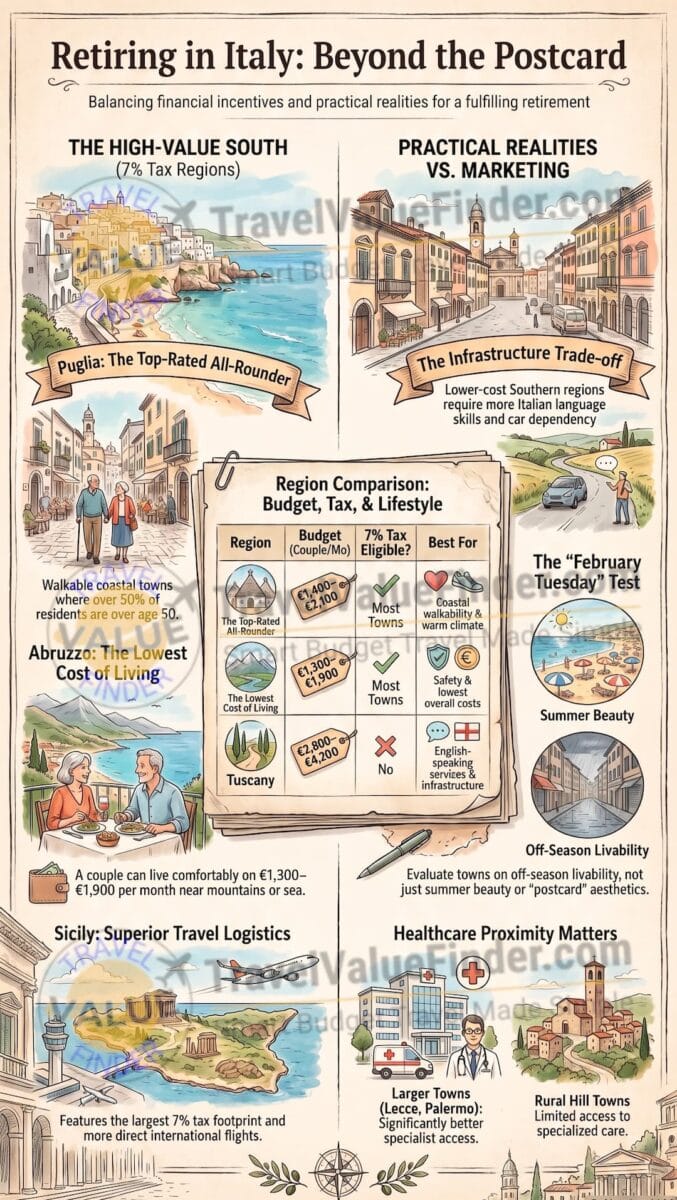
Puglia: The Whitewashed Favorite
Ostuni’s hilltop historic center keeps cafes, small grocers, and pharmacies within an easy walk. The Adriatic coast sits just minutes downhill, making it easy to split days between town and sea.
Polignano a Mare and Monopoli offer a similar coastal walkability with more daily bustle. Lecce, sometimes called the Florence of the South, adds baroque architecture and a genuine small city feel.
Puglia’s flat, sun bleached landscape and characteristic trulli, the region’s cone roofed stone huts, give it a visual identity unlike anywhere else in Italy. Olive groves stretch for miles between towns, and the region produces a meaningful share of the country’s olive oil.
Sicily: Bigger, Livelier, Better Connected
Sicily offers more direct international flight routes than most of the southern mainland, which matters for regular trips home. Palermo brings big city energy, while Taormina leans more polished and tourist friendly.
Syracuse and Ragusa round out the island with historic centers and a slower pace than Palermo. Sicily’s reputation from decades past rarely matches the daily reality most visitors experience today.
Mount Etna, still active and visible from much of the island’s east coast, gives Sicily a dramatic backdrop that no mainland region can match. The island’s food culture blends Italian, Arab, and Greek influences in a way that feels distinct from anywhere else in the country.
Abruzzo and Calabria: The Quiet South
Abruzzo stretches from the Gran Sasso mountains to the Adriatic coast, giving travelers a real choice between cool summers and beach towns. Sulmona’s medieval center rewards travelers who want authenticity over polish.
Calabria remains the least developed of the southern regions for foreign visitors. Tropea’s cliffside setting over clear water is the region’s best known draw, with far fewer crowds than Puglia.
Both regions require more patience with infrastructure than Tuscany or Puglia, with less English spoken and fewer amenities built specifically for visitors. That trade off is exactly why they still feel undiscovered compared to Italy’s more established travel regions.
The question that changed how I judge a town was not how it looks in July, but how it feels on a quiet Tuesday in February.” Leslie Nics, TravelValueFinder.com
Tuscany and Lake Como: The Polished Option
Tuscany and Lake Como carry an established, English friendly travel infrastructure built over decades. Lucca and Cortona stand out as walkable, historic towns with less crowding than Florence itself.
Lake Como’s lakeside towns bring some of the most photographed scenery in the country. Both regions suit travelers who want ease and familiarity over discovery.
This polish comes with a trade off. Tuscany and Lake Como see the highest concentration of foreign visitors of any Italian region, which means daily life can feel more staged for tourists than in Puglia or Sicily, especially during peak summer months.
Matera and the Regions Few Consider First
Basilicata’s Matera is unlike anywhere else in Italy, with its ancient cave dwelling Sassi district carved directly into rock. It draws travelers seeking something architecturally singular without Tuscany level crowds.
Molise sits even quieter still, often overlooked even by Italians. It suits travelers who prioritize privacy and stillness over amenities and company.
Matera’s cave dwellings were inhabited well into the twentieth century before being emptied and later restored as hotels and homes. Staying a night in one of these converted spaces gives a longer visit a sense of history that a typical hotel room cannot match.
What Year Round Sunshine Actually Means
Retiree guides love the phrase year round sunshine, and it oversells the reality. Coastal Puglia and Sicily see mild winters by northern European standards, but mild still means real rain and cooler days.
Inland hill towns in Abruzzo, Basilicata, and Calabria can turn genuinely cold, sometimes snowy, despite sitting in the south. A town’s elevation and distance from the coast tells you more than its region’s name does.
This is also where most first timers get tripped up, judging a town only by a summer visit, assuming every southern region shares the same climate, and ruling out Sicily or Calabria on an outdated reputation rather than the daily reality.
Rome and the regions just south of it sit in a genuine middle ground, warmer than the north but without the extreme summer heat that hits Puglia and Sicily in July and August. That middle ground is part of why so many long stayers use central Italy as a base for exploring both directions.
Which town is best for a car free stay?
Ostuni and Lecce in Puglia, and Lucca in Tuscany, all keep daily errands within walking distance.
Is Matera worth visiting outside a day trip?
Yes. Its cave dwelling architecture rewards a slower, multi day visit over a quick stop.
How does southern Italy compare on cost to Tuscany?
See our Italy travel cost guide for a full regional cost breakdown.
Where can I find more slow travel guides like this one?
Our Retirement Travel category covers more extended and slow travel guides across several countries.
Is English widely spoken in southern Italy?
Less than in Tuscany or Lake Como, though tourist areas of Puglia and Sicily manage well enough. A little Italian goes a long way in smaller inland towns.
What is the best season for a first visit to southern Italy?
Late spring and early fall offer the most comfortable weather with fewer crowds than peak summer. Winter suits travelers seeking a quiet, low cost visit.
Country and safety information comes from the US Department of State. Tourism context comes from ENIT, Italy’s national tourism board. Rail detail comes from Trenitalia, and population figures cited come from Istituto Nazionale di Statistica.