Travel Value Finder

Leslie Nics, TravelValueFinder.com | Last updated: October 2026 |
Vienna is a very different senior-travel proposition from a compact historic city or a destination where the main challenge is steep terrain. For an independent traveler after 55, Vienna’s attraction is its combination of culture, public transportation, neighborhoods, parks, cafés, markets, and day-trip possibilities.
The challenge is different, too. Vienna is a large capital with a huge amount to see. A short trip can easily become a checklist of museums, palaces, churches, concert halls, and neighborhoods. For a longer stay, the question is not simply whether Vienna has enough to do. It is whether you can organize those choices into a comfortable daily rhythm.
This audit applies the Travel Value Finder Senior Travel framework to Vienna: stay in one base, move around strategically, group activities geographically, build in slower days, and judge transportation together with the walking required at either end.
Table of Contents
Why Vienna Can Work So Well as a Single-Hub Destination
Vienna is large enough to keep a traveler interested for several weeks without requiring repeated hotel changes. Historic districts, museums, music venues, parks, markets, residential neighborhoods, and everyday cafés give a long-stay traveler many different versions of the city.
The single-hub idea is particularly useful here. Instead of changing accommodation every few days, learn one neighborhood first. Find the supermarket, pharmacy, café, easiest public-transport route, and a few comfortable places to sit. Then gradually expand your radius.
The goal is simple: stay longer, move less, and explore more.
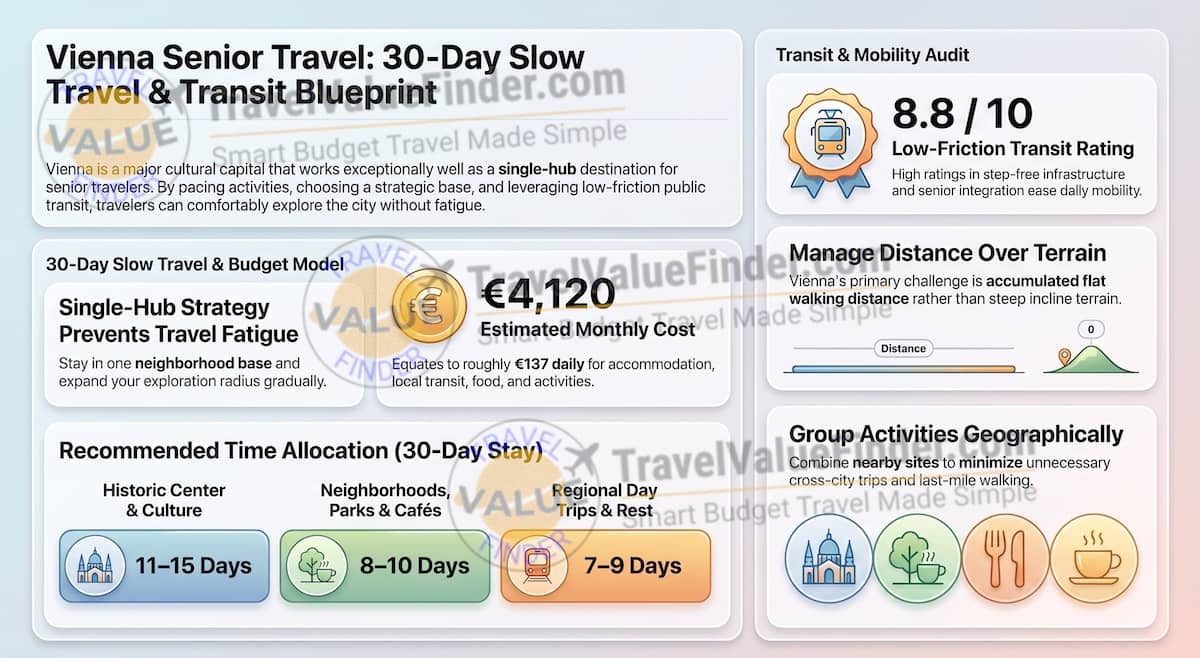
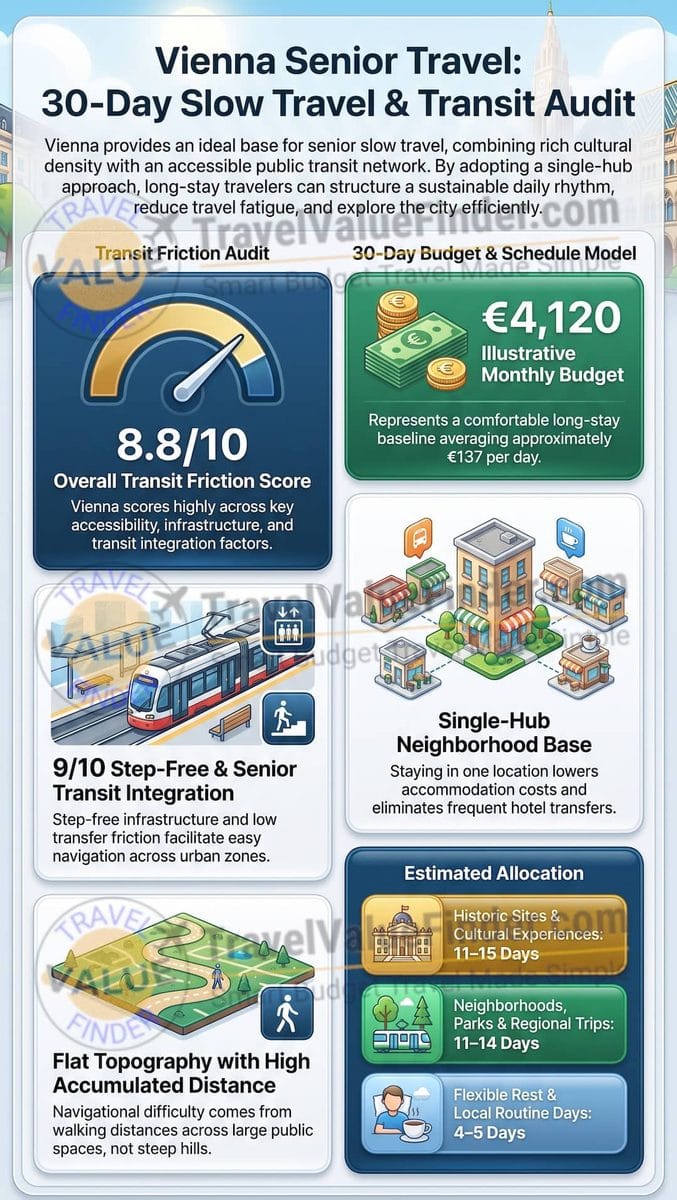
The 30-Day Vienna Slow Travel Model
A month in Vienna does not need to mean doing something major every day. A more sustainable plan separates high-interest cultural days from ordinary neighborhood days, parks, cafés, shopping, laundry, rest, and flexible time.
| Focus | Approximate Time |
| Historic center and major landmarks | 6–8 days |
| Museums, music and cultural experiences | 5–7 days |
| Neighborhoods, cafés and markets | 5–6 days |
| Parks, gardens and slower outdoor days | 3–4 days |
| Regional day trips | 3–4 days |
| Flexible or rest days | 4–5 days |
Vienna’s Big Advantage: Divide the City Into Manageable Areas
For senior travel, Vienna is easier to think about in zones than as one giant sightseeing list. Put attractions that are geographically close together on the same day. This reduces unnecessary cross-city travel and makes the day easier to adjust.
A day focused on the historic center can stay focused there. Another can combine a museum area with nearby cafés. A different day can concentrate on Schönbrunn and its surroundings rather than adding several unrelated attractions on the other side of the city.
This approach also gives you an easy escape route. If you have had enough after two or three hours, you can return to your base rather than feeling that you still have half a city to cross.
Why This Pace Can Work After Retirement
A long Vienna stay gives you something a short city break cannot: flexibility. You can change plans when the weather changes, return to a museum you enjoyed, spend an afternoon reading in a café, or simply take a quiet day after an evening performance.
Museums can be surprisingly tiring. Concerts and performances may finish later than expected. Even a pleasant day of sightseeing can add up to a lot of standing and walking.
A slower schedule lets you respond to how the day actually feels rather than trying to complete an itinerary written weeks earlier.
Why Staying in One Place Can Change the Economics
A long-stay budget is not just the nightly accommodation rate multiplied by 30. Location affects transportation, groceries, dining choices, laundry, time, and the number of journeys you need to make.
A very central apartment may cost more but reduce travel time. A quieter property outside the most expensive tourist streets may offer better value if it has convenient public transportation and everyday services nearby.
For a month-long stay, look at the whole routine: accommodation, local transportation, grocery access, eating out, laundry, kitchen facilities, and the practical time cost of getting around.
An Illustrative Vienna Monthly Budget
The following is a planning example for a comfortable one-month stay. It is not a current universal price quote. Actual costs vary substantially by season, neighborhood, accommodation type, dining style, and the number and type of paid activities.
| Category | Illustrative Monthly Amount |
| Comfortable long-stay accommodation | €2,400 |
| Local transportation | €120 |
| Food and dining | €1,050 |
| Activities and regional trips | €550 |
| Illustrative total | €4,120 |
| Approximate daily equivalent | €137 |
The value of this type of model is not precision. It gives you a starting point for asking whether a destination fits your own monthly travel budget.
Vienna Transit Friction Audit
Public transportation is central to the Vienna senior-travel proposition. The important question is not simply whether a city has a good network. It is whether your particular accommodation and daily destinations can be connected without creating excessive transfers, stairs, walking, or last-mile effort.
For this Travel Value Finder audit, the planning questions include station access, network coverage, transfer simplicity, walking between stops and destinations, last-mile alternatives, and how easily a traveler can repeat familiar routes.
| Planning Factor | TVF Planning Score |
| Step-Free Infrastructure | 9/10 |
| Topography & Surfaces | 8/10 |
| Last-Mile Options | 9/10 |
| Senior Transit Integration | 9/10 |
| Overall Transit Friction Score | 8.8/10 |
These are Travel Value Finder editorial planning scores, not an official accessibility rating or certification. They are intended to help travelers think through practical friction; individual stations, routes, buildings, and personal mobility needs can differ.
Vienna Walking: Less About Hills, More About Distance and Pace
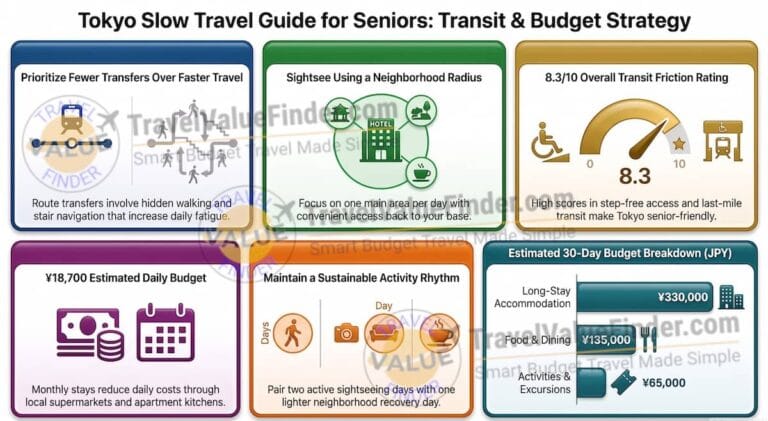
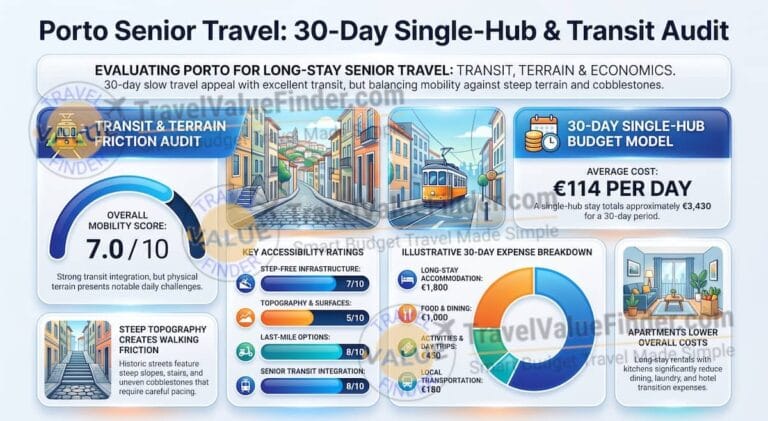
Vienna presents a different walking equation from Porto (see Porto Senior Travel). Hills are not necessarily the dominant issue across the city. Instead, the challenge can be accumulated distance between large attractions, squares, museums, parks, public-transport stops, and the places where you want to eat.
A map can make two attractions look close while the actual outing includes station access, crossing large public spaces, standing in queues, navigating a museum, and walking again afterward.
The practical response is not to avoid walking. It is to use transportation for longer legs, concentrate on one district at a time, schedule seated breaks, and avoid turning every day into a distance challenge.
Choosing the Right Vienna Base
For a month-long stay, the most famous address is not automatically the most useful address. Convenience to public transportation and everyday services can matter more than being directly beside a major landmark.
Look for:
- A straightforward public-transport route to the areas you expect to visit often.
- A supermarket, pharmacy, cafés, and basic services within a comfortable distance.
- A quiet bedroom and a building that is easy to enter.
- An elevator or a clearly understood stair situation.
- A comfortable living area where you can spend a non-sightseeing day.
- A practical kitchen and laundry arrangement for a longer stay.
- A neighborhood that feels comfortable returning to in the evening.
Vienna by Neighborhood: Think in Daily Life, Not Just Attractions
A short-stay visitor can choose a hotel because it is close to a famous attraction. A month-long traveler needs something different. You will buy groceries, do laundry, rest, eat ordinary meals, charge devices, possibly work online, and return home after an evening performance.
That makes the neighborhood itself part of the travel experience. A slightly quieter location with dependable transportation may provide better long-stay value than paying a premium simply for a landmark view.
A Possible 30-Day Vienna Rhythm
Week 1: Learn Your Local Routine
Keep the first week deliberately light. Find the supermarket and pharmacy, learn your most useful transportation route, identify a few cafés or restaurants, and take short exploratory walks. Add only one or two major attractions at first.
Week 2: Historic Vienna and Cultural Days
Use this week for the major historic and cultural experiences that interest you. Group activities geographically. Avoid stacking several long museum or walking days together. If you attend an evening performance, make the following morning flexible.
Week 3: Parks, Neighborhoods and Regional Exploration
Mix quieter city days with one or two regional excursions. Vienna works particularly well for this rhythm because a long stay does not require every day to be a major sightseeing day.
Week 4: Revisit and Slow Down
Return to a museum, market, café, park, or neighborhood you particularly enjoyed. The final week can be less about collecting attractions and more about experiencing the city as a temporary home.
Using Vienna as a Regional Day-Trip Hub
The single-hub philosophy does not mean staying inside Vienna for 30 days. It means choosing regional trips selectively so they add variety without turning the whole trip into a series of transfers.
| Possible Excursion | Why It May Fit the Slow-Travel Model |
| Bratislava | A cross-border city option; plan the complete journey, including transfers and walking. |
| Wachau Valley | A different landscape and pace; the best approach depends on season and chosen towns or activities. |
| Graz | A substantial Austrian city that may suit a full-day excursion for travelers comfortable with a longer outing. |
| Baden bei Wien | A closer, lower-commitment option when you want a change of scene without a major travel day. |
Before booking a day trip, consider the whole door-to-door experience rather than only the train or bus journey: getting to the station, transfers, walking at the destination, time standing, and the return journey.
Vienna Seasonal Considerations
A 30-day stay gives you flexibility, but season still matters.
- Summer can provide long daylight hours and more opportunities for parks and outdoor activities, although hot weather can make extended walking less comfortable.
- Winter brings shorter daylight and colder conditions, with wet or icy surfaces potentially affecting walking plans.
- Spring and autumn can offer a useful middle ground but may involve changeable weather.
The advantage of slow travel is that you can move demanding outdoor days around the weather rather than committing every sightseeing activity to a fixed schedule.
What to Look for in a Vienna Long-Stay Apartment
For a short city break, a small room may be perfectly adequate. For 30 days, the practical details become much more important.
- Elevator and building access that match your needs.
- Reliable heating and, where relevant, cooling.
- A supermarket and everyday services nearby.
- A simple public-transport route for your most frequent journeys.
- A quiet bedroom for consistent sleep.
- Kitchen and laundry facilities suitable for a month-long stay.
- Comfortable seating and enough living space for rest days.
Where Vienna May Not Work as Well
Vienna can be a demanding destination if you approach it as a checklist. The sheer number of museums, cultural attractions, neighborhoods, and historic sites can encourage over-scheduling.
Long cultural days can involve substantial standing and walking. A central location can also become expensive when combined with frequent paid attractions and dining out. Winter conditions may create additional walking considerations.
For many travelers, the answer is not to shorten the trip. It is to slow it down.
Who Is Vienna Best Suited To?
Vienna is particularly interesting for independent senior travelers who enjoy culture, museums, music, architecture, cafés, parks, and the idea of using a major European city as a temporary home.
It can also suit travelers who prefer public transportation to relying heavily on taxis and who enjoy organizing their days around neighborhoods rather than rushing from landmark to landmark.
It may require more planning for travelers who strongly prefer small-town quiet, dislike large-city environments, or find extended museum and walking days tiring. In those cases, a carefully chosen base and a slower schedule become especially important.
Vienna Senior Travel: The Bottom Line
Senior travel should not be reduced to a simple question of whether a city is ‘easy’ or ‘difficult.’ A better question is whether the destination supports a sustainable daily routine for the individual traveler.
Vienna’s public transportation can reduce the need to walk long distances between distant parts of the city. Its cultural depth provides plenty to do over several weeks. Its neighborhoods, parks, cafés, and markets make it possible to create ordinary days as well as sightseeing days.
The key is pacing. Choose a sensible base, group activities geographically, use public transportation strategically, and alternate demanding cultural days with quieter ones.
For the right independent traveler, Vienna can work very well as a single-hub senior travel destination: a place where you can experience a major European capital without changing hotels every few days.
Travel differently, not less.
Frequently Asked Questions
Is Vienna good for seniors?
Vienna can work well for independent senior travelers who enjoy culture, public transportation, museums, music, architecture, and city life. The main consideration is the scale of the city and the amount of walking that can accumulate during sightseeing days.
Is Vienna easy to get around?
Vienna has an extensive public-transport network, but the complete route matters. Consider the walk from your accommodation to the stop, transfers, station access, and the walking required after you arrive.
Is Vienna good for slow travel?
Yes, particularly for travelers who enjoy spending time in museums, neighborhoods, cafés, parks, markets, and cultural venues rather than trying to complete every major attraction in a few days.
How long should seniors stay in Vienna?
A two- to four-week stay can make sense for travelers who want to experience Vienna at a slower pace. The ideal length depends on interests, budget, mobility, and how many regional excursions you want to include.
What is the biggest senior-travel challenge in Vienna?
For many independent travelers, the issue is likely to be over-scheduling rather than a lack of transportation options. A city with so much to see can tempt travelers to plan too much for each day.
Where should seniors stay in Vienna?
For a longer stay, prioritize a comfortable neighborhood with convenient public transportation, grocery and pharmacy access, quiet sleeping conditions, and building access that suits your needs. Being directly beside a famous attraction is not necessarily the most practical choice.
Does Travel Value Finder provide an official accessibility rating for Vienna?
No. The Transit Friction scores in this article are Travel Value Finder planning assessments designed to help travelers think through practical transportation and walking considerations. They are not official accessibility certification.
Explore the Travel Value Finder Senior Travel Framework
Vienna applies the Travel Value Finder Senior Travel framework to a large Central European capital. The central considerations here are different from those in a hilly historic city: public transportation, cultural density, neighborhood choice, accumulated walking, and daily pacing become especially important.
This destination audit is designed to sit beneath the main Senior Travel pillar. The pillar explains the overall approach to independent senior travel; this page shows how that approach can be applied to Vienna, as it did for Seville Senior Travel.
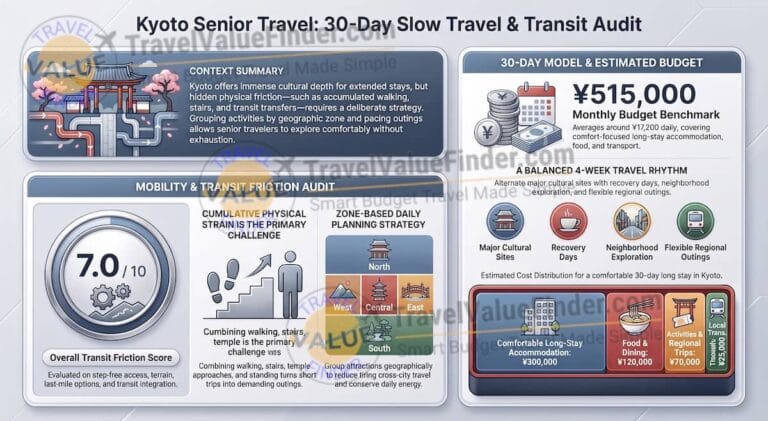
Next in the destination series: Kyoto.
Sources
- Vienna Train Stations
- International Bus Terminal, Vienna Central Station