Travel Value Finder

From Leslie Nics at TravelValueFinder.com. Put together in September 2026, drawing on time spent in Mérida, San Miguel de Allende, and Mexico City.
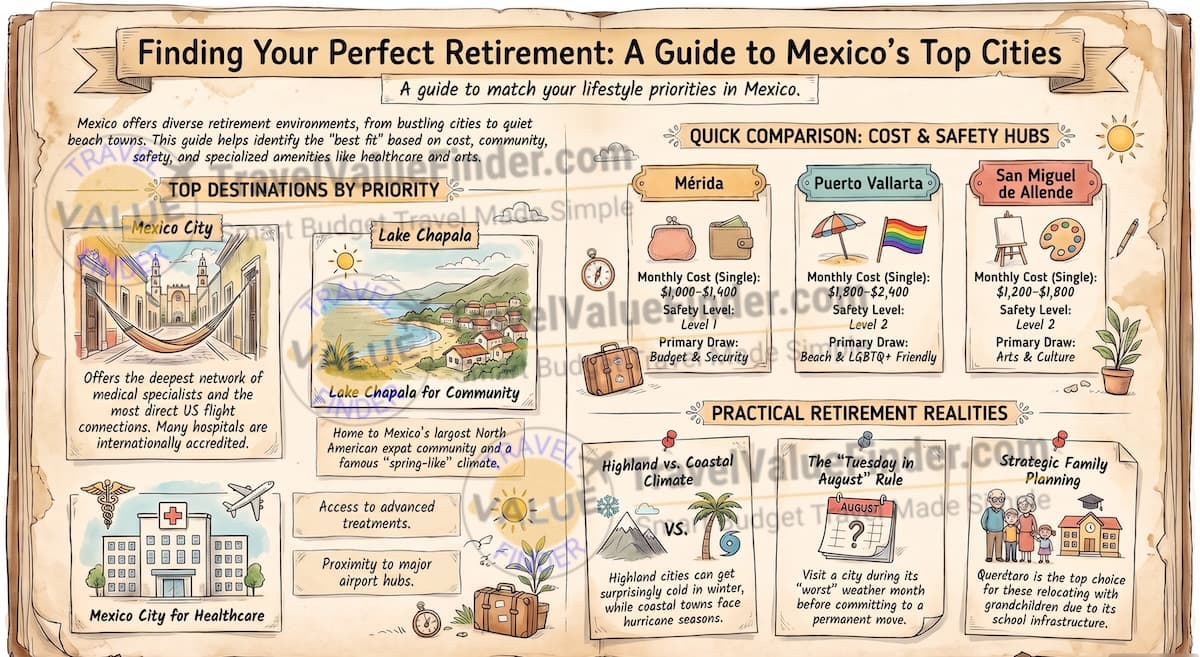
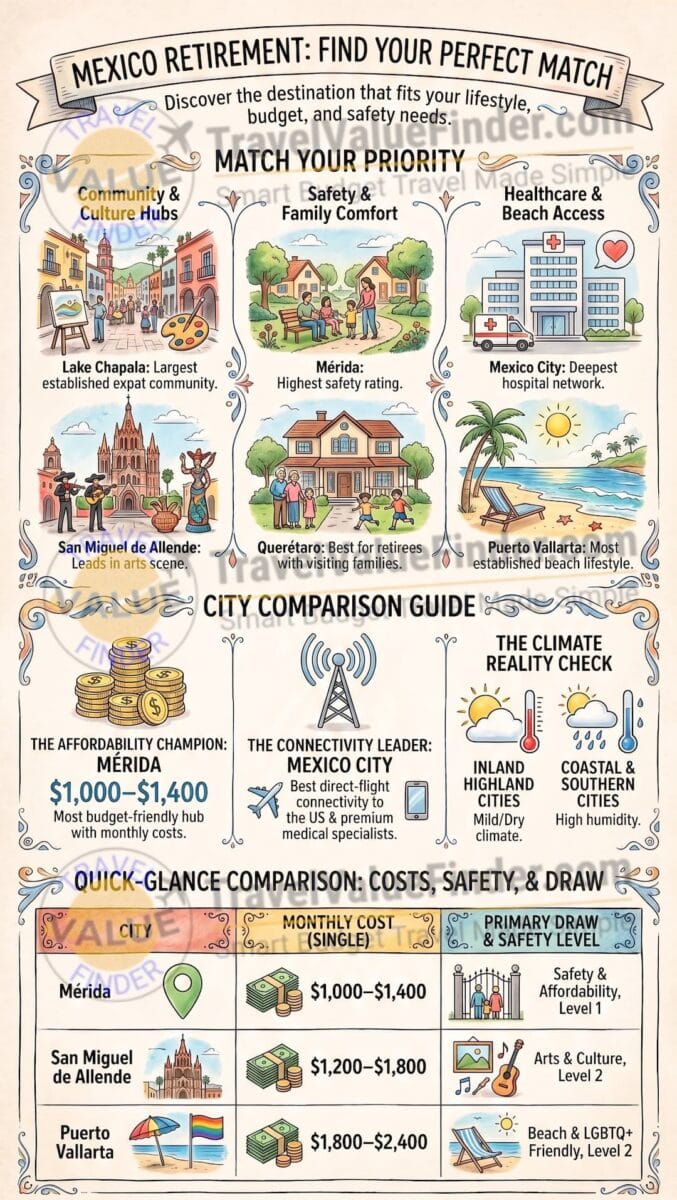
The best cities in Mexico for retirement travel depend on what kind of trip you actually want. Mérida suits travelers who want a genuinely calm, safe base. Lake Chapala and Ajijic suit those chasing an established community. San Miguel de Allende suits anyone drawn to arts and culture, and Puerto Vallarta suits beach lovers.
This guide matches each city to a travel style instead of ranking them against each other, since the right one depends entirely on how you like to spend a day.
Table of Contents
Match Your Priority to a City
| If You Want | Best Fit | Why |
| A calm, easy pace | Mérida | Colonial architecture, walkable center, genuinely unhurried |
| A ready made social scene | Lake Chapala, Ajijic | The largest long running North American community in Mexico |
| Arts and fine dining | San Miguel de Allende | A UNESCO historic center with a deep gallery and restaurant scene |
| A family friendly city | Querétaro | A real Mexican city with strong international school options |
| Beach access | Puerto Vallarta | Established beach town character with a big social infrastructure |
| Big city amenities | Mexico City | The deepest hospital network and most direct US flights |
| Food and culture, less crowded | Oaxaca City | A UNESCO center with a renowned culinary scene |
Quick Answers
| Question | Quick Answer |
| What is the calmest city on this list? | Mérida, known for its colonial architecture and unhurried pace. |
| Where do most American retirees settle? | Lake Chapala and Ajijic host the largest established community. |
| Which city has the best US flight connections? | Mexico City, Puerto Vallarta, and Mérida all offer direct routes. |
| Do you need Spanish to get by day to day? | Not in Lake Chapala or San Miguel de Allende, though it helps everywhere else. |
Mérida: Calm, Colonial, and Coastal Adjacent
Mérida’s colonial center was built with the heat in mind, with thick walls, shaded courtyards, and wide covered walkways. The climate runs hot and humid most of the year, easing only briefly from December through February.
Gulf beaches and Mayan ruins both sit within easy reach without living directly on the coast. Mérida carries the mildest US State Department safety advisory of any established retirement hub in the country, a detail worth knowing even for a short visit.
The city’s pace suits travelers who want daily life to feel unhurried without feeling isolated. Sunday evenings close off the main square for a free outdoor concert, a tradition locals and long stayers both turn out for regularly.
Lake Chapala and Ajijic: The Established Community
This is the largest concentration of North American long stayers anywhere in Mexico, with decades old social clubs running weekly activities. The climate here is genuinely mild year round, with barely any need for air conditioning or heating.
The trade off is a strong expat presence, which some travelers find comforting and others find isolating from local culture. A short visit tends to make clear which camp you fall into.
Ajijic’s lakeside malecón fills with walkers and cyclists most evenings, and the weekly Wednesday market has become a genuine social institution rather than just a place to shop.
Spanish is optional here in a way it rarely is elsewhere in Mexico.
San Miguel de Allende: Arts and a Cosmopolitan Pace
This UNESCO listed colonial city built its reputation on galleries, fine dining, and a genuinely international creative scene. Sitting at altitude, the climate stays mild and dry for most of the year.
The city draws a mix of long term artists, writers, and visitors who came for a week and stayed for a season. Its restaurant scene punches well above its size, with a concentration of well regarded kitchens rarely found in a city this compact.
San Miguel is the one city on this list where I never ran out of things to do, even after a full month.” Leslie Nics, TravelValueFinder.com
Querétaro and Oaxaca City: Two Different Kinds of Local
Querétaro functions as a genuine Mexican city rather than a retiree specific enclave, with a strong international school network that draws families and grandparents alike. It consistently ranks among the country’s safer major cities.
Oaxaca City carries a culinary reputation that rivals San Miguel de Allende, in a UNESCO listed center with a smaller, quieter expat presence. Its rainy season runs mild and brief, from roughly June through September.
Querétaro’s historic aqueduct and well preserved center give it a genuine sense of place that some purpose built retirement towns lack. Oaxaca’s markets, particularly for mezcal and mole, draw food focused travelers from well beyond Mexico’s own borders.
Puerto Vallarta and Mexico City: Beach and Big City
Puerto Vallarta is Mexico’s most established beach retirement town and its most LGBTQ+ friendly city, with an international airport and a mature social scene. Its tropical climate carries a real hurricane season, roughly June through November, worth planning around rather than ignoring.
Mexico City offers the deepest hospital network in the country and the best direct flight connections to the US of anywhere on this list. Safety varies meaningfully by neighborhood, so a scouting visit matters more here than almost anywhere else on this list.
Puerto Vallarta’s malecón boardwalk and old town neighborhoods keep a walkable, low key character despite the city’s size, in contrast to the more spread out resort zones further north.
Mexico City rewards travelers who treat it like the genuine metropolis it is, with distinct neighborhoods that feel almost like separate small cities.
The Climate Reality Check Most Lists Skip
Highland cities like San Miguel de Allende, Querétaro, and Oaxaca sit at elevation and rarely need air conditioning, but nights can run genuinely cool from December through February, which surprises travelers expecting uniform warmth.
Lake Chapala’s mild, low swing climate is the outlier of the group, which is a large part of why it built the retirement community it has.
Mérida and the Yucatán run hot and humid nearly year round, and coastal towns like Puerto Vallarta carry genuine hurricane season exposure that a one week vacation would never reveal.
Packing for a scouting trip across more than one of these cities means packing for genuinely different climates in the same country, not just different scenery. A fleece that never leaves the suitcase in Mérida becomes essential in San Miguel de Allende after sunset.
Mistakes Worth Avoiding
- Choosing a city based on a one week vacation impression rather than a longer scouting trip
- Assuming every city shares Lake Chapala’s famously mild climate
- Picking a coastal town without accounting for hurricane season disruption
- Overlooking how much healthcare access varies outside Mexico City, Mérida, or Guadalajara
- Judging safety by an outdated reputation instead of current advisory information
What’s the difference between Mérida and San Miguel de Allende for a long stay?
Mérida runs calmer and carries a milder safety advisory. San Miguel de Allende offers a deeper arts, dining, and cultural scene in exchange.
Is Puerto Vallarta or a quieter beach town better for a first visit?
Puerto Vallarta’s established infrastructure makes it easier for a first timer. Quieter coastal towns reward a second or third visit once you know what you are looking for.
Which city is easiest without much Spanish?
Lake Chapala and San Miguel de Allende have the most English fluent service infrastructure, built up over decades of long staying visitors.
Do any of these cities have direct flights to the US?
Mexico City, Puerto Vallarta, and Mérida all offer direct connections to multiple major US cities. Smaller hubs like Lake Chapala typically connect through Guadalajara.
Is it common to split time between more than one of these cities?
Yes, and it is a good way to test the climate and pace differences before settling on one. A season split between a highland city and a coastal one covers a lot of ground.
Explore more slow travel guides like this one
Our Retirement Travel category covers more extended and slow travel guides across several countries.
Safety context draws on the US Department of State’s Mexico travel advisory. Population and city data comes from INEGI, Mexico’s national statistics agency.