Travel Value Finder

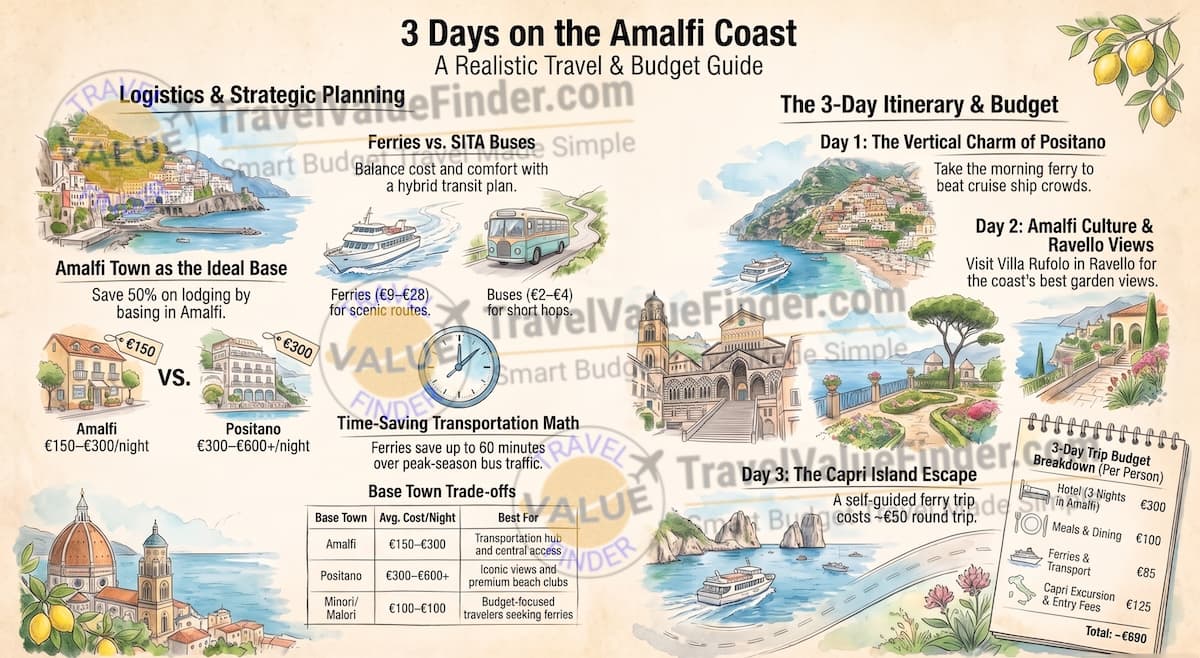
A well-planned Amalfi Coast itinerary runs 3 days. One day each in:
- Positano,
- Amalfi/Ravello, and a
- Capri day trip,
These are based out of Amalfi town rather than pricier Positano.
Leslie Nics, TravelValueFinder.com | Last updated: Aug 2026 | Based on first-hand trip planning and current 2026 pricing research
Budget €700–€1,000 per person for 3 days covering a mid-range hotel, ferries, meals, and one Capri excursion.
Transportation is the detail that makes or breaks the budget, since ferries cost 3–4x a SITA bus ticket but save real time and motion-sickness risk on the coast’s famously winding roads.
Most Amalfi Coast content either romanticizes the coastal road (it’s stunning, and also nauseating in a packed summer bus) or drowns first-timers in ferry timetables without ever adding the numbers into one real budget.
This guide does both: a real day-by-day plan and the actual transportation math.
Table of Contents
People Also Ask
How many days do you need on the Amalfi Coast?
3 days is a realistic minimum for a first visit – one day each in Positano, Amalfi/Ravello, and a Capri day trip. Longer trips add Sorrento, additional coastal towns, or a slower pace in each stop.
Is it better to stay in Positano or Amalfi?
Amalfi is the more practical base, it’s the region’s transportation hub and runs roughly half the hotel cost of Positano for comparable quality. Positano is worth a full day visit regardless of where you sleep.
How do you get around the Amalfi Coast without a car?
SITA buses and seasonal ferries (April–October) cover every major town. Ferries are faster and more comfortable at a real cost premium; buses are the budget option but slow down significantly in peak-season traffic.
Is Capri worth a day trip from the Amalfi Coast?
Yes, a self-guided ferry day trip costs €40–€56 round trip and leaves 4–5 hours to explore the Piazzetta, take the funicular, and see the Faraglioni rock formations.
3 Days on the Amalfi Coast: Where to Base Yourself
Here’s what surprised me most going in. The Amalfi Coast isn’t really one destination, it’s a string of small towns connected by a road that was genuinely not built for modern traffic volume.
A seasonal ferry network solves most of that problem for a price. Almost every planning mistake on this trip traces back to underestimating how much those connections between towns not the towns themselves shape the whole itinerary.
This is the first decision, and it drives almost everything else. Amalfi town is the practical choice for a first Amalfi Coast itinerary.
It’s the transportation hub where SITA buses and ferries to every other town converge, and mid-range hotels run €150–€300/night versus €300–€600+ for equivalent quality in Positano.
Positano is more photogenic and has the coast’s best-known beach, but you pay a real premium to sleep there rather than just visit for a day. Find out on Where to Stay on the Amalfi Coast
| Base Town | Mid-Range Hotel | Best For | Trade-Off |
| Amalfi | €150–€300/night | Transportation hub, central to everything | Less photogenic than Positano itself |
| Positano | €300–€600+/night | The coast’s most iconic views and beach | Highest prices, steep steps everywhere |
| Minori / Maiori | €100–€180/night | Budget-focused base, still ferry-connected | Fewer restaurants and shops in town |
| Sorrento | €120–€250/night | Easier rail/airport access, day-trip base | Not technically on the Amalfi Coast itself |
Getting There and Around: Bus vs. Ferry vs. Private Driver
This is the section most itineraries skip past, and it’s the one that actually determines both your budget and your patience level.
| Option | Cost | Time (Sorrento–Amalfi) | Trade-Off |
| SITA bus | €2–€4/ride, or €8–€12 for a 24-hr Costiera pass | 90–100 min (up to 2.5 hrs in August traffic) | Cheapest option; standing-room-only and winding-road nausea in peak season |
| Ferry (April–October only) | €9–€28 depending on route | 20–50 min | Faster, scenic, motion-sickness-friendly; seasonal and weather-dependent |
| Private driver/sedan | €150–€220 for a point-to-point transfer; €450+ for a full-day private tour | Fastest, flexible stops | By far the most expensive option, but the only door-to-door choice for early flights |
Reality Check Ferries only run April through October, and can be cancelled on short notice in rough seas. If your trip falls outside that window, or if you have an early-morning flight from Naples, budget for a road transfer instead there is no ferry alternative for those specific situations.
The honest recommendation, after pricing all three: use ferries for the scenic town-to-town legs (Amalfi–Positano, Amalfi–Capri), and accept the SITA bus for shorter, less crowded hops like Amalfi–Ravello, where the ferry option doesn’t exist anyway.
Save the private driver specifically for airport transfers, where a wrong ferry schedule could mean missing a flight.
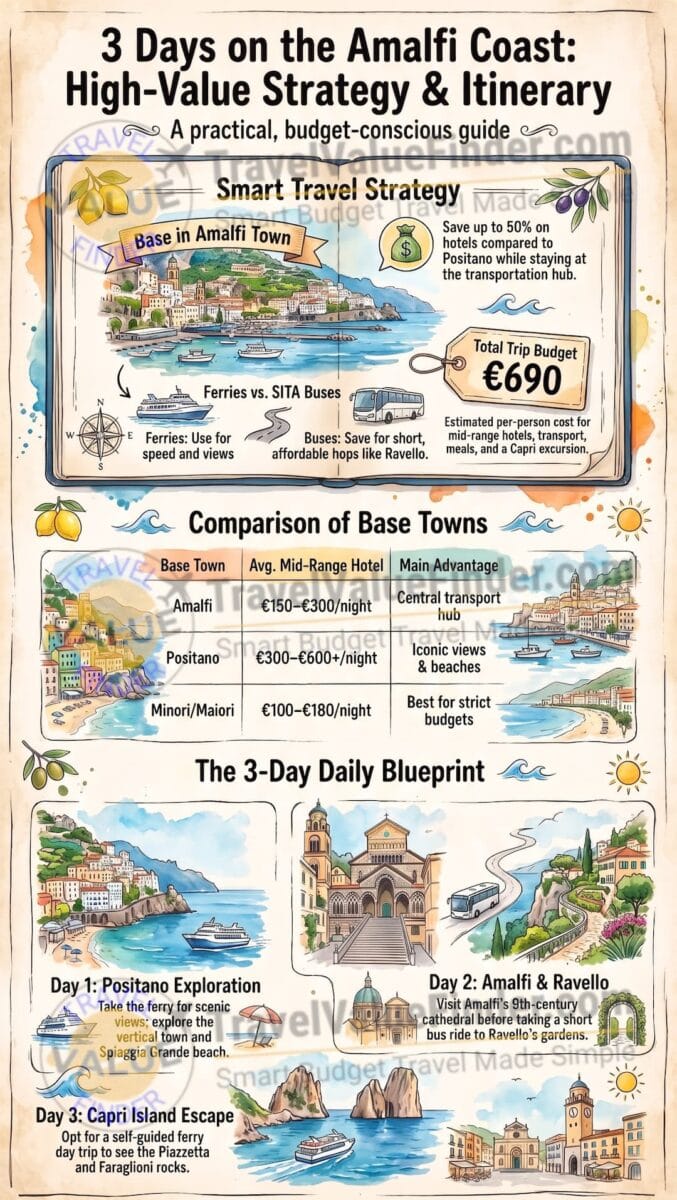
A Real 3-Day Itinerary
Day 1: Positano
Ferry from Amalfi to Positano (€9–€10, ~25 minutes) rather than the bus – worth the premium on the day you actually want to enjoy the coastal views rather than white-knuckle through them.
Spend the day exploring the vertical town, the Spiaggia Grande beach, and the Church of Santa Maria Assunta.
A beach club lounger runs €35/day per person in peak season, or free at the small public strip if you’re comfortable without a reserved spot.
- Morning: arrive by 9:30–10 AM ferry to beat the day-trip crowds off cruise ships and tour buses, which typically arrive mid-morning.
- Midday: wander the vertical town’s staircases and boutiques before the midday sun peaks – most shops close for a few hours in early afternoon regardless.
- Afternoon: beach time at Spiaggia Grande, either a paid lounger section or the smaller free public strip at either end.
- Evening: an early dinner reservation matters here. Positano’s best-regarded restaurants book up days ahead in peak season, and walk-ins are a real gamble July–August.
Get Your Amalfi Coast Itinerary with the Trip Planner, and download your PDF, no account or sign-in needed.
Day 2: Amalfi + Ravello
Stay closer to home base. Explore Amalfi’s 9th-century cathedral and the town’s working-port character in the morning, then take the SITA bus up to Ravello (€2–€3, ~25 minutes) for Villa Rufolo’s gardens and cliff-top views over the coast.
This is genuinely one of the best views on the entire Amalfi Coast, and less crowded than Positano’s beach.
- Morning: Amalfi Cathedral (Duomo di Sant’Andrea) and the adjoining Cloister of Paradise, both an easy walk from most in-town hotels.
- Midday: the bus ride up to Ravello itself is part of the experience – sit on the uphill side for the best views over Amalfi and the coastline as the road climbs.
- Afternoon: Villa Rufolo’s gardens, then a slower wander through Ravello’s genuinely quiet streets – a real contrast to Positano’s crowds the day before.
- Evening: return to Amalfi by bus (last buses run relatively early, so confirm the schedule before committing to a late Ravello dinner).
Day 3: Capri Day Trip
| Capri Option | Cost | What’s Included |
| Ferry only (self-guided) | €40–€56 round trip | Just transportation – explore Capri independently |
| Group boat tour/mini-cruise | €80–€130/person | Ferry + coastal cruise + swim stops + free time on the island |
| Private boat charter | €500–€1,500/day (split across a group) | Full customization, swim stops, cave visits – best value for groups of 4+ |
A self-guided ferry-only day is the budget-friendly option and still leaves 4–5 hours on Capri. This provide enough time for the Piazzetta, a funicular ride, and a walk toward the Faraglioni rock formations without needing a tour structure.
Arrive at the port at least 30–45 minutes before departure; boarding for popular island routes fills up fast even with a valid ticket.
Book the ferry a day ahead if traveling in July or August. The Amalfi–Capri route runs more than 10 daily crossings in peak season but popular morning departures do sell out.
What the Full 3-Day Trip Actually Cost
| Category | Per Person |
| Hotel, 3 nights in Amalfi (mid-range, split for two) | €300 |
| Ferries (Amalfi–Positano round trip, Amalfi–Capri round trip) | €75 |
| SITA bus (Amalfi–Ravello round trip, misc.) | €10 |
| Capri excursion (self-guided ferry + funicular + lunch) | €90 |
| Meals, 3 days (mix of trattoria lunches and one nicer dinner) | €180 |
| Beach club day in Positano | €35 |
| Total | ≈ €690 |
If You Have a 4th Day: The Path of the Gods
For travelers with an extra day, the Path of the Gods (Sentiero degli Dei) is the coast’s best free activity. This is a roughly 3-hour, moderate-difficulty trail connecting Bomerano (above Agerola) to Nocelle, above Positano, with around 600 meters of elevation change and some of the best coastal views on the entire Amalfi Coast, all without an entrance fee.
- No entrance fee, but proper footwear is genuinely necessary. This isn’t a casual walk in sandals.
- Bring more water than seems necessary; shade is limited for long stretches of the trail.
- Download offline trail maps before starting – mobile signal is unreliable along most of the route.
- The trail ends with a steep staircase down into Nocelle/Positano, so budget for tired legs on the descent, not just the climb.
Best Time to Visit
| Season | Weather | Ferries Running? | Crowds & Prices |
| Late May–June | Warm, reliably sunny | Yes, full schedule | Lower than peak, still lively |
| July–August | Hot, peak Mediterranean sun | Yes, but routes sell out | Highest of the year on both counts |
| September | Still warm, sea still swimmable | Yes, full schedule | Noticeably calmer than August |
| November–March | Cool, rainy, many businesses close | No, ferries stop running entirely | Lowest, but a genuinely different, quieter coast |
September deserves more attention than it usually gets in Amalfi Coast planning. The sea is still warm from summer, ferries run their full schedule, and the crowds that make July and August genuinely stressful have largely thinned out.
Packing Tips for the Coast
- A soft-sided duffel or backpack, not a hard-shell suitcase – nearly every town involves stairs, and SITA buses have limited, awkward luggage space.
- Comfortable, closed-toe walking shoes; sandals aren’t enough for the steep, sometimes uneven stone stairs connecting most towns’ upper and lower sections.
- A light, packable rain layer even in summer. Brief afternoon showers aren’t unusual, and ferries get genuinely breezy.
- A printed or downloaded ferry schedule because mobile signal is unreliable in several coastal stretches, and same applies to the Path of the Gods hike if that’s on your list.
Common Mistakes First-Timers Make
- Basing the whole trip in Positano for the view, without pricing the hotel premium against a day-trip visit from a cheaper base.
- Relying entirely on SITA buses in July or August, when a 90-minute route can stretch past 2 hours in coastal traffic.
- Booking a ferry-dependent itinerary outside the April–October season, when ferries don’t run at all.
- Bringing a large hard-shell suitcase. Amalfi Coast towns are steep, stepped, and narrow, and SITA buses have limited luggage space.
- Assuming a private driver is unaffordable without checking the point-to-point transfer price specifically, it’s far cheaper than a full-day hire and solves the one problem ferries and buses genuinely can’t (early-morning airport runs).
Find Out More About Visiting Italy
- Where to Stay on the Amalfi Coast
- Best Budget Hotels on the Amalfi Coast
- Italy Travel Guide
- How Much Does It Cost to Visit Italy?
- Rome Travel Guide
- Rome or Florence: Which Should You Visit First?
FAQ
What is the best base town on the Amalfi Coast?
Amalfi town, for most first-time visitors: it’s central to ferry and bus connections and costs roughly half of what an equivalent Positano hotel runs.
How much does a day trip to Capri cost?
€40–€56 round trip for a self-guided ferry visit; €80–€130/person for an organized boat tour with swim stops included.
Is the Amalfi Coast walkable?
Within towns, yes, though expect steep stairs and hills almost everywhere. Between towns, no, you’ll need the SITA bus, a ferry, or a private driver.
What is the cheapest way to get around the Amalfi Coast?
SITA buses, at €2–€4 per ride or €8–€12 for a 24-hour unlimited pass – meaningfully cheaper than ferries, at the cost of slower, more crowded travel in peak season.
When is the best time to visit the Amalfi Coast?
Late May–June or September are the sweet spot: ferries are running, weather is warm, and crowds and prices sit well below the July–August peak.
Sources