Travel Value Finder

This Boston travel guide covers;
- when to visit,
- how to get around without a car,
- where to stay by neighborhood,
- what to eat, and
- what first-time visitors from the US and Canada should know before booking.
I will also include MBTA basics, walkable neighborhoods, and a realistic first-timer itinerary.
Leslie Nics, TravelValueFinder.com | Last updated: August 2026 | Based on first-hand Boston trip research and current 2026 pricing for US and Canadian travelers
Table of Contents
What This Boston Travel Guide Covers (And Why Boston Needs One)
Most Boston travel guide content online falls into one of two buckets;
- a tourism-board list of official attractions, or
- a syndicated “best things to do” roundup that reads the same whether it was written by someone who’s been to Boston twice or never.
This guide is neither.
It’s built from repeat trips, a few genuine mistakes, and a deliberate decision to organize information the way I actually needed it when I was planning.
Not attraction-first, but decision-first;
- when to go,
- how to get around,
- where to stay, and
- what to eat.
These are with links out to deeper guides on each of those if you want the full detail.
If you only read one section, make it Getting Around Boston below. It’s the single decision that affects your budget and your daily plans more than anything else on this page.
People Also Ask
Is Boston walkable for tourists?
Yes, the downtown core, including Back Bay, Beacon Hill, the North End, and Downtown Crossing, is compact enough to cover mostly on foot. The T fills in the gaps for neighborhoods farther out, like Fenway or Cambridge.
How many days do you need in Boston?
Three days is enough to see the highlights without rushing. The Freedom Trail, a North End meal, and a half-day in Cambridge. Two days works for a quicker trip; five or more lets you add day trips to Salem or Cape Cod.
Is Boston expensive to visit?
Boston runs on the pricier end for US cities, especially for hotels in summer and fall. Visiting in winter or shoulder season, and skipping the rental car in favor of the T, meaningfully lowers the cost.
What is Boston best known for?
Its Revolutionary War history (the Freedom Trail connects most of the major sites), its concentration of universities including Harvard and MIT, its sports culture around the Red Sox and Fenway Park, and its North End Italian food scene.
Boston Basics: Size, Layout, and What to Expect
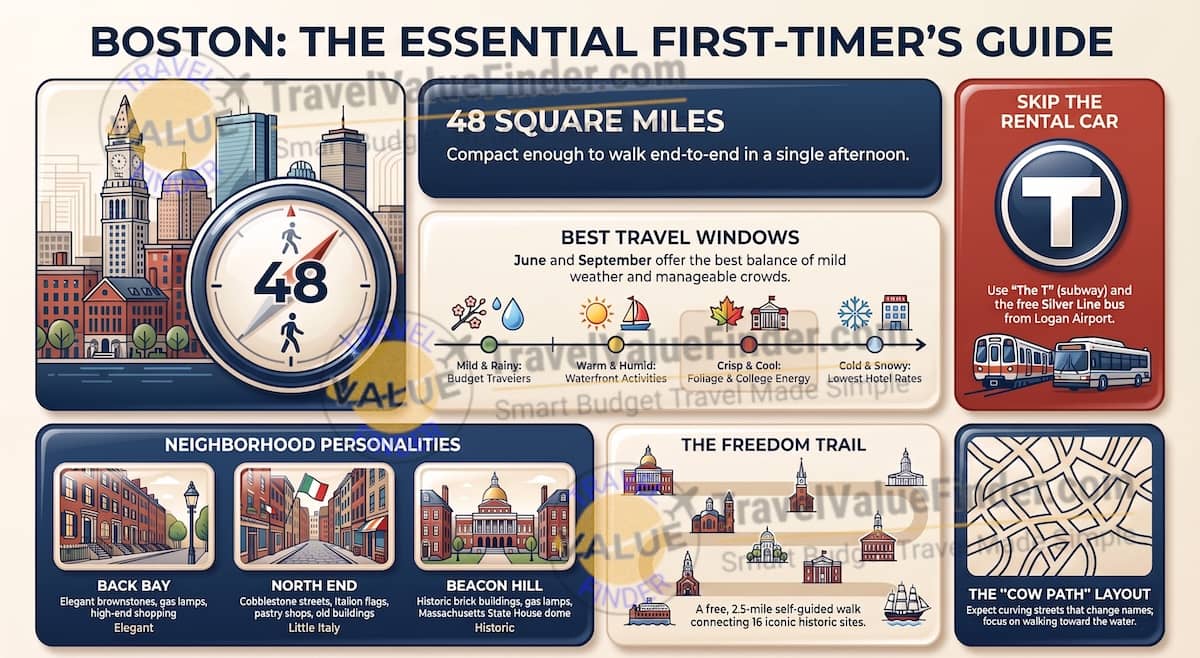
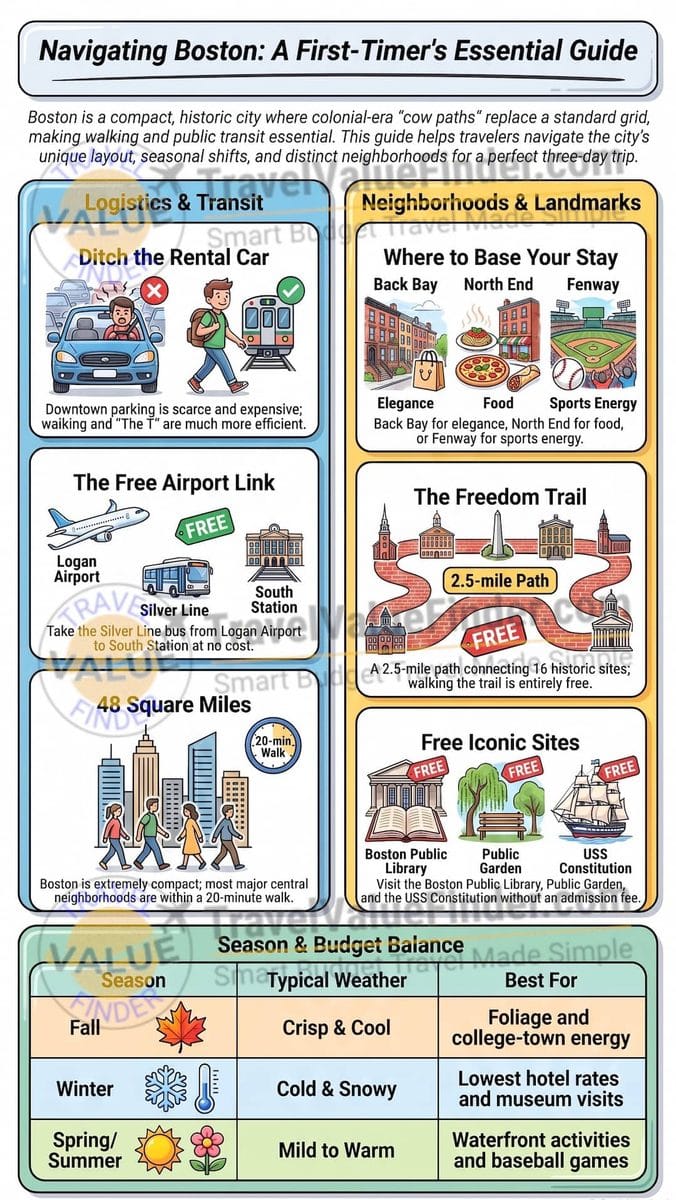
Boston proper is compact; about 48 square miles, small enough that many first-time visitors overestimate how much time they’ll need to get between neighborhoods.
The city sits on a harbor, split from Cambridge (home to Harvard and MIT) by the Charles River, and its downtown core; Beacon Hill, Back Bay, the North End, Downtown Crossing.
The Seaport is almost entirely walkable if you’re staying central. Logan International Airport (BOS) is unusually close to downtown, just across the harbor, which matters for how you plan your first and last day.
The layout is the first thing that trips people up. Boston predates the grid-street planning most American cities use, so streets curve, dead-end, and change names without warning.
Google Maps handles it fine. Just don’t expect the intuitive sense of direction you might have in a grid city like Chicago or Manhattan.
Boston rewards people who put the phone away and just walk toward the water. You’ll get lost less than you think, and every wrong turn leads past something old and interesting.” Leslie Nics, Founder & Lead Travel Writer, TravelValueFinder.com
When to Visit Boston
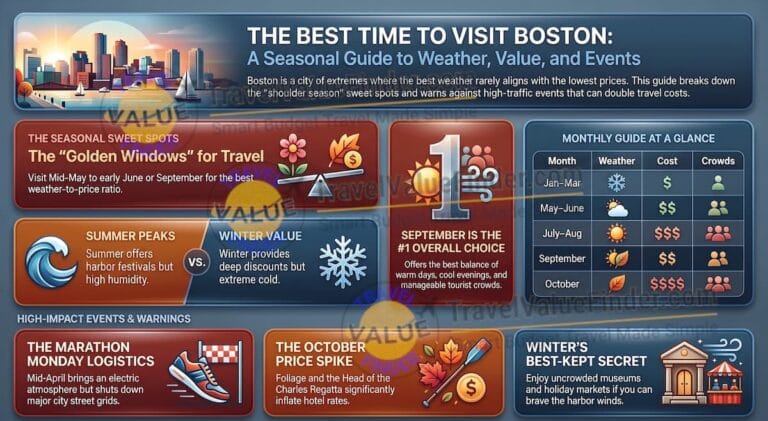
Boston has four distinct seasons, and which one is “best” really depends on your budget and your tolerance for crowds.
- Summer is peak season; warm, sometimes humid, and busy with both tourists and the city’s enormous student population moving in and out.
- Fall brings foliage crowds and crisp weather, especially through Columbus Day weekend.
- Winter is genuinely cold, with the heaviest snow typically landing in January and February, but it’s also when hotel rates drop the most.
- Spring is the most unpredictable. Some years mild by April, some years still raw through May, but it’s a strong value window if you’re flexible.
| Season | Typical Weather | Crowds & Price | Best For |
| Spring (Apr–May) | Mild, unpredictable, some rain | Moderate | Budget travelers, fewer crowds |
| Summer (Jun–Aug) | Warm, humid, occasional heat waves | Highest | Freedom Trail, Fenway games, waterfront |
| Fall (Sep–Oct) | Crisp days, cool evenings | High (foliage season) | Foliage day trips, college-town energy |
| Winter (Nov–Mar) | Cold, snow likely Jan–Feb | Lowest | Cheapest hotel rates, museums, holiday lights |
For a full month-by-month breakdown, including which weeks specifically to avoid or target, see our Best Time to Visit Boston guide.
Getting Around Boston Without a Car
This is the section I most wish someone had made me read before my first trip.
Boston’s subway system, the MBTA, universally called “the T” connects the airport, downtown, and most of the neighborhoods visitors care about.
The Silver Line bus runs from Logan Airport directly to South Station at no cost. From there the rest of the T network is easy to navigate with a reloadable CharlieCard.
If you’re staying in the downtown core, you likely won’t need the T much either. Back Bay, Beacon Hill, the North End, and Downtown Crossing are all within a 20–30 minute walk of each other.
Where the T earns its keep is getting to Fenway, Cambridge, or the outer neighborhoods without paying for a rideshare every time.
I rented a car for my first Boston trip out of habit. I spent more on a single day of downtown parking than I would have spent on three days of T fares. I haven’t rented a car in Boston since.” Leslie Nics, Founder & Lead Travel Writer, TravelValueFinder.com
Parking downtown is expensive and often scarce, and most hotels in the city core charge separately for it.
Unless your trip includes day excursions well outside the city such as Salem, Cape Cod, the Berkshires, skip the rental car and budget instead for the T and occasional rideshares.
Boston Neighborhoods to Know Before You Book
Where you stay in Boston shapes your trip more than in most cities, because the neighborhoods have genuinely different personalities rather than just different price points.
| Neighborhood | Vibe | Good For |
| Back Bay | Elegant brownstones, Newbury Street shopping | First-time visitors, walkability |
| Beacon Hill | Historic, gas-lit, quiet | Photos, a quieter home base |
| North End | Boston’s Little Italy, dense with restaurants | Food-focused trips |
| Seaport | Newer, waterfront, modern high-rises | Business travelers, harbor views |
| Fenway/Kenmore | Sports energy, nightlife, near the ballpark | Baseball fans, budget-friendly stays |
For a full neighborhood-by-neighborhood breakdown with specific hotel picks in each, see our Where to Stay in Boston: Best Areas guide.
What to Eat in Boston
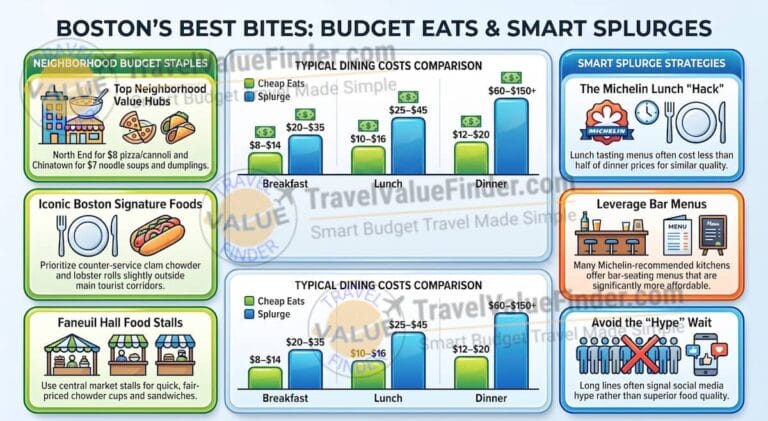
Boston’s food identity is a genuine mix of old New England (clam chowder, lobster rolls, fresh seafood).
There are the North End’s dense concentration of Italian bakeries and red-sauce restaurants that have been family-run for generations.
It’s also, less predictably, home to a handful of excellent Michelin-recognized restaurants that don’t get nearly the attention the seafood shacks do.
The best clam chowder I had in Boston wasn’t at the place with the line down the block. It was at a counter-service spot two streets over that the line was too impatient to go looking for.” Leslie Nics, Founder & Lead Travel Writer, TravelValueFinder.com
We cover this in full, including specific budget picks and the city’s Michelin-recommended restaurants worth the splurge in our Boston Cheap Eats guide.
Top Free and Low-Cost Things to Do in Boston
- Freedom Trail : a 2.5-mile, self-guided walk connecting 16 historic sites, free to walk on your own (Boston National Historical Park, part of the trail, is a National Park Service site)
- Boston Common & Public Garden : the country’s oldest public park, free to enter, especially good in spring and fall
- Charles River Esplanade : a long waterfront path good for a low-key morning walk or run
- Copley Square & Boston Public Library : the library’s main branch is free to enter and worth a look for the architecture alone
- USS Constitution & Charlestown Navy Yard : free to visit the yard; the ship itself, the world’s oldest commissioned warship afloat, is part of the National Park Service site
- Harvard Square day trip : a short T ride into Cambridge, worth half a day even if you’re not touring the campus formally
A First-Timer’s Boston Itinerary (Short Version)
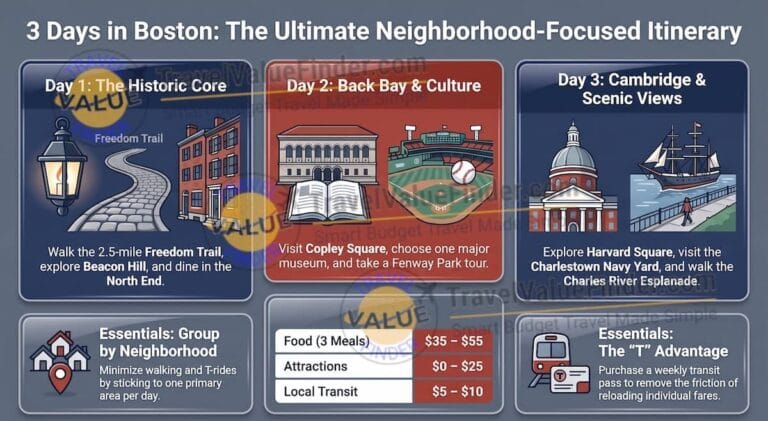
If this is your first trip, three days is enough to cover the Freedom Trail, a North End meal, a Fenway visit if there’s a game, and a half-day in Cambridge, without feeling rushed.
We’ve mapped this out hour-by-hour, including what we’d change after doing it ourselves, in our 3 Days in Boston itinerary guide.
Alternatively, get your personalized Boston itinerary with our Trip Planner (free PDF download)
For My Next Visit to Boston
Beyond the day-to-day itinerary choices (which get their own breakdown in the 3-day guide), there are a few bigger-picture things I’d change about how I planned the trip overall.
- First, I’d have bought a weekly T pass instead of loading single fares one at a time. It wasn’t dramatically cheaper, but it removed the friction of stopping to reload a card every time we changed plans.
- Second, I underestimated how much the North End’s popularity concentrates foot traffic at dinner time. I’d go earlier or later next time rather than fighting the 7 p.m. crowd.
- And third, I’d have checked Fenway’s schedule before booking my hotel dates, not after. A home game changes the entire neighborhood’s noise level, crowd, and hotel pricing around Kenmore.
Boston for Canadian Visitors
Boston is one of the more accessible US cities for Canadian travelers, whether you’re flying in or driving down from Ontario or Quebec.
A valid passport is required for air travel regardless of how short the trip is, and it’s required for land border crossings too.
A driver’s license alone isn’t sufficient, even for a day trip. If you cross the US-Canada border often, a NEXUS card can speed up the process at eligible crossings.
| From | Approx. Driving Distance | Approx. Flight Time |
| Toronto, ON | ~7–8 hours | ~1.5 hours |
| Montreal, QC | ~5–6 hours | ~1.5 hours |
| Ottawa, ON | ~7–8 hours | ~1.5–2 hours |
A few other practical notes for Canadian visitors:
- prices in Boston are in US dollars, so factor in the exchange rate when budgeting against a Canadian-dollar price you might be used to;
- tipping norms run higher than in most of Canada, with 18–20% standard at sit-down restaurants;
- and cell carriers vary widely on US roaming charges, so it’s worth checking your plan or picking up a US-compatible eSIM before you go rather than after you land.
Frequently Asked Questions
Do I need a car in Boston?
No, for a trip centered on the downtown core, a car adds cost (parking, tolls) without much benefit. The T and walking cover almost everything visitors want to see.
What’s the best month to visit Boston?
June and September tend to offer the best balance of good weather and manageable crowds, avoiding the peak-summer tourist volume and the heaviest fall foliage rush.
Is the Freedom Trail free?
Walking the trail itself is free. A few individual sites along the way charge admission, but the trail’s National Park Service sites, including Boston National Historical Park locations, are free to enter.
How far is Boston from New York City?
About 215 miles, roughly a 4-hour drive or a similar train time on Amtrak’s regional service, making it a realistic add-on for a longer East Coast trip.
Can Canadians drive to Boston without a passport?
No. A valid passport (or NEXUS card at eligible crossings) is required to cross the US-Canada border by land, even for a short day trip; a driver’s license alone is not accepted.
Sources