Travel Value Finder

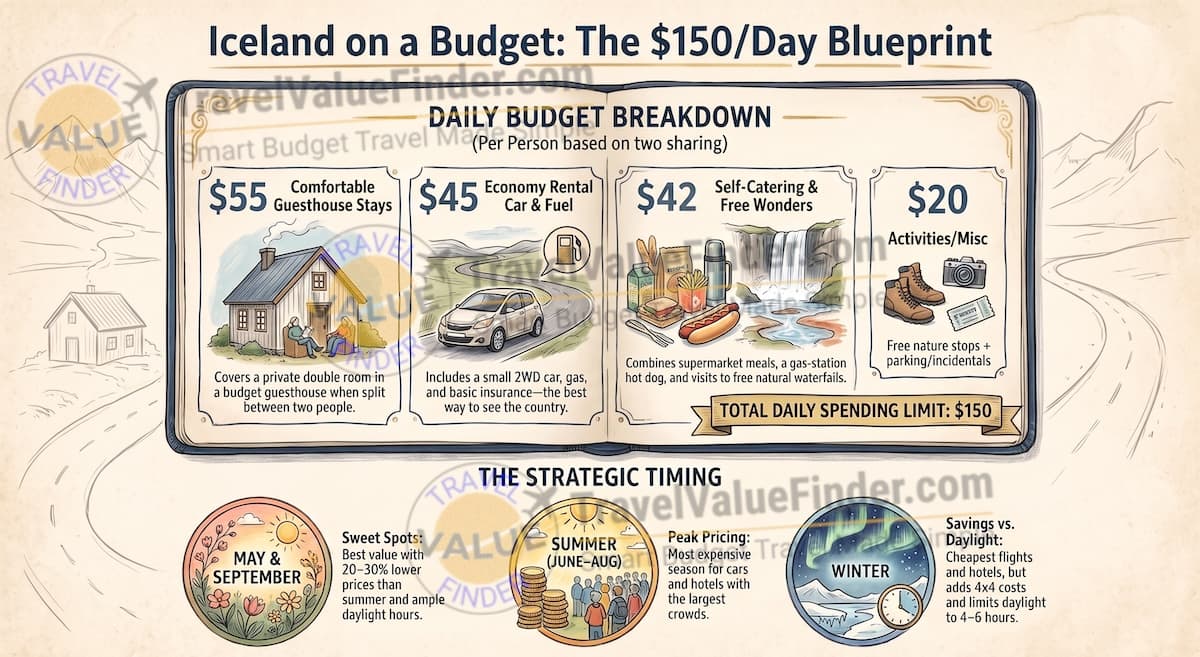
May and September offer the best time to visit Iceland on this budget. Prices drop 20 to 30 percent below summer rates. Daylight stays long, and northern lights chances begin in September.
This guide covers the best time to visit Iceland on a $150 a day budget. It compares seasonal costs, weather, and your northern lights chances side by side. Use it to pick a month that fits both your budget and your travel goals.
Leslie Nics, TravelValueFinder.com. Last updated September 2026.
Table of Contents
Best Time to Visit Iceland by Season
Iceland prices swing sharply by season. The table below compares cost, weather, and northern lights odds for each option.
| Season | Avg. Cost per Day | Weather and Daylight | Northern Lights |
| Summer (Jun to Aug) | $180 to $220 | 24 hour daylight, mild temps | Skies too bright to see them |
| Shoulder (May, Sept) | $130 to $150 | Long days, cool and mild | Possible from September onward |
| Winter (Nov to Mar) | $100 to $130 | 4 to 6 hours of daylight | Best chance of the year |
Shoulder season keeps your $150 budget intact while still offering good weather. Winter is cheapest but trades away daylight hours for northern lights odds.
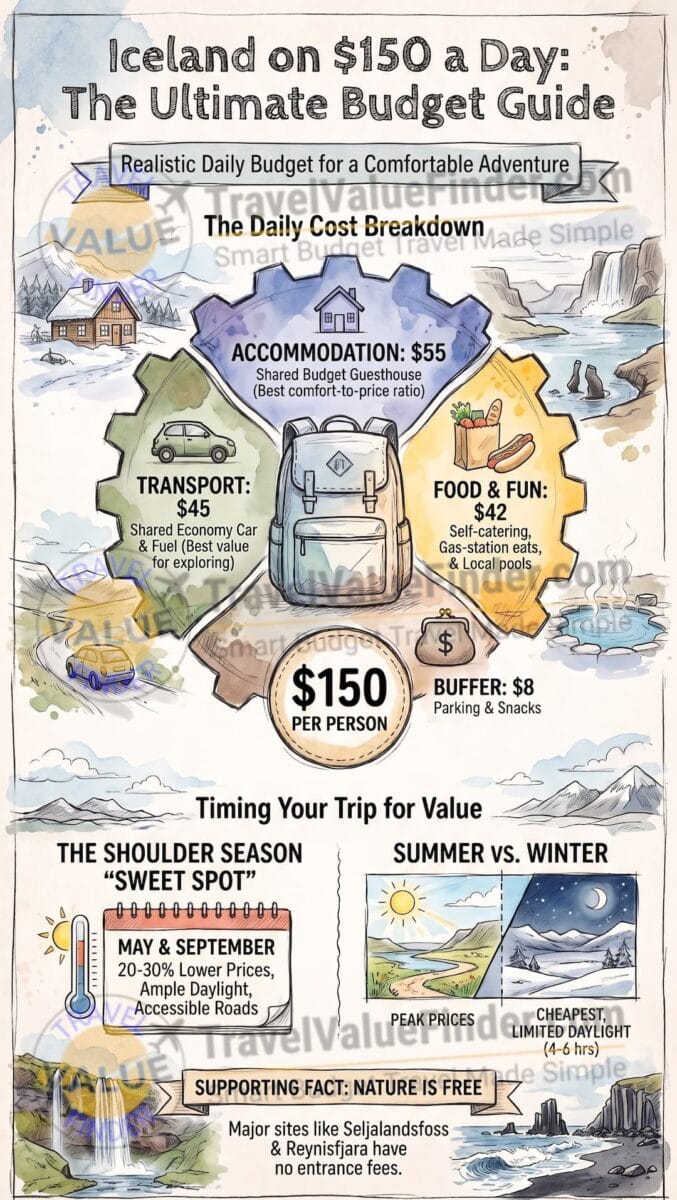
Your $150 a Day Iceland Budget Breakdown
Here is where a $150 daily budget goes, based on two travelers sharing a car and a room.
| Category | Cost per Person | What It Buys |
| Guesthouse room (shared) | $55 | A private double room split two ways |
| Rental car, gas, insurance | $45 | A small economy car, shared two ways |
| Food | $30 | Self catered meals plus one restaurant stop |
| Activities (daily average) | $12 | Free hikes most days, one paid stop |
| Buffer | $8 | Parking, snacks, small extras |
| Total | $150 | A full, comfortable day in Iceland |
Northern Lights and What They Cost
Watching the northern lights in Iceland is free. You only need dark skies, clear weather, and a bit of luck.
Your best window runs from September through March. Dark hours are long enough during those months to give you a real chance.
Get away from Reykjavik to escape city light pollution. A short drive along the south coast usually works well.
Guided aurora tours run $80 to $150 per person. They are not required if you already have a rental car.
Where Your Money Goes Each Day
| Line Item | Money Saving Tip |
| Room | Choose a guesthouse outside Reykjavik or along the Ring Road. |
| Car | Book one shared economy car with insurance included. |
| Food | Shop at Bonus and Kronan, and try a gas station hot dog. |
| Activities | Rely on free waterfalls, and add one paid stop now and then. |
The room and the car are your two biggest costs, so book both early. Food and activities are where daily choices matter most.
What a $150 Day in Iceland Looks Like
You wake up in a guesthouse near Vik, then make coffee and skyr in the shared kitchen.
Reynisfjara’s black sand beach is free, and you can easily spend an hour there.
Lunch is a packed sandwich, eaten in the car with a waterfall in view.
Skogafoss and Seljalandsfoss fill the afternoon, and both cost nothing to visit.
Dinner is a gas station hot dog, and you end the day at a local pool.
That full day, from breakfast to the pool, lands right at $150 per person.
How This Budget Compares to Other Iceland Trips
A $150 a day budget sits between shoestring camping and a mid range comfort trip. The table below shows where each style lands.
| Trip Style | Cost per Day | What Changes |
| Camping | $75 to $100 | Tent or van instead of a room, less weather protection |
| This guide | $150 | Real bed, shared car, one paid activity on average |
| Mid range comfort | $300 to $350 | Private car, hotels, and daily paid activities |
What This Budget Does Not Cover
- International flights, typically $450 to $750 round trip in shoulder season.
- Blue Lagoon or other premium spa visits, around $95 to $124 each.
- Guided glacier, ice cave, or northern lights tours, roughly $80 to $250 each.
- Iceland’s rental car kilometer fee, about $80 to $110 for a full trip.
Five Ways to Protect Your Budget
- Book your car and room 4 to 6 months ahead. Iceland’s supply is limited, and prices climb fast.
- Shop only at Bonus and Kronan. Convenience stores mark up groceries by a wide margin.
- Buy alcohol at the Keflavik duty free shop. Bar prices run 3 to 4 times higher.
- Fill your water bottle from the tap. Iceland’s tap water is some of the cleanest on Earth.
- Use a card with no foreign transaction fee. It is an easy, effortless saving on every purchase.
Plan the Rest of Your Trip
- Northern Lights in Greenland, for a look at how a nearby aurora trip compares.
- How to Find Cheap Flights, for the flight portion of this budget.
- The Essential Travel Packing List, since layers matter more in Iceland than almost anywhere.
People Also Ask
Is $150 a day enough for Iceland?
Yes. It covers a shared room, a shared rental car, real food, and one paid activity on average.
What is the best time to visit Iceland on a budget?
May and September, since prices sit 20 to 30 percent below summer while weather stays good.
Do I need a rental car in Iceland?
Yes, for anywhere beyond Reykjavik. Public transport outside the capital is limited.
How much does food cost per day in Iceland?
Around $22 to $36 a day, if you shop at budget supermarkets and add one restaurant meal.
Frequently Asked Questions
Is Iceland too expensive for budget travelers?
No. Many top sights, like waterfalls and black sand beaches, cost nothing to visit.
What is the cheapest month to visit Iceland?
January through March, though you will only get 4 to 6 hours of daylight.
Can I see the northern lights on this budget?
Yes. Viewing them is free, and a rental car lets you chase clear, dark skies.
Does camping cut the budget further?
Yes, camping can bring the daily cost down to about $75 to $100.
How many days should I plan for this trip?
7 to 10 days works well, at roughly $1,050 to $1,500 per person on the ground.
Sources
CDC Travelers’ Health: Iceland, official health and vaccination guidance.
Disclaimer: Prices are estimates based on research at time of publication (2026) and can vary by season, exchange rate, and booking window.