Travel Value Finder

Notes from Leslie Nics, TravelValueFinder.com founder. September 2026 update, built on travel through Paris, Nice, and Lyon.
France for retirees usually means the same season, returned to year after year, not a permanent move. Most retirees settle into one anchor season, often warm months in the south, and build the rest of their year around it.
This guide covers what that repeating rhythm actually feels like, from daily habits to the regions people keep coming back to. Three months is enough to feel like a local rather than a visitor.
France rewards repetition in a way few countries do. A vineyard, a bakery, a market stall, each becomes more interesting the second and third time you visit, once you start noticing what changes with the season and what stays the same.
Table of Contents
Two Frances: The South and Everywhere Else
France splits into two moods more than most visitors expect. The south chases sun and crowds in summer, while the rest of the country offers a calmer, greener alternative.
Understanding this split early saves a lot of trial and error. A traveler who books a Provence stay in August without knowing about the crowds, or a Brittany stay in January without expecting gray skies, often ends up disappointed for reasons that were entirely predictable in advance.
| Season | Where People Head | Why |
| Spring (Mar to May) | Paris, the Loire Valley | Mild weather, blooming countryside, thinner crowds |
| Summer (Jun to Aug) | Provence, the Cote d’Azur | Warm coastal days, though the busiest and priciest months |
| Fall (Sep to Oct) | Provence again, Dordogne | Harvest season, warm days, far fewer visitors |
| Winter (Nov to Feb) | Brittany, Normandy, or home | Quiet coastal towns, mild but often gray |
A Day That Repeats
Mornings start at the market, not the grocery store. Bread, cheese, and produce come from the same stalls each week, and the vendors start to remember your order.
Afternoons slow down, especially in smaller towns where shops close for a few hours. Evenings bring the apero hour, a slow drink before dinner, followed by a walk as the light fades.
Lunch, not dinner, is often the more social meal in smaller French towns, especially on weekends when family gatherings can stretch two or three hours. Restaurants that look closed at three in the afternoon are usually just between services, not shut for the day.
“The market run stopped feeling like a task around week two. It became the best part of the morning.” – Leslie Nics, TravelValueFinder.com
Regions Worth Returning To
Provence and the Cote d’Azur
Lavender fields, hilltop villages, and a coastline that stays busy well into fall define this region. Summer brings crowds, so many long stayers prefer the quieter shoulder months instead.
Aix en Provence and smaller towns like Uzès offer a quieter alternative to the busier coastal strip, while still sitting close enough for an easy day trip down to the water.
Brittany and Normandy
These northern coasts trade heat for dramatic tides and a slower, more local pace. Summer here still runs cooler than most of the country, which suits travelers who dislike the heat.
The tidal patterns along Mont Saint Michel and the Brittany coast are dramatic enough to plan a day around, with the sea receding far enough to walk across sand that was underwater hours earlier.
The Dordogne and Countryside France
Stone villages, river valleys, and a genuinely rural pace make this region a favorite for retirees seeking quiet. It rewards a car and a slower travel style over a packed itinerary.
Canoeing the Dordogne river past medieval castles is one of the region’s quieter pleasures, best done on a weekday morning before the summer boat traffic picks up.
Paris in the Shoulder Season
Spring and fall let retirees experience Paris without summer’s crowds and prices. For a first visit, our roundup of budget hotels in Paris is a useful starting point.
Neighborhood markets, from the Marché d’Aligre to smaller weekly stalls, offer a version of Paris that most short trip visitors never see. A season long stay is long enough to develop a genuine favorite among them.
What I Did Not Expect
I expected the language to be the hardest adjustment. Instead, it was the rhythm, especially Sunday closures and long August shutdowns in smaller towns.
Once I stopped planning around a normal weekday schedule, the pace stopped feeling like an obstacle. It became one of the better parts of staying somewhere this long.
The other surprise was how much regional identity still shapes daily life. A baker in Provence and a baker in Brittany will each tell you, without prompting, why their region’s bread is better. That kind of local pride shows up in food, dialect, and even how a town celebrates a holiday, and it rarely comes through on a short trip.
Four Adjustments Worth Planning For
A few things trip up most first time long stayers, and knowing them ahead of time smooths the first few weeks considerably.
1. How much of daily life pauses on Sundays and in August
2. How different the south feels in July compared to September
3. How useful a few basic French phrases turn out to be
4. How attached you get to one weekly market stall
Keeping the Logistics Simple
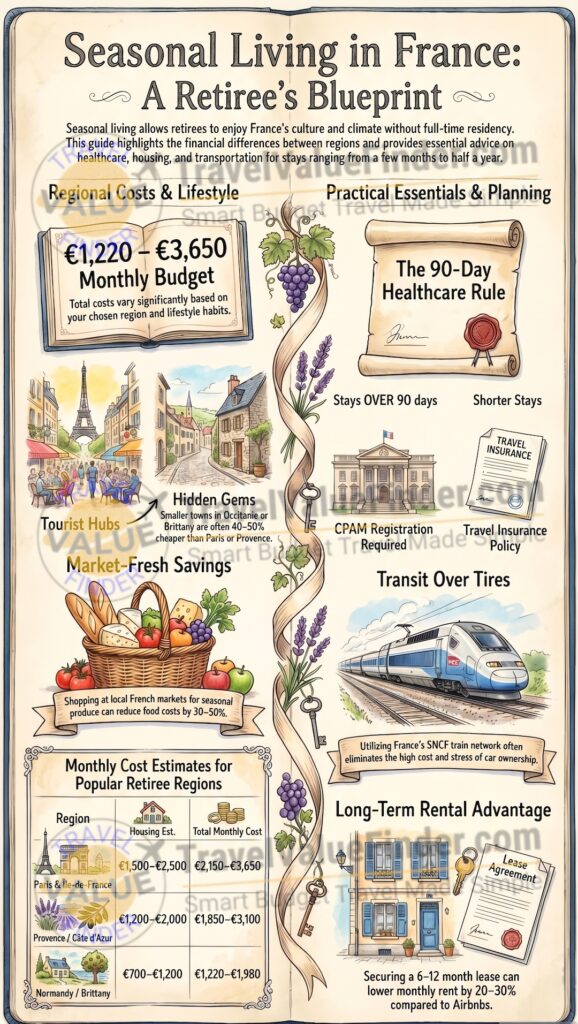
Many retirees structure a France stay around the 90 day Schengen limit for visa free visits. Rules and visa categories can change, so check official French and US government sources before setting your dates.
SNCF trains connect most regions well, and a car mainly helps in rural areas like the Dordogne. A local SIM or eSIM makes daily logistics simpler than relying on rental wifi.
Finding a rental built for a stay of months, rather than a hotel or a short term vacation rental, tends to make the biggest practical difference. Longer term listings usually include a real kitchen, which matters far more once market shopping becomes a daily habit rather than an occasional treat.
Is the south of France worth visiting outside summer?
Yes, and many long stayers prefer it. Spring and fall bring warm days with far fewer crowds.
Can you get by without a car in France?
In cities and larger towns, yes. Rural regions like the Dordogne benefit from one.
Is Paris a good base for an extended stay?
It can be, especially outside summer. Many retirees prefer pairing a Paris stretch with time in a quieter region.
How much does the weather shift between regions?
More than most visitors expect. The south can be twenty degrees warmer than Brittany on the same day, which is part of why the seasonal migration pattern exists in the first place.
How do French regions compare for a longer term base?
See our guide to best regions in France after 55 for how the major regions differ.
Where can I find more slow travel guides like this one?
Our Retirement Travel category covers more extended and slow travel guides across several countries.
Weather patterns come from Meteo France. Country and entry information comes from the US Department of State. Rail detail comes from SNCF, and tourism context from Atout France, the national tourism board.