Travel Value Finder


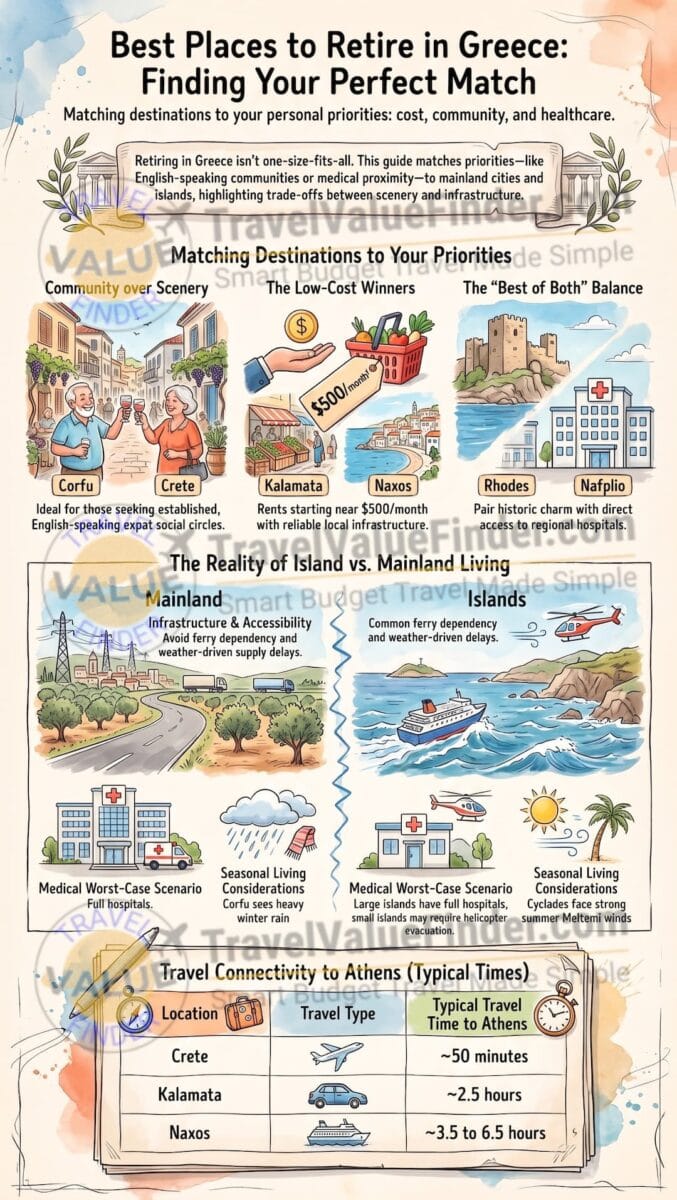
Choosing between mainland Greece and an island for retirement travel comes down to how much you value ease of movement versus scenery. The mainland offers simpler logistics and steadier weather. Islands offer the pace and views most people picture when they imagine Greece.
Neither is the objectively right answer. This guide lays out what each actually trades away, so the choice fits how you like to travel rather than how a place photographs.
Leslie Nics reporting for TravelValueFinder.com. Put together September 2026 from time spent in Athens, Crete, and the Cyclades.
Table of Contents
The Real Trade Off: Mainland or Island
This is a more useful split than any single ranked list, since the two options suit genuinely different travelers rather than one being objectively better.
| Factor | Mainland (Athens, Nafplio, Kalamata) | Island (Crete, Corfu, Rhodes, Naxos) |
| Getting around | Roads and rail, no ferry dependency | Ferries and flights, weather can disrupt plans |
| Pace | Closer to a small city rhythm | Slower, more seasonal, quieter in winter |
| Social scene | Mixed local and visitor | Established expat pockets on larger islands |
| Weather consistency | More stable, less wind exposure | Meltemi winds can disrupt summer ferry schedules |
Corfu and Crete: The Established Communities
Corfu carries one of Greece’s most established foreign retiree populations, built up over decades by British, German, and Italian arrivals. English speaking services and a real sense of community make it a forgiving first stop for travelers without Greek.
Roda and Agios Gordios are two of the most commonly recommended bases, both offering easy access to beaches and Corfu’s green, mountainous interior. The island’s north is dotted with fishing villages and turquoise bays, while the south leans quieter with sleepy villages and remote sandy beaches.
Crete plays a similar role at a larger scale. Rethymno and Chania both draw sizable international populations, and the island’s size means a quieter southern coastal town still sits within reach of that wider community.
Organized social groups run regular events specifically for long term foreign residents, giving newcomers an easy way in.
Kalamata and Naxos: Away From the Postcard Crowds
Kalamata, on the Peloponnese peninsula, rarely appears on typical Greece retirement lists because it does not photograph like Santorini. Its regional airport and mainland location make it easy to reach without a ferry.
It is increasingly mentioned alongside Athens and Thessaloniki as a serious option for travelers who want mainland ease without settling for a town with limited services. Its seasonal European flight connections add a real convenience most budget focused mainland towns lack.
Naxos, the largest of the Cyclades, offers a similar quieter alternative on the island side. It is bigger and less developed for tourism than its Cycladic neighbors, with one of the region’s more family friendly beaches and a strong local agricultural culture still visible in daily life.
Kalamata gets skipped by most retirement guides because it does not photograph like Santorini. That is exactly why I keep recommending it.” Leslie Nics, TravelValueFinder.com
Rhodes and Nafplio: Character With Convenience
Rhodes pairs a UNESCO listed medieval old town with over 300 days of sunshine a year and more than 220 kilometers of coastline. Rhodes Town offers the most going on, while Lindos and Archangelos give a quieter, lower key base on the same island.
On the mainland, Nafplio offers a similarly balanced profile: a genuinely friendly social scene in a walkable, historic waterfront town that never depends on a ferry schedule. Its neoclassical architecture and harbor front cafes give it a character closer to a small Italian coastal town than a typical Greek destination.
Evia and Paros: The Ones Fewer People Mention
Evia is the option almost nobody brings up, and it deserves more attention than it gets. Connected to the mainland by two bridges, it is Greece’s second largest island, sitting just fifty miles from Athens without feeling like a suburb of it.
Paros sits in an interesting middle position, delivering real Cycladic beauty and a multicultural, friendly community without Santorini or Mykonos level costs and crowds. Its smaller sister island Antiparos has quietly built a reputation of its own among longtime visitors.
Both islands reward travelers willing to look past the most photographed names in the Cyclades. Evia’s size means genuinely different regions within one island, from mountain villages to quiet beach towns, while Paros keeps a walkable, port town feel at its center that larger islands have largely lost to development.
What is the best Greek island to retire to for travel purposes?
It depends on priorities. Crete and Rhodes offer the most infrastructure, Corfu the most established community, and Naxos or Paros a quieter, more authentic pace.
Is it better to base in mainland Greece or on an island?
The mainland offers steadier logistics and weather. Islands trade some of that predictability for scenery and a slower pace.
Is Corfu a good choice without much Greek?
Yes. Corfu has one of Greece’s most established English speaking communities, built up over decades.
Is Naxos a good alternative to Santorini or Mykonos?
Yes, for travelers who want authenticity and a quieter pace over nightlife and name recognition. It is larger and considerably less crowded than either.
Does Rhodes get overcrowded with visitors?
Rhodes Town and Lindos see real seasonal tourism. The island is large enough that quieter residential areas stay available year round.
Is Kalamata well connected for regular travel?
Yes. It has its own airport with seasonal European connections and a growing reputation among both retirees and remote workers.
Where can I find more slow travel guides like this one?
Our Retirement Travel category covers more extended and slow travel guides across several countries.
Climate and Seasonality Across Regions
Guides that describe Greece as uniformly sunny miss real regional variation that matters for a longer stay, not just a vacation week.
The Cyclades, including Naxos and Paros, see strong Meltemi winds through summer, which can disrupt ferry schedules and outdoor plans for days at a stretch. Corfu, sitting in the Ionian rather than the Aegean, gets noticeably heavier winter rain than the Cyclades or Dodecanese, while Crete and Rhodes run milder and drier through more of the year.
None of this rules any region out. It is a reason to ask what a specific place is like in its worst weather month, not just its best one, before committing to a season there.
Smaller islands carry an additional seasonal consideration beyond weather: supply and service reliability. Naxos and Paros can see delays receiving packages during adverse weather or peak tourist season, when ferry capacity gets stretched thin by cargo and passenger demand competing for the same limited crossings.
Getting There and Back
For travelers planning to fly home regularly, connectivity is worth its own look rather than an afterthought.
| Place | Airport Access | Typical Travel Time to Athens |
| Rhodes | International airport, direct EU flights | About 1 hour by air |
| Crete | Two international airports (Heraklion, Chania) | About 50 minutes by air |
| Corfu | International airport, seasonal EU flights | About 1 hour by air, no direct ferry |
| Naxos | Regional airport to Athens | About 40 minutes by air, 3.5 to 6.5 hours by ferry |
| Kalamata | Regional airport, seasonal EU flights | About 2.5 hours by car or bus |
| Nafplio, Evia | No local airport, Athens airport by road | About 1.5 to 2 hours by car or bus |
The mainland options win decisively on predictability here, with no ferry dependency and no weather driven cancellations. That convenience is a real trade off against island scenery, worth weighing on its own rather than as a footnote.
For travelers who plan to fly home several times a year, that predictability compounds quickly. A canceled ferry during Meltemi season can turn a planned weekend trip into a multi day delay, something worth testing on a scouting visit before committing to an island base for the long term.
Sources
- Hellenic Statistical Authority (ELSTAT), regional population and infrastructure data
- Greek Ministry of Health, regional hospital and healthcare facility listings
- Greek National Tourism Organisation, regional connectivity and airport data