Travel Value Finder

Leslie Nics, TravelValueFinder.com | Last updated: September 2026 |
Seville is the kind of city that can make you rethink how you travel after retirement.
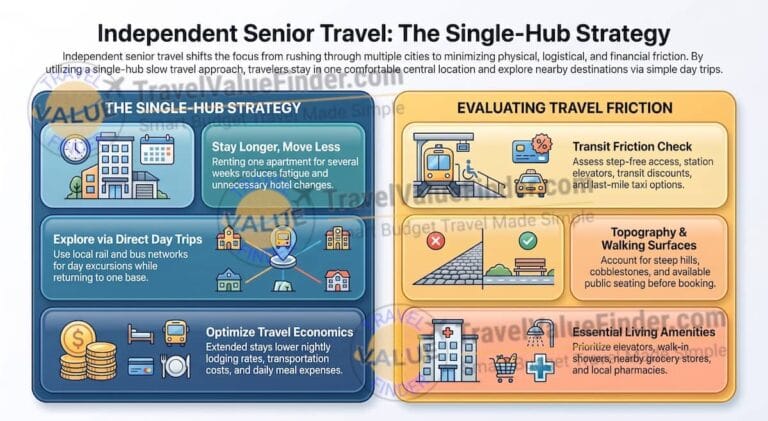
Instead of trying to combine Seville with several other Spanish cities in a fast-moving itinerary, consider using it as a single-hub base for several weeks.
Unpack once. Learn your neighborhood. Shop at the local market. Take the train when you want to explore. And come back to the same apartment at the end of the day.
For independent senior travelers, that can remove some of the unnecessary friction that comes with moving every few days.
This Travel Value Finder audit looks at Seville through the same framework described in our Senior Travel Guide: accommodation value, transportation, physical friction, last-mile options and regional day-trip potential.
The question isn’t whether Seville is a beautiful city. It obviously is.
The more useful question is:
Could Seville work as a comfortable 30-day base for independent senior travel?
Table of Contents
Why Seville Works as a Single-Hub Destination
Seville offers a historic center, restaurants and cafés, markets, cultural attractions, and access to regional transportation. That means you don’t have to fill every day with a major excursion.
Some days can simply be local days: walk a little, have lunch, visit a market, sit in a plaza, and return to your apartment.
Then take a regional day trip when you feel like exploring farther.
That rhythm is very different from a fast itinerary that tries to cover several Spanish cities in one continuous loop.
The 30-Day Seville Slow Travel Model
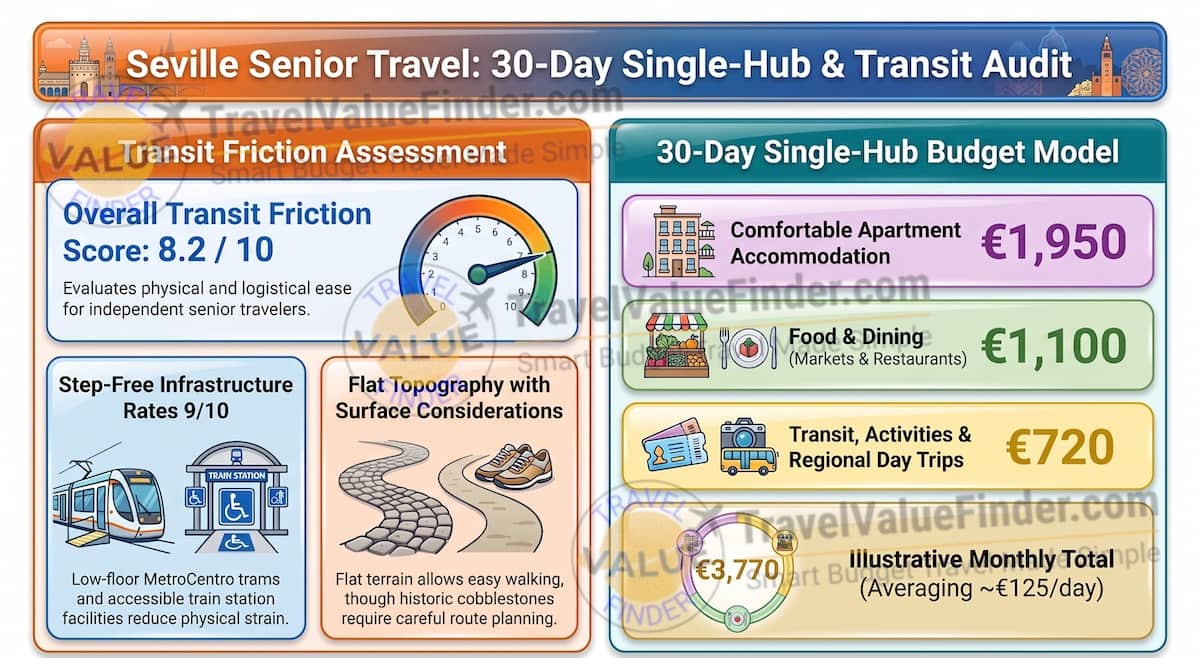
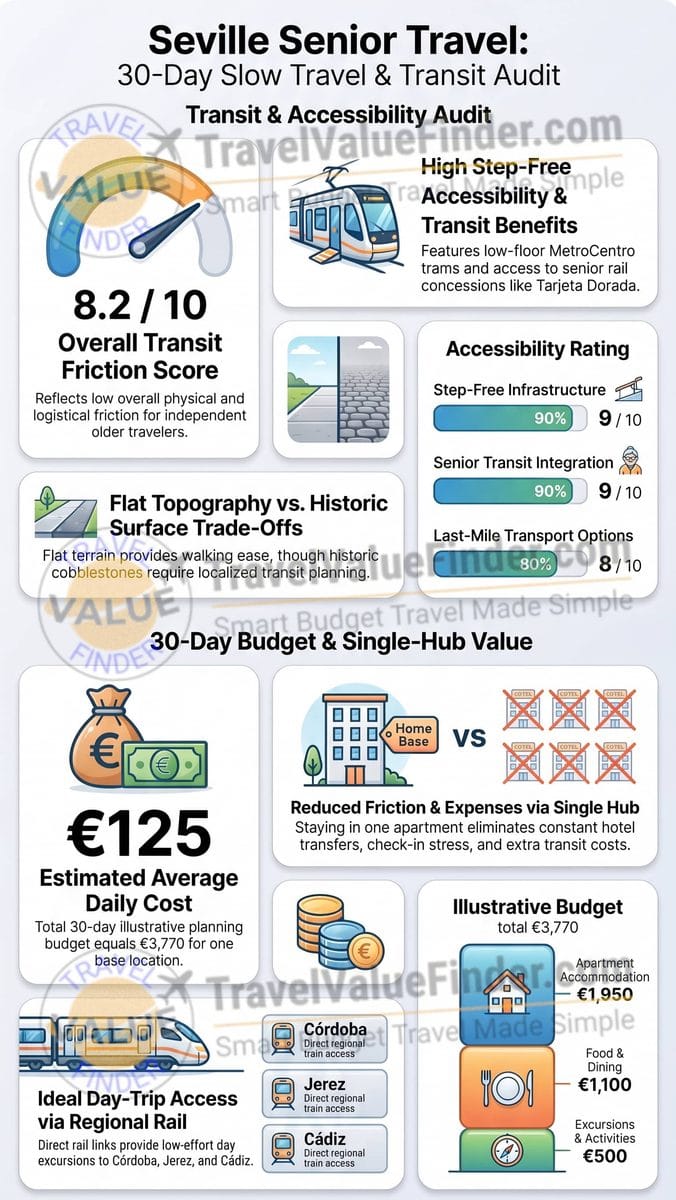
For planning purposes, a 30-day stay can be built around a comfortable apartment, local and rail transportation, food and dining, and activities or day trips.
| Comfortable apartment | €1,950 |
| Local & rail transportation | €220 |
| Food & dining | €1,100 |
| Activities & trips | €500 |
| Total | €3,770 |
| Approx. daily cost | €125 |
These figures are an illustrative planning budget, not a current universal price quote.
Accommodation prices vary by season and property, food spending depends on travel style, and rail costs vary by route and booking conditions.
The purpose of the model is to show how a longer single-base trip can be budgeted. Staying in one place can potentially reduce the costs and inconvenience associated with repeatedly changing accommodation.
Why Staying in One Place Can Change the Economics
Frequent movement creates costs that aren’t always obvious when planning a trip.
- Another hotel
- Another transfer
- Another check-in and check-out
- Luggage handling
- Another transportation ticket
- Lost sightseeing time
- More restaurant meals while traveling
With a single base, some of those costs disappear. You can also establish routines: breakfast at home, coffee around the corner, supermarket once or twice a week, and a restaurant when you feel like it.
That doesn’t guarantee a cheaper trip, but it can make the budget more controllable.
Seville Transit Friction Audit
The Travel Value Finder Senior Travel framework looks beyond the usual question of whether a city has public transportation. The more useful question is: How much physical and logistical friction does that transportation create for an independent older traveler?
Transit Friction Score: 8.2 / 10
| Step-Free Infrastructure | 9/10 |
| Topography & Surfaces | 7/10 |
| Last-Mile Options | 8/10 |
| Senior Transit Integration | 9/10 |
| Overall | 8.2/10 |
These scores are a Travel Value Finder planning framework, not an official accessibility certification.
The individual components are more useful than the headline number because they show where the city works well and where a traveler may need to plan around limitations.
1. Step-Free Infrastructure – 9/10
Seville’s low-floor MetroCentro tram and the transportation facilities at Santa Justa rail station can be useful for travelers concerned about stairs and station access.
For an independent senior traveler, these details matter. Check current station and service information before traveling because accessibility arrangements can change.
2. Topography & Surfaces – 7/10
Seville’s generally flat terrain can make a significant difference when walking around a city for several weeks.
But flat does not mean effortless. Historic areas can contain uneven surfaces and cobblestones.
Identify smoother primary routes and use taxis or public transportation when your legs need a break.
3. Last-Mile Options – 8/10
You may manage sightseeing well but suddenly find that you don’t want to walk another 20 minutes back to your accommodation. That’s when taxis and other local transportation options become important.
For a longer stay, knowing how to use local taxi and rideshare options can make the city feel more manageable.
4. Senior Transit Benefits – 9/10
Spain offers senior rail benefits for eligible travelers, including the Tarjeta Dorada. Because eligibility, pricing, and discount levels can change, check current official Renfe information before relying on a particular discount.
The broader lesson is simple: investigate destination-specific transportation concessions before booking a long stay.
Seville Walking: The Important Trade-Off
Seville can work well for travelers who enjoy walking, but you shouldn’t confuse ‘walkable’ with ‘walk everywhere.’
You might happily walk through the historic center in the morning. By late afternoon, a short taxi ride may be the smarter option.
The goal isn’t to prove how much you can walk. The goal is to have enough energy left to enjoy the evening.
Using Seville as a Regional Day-Trip Hub
A major advantage of the single-hub strategy is that your base doesn’t have to limit your travel.
Córdoba
A practical cultural day-trip candidate with fast rail connections.
Jerez de la Frontera
A different atmosphere associated with sherry and equestrian heritage.
Cádiz
A coastal alternative for a change of scenery.
Travel times and current train schedules should be checked before booking.
A Possible 30-Day Seville Rhythm
Week 1 – Settle In
Learn the neighborhood. Find the supermarket, pharmacy, favorite café, nearest transit stop, and local taxi or rideshare options. Then begin exploring.
Week 2 – Explore Seville
Mix major attractions with ordinary days. You don’t have to visit a major landmark every day.
Week 3 – Regional Exploration
Add day trips when you feel energetic: Córdoba, Jerez, Cádiz, or another destination that fits your interests.
Week 4 – Live Like a Local
Slow down. Return to places you enjoyed. Try restaurants outside the main tourist areas. Shop at local markets. Enjoy the city without constantly checking off attractions.
What to Look for in a Seville Long-Stay Apartment
- Elevator
- Comfortable bed
- Practical bathroom
- Walk-in shower where possible
- Kitchen
- Washing machine
- Air conditioning when needed
- Supermarket within easy reach
- Pharmacy nearby
- Public transportation nearby
- Relatively quiet sleeping area
An apartment that is cheaper but requires a long walk every time you return may not represent better value. For senior travel, convenience is part of the value calculation.
Where Seville May Not Work as Well
- Uneven surfaces in some areas
- Cobblestones
- Busy tourist areas
- Substantial walking if you try to see everything on foot
- Very hot weather during some periods of the year
This is why timing matters. A destination that feels comfortable in one season may feel very different during a period of extreme heat.
Who Is Seville Best Suited To?
- Senior travelers who enjoy historic cities
- Travelers who like walking but don’t need to walk everywhere
- People interested in cultural experiences
- Travelers who prefer apartments for longer stays
- People who enjoy food and markets
- Travelers who want access to regional rail
- Travelers who like one base rather than frequent hotel changes
- Independent travelers comfortable with planning
It may be less suitable for someone who wants a completely car-free rural retreat, a beach-focused vacation, or a destination with no uneven historic surfaces. The point of an audit is not to declare a city perfect. It is to identify the fit.
Seville Senior Travel: The Bottom Line
Seville illustrates why senior travel should not be judged simply by a list of attractions.
The more interesting question is whether the city allows you to build a comfortable rhythm around yourself.
- Stay in one apartment
- Walk when you want
- Use public transportation when it makes sense
- Take a taxi when you’re tired
- Take a train for a day trip
- Cook occasionally
- Eat out when you feel like it
- Leave enough empty space in the calendar to enjoy being there
That’s the single-hub approach to senior travel.
The Transit Friction framework gives Seville an overall planning score of 8.2/10, with particular strengths identified in step-free infrastructure and senior transportation benefits, while historic surfaces remain an important consideration.
For the broader strategy behind these audits, start with the Senior Travel Guide.
Frequently Asked Questions About Senior Travel in Seville
Is Seville good for senior travelers?
Seville can be a practical destination for independent senior travelers, particularly those who value a relatively flat city, cultural attractions and regional transportation. However, historic surfaces, walking distances and seasonal temperatures should be considered when planning a trip.
Is Seville easy to get around without a car?
The city has public transportation and taxi options, making a car unnecessary for many visitors. The appropriate choice depends on your accommodation, mobility and planned activities.
Can Seville work as a long-stay destination for seniors?
Yes, it can be considered as a long-stay base because the city offers accommodation, restaurants, markets, cultural attractions and access to regional destinations. Actual long-stay value depends on accommodation prices and season.
What are good day trips from Seville for senior travelers?
The original Travel Value Finder model highlights Córdoba, Jerez de la Frontera and Cádiz as potential day trips. Check current train schedules and accessibility information before traveling.
Is Seville very hilly?
Seville is generally flat, which can be helpful for travelers who prefer to minimize steep walking. Historic areas can nevertheless contain uneven surfaces and cobblestones.
What is the Seville Transit Friction Score?
The Travel Value Finder audit gives Seville an original score of 8.2/10 based on four planning categories: step-free infrastructure, topography and surfaces, last-mile options and senior transit integration. It is a Travel Value Finder planning framework rather than an official accessibility rating.
Is Seville suitable for slow travel?
Seville can work particularly well with a slow-travel approach because you can combine local sightseeing with occasional regional day trips instead of changing accommodation frequently.
Should seniors stay in a hotel or apartment in Seville?
For a short visit, either can work. For a longer stay, an apartment with a kitchen and laundry can provide additional convenience and flexibility. The best choice depends on budget, location and personal preferences.
Sources
- US Department of State, Spain Travel Advisory
- US Department of State, Personal Travel Needs