Travel Value Finder

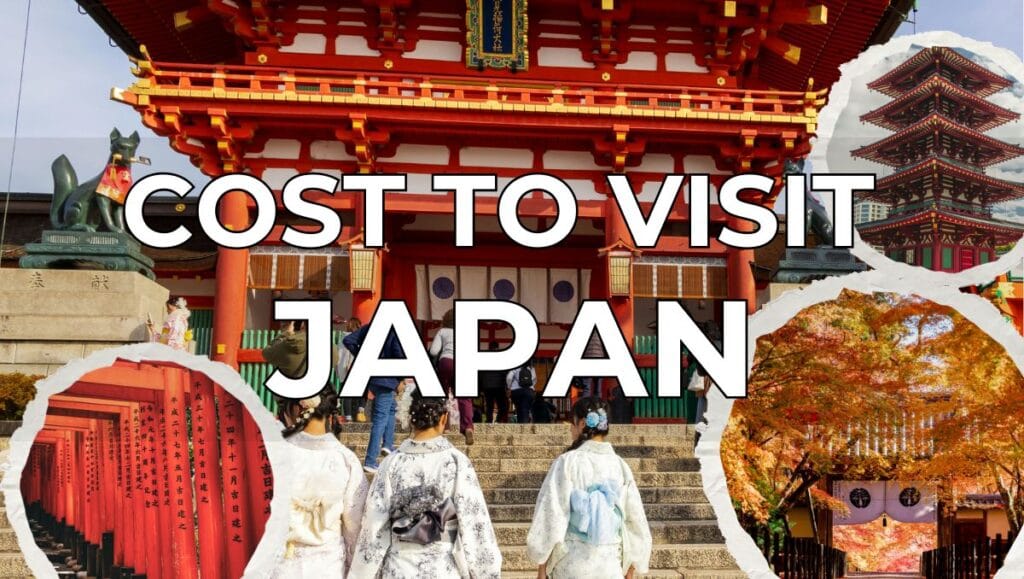
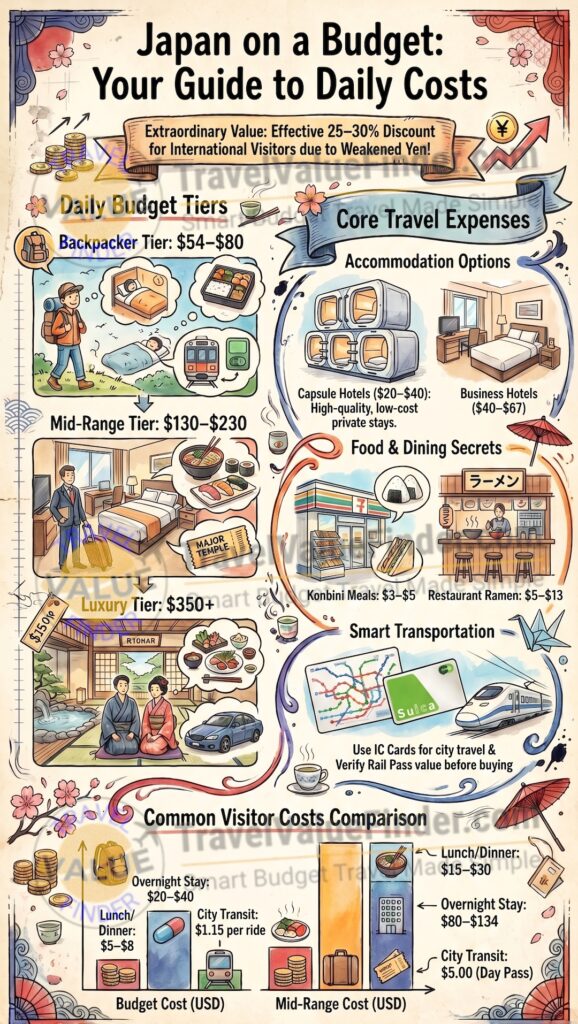
The cost to visit Japan per day ranges from roughly $54 for a backpacker to $350+ for luxury travelers. Most first-time visitors planning a comfortable trip should budget $130 – $230 per day on the ground, excluding flights.
Leslie Nics | TravelValueFinder.com | Updated September, 2026
Table of Contents
People Also Ask
Is Japan expensive to visit in 2026?
It sits in the middle of Asia’s price range, pricier than Vietnam or Cambodia, comparable to South Korea.
What is the cheapest month to visit Japan?
February and June, outside the rainy stretch, both offer the lowest flight and hotel prices.
Do I need cash in Japan?
Yes, some. Many small restaurants and shrines remain cash only, even as cards spread in major cities.
Cost to Visit Japan at a Glance: Quick Daily Budget Guide
Here is the short answer to the most important question about the cost to visit Japan in 2026:
| Budget Tier | Daily Cost | 7-Day Total | 14-Day Total | Typical Traveller Profile |
| Backpacker | $54 – $80 | $378 – $560 | $756 – $1,120 | Hostel/capsule, konbini meals, local trains |
| Budget | $80 – $130 | $560 – $910 | $1,120 – $1,820 | Budget hotel, mix of restaurants + konbini |
| Mid-Range | $130 – $230 | $910 – $1,610 | $1,820 – $3,220 | Business hotel, restaurants, paid attractions |
| Comfort | $230 – $349 | $1,610 – $2,440 | $3,220 – $4,890 | 4-star hotel or ryokan, fine dining |
| Luxury | $349 – $889+ | $2,440 – $6,200+ | $4,900 – $12,400+ | Luxury ryokan or 5-star, kaiseki, private tours |
Sources: Numbeo Japan cost index. All figures USD. Excludes international flights. Actual costs vary by city, season, and itinerary.
Why 2026 Is One of the Best Years for the Cost to Visit Japan
The single biggest factor changing the cost to visit Japan right now is the Japanese yen’s continued weakness against major currencies.
Here is what that means in practice:
| Category | Pre-Weak Yen (2019-2022) | Current 2026 (Weak Yen) |
| Budget hotel / night | ~$100 – $120 | ~$70 – $90 |
| Ramen bowl | ~$12 – $14 | ~$9 – $11 |
| Daily budget (mid-range) | ~$180 – $220 | ~$130 – $170 |
| 2-week trip total (excl. flights) | ~$2,500 – $3,500 | ~$1,820 – $2,600 |
| Effective saving for USD travellers | – | 25 – 30% cheaper than 4 years ago |
Important 2026 updates to factor into your budget:
- Tourist tax increase: Japan’s departure tax rose from ¥1,000 to ¥3,000 per person. Factor this into your outbound flight cost
- JR Pass price hike (October 2026): A further 5 – 6% increase on JR Pass prices is confirmed for October 1, 2026. Buy before this date if visiting after October. See the JR Pass section below for the full breakdown
- Tax-free shopping change: Starting November 1, 2026, tourists pay the full 10% consumption tax upfront and claim a refund at departure airports. Factor this into your shopping budget if you plan to buy electronics or goods over ¥5,000
- Himeji Castle dual pricing: Japan is beginning to implement higher entry prices for international vs. domestic visitors at some attractions. Himeji Castle introduced this from March 2026.
Flights to Japan: What to Budget
Flights are the biggest single cost when calculating the overall cost to visit Japan.
Here is what to expect in 2026:
| Departure Region | Budget Fare (return) | Typical Fare | Best Entry Airports |
| USA (East Coast) | $550 – $750 | $800 – $1,200 | Narita (NRT) or Haneda (HND) |
| USA (West Coast) | $450 – $650 | $700 – $1,000 | Haneda, Narita – shorter flight |
| Canada | $600 – $850 | $900 – $1,300 | Narita or Haneda |
| UK / Europe | £400 – £600 | £700 – £1,100 | Narita, Haneda, or Osaka KIX |
| Australia | $600 – $900 | $1,000 – $1,500 | All major Japanese airports |
- Book 2 – 4 months ahead for the best prices. Cherry blossom season (late March – April) and Golden Week (late April – early May) are peak pricing periods. Book much earlier for these dates
- February, June, and September – October (excluding Golden Week) offer the best flight deals to Japan
- Use Google Flights date grid to see the cheapest days across an entire month at a glance. Full guide: How to Find Cheap Flights: 12 Proven Strategies
Japan Accommodation Costs: From Capsule Hotels to Ryokans
Accommodation is one of the most variable parts of the cost to visit Japan.
Japan uniquely offers accommodation types found nowhere else on earth from ¥3,000-per-night capsule hotels to ¥50,000-per-night traditional ryokan inns.
Here is what to expect across the spectrum:
Japan Hotel and Accommodation Prices by Type (2026)
| Accommodation Type | Price Range / Night | What You Get |
| Hostel dorm | ¥3,000 – ¥5,500 ($20 – $37) | Clean dormitory beds; sociable common areas. Strong hostel scenes in Tokyo (Asakusa), Kyoto, and Osaka |
| Capsule hotel | ¥3,000 – ¥6,000 ($20 – $40) | Uniquely Japanese experience; private sleep pod, often excellent shared bathrooms and communal lounges |
| Budget business hotel | ¥6,000 – ¥10,000 ($40 – $67) | Clean, efficient private rooms. Chains like Toyoko Inn, Super Hotel, and APA Hotel offer excellent value |
| Mid-range hotel (3-star) | ¥12,000 – ¥20,000 ($80 – $134) | Comfortable rooms, often excellent breakfast options. Dormy Inn chain is a particularly reliable mid-range choice |
| Budget ryokan | ¥8,000 – ¥15,000 ($54 – $100) | Traditional Japanese inn with futon bedding and shared or private onsen baths – a must-do experience |
| Luxury ryokan | ¥30,000 – ¥80,000+ ($200 – $540+) | Full-board kaiseki dining, private onsen, immaculate service – Japan’s most memorable accommodation experience |
| 4 – 5 star hotel | ¥25,000 – ¥80,000+ ($165 – $540+) | International luxury chains plus Japan’s own exceptional hotel brands in major cities |
Money-Saving Accommodation Tips for Japan
- Book budget business hotels through Booking.com. Chain brands like Toyoko Inn and Super Hotel deliver excellent clean value from ¥5,500
- Tokyo’s Asakusa and Ueno neighbourhoods consistently offer better value accommodation than Shinjuku or Ginza for equivalent quality
- In Kyoto, consider staying in nearby Osaka. 15 minutes by bullet train and significantly cheaper, and day-tripping into Kyoto
- Peak pricing seasons: cherry blossom (late March – April), Golden Week (late April – early May), and autumn foliage (November). Book months ahead for these periods
- Compare all options through our partner: Search Japan Hotels – TravelValueFinder Deals
Japan Food Costs: What You Will Actually Spend
Food is where Japan genuinely surprises people.
The cost to visit Japan drops significantly when you realise that Japan has some of the world’s best food at some of its most democratic prices.
A bowl of ramen at a standing counter, a plate of sushi from a conveyor belt, a bento box from a konbini (convenience store) typically cost $5 – $15, and are extraordinary by any standard.
Japan Food and Drink Prices 2026 – Complete Price Guide
| Item | Budget Option | Mid-Range / Restaurant |
| Ramen (standing counter / local shop) | ¥700 – ¥1,200 ($5 – $8) | ¥1,200 – ¥2,000 ($8 – $13) |
| Sushi (conveyor belt / kaiten) | ¥1,000 – ¥2,000 ($7 – $13) | ¥3,000 – ¥8,000 ($20 – $54) |
| Set lunch (teishoku) | ¥800 – ¥1,200 ($5 – $8) | ¥1,500 – ¥2,500 ($10 – $17) |
| Tonkatsu (breaded pork cutlet) | ¥1,000 – ¥1,500 ($7 – $10) | ¥1,800 – ¥3,500 ($12 – $23) |
| Tempura set | ¥800 – ¥1,500 ($5 – $10) | ¥2,000 – ¥5,000 ($13 – $34) |
| Convenience store (konbini) meal | ¥450 – ¥800 ($3 – $5) | – |
| McDonalds / fast food | ¥600 – ¥900 ($4 – $6) | – |
| Takoyaki (octopus balls) | ¥400 – ¥800 ($3 – $5) | – |
| Beer (at an izakaya) | ¥400 – ¥600 ($3 – $4) | ¥600 – ¥900 ($4 – $6) |
| Green tea / matcha latte | ¥150 – ¥400 ($1 – $3) | ¥600 – ¥1,200 ($4 – $8) (café) |
| Kaiseki dinner (full experience) | – | ¥8,000 – ¥30,000+ ($54 – $200+) |
| Daily food budget | ¥2,000 – ¥3,500 ($14 – $23) | ¥4,500 – ¥8,000 ($30 – $54) |
Prices from japan-guide.com food cost research, and first-hand Japan research. April 2026 exchange rate approximately ¥149 = $1 USD.
Japan’s Secret Weapon: The Konbini
Japan’s convenience stores 7-Eleven, Lawson, and FamilyMart are genuinely extraordinary.
They sell freshly made onigiri (rice balls) for ¥130 – ¥200, hot noodle soups for ¥400, bento boxes for ¥450 – ¥700, excellent sandwiches, and remarkable pastries.
For budget travelers, one or two konbini meals per day, combined with one sit-down meal, is one of the most effective strategies to manage the cost to visit Japan without ever eating badly.
Japan Transport Costs: Trains, JR Pass and IC Cards
Transport is the most complex and often most misunderstood part of the cost to visit Japan.
Japan has the world’s best train system, and understanding it properly can save you hundreds of dollars, or cost you hundreds if you get it wrong.
The JR Pass: 2026 Honest Assessment
The Japan Rail Pass offers unlimited travel on most Japan Railways (JR) trains including most Shinkansen bullet trains for a set period.
However, following a 70% price increase in October 2023, and another 5 – 6% increase confirmed for October 1, 2026 the pass now requires careful calculation before buying.
| JR Pass Type | 2026 Price (¥ / USD approx.) | Worth It? |
| 7-day Ordinary | ¥50,000 (~$335) | Only if taking 3+ long-distance Shinkansen trips within 7 days (e.g. Tokyo – Kyoto – Hiroshima – back) |
| 14-day Ordinary | ¥80,000 (~$537) | Better value for multi-city itineraries covering Tokyo, Kyoto, Osaka, Hiroshima, and Fukuoka |
| 21-day Ordinary | ¥100,000 (~$671) | Good for extensive Japan travel including Hokkaido, Kyushu, and multiple regions |
| 7-day Green Car (1st class) | ¥70,000 (~$470) | Rarely worth the premium over Ordinary Car |
Key rules for the JR Pass in 2026:
- A simple Tokyo – Kyoto return costs ~¥27,940 in individual tickets. The 7-day pass costs ¥50,000. You need an extra ¥22,000+ in additional JR rides to break even. That requires a longer itinerary than just the Golden Route. Source: JR Pass 2026 analysis – tanuki-tabi-travel.com
- The Nozomi and Mizuho (fastest Shinkansen) now require a supplemental ticket even with a JR Pass (~¥4,960 per journey Tokyo – Kyoto). The Hikari is just 5 – 15 minutes slower and is fully covered. Use the Hikari instead
- Buy before October 1, 2026 if your trip falls after that date. A 5 – 6% price increase is confirmed. Source: Travel and Tour World – JR Pass 2026 price announcement
- Use the japan-guide.com JR Pass Calculator to check whether your specific itinerary justifies the pass before buying
IC Cards (Suica / PASMO): Every Visitor Needs One
Regardless of whether you buy a JR Pass, every visitor to Japan should get a Suica or PASMO IC card.
These are rechargeable smart cards that work on almost all trains, subways, buses, and even convenience stores and vending machines across Japan.
Load them with yen and tap to pay with no tickets, no queuing, and no confusion.
Japan City Transport Costs (2026)
| City / Transport | Fare | Notes |
| Tokyo Metro (single journey) | ¥170 – ¥320 ($1.15 – $2.15) | Day pass: ¥600 – ¥1,000. IC card is the best option for casual use |
| Osaka subway (single) | ¥190 – ¥360 ($1.28 – $2.42) | 1-day pass: ¥820. Most useful for Dotonbori and Namba area |
| Kyoto bus (single) | ¥230 ($1.55) | 1-day bus pass: ¥700. Kyoto’s bus network covers most temples |
| Narita Airport – Tokyo (Narita Express) | ¥3,070 ($21) | Fastest; book online for discounts |
| Narita Airport – Tokyo (Keisei Skyliner) | ¥2,570 ($17) | Slightly slower but cheaper than Narita Express |
| Haneda Airport – Tokyo (monorail/train) | ¥500 – ¥650 ($3.35 – $4.37) | Much cheaper than Narita transfers; choose Haneda if available |
| Tokyo – Kyoto (Hikari Shinkansen, 1-way) | ¥13,970 ($94) | 2h 30m journey; book on Smartex or JR website |
| Highway bus Tokyo – Osaka | ¥3,000 – ¥5,000 ($20 – $34) | 8 hours overnight; saves a night’s accommodation |
Japan Attraction and Activity Costs
Activities are where the cost to visit Japan can be kept very low or can spike dramatically depending on your choices.
Japan has hundreds of free shrines, temples, parks, and neighbourhoods alongside world-class paid experiences:
Japan Attraction Entry Prices 2026 – Reference Table
| Attraction | Adult Price | Free Option? | Booking Tip |
| Fushimi Inari Shrine, Kyoto | Free | Always free | Go before 7am or after 5pm to avoid crowds |
| Senso-ji Temple, Tokyo | Free | Always free | Nakamise shopping street at entrance |
| Meiji Shrine, Tokyo | Free | Always free | Peaceful forest walk; a Tokyo essential |
| Nara Deer Park | Free | Always free | Buy deer crackers (¥200) from vendors |
| Arashiyama Bamboo Grove | Free | Always free | Go at sunrise; deserted and magical |
| Himeji Castle | ¥1,000 – ¥3,600 ($7 – $24, dual pricing from 2026) | No | International visitors now pay higher rate from March 2026 |
| Osaka Castle | ¥600 ($4) | Grounds free | Tower interior has castle museum exhibit |
| Tokyo Tower observation | ¥1,200 ($8) | No | Main vs Top deck; Main deck is good value |
| Tokyo Skytree (Top floor) | ¥3,400 ($23) | No | Book online to guarantee entry |
| Hiroshima Peace Memorial Museum | ¥200 ($1.35) | No | One of the most important museums in the world |
| Universal Studios Japan (Osaka) | ¥8,600 – ¥10,900+ ($58 – $73+) | No | Prices vary by day; buy online |
| Mount Fuji area access | ¥2,000 ($13) + ¥2,000 conservation | No | Fee introduced 2024; buy at station or online |
| Tea ceremony experience | ¥1,500 – ¥3,000 ($10 – $20) | – | Book through GetYourGuide for best value |
Leslie Nics’s tip: Japan’s best experiences are disproportionately free.
- The Fushimi Inari shrine tunnel (with 10,000 vermillion torii gates),
- the Arashiyama bamboo grove at sunrise,
- the Nara deer park, Senso-ji in Asakusa, and
- the Meiji Shrine in Tokyo all cost nothing.
These are rank among Japan’s most memorable travel experiences. Build your itinerary around free sights first, then add a small number of paid experiences.
City-by-City Cost to Visit Japan: Daily Budget Comparison
The cost to visit Japan varies significantly between cities.
Tokyo is Japan’s most expensive major city; Kyushu and rural Japan are dramatically cheaper.
Here is a city-by-city comparison:
| City | Budget/day | Mid-Range/day | Expensive? | Why the Difference |
| Tokyo | $80 – $110 | $150 – $230 | Most expensive | Japan’s priciest city; central accommodation expensive |
| Kyoto | $70 – $100 | $130 – $210 | Expensive | Tourism premium; ryokan costs elevate the average |
| Osaka | $60 – $90 | $120 – $190 | Moderate | Best-value major city; food scene especially affordable |
| Hiroshima | $55 – $80 | $110 – $180 | Moderate | Manageable size; limited tourist premium |
| Nara | $55 – $80 | $100 – $170 | Affordable | Easy day trip from Osaka; stay costs optional |
| Fukuoka | $55 – $80 | $110 – $170 | Affordable | Underrated; excellent ramen and yatai street food |
| Sapporo | $55 – $85 | $110 – $180 | Affordable | Cold climate; great skiing and fresh seafood |
| Rural Japan / ryokan | $100 – $180 (incl. meals) | $200 – $500 | Varies widely | Ryokan prices include 2 meals; overall often good value |
Sample Japan Trip Budgets: 7 Days and 14 Days
To make the cost to visit Japan concrete, here are two complete worked trip budgets with real 2026 numbers:
7-Day Japan Trip: Budget Traveler (Tokyo + Kyoto Classic Route)
| Category | Estimated Cost | Notes |
| Return flights (from US West Coast) | $500 – $700 | Booked 10 – 12 weeks ahead |
| Accommodation (7 nights, capsule/budget) | $140 – $280 | $20 – $40/night average |
| Food (konbini + ramen + set lunches) | $98 – $161 | $14 – $23/day budget approach |
| Transport (IC card + Shinkansen × 1) | $90 – $130 | No JR Pass; individual tickets |
| Activities (free sights + 2 paid) | $30 – $60 | Mix of free shrines + 1 – 2 paid entries |
| Departure tourist tax | $20 | ¥3,000 per person |
| Miscellaneous (SIM/eSIM, tips, snacks) | $30 – $50 | Airalo Japan eSIM ~$10; extras |
| Total (7 days, excl. flights) | $408 – $681 | ~$58 – $97/day |
| Total (incl. flights from US) | $908 – $1,381 |
For shorter visit, find out more on Tokyo Travel 4 Days Budget Guide
Use our free Trip Planner to build a cost-optimized Japan day-by-day itinerary: Free Day-to-Day Trip Planner
Best Time to Visit Japan to Reduce the Cost
Timing your trip strategically has a dramatic impact on the cost to visit Japan, particularly for accommodation and flights:
| Season | Period | Accommodation Cost | Crowds | Highlights |
| Cherry blossom | Late Mar – Apr | Highest +25% | Extremely busy | Stunning sakura |
| Golden Week | Late Apr – Early May | Very high | Domestic crowds | Festive atmosphere |
| Summer | Jun – Aug | Moderate | Busy | Festivals, fireworks |
| Autumn foliage | November | High +20% | Very busy | Spectacular koyo |
| Shoulder | May, Sept – Oct | Moderate – good value | Manageable | Pleasant weather |
| Low season | Feb, Jun (rainy) | Lowest – best prices | Quiet | Snow, skiing (Feb) |
Leslie Nics’s recommendation: For the best balance of price and experience, visit in May (after Golden Week ends, around May 7) or September. Both offer good weather, manageable crowds, and accommodation prices well below the cherry blossom and autumn foliage peaks.
8 Tips to Reduce the Cost to Visit Japan
- Calculate your JR Pass math before buying: Use the japan-guide.com JR Pass Calculator with your specific itinerary. For Tokyo + Kyoto only, individual tickets are cheaper. For Tokyo + Kyoto + Hiroshima + Osaka in 7 days, the pass may pay off
- Eat at least one meal per day from a konbini: 7-Eleven, Lawson, and FamilyMart sell genuinely excellent food for ¥300 – ¥700 per meal. A konbini breakfast + one restaurant lunch + one restaurant dinner keeps food costs under $25
- Stay in budget business hotels over hostels for value: Toyoko Inn, Super Hotel, and APA Hotel chains deliver clean private rooms from ¥5,500 – ¥8,000 ($37 – $54). They are often better value than hostel private rooms
- Use Haneda Airport if at all possible: Airport transfer from Haneda to central Tokyo costs ¥500 – ¥650 vs. ¥2,570 – ¥3,070 from Narita; a saving of over $15 before you even arrive in the city
- Buy a Suica IC card on arrival and keep it loaded: Works on all city transport, convenience stores, and many vending machines. Eliminates fumbling for change and is slightly cheaper than individual tickets on some lines
- Avoid peak dates with iron discipline: Cherry blossom season (late March – April) and Golden Week (late April – early May) see accommodation prices spike 20 – 50% above normal. Even shifting by one week saves significantly
- Visit temples and shrines for free first : Japan’s most iconic experiences (Fushimi Inari, Senso-ji, Meiji Shrine, Arashiyama bamboo grove, Nara deer park) are all free. Spend your activity budget on unique paid experiences like a tea ceremony or onsen ryokan night
- Use highway buses for long overnight routes: Tokyo to Osaka by overnight highway bus costs ¥3,000 – ¥5,000 ($20 – $34) vs. ¥13,970 ($94) by Shinkansen. You travel overnight and save a night’s accommodation
Plan Your Japan Trip: Essential Resources on TravelValueFinder
Everything you need to plan and book your Japan trip:
- Japan Travel Guides: Everything You Need to Plan an Unforgettable Trip to Japan
- 25 Best Things to Do in Tokyo: The Ultimate Tokyo Bucket List for First-Timers & Return Visitors
- 25 Best Things to Do in Osaka: The Ultimate Osaka Bucket List: Food, Culture, Nightlife & Hidden Gems
Ready to book your Japan trip? Find the best flights and hotels through our partner: Search Japan Flights and Hotels – TravelValueFinder Deals.
Compare hundreds of providers for real-time prices. We earn a small commission at no extra cost to you – which helps keep all our guides completely free.
Frequently Asked Questions: Cost to Visit Japan
How much does a 2-week trip to Japan cost in 2026?
We estimate a 2-week (14-day) trip to Japan costs approximately $908 – $1,381 for a budget backpacker (including flights from the US) or $3,070 – $5,220 for a comfortable mid-range traveler.
Is Japan expensive to visit in 2026?
Japan is moderately priced. Not as cheap as Southeast Asia, but more affordable than the UK, Australia, or Scandinavia.
Is the Japan Rail Pass worth buying in 2026?
The JR Pass is worth buying in 2026 only if your itinerary includes at least 3 long-distance Shinkansen journeys within the pass validity period.
What is the cheapest month to visit Japan?
February and June offer the lowest prices for accommodation and flights.
How much cash should I bring to Japan?
Budget for ¥5,000 – ¥10,000 ($34 – $67) in cash per day as a baseline, in addition to card payments for hotels and larger purchases.
Do I need travel insurance for Japan?
Yes, travel insurance is essential for Japan. Medical treatment for foreigners in Japan can be very expensive without coverage. Japan also does not have emergency rooms in the same walk-in sense as some countries.
How does the cost to visit Japan compare to other Asian destinations?
Japan sits in the upper tier of Asian travel costs. It is significantly more expensive than Vietnam, Cambodia, or India; comparable to South Korea and Taiwan; and less expensive than Singapore or Hong Kong at the mid-range tier.
Final Thoughts: The Cost to Visit Japan Is Lower Than You Think
The cost to visit Japan is genuinely more accessible in 2026 than it has been in years. For American, European, and Australian travelers, the weak yen has essentially put Japan on sale.
The reputation for being expensive is outdated.
- A bowl of ramen at a standing counter costs $7.
- A clean hotel room with exceptional service costs $40.
- A bullet train that reaches 320km/h costs $94.
None of that is cheap, but all of it is extraordinary value. Check out the Travel Cost guide to more destinations.
Japan is waiting. Budget for it honestly, plan for it well, and book the trip.
Disclaimer: This article contains affiliate links. When you book through our hotel search, TravelValueFinder may earn a small commission at no extra cost to you. This helps keep the site free to use. We only recommend products and services we genuinely believe add value to your trip.