Travel Value Finder

The 25 best things to do in Tokyo include:
- visiting Shibuya Crossing,
- exploring Senso-ji Temple in Asakusa,
- strolling through Shinjuku Gyoen garden,
- climbing Tokyo Skytree,
- eating your way through Tsukiji Outer Market,
- experiencing teamLab’s immersive digital art,
- wandering Akihabara’s anime,
- tech district, and
- taking day trips to Nikko, Kamakura, or Hakone.
Tokyo offers world-class experiences across culture, food, nightlife, art, and nature for every budget.
Leslie Nics, TravelValueFinder.com | Last updated: September 2026.
Table of Contents
Why Tokyo Is Unlike Any City on Earth
Tokyo is the kind of city that completely rewires your expectations of what a metropolis can be.
- It’s home to over 13 million people yet somehow feels clean, quiet, and effortlessly efficient.
- It has more Michelin-starred restaurants than any other city in the world.
- Its convenience stores sell food that beats most sit-down restaurants anywhere else.
- And its neighborhoods, from the neon chaos of Akihabara to the serene stone paths of Yanaka feel like entirely different cities within a city.
And when you’re ready to book a place to stay, compare hundreds of Tokyo hotels in one search: Find the best Tokyo hotel deals here.
Tokyo’s 25 Best Activities at a Glance
Here’s your quick-reference overview of all 25 experiences covered in this guide:
| # | Activity | Area | Approx. Cost |
| 1 | Shibuya Crossing & Scramble | Shibuya | Free |
| 2 | Senso-ji Temple, Asakusa | Asakusa | Free |
| 3 | Shinjuku Gyoen Garden | Shinjuku | ¥500 |
| 4 | Tokyo Skytree | Asakusa | ¥2,100+ |
| 5 | Tsukiji Outer Market Food Tour | Tsukiji | Cost of food |
| 6 | teamLab Borderless / Planets | Odaiba / Toyosu | ¥3,200+ |
| 7 | Akihabara Electronics & Anime | Akihabara | Free to browse |
| 8 | Meiji Shrine | Harajuku | Free |
| 9 | Harajuku & Takeshita Street | Harajuku | Free |
| 10 | Tokyo National Museum | Ueno | ¥1,000 |
| 11 | Ueno Park & Ueno Zoo | Ueno | Free / ¥600 zoo |
| 12 | Odaiba & teamLab Planets | Odaiba | ¥3,200+ |
| 13 | Nakameguro Canal Walk | Nakameguro | Free |
| 14 | Yoyogi Park Picnic | Harajuku | Free |
| 15 | Sumo Tournament (Jan/May/Sep) | Ryogoku | ¥2,200+ |
| 16 | Kabuki-za Theatre | Ginza | From ¥1,000 |
| 17 | Tokyo Tower Night View | Shiba | ¥1,200 |
| 18 | Roppongi Art Museums | Roppongi | ¥1,500+ |
| 19 | Shimokitazawa Vintage Shopping | Shimokitazawa | Free to browse |
| 20 | Yanaka Old Town District | Yanaka | Free |
| 21 | Koenji Street Art & Thrift | Koenji | Free |
| 22 | Day Trip to Nikko | Nikko (day trip) | ¥4,400 entry+ |
| 23 | Day Trip to Kamakura | Kamakura (day trip) | ¥200+ |
| 24 | Day Trip to Hakone & Mt Fuji | Hakone (day trip) | ¥1,800+ |
| 25 | Robot Restaurant Show | Shinjuku | ¥8,000+ |
Part 1: Tokyo’s Iconic Must-See Sights
Tokyo is a dynamic blend of tradition and modernity, offering unforgettable landmarks that showcase the city’s unique character.
1. Shibuya Crossing: Tokyo’s Heartbeat
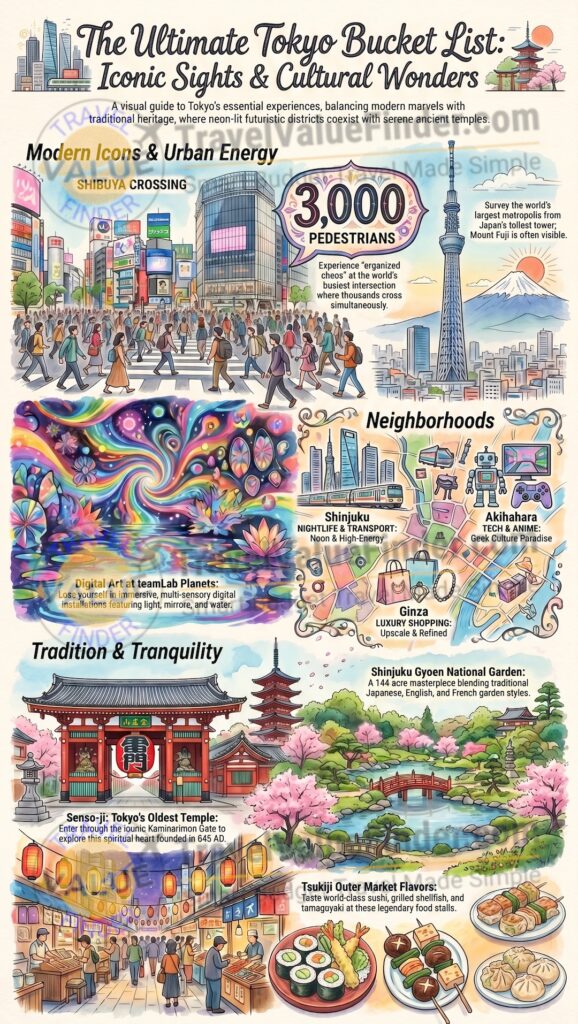
If there’s one image that defines Tokyo, it’s Shibuya Crossing.
Up to 3,000 people cross simultaneously when the lights change, flowing together in all directions before seamlessly reorganizing on the other side.
It’s organized chaos at its most beautiful. Stand on the upper floor of the Starbucks or the Mag’s Park viewing deck to see it from above the view from street level is equally thrilling.
Insider tip: Visit both during peak daytime and again at night. The crossing transforms completely under neon lights.
Getting there: Shibuya Station (multiple lines). Free to enjoy anytime.
2. Senso-ji Temple, Asakusa: Tokyo’s Spiritual Heart
Tokyo’s oldest temple dates back to 645 AD and remains one of the most visited religious sites in the world.
Walk through the iconic Kaminarimon (Thunder Gate) with its giant red lantern, and browse the Nakamise shopping street for traditional souvenirs.
Find a quiet moment inside the main hall even on a busy day. There’s something genuinely peaceful about the place.
Best time to visit: Early morning (before 8am) to experience the temple with few crowds, and a completely different serene atmosphere.
Nearby: Asakusa is a great base for exploring the area. The Sumida River, Tokyo Skytree, and Nakamise Street are all walkable from here.
3. Shinjuku Gyoen: The City’s Most Beautiful Garden
In a city of concrete and glass, Shinjuku Gyoen is a masterpiece of calm.
This massive national garden blends French formal gardens, English landscape gardens, and traditional Japanese gardens. All within a 15-minute walk of Shinjuku Station.
It’s glorious year-round, but absolutely world-class during cherry blossom season in late March/early April and autumn foliage season in November.
Cost: ¥500 adults. Closed Mondays. No alcohol permitted. A blessing that keeps the atmosphere peaceful.
4. Tokyo Skytree: The View That Puts Everything in Context
At 634 meters, Tokyo Skytree is the tallest tower in Japan and the tallest in the world by certain measures.
From the observation decks at 350m and 450m, the scale of Tokyo becomes viscerally real. On a clear day, you can see Mount Fuji rising on the horizon.
It’s one of the best things to do in Tokyo for first-time visitors who want to understand the city’s sheer size.
Tip: Book tickets online in advance to skip the queue. Best views are on a clear winter day or just before sunset.
Part 2: Food Experiences You Can’t Miss
Japan is a paradise for food lovers, offering unforgettable culinary experiences at every turn.
From fresh seafood and street bites at Tsukiji Outer Market, to slurping rich and flavorful ramen tailored to every palate, these experiences showcase the heart of Japanese food culture.
Honestly, some of my best Tokyo meals weren’t at restaurants at all. They were from 7-Eleven. Japan’s convenience stores completely reset my understanding of what ‘convenience food’ can mean. Leslie Nics, TravelValueFinder.com
5. Tsukiji Outer Market: The World’s Best Food Market
Dozens of stalls sell incredibly fresh sushi, tamagoyaki (egg omelette), grilled shellfish, matcha soft-serve, and street snacks. Arrive hungry and bring cash.
Leslie Nics’s picks: Fresh uni (sea urchin) on rice, warm tamagoyaki from Marutake, and a tuna sashimi set from any of the tiny sushi counters tucked into the market lanes.
6. Ramen: Finding Your Perfect Bowl
Tokyo ramen is its own category. This is typically a soy-based (shoyu) broth, clear but deeply flavored with thin noodles and simple but precise toppings.
The city has hundreds of excellent ramen shops, ranging from no-frills counter seats to serious destinations with hour-long queues.
Where to start: Ichiran (chain but genuinely excellent), Fuunji in Shinjuku for tsukemen (dipping noodles), or Afuri in Harajuku for lighter yuzu-flavored broth.
7. An Izakaya Night: Japanese Pub Culture at Its Best
An izakaya is a Japanese gastropub. It is casual, noisy, warm, and built around sharing small plates and drinks with friends.
It’s how Tokyo locals actually socialize. Order edamame, yakitori (grilled skewers), karaage (Japanese fried chicken), and cold Sapporo beer. The experience is as much about the atmosphere as the food.
Great areas: Shinjuku’s Golden Gai (tiny atmospheric bars seating 6 – 8 people), Nakameguro, or any of the alleys around Yurakucho Station.
Part 3: Arts, Culture & Only-in-Tokyo Experiences
Tokyo offers a rich blend of traditional heritage and cutting-edge creativity, making it a cultural powerhouse unlike any other city.
8. Meiji Shrine: Serenity Inside the City
Tucked inside a dense forested park in the middle of Harajuku, Meiji Shrine is one of Tokyo’s most tranquil escapes.
Dedicated to Emperor Meiji and Empress Shoken, the shrine draws millions of visitors but somehow absorbs them all into the calm of its wooded pathways.
Visit in the morning when the light filters through the trees and the crowds are thinnest.
9. teamLab Borderless / teamLab Planets – Digital Art That Changes You
teamLab’s immersive digital art installations have become among the most talked-about cultural experiences in Asia.
teamLab Planets in Toyosu is particularly extraordinary. You wade through water, walk through mirror rooms, and lose yourself in endlessly looping digital flowers and light.
It’s one of the best things to do in Tokyo for photographers, art lovers, and honestly anyone.
Book in advance: Tickets sell out weeks ahead, especially on weekends. teamLab Borderless reopened in a new location in Azabudai Hills in 2024.
10. Tokyo National Museum, Ueno
Japan’s oldest and largest museum contains over 110,000 works spanning Japanese art, archaeology, and history.
In here, you’ll find samurai armor and ancient pottery to stunning Buddhist sculpture and delicate ukiyo-e woodblock prints.
The main building alone is worth an afternoon. The surrounding Ueno Park is also home to several other excellent museums and the popular Ueno Zoo.
11. Kabuki-za Theatre, Ginza: Traditional Japanese Drama
Kabuki is Japan’s most theatrical art form with elaborate costumes, dramatic makeup, stylized movement, and storylines spanning samurai epics to ghost stories.
The Kabuki-za in Ginza is the premier venue, and you don’t need to commit to a full performance. A single-act tickets let you experience one scene from as little as ¥1,000.
12. Sumo Tournament: Japan’s National Sport
If your trip overlaps with one of Tokyo’s three annual Grand Sumo Tournaments (January, May, September at Ryogoku Kokugikan), attending a day of matches is one of the most culturally immersive things to do in Tokyo.
The ritual, pageantry, and raw physicality of the matches is mesmerizing even for those who’ve never watched sumo before.
Tip: Arrive early for the lower-division bouts when the arena is quieter and you can appreciate the ceremony. The stadium fills as the top-division matches approach in the afternoon.
Part 4: Tokyo Neighborhoods Worth Exploring
Tokyo is made up of diverse neighborhoods, each offering its own unique atmosphere and charm.
13. Akihabara: The World Capital of Anime & Electronics
Even if you’re not a manga or anime fan, Akihabara is a genuinely remarkable place.
There are multi-story buildings devoted entirely to electronics, video games, trading cards, and figurines.
The neon, the density, and the sheer enthusiasm of the fans who pilgrim here from around the world make it unmissable. For anime lovers, it’s simply paradise.
14. Harajuku & Takeshita Street
Takeshita Street is a narrow lane packed with the most extravagant youth fashion in the world. You’ll find rainbow crepes, platform shoes, gothic lolita dresses, and everything in between.
A 10-minute walk away, Omotesando is Tokyo’s version of the Champs-Élysées; elegant, tree-lined, and lined with flagship stores from every major international brand.
15. Nakameguro Canal: Tokyo’s Most Romantic Walk
The Meguro River is lined with cherry trees that erupt in pink every spring, making it one of Tokyo’s most photographed locations during sakura season.
But even outside blossom time, Nakameguro is one of the city’s most pleasant neighborhoods with independent coffee shops, vinyl record stores, small galleries, and excellent restaurants fill the streets along the canal.
Nakameguro during cherry blossom season is one of the most beautiful urban scenes I’ve ever experienced. Leslie Nics, TravelValueFinder.com
16. Yanaka: Old Tokyo That Time Forgot
Yanaka is the rare Tokyo neighborhood. It survived both the 1923 earthquake and World War II bombings largely intact, preserving the feel of old shitamachi (downtown) Tokyo.
Its winding lanes are lined with traditional wooden houses, family-run shotengai (covered shopping streets), independent artisan shops, and one of the city’s most atmospheric cemeteries.
It’s the quieter, slower Tokyo, and deeply worth your time.
17. Shimokitazawa: Vintage, Vinyl & Village Vibes
Beloved by Tokyo’s creative class, Shimokitazawa is a maze of second-hand clothing shops, live music venues, tiny jazz bars, independent bookshops, and excellent coffee.
It has a relaxed, bohemian energy completely unlike the slick commercial neighborhoods of central Tokyo.
Spend an afternoon here and you’ll understand why locals consider it the city’s most liveable neighborhood.
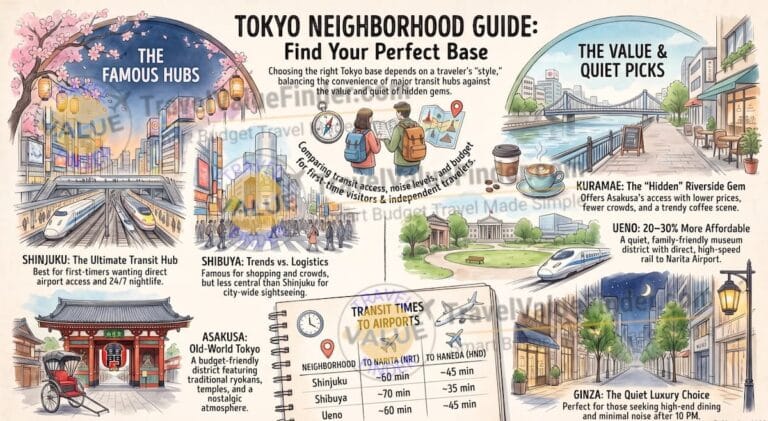
Tokyo Neighborhood Guide At a Glance
Not sure which area to base yourself or spend an afternoon? Here’s a quick breakdown:
| Neighborhood | Best For | Watch Out For |
| Shinjuku | Shopping, nightlife, parks, easy transport hub | Crowds, noise |
| Shibuya | Trendy, great food, famous crossing, youth culture | Expensive, busy |
| Asakusa | Traditional atmosphere, temples, crafts, street food | Touristy in peak hours |
| Akihabara | Anime, tech, gaming, quirky cafes | Very niche; can overwhelm |
| Ginza | Luxury shopping, fine dining, art galleries | Pricey |
| Harajuku | Fashion, shrines, crepe stands, streetwear | Can be crowded on weekends |
| Roppongi | International dining, nightlife, world-class art museums | Expensive; rowdy at night |
| Yanaka | Quiet old-town feel, independent shops, cemeteries | Few big attractions |
See also: Best Hotels in Tokyo: Where to Stay for Every Traveler
Part 5: Best Day Trips from Tokyo
Tokyo’s location is actually one of its greatest travel advantages. Within two hours you can be watching deer bow at you in Nikko, walking along a beach in Kamakura, or staring up at Mount Fuji from a lakeside village. Leslie Nics, TravelValueFinder.com
18. Day Trip to Nikko: Temples, Waterfalls & Mountain Air
Nikko is arguably the most spectacular collection of shrines and temples in Japan, set deep in forested mountains 2 hours north of Tokyo.
The Tosho-gu Shrine complex with its intricate carvings, gold lacquer, and famous ‘see no evil’ monkeys is a UNESCO World Heritage Site.
The surrounding national park offers stunning waterfalls and mountain scenery.
Getting there: The Nikko Limited Express from Asakusa Station (about 2 hours, ¥2,720). Book a JR Pass if combining with other day trips.
19. Day Trip to Kamakura: Coastal Buddha & Zen Temples
Kamakura is a seaside town 1 hour from Tokyo, home to the famous 13-meter bronze Great Buddha (Kotoku-in), dozens of Zen temples, and excellent beach culture.
Walk the Daibutsu Hiking Course between temples through forested hills, then end the day with fresh seafood at the harbor.
Getting there: JR Yokosuka Line from Tokyo Station (about 1 hour, ¥920).
20. Day Trip to Hakone & Mount Fuji
Hakone is the classic base for viewing Mount Fuji, and it doubles as one of Japan’s premier onsen resort areas.
Take the circular route via the Hakone Open-Air Museum, Lake Ashi ropeway, and a boat cruise for the full experience.
On a clear day, the views of Fuji are breathtaking. Stay overnight at a ryokan to transform it from a day trip into a highlight of your entire Japan trip.
Find and compare Hakone ryokan and hotels: Search here.
Part 6: Shopping in Tokyo: From Markets to Luxury
Tokyo is a shopper’s paradise, offering everything from bustling street markets to world-class luxury boutiques.
From the lively bargains at:
- Ameya-Yokocho Market in Ueno,
- to cutting-edge electronics and anime merchandise in Akihabara, and
- high-end fashion and flagship stores in Ginza,
each destination delivers a unique shopping experience.
Read below for details on what to expect in each area.
21. Ameya-Yokocho Market, Ueno: Street Market Energy
“Ameyoko” is a bustling open-air market under the elevated JR train tracks near Ueno Station. There are many stalls selling everything from fresh fish and dried nuts to sneakers, cosmetics, and military surplus gear.
It’s vibrant, cheap, and gives a wonderful glimpse into everyday Tokyo shopping culture.
22. Akihabara for Electronics & Anime Merchandise
Whether you’re hunting for rare vintage video games, the latest tech gadgets at Japanese retail prices, or officially licensed anime merchandise, Akihabara has no equal.
Multi-story stores like Yodobashi Camera and Sofmap offer incredible variety. For figurines and collectibles, explore the smaller specialist shops on the side streets.
23. Ginza: Tokyo’s Luxury Shopping District
Ginza is Tokyo’s answer to Milan’s Via Montenapoleone.
It is the most expensive real estate in Japan, lined with every major luxury brand from Chanel to Hermès alongside Japanese department store giants like Mitsukoshi and Matsuya.
Even if you’re not shopping, the architecture, the people-watching, and the quiet café culture of Ginza are worth experiencing.
Part 7: Unique Tokyo Experiences
Tokyo offers unforgettable experiences that go beyond traditional sightseeing, blending relaxation, entertainment, and vibrant city life.
24. Onsen Experience: Even in the City
Tokyo has several excellent public bathhouses (sento) and urban onsen facilities where you can experience Japanese bathing culture without leaving the city.
- Thermae-Yu in Shinjuku is a full-facility onsen spa using natural hot spring water, open late into the night.
- Oedo Onsen Monogatari in Odaiba (currently being renovated as of 2026; check status before visiting) was a popular option in a traditional festival-market setting.
Remember: Most onsen facilities prohibit visible tattoos. Always check the policy before visiting.
25. Robot Restaurant, Shinjuku: Pure Tokyo Absurdity
The Robot Restaurant is not subtle, not cheap (around ¥8,000+), and not even really a restaurant in any traditional sense.
It’s a multi-act spectacle of giant robots, dancers, LED everything, and pure sensory overload.
It’s unabashedly kitsch. But it’s also genuinely spectacular, and a reminder that Tokyo can do absurdist entertainment better than anyone on earth. Worth it for the sheer audacity of the experience.
The Robot Restaurant is the travel equivalent of eating a deep-fried dessert at a state fair. You know it’s completely ridiculous, and yet somehow it’s exactly right. Tokyo earns the right to be that audacious. Leslie Nics, TravelValueFinder.com
Practical Tips for Visiting Tokyo
Leslie Nics’s Top Tokyo Practical Tips:
- IC Card first: Get a Suica or Pasmo IC card at the airport immediately. Tap in, tap out. It works on every train, bus, and even at convenience stores and vending machines.
- Google Maps is your best friend: Japan’s train system is complex but Google Maps handles it perfectly. Always check the last train time, they stop around midnight.
- Cash still matters: Many smaller restaurants, izakayas, and traditional shops are still cash only. Withdraw from 7-Eleven or Japan Post ATMs for reliable foreign card acceptance.
- Queue at stations: Follow the marked lines on train platforms. Always let people exit before you board.
- Shoes you can slip on/off: You’ll remove your shoes constantly at ryokan, traditional restaurants, and some museums.
- Download Hyperdia or Google Maps offline: For navigation when your data is slow or absent.
- Book popular attractions in advance: teamLab, Robot Restaurant, popular ramen shops, and hotels during cherry blossom season all benefit from pre-booking.
How Much Does a Day in Tokyo Cost?
Tokyo can be as cheap or as expensive as you want it to be.
Here’s a realistic daily budget breakdown:
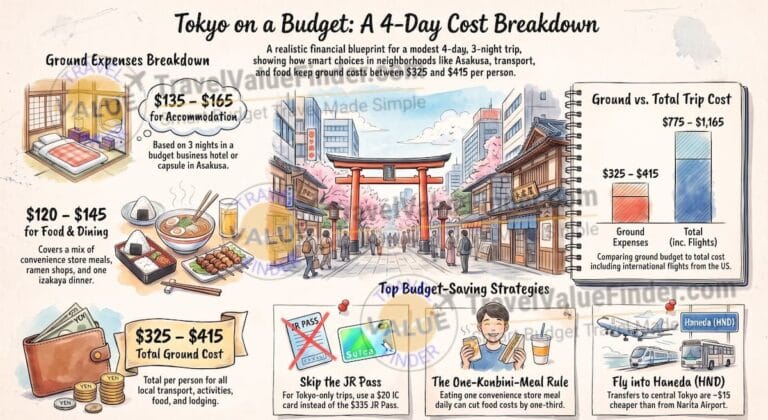
- Budget day (¥5,000 – ¥8,000): Convenience store breakfast, ramen lunch, cheap izakaya dinner, all travel by IC card, free sights like Meiji Shrine and Shibuya Crossing
- Mid-range day (¥12,000 – ¥20,000): Sit-down breakfast, sushi lunch, museum entry, nice izakaya dinner with drinks
- Splurge day (¥30,000+): Omakase sushi, teamLab tickets, Tokyo Skytree, nice cocktail bar in Ginza or Roppongi
Find out more about my 4-day budget in Travel to Tokyo
Related Guides from TravelValueFinder
Planning your wider Japan trip? These guides will help:
- 25 Best Things to Do in Tokyo: The Ultimate Guide
- The Tokyo Neighborhood Every Guide Skips (And Why I’d Stay There Twice)
- How Much Does It Cost to Visit Japan? What to Budget Per Day
- 25 Best Things to Do in Osaka: The Ultimate Osaka Bucket List: Food, Culture, Nightlife & Hidden Gems
- Best Hotels in Tokyo: Where to Stay for Every Traveler
- Best Hotels in Osaka: Top Picks for Every Budget
- Japan Travel Guide 2026: Everything You Need to Plan Your Trip
Trusted External Resources
For official and up-to-date Tokyo and Japan travel information:
- Japan National Tourism Organization (JNTO) – Official travel planning resource
- japan-guide.com – In-depth Tokyo travel information
- Go Tokyo – Tokyo Metropolitan Government’s official visitor guide
- teamLab Planets – Official booking page
Frequently Asked Questions – Things to Do in Tokyo
How many days do I need in Tokyo?
Most first-time visitors spend 3 – 5 days in Tokyo, which covers the main highlights.
What is the #1 thing to do in Tokyo?
Most visitors would say Shibuya Crossing or Senso-ji Temple in Asakusa as their headline experience.
Is Tokyo safe for solo travelers?
Tokyo is one of the safest cities in the world for solo travelers, including women traveling alone. Violent crime is extremely rare. The transport system is reliable and well-lit, and even navigating without much Japanese is easy due to extensive English signage and helpful locals.
What is the best area to stay in Tokyo?
Shinjuku offers the best transport connections and a huge range of hotels across all price points. Asakusa is ideal if you want traditional atmosphere. Shibuya is great for shopping and nightlife.
What should I not miss in Tokyo as a first-timer?
The non-negotiables for first-timers: Shibuya Crossing (day and night), Senso-ji Temple at sunrise, at least one proper ramen shop, a night in Shinjuku’s Golden Gai or an izakaya, the view from Tokyo Skytree on a clear day, and an early morning visit to Tsukiji Outer Market. Everything else builds on these foundations.
Can I visit Tokyo on a budget?
Absolutely. Many of Tokyo’s greatest experiences are free; Meiji Shrine, Shibuya Crossing, Shinjuku’s night streets, Nakameguro canal, Yanaka’s old lanes, Ueno Park.
What is the best time to visit Tokyo?
Spring (late March – early May) for cherry blossoms, and autumn (October – November) for fall foliage are the two most spectacular seasons.
Do I need to speak Japanese to visit Tokyo?
Not at all. English signage is excellent throughout the transport system and most tourist areas.
Ready to Book Your Tokyo Stay?
Compare hundreds of Tokyo hotels from budget capsule hotels to luxury city views, and book the best available rate.
Search & Compare Tokyo Hotels – Best Prices Guaranteed
Disclaimer: This article contains affiliate links. When you book through our hotel search, TravelValueFinder may earn a small commission at no extra cost to you. This helps keep the site free. We only recommend products and services we genuinely believe add value to your trip.