Travel Value Finder

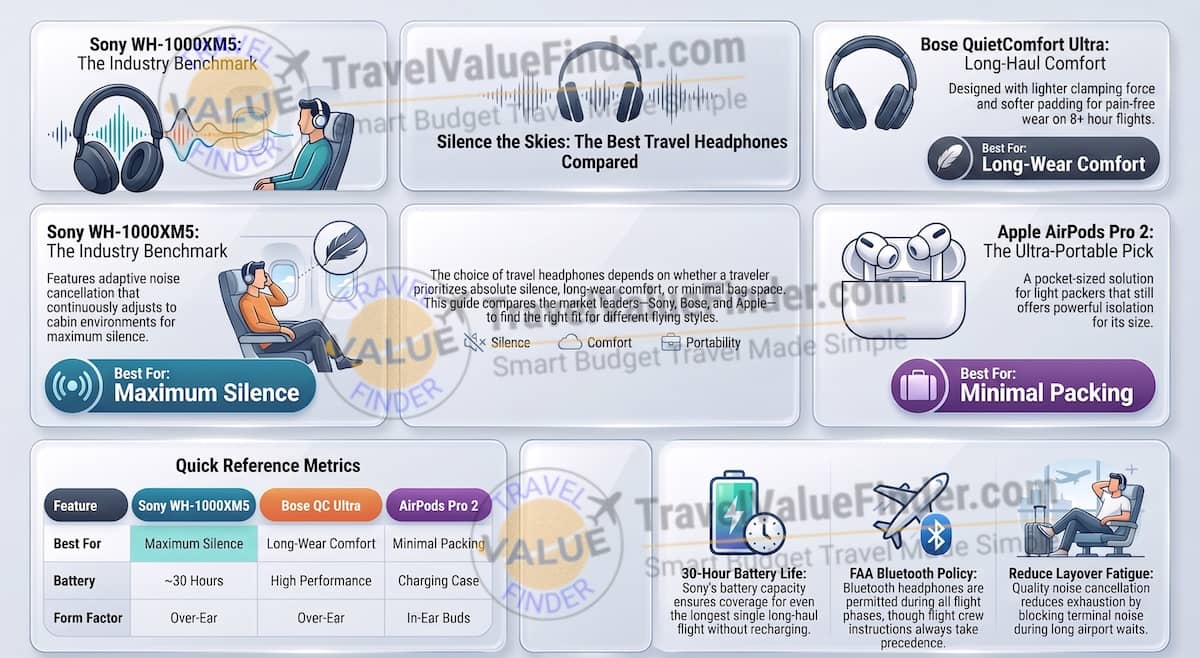
The best noise-cancelling headphones for travel split cleanly along one question: what actually bothers you more on a flight, the noise or the weight on your ears for eight hours straight?
- The Sony WH-1000XM5 has the strongest adaptive noise cancellation of the three and is the pick most travel sites converge on as the overall best.
- The Bose QuietComfort Ultra trades a sliver of that noise-cancellation edge for genuinely better long-haul comfort.
- The Apple AirPods Pro 2 gives up some isolation entirely in exchange for a case that fits in a jacket pocket instead of a backpack.
Leslie Nics, TravelValueFinder.com | Last updated: Aug 2026 | Based on first-hand experience and on what’s the best travel gears (compared and tested) for travelers
Table of Contents
Which Noise-Cancelling Headphones Should You Buy for Travel?
All three block engine drone effectively. The real differences show up after hour six of wearing them, or when you’re deciding how much space they’re allowed to take up in your bag.
- Want the strongest all-around noise cancellation? Get the Sony WH-1000XM5.
- Flying long-haul and comfort matters most? Get the Bose QuietComfort Ultra.
- Want to pack the smallest, lightest option and already live in the Apple ecosystem? Get the AirPods Pro 2.
People assume the most expensive pair wins. What actually decides it is whether you’re a side sleeper who needs something that doesn’t dig into your ear on a red-eye. That rules out over-ear for some people entirely, price aside. Leslie Nics, Founder & Lead Travel Writer, TravelValueFinder.com
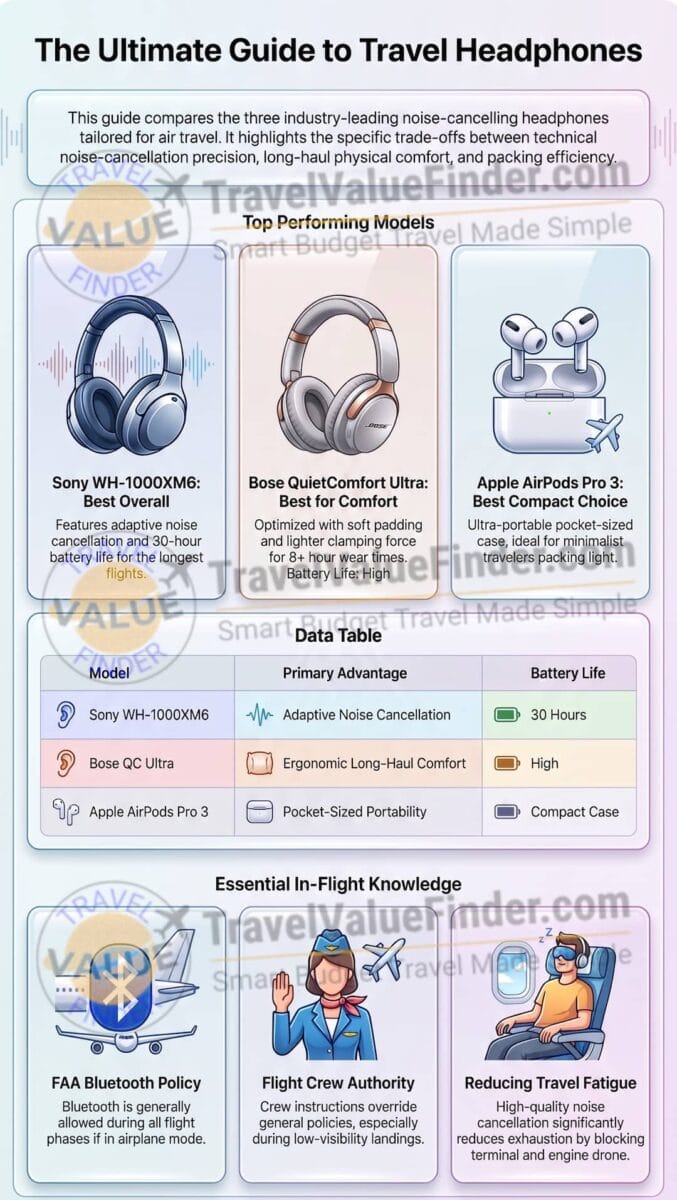
How Sony WH-1000XM5, Bose QC Ultra, and AirPods Pro 2 Compare
These three are the recurring top picks across independent travel-headphone testing and comparison coverage, and all three are established, well-reviewed, currently in-stock Amazon listings rather than newer, unproven models:
| Product | Why It Made the List | Get It |
| Sony WH-1000XM6 | Best overall for travel. Widely considered the benchmark for adaptive noise cancellation on flights. Sony’s processor continuously adjusts to cabin noise rather than applying one fixed level. Roughly 30 hours of battery life and one of the largest, most consistent review bases of any travel headphone on Amazon. | Check Price on Amazon |
| Bose QuietComfort Ultra Headphones | Best comfort for long-haul flights. Bose’s clamping force and ear cup padding are consistently rated more comfortable over 8+ hour flights than Sony’s, at a slight trade-off in outright noise-cancellation precision. The pick for travelers whose main complaint with headphones is sore ears, not noise. | Check Price on Amazon |
| Apple AirPods Pro 3 | Best compact pick. A fraction of the size and weight of either over-ear option, with a charging case small enough to disappear into a jacket pocket. Noise cancellation is genuinely strong for an earbud but doesn’t match the isolation of full over-ear cups on a loud engine. Best for travelers who prioritize packing light over maximum noise blocking. | Check Price on Amazon |
Sony WH-1000XM6 : Best Overall
Sony’s adaptive noise cancellation reads the cabin environment continuously and adjusts in real time, rather than applying a single fixed cancellation level the way older headphones do; which is a meaningful difference between a quiet cruising cabin and a noisier boarding process.
Battery life runs around 30 hours, and it’s consistently the pair independent testers reach for first when comparing pure noise-cancellation performance.
Bose QuietComfort Ultra Headphones : Best for Long-Haul Comfort
Bose has built its travel reputation on comfort more than raw cancellation strength, and the QuietComfort Ultra continues that pattern; lighter clamping force and softer ear cup padding that a meaningful number of long-haul travelers find noticeably easier to wear for 8+ hours than Sony’s.
The noise cancellation is excellent, just a step behind the WH-1000XM5’s precision in side-by-side testing. For travelers whose main complaint with headphones has always been sore ears rather than residual noise, this is the pick.
Apple AirPods Pro 3 : Best Compact Pick
Neither over-ear option packs down anywhere close to the AirPods Pro 3’s case, which is small enough to live in a jacket pocket rather than take up dedicated bag space.
Noise cancellation is genuinely strong for an earbud, but earbuds can’t physically match the isolation of a full ear cup sealing against engine drone, so on a loud aircraft the over-ear options still win on raw noise blocking.
The trade-off is worth it for travelers who pack light or who find over-ear headphones simply too bulky to justify.
Can You Use Bluetooth Headphones During Takeoff and Landing?
Since a 2013 FAA policy change, airlines have been able to allow passengers to use portable electronic devices.
These include Bluetooth headphones in airplane mode and during all phases of flight, not just above 10,000 feet. This is allowed once the airline verifies its fleet can tolerate the interference.
Most major US carriers have done exactly that. This is why you’ll often see fellow passengers wearing headphones straight through boarding, takeoff, and landing today.
That said, the FAA’s own guidance is clear that final authority sits with the individual airline.
Flight crew still ask passengers to pause device use for a specific reason such as a low-visibility landing. If a flight attendant asks you to remove your headphones, that instruction overrides the general policy.
A Quieter Flight, A Layover Experience
I flew with cheap wired earbuds for years because spending $300+ on headphones felt hard to justify for something I’d use a few hours a month.
What changed my mind wasn’t a single flight. It was realizing how much a long layover could be.
With real noise cancellation on reduces how wiped out I feel landing compared to fighting terminal noise and a crying-baby row with nothing blocking it.
It’s the one gear upgrade on this list I’d tell a frequent flyer to prioritize over almost anything else.
Noise-cancelling headphones are the closest thing to buying yourself a quieter flight. Nothing else in your carry-on does that. Leslie Nics, Founder & Lead Travel Writer, TravelValueFinder.com
Find more about the best travel packing list that suits most travelers.
Travel Packing & Gear Guide
- Best Travel Adapter for International Travel
- Best Water Purification Bottle for Travel
- Best Travel Neck Pillow for Flights
- Best E-Reader for Travel: Kindle vs. Kobo Compared – Kindle Paperwhite
- Best Luggage Tracker for Travel
- Best Noise-Cancelling Headphones for Travel: Sony vs. Bose vs. Apple
- Best Carry-On Travel Backpack: Osprey vs. Nomatic
- Best Anti-Theft Crossbody Bag for Travel
- Best Tech Organizer Pouch for Travel: FYY vs. BAGSMART vs. tomtoc
FAQ: Best Noise-Cancelling Headphones for Travel
Is the Sony WH-1000XM5 or Bose QuietComfort Ultra better for long flights?
The Sony edges out Bose on raw noise cancellation, but Bose is generally rated more comfortable over very long wear times. The right pick depends on which one bothers you more on a flight.
Do AirPods Pro 2 block engine noise as well as over-ear headphones?
Not quite. Earbuds can’t physically seal out low-frequency engine drone as completely as full over-ear cups, though the AirPods Pro 2’s noise cancellation is strong for the category.
Can I use Bluetooth headphones during takeoff and landing?
On most major US carriers, yes, following the FAA’s 2013 policy allowing PED use during all flight phases, but the airline and crew have final say and can ask you to pause use at any time.
How long does the battery last on the Sony WH-1000XM5?
Roughly 30 hours with noise cancellation on, which comfortably covers even the longest single long-haul flight without a recharge.
Sources
- FAA: Portable Electronic Devices Policy Announcement
- FAA: Portable Electronics Frequently Asked Questions
Affiliate Disclosure: TravelValueFinder.com is a participant in the Amazon Services LLC Associates Program. As an Amazon Associate, we earn from qualifying purchases made through links on this page, at no additional cost to you. See our full Trust & Transparency Policy for details.