Slow Travel 2026: The Complete Guide to Traveling Slower, Deeper, and Far Smarter

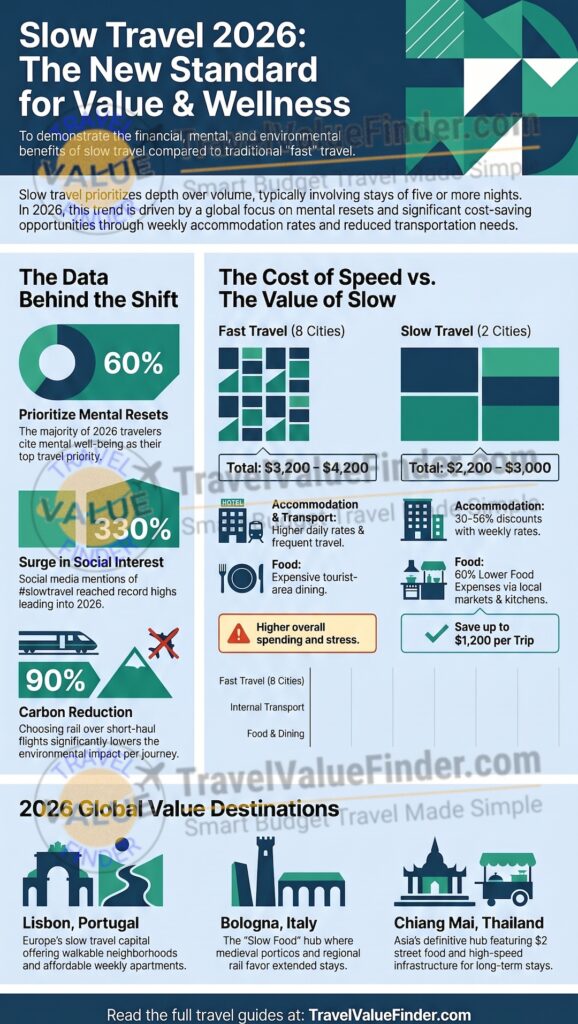
Slow travel 2026 has reached an all-time high in global search interest — and the data behind the surge is striking. Over 60% of travelers now prioritize a mental reset above all else when planning a trip, according to the KAYAK 2026 What the Future Report. The hashtag #slowtravel saw a 330% increase in social media mentions leading into 2026. Travelers are choosing to spend one to two weeks in fewer destinations rather than rushing through as many cities as possible. This complete guide explains exactly what slow travel is, why it saves real money, the documented health benefits, the eight best destinations, and Leslie Nics’ step-by-step framework for planning your first slow trip.

Leslie Nics | TravelValueFinder.com | Travel Alert | April 27, 2026 | Last reviewed: April 27, 2026

What is slow travel? Slow travel is a travel philosophy that prioritizes spending more time in fewer places — typically five or more nights per destination — to experience local culture, food, and daily life more deeply. In 2026, over 60% of global travelers cite a mental reset as their top travel priority (KAYAK 2026), driving slow travel to its highest-ever search interest. Key advantages: 20–40% cost savings through weekly accommodation rates, 86–90% lower carbon emissions by replacing flights with rail, and documented cortisol reduction during extended stays of 5+ days.

What Is Slow Travel? The Definition That Actually Makes Sense

Slow travel is an approach to travel that prioritizes depth, presence, and local connection over speed and volume. In practice: instead of visiting eight cities in ten days, you visit two — and you actually live in them. You find a favorite bakery on day two. You walk the same market on day four and the vendor remembers you. You rent an apartment, cook from a local market, and come home restored rather than needing a recovery day. Slow travel grew from the Slow Food movement founded in Italy in 1989. By 2026 it has reached mainstream dominance, with Explore Worldwide documenting a clear traveler shift toward lesser-known destinations that reward time — Colombia’s Coffee Triangle, inland Croatia — over viral hotspots that punish it with crowds.

Slow travel taught me that the real cost of rushing is not just money — it is experience. When I spent three weeks in Lisbon instead of three days, I found a neighborhood, a routine, and a sense of place that no checklist could have given me. — Leslie Nics, TravelValueFinder.com

The 2026 Slow Travel Data: What Is Driving the Surge

MetricFigureSource
Travelers citing mental reset as top travel priority60%+KAYAK 2026 What the Future Report
Increase in #slowtravel social media mentions 2025–2026330%Multiple social data sources, 2026
Travel advisors reporting surge in shoulder-season interest76%Advisor survey, Michele Ponte March 2026
UK adults who have taken a non-flight trip in past year29%Holiday Pirates / YouGov UK 2025–26
UK adults who would prioritise slow travel if accessible23%Holiday Pirates / YouGov UK 2025–26
UK adults who find flying-based travel stressful25% (1 in 4)Holiday Pirates / YouGov UK 2025–26
Americans identifying as digital nomads in 202518.1 millionIndustry data 2025
Rail vs short-haul flight: carbon emissions reduction86–90% reductionCarbonClick 2025
Travelers moving away from viral Instagram destinationsSignificant majorityExplore Worldwide 2026 Trends
Travelers prioritizing wellness-focused vacationsStrong majorityGlobal Wellness Institute / KAYAK 2026

Sources: KAYAK 2026; Explore Worldwide 2026; Holiday Pirates/YouGov UK; Backroads 2026 Outlook; CarbonClick 2025; Global Wellness Institute.

Slow Travel vs Fast Travel: The Real Cost Comparison

Cost FactorFast Travel — 8 Cities, 10 DaysSlow Travel — 2 Cities, 10 DaysSavings
AccommodationFull nightly rate every night: USD 3,200–4,200 totalWeekly rate 30–50% discount: USD 2,200–3,000 totalUSD 400–1,200
Internal transport7–8 trains/buses between cities: USD 300–6001–2 trains only: USD 80–150USD 150–450
Food costsEating out in tourist areas: USD 60–90/dayCooking + strategic dining: USD 35–55/dayUSD 250–350 over 10 days
Packing stressRepacking every 1–2 nightsUnpack once for 5+ nightsZero — immeasurable personal value
Post-trip recoveryOften needs 1–2 recovery daysReturns genuinely restedProductivity gains on return
Total — couple, 10 daysUSD 3,200–4,200USD 2,200–3,000Save USD 400–1,200 per trip

Cost estimates based on mid-range European destination pair. Live Booking.com, Airbnb, and Google Flights data, April 2026.

What Does This Mean for Your Travel Budget?

Weekly accommodation rates are the single most powerful financial argument for slow travel. Airbnb, VRBO, and Booking.com all offer weekly rates that reduce effective nightly cost by 30–50%. On a 10-night Lisbon or Bologna apartment, a couple saves USD 300–600 in accommodation alone versus nightly booking at the same property.

The transport saving is equally significant: a fast traveler moving between 8 cities pays for 7–8 internal trains. A slow traveler moving between 2 cities pays for 1–2. In Europe that represents USD 200–400 in transport savings. Rail also cuts carbon emissions 86–90% compared to equivalent short-haul flights (CarbonClick 2025).

The food saving is real but less obvious: a kitchen in your apartment means 3–4 meals per week from a local market. Fresh pasta ingredients in Bologna cost a fraction of the same dish in a tourist restaurant. This difference compounds over 10 days into USD 250–350 in savings.

10 Proven Benefits of Slow Travel in 2026

BenefitWhat the Research ShowsCategory
Costs 20–40% less than fast travelWeekly rates, fewer transport legs, kitchen cookingFinancial
Reduces cortisol during extended nature and local immersionGlobal Wellness Institute researchHealth
Improves sleep quality — 87% of extended-stay participants report improvementGWI research on extended stays vs short tripsHealth
Increases oxytocin through genuine local social connectionBehavioral science research on meaningful vs superficial contactWellbeing
Reduces carbon footprint 86–90% when rail replaces short-haul flightsCarbonClick 2025 emissions dataEnvironmental
Supports local economies — spend goes to local businesses not chainsTourism economics research 2025Community
Enables meaningful language learning even in 5+ day staysImmersion acquisition researchPersonal growth
Delivers better food through access to markets and non-tourist restaurantsSlow Food movement research on culinary immersionExperiential
Creates more lasting memories — depth over volume (peak-end rule)Kahneman behavioral research on experience memoryPsychological
Enables retirement destination research through lived experienceTravelValueFinder reader feedback and surveysPractical

Sources: Global Wellness Institute; CarbonClick 2025; Daniel Kahneman peak-end rule research; Holiday Pirates 2025–26 survey.

The 8 Best Slow Travel Destinations 2026

The best slow travel destinations share four qualities: walkable or excellent local transport; distinct neighborhoods worth multiple days of exploration; weekly accommodation rates that reward longer stays; and enough variety to prevent monotony without requiring constant movement.

1. Lisbon, Portugal — Europe’s Definitive Slow Travel Capital

Lisbon’s seven hills create natural neighborhoods — Alfama, Mouraria, Bairro Alto, Príncipe Real, LX Factory area — each with distinct character that only reveals itself to visitors who stay long enough to find it. Weekly one-bedroom apartments in central Alfama or Mouraria: USD 700–1,100 — dramatically cheaper than seven nightly hotel rates at the same quality. English widely spoken. Metro and tram makes car-free living fully practical. 290 days of sunshine annually.

Full accommodation guide: Lisbon Hotels | Best Budget Neighborhoods & Cheap Stays — pricing strategies applicable across the Portugal market.

2. Bologna, Italy — The Slow Food Capital for Slow Travelers

The capital of Emilia-Romagna — the region that produces Parmigiano-Reggiano, Prosciutto di Parma, mortadella, and the original tagliatelle al ragù. 40km of covered portico walkways, a medieval tower district used as a pedestrian thoroughfare, and day trips to Modena, Parma, and Ferrara under 45 minutes by regional train. Weekly apartments: USD 600–900 for a furnished one-bedroom with kitchen.

3. Chiang Mai, Thailand — Asia’s Definitive Slow Travel Hub

300+ Buddhist temples, thriving arts and craft scene, exceptional street food at USD 2–5, mountains for hiking within 30 minutes, monthly furnished apartments from USD 400–800 with fast WiFi. Affordable private healthcare that rivals European standards. The Nimman Road area and Old City have well-established slow traveler infrastructure including yoga studios, cooking classes, and weekly markets.

4. Porto, Portugal — Quieter, Cheaper, Equally Rewarding

Most of what makes Lisbon appealing at consistently lower prices and fewer tourists outside summer. Ribeira waterfront, Vila Nova de Gaia’s port wine cellars, Foz do Douro’s Atlantic beaches, and the Cedofeita creative arts district each reward multiple visits. Portugal’s NHR tax regime makes Porto a compelling slow travel-to-retirement transition city.

Full guide: Cheap Hotels in Porto — Best Budget Stays Under €120 — neighborhood pricing for extended stays.

5. Medellín, Colombia — Latin America’s Rising Slow Travel Star

Eternal spring climate averaging 22°C year-round. El Poblado and Laureles neighborhoods: walkable, independent cafés, co-working spaces, yoga studios. Monthly furnished apartments with reliable WiFi: USD 600–1,200. Colombia’s Coffee Triangle — cited by KAYAK 2026 as a top non-viral destination — is 3 hours by bus for a day trip or extended slow stay within the slow stay.

6. Alentejo, Portugal — Europe’s Quietest Slow Travel Region

Cork oak forests, olive groves, hilltop villages, and genuine silence — a quality becoming rare in modern travel. Évora (UNESCO World Heritage, intact Roman temple) serves as the base. Weekly rural property rentals: USD 500–800 for farmhouses with kitchen, outdoor space, and cork forest views. Wineries that still welcome drop-in visitors. No Instagram queues at any viewpoint.

7. Hoi An, Vietnam — Asia’s Most Charming Ancient Town for Extended Stays

UNESCO-listed Ancient Town that remains genuinely inhabited rather than museumified. Pedestrianized center, An Bàng beach 15 minutes by bicycle, cooking schools using morning market produce. Private guesthouse rooms: USD 25–50/night, lower with longer-stay negotiation. Full restaurant meals: USD 4–10. Total daily budget all-in: USD 45–70 — the most affordable destination on this list.

8. Japan’s Emerging Regions — Tohoku, Shikoku, San-in Coast

Receiving significant infrastructure investment from 2026 tourist tax revenue. Onsen ryokan culture with morning mineral baths in the room rate, temple pilgrimage walking routes, traditional craft villages. Accommodation at 40–60% below Tokyo or Kyoto rates. No mass-market tourist crowds. The definitive Japan slow travel opportunity of 2026.

Read the Japan context: Japan Tourist Tax 2026: Your Trip’s True Cost — which emerging regions offer the best slow travel value.

Slow Travel 2026 - The Complete Guide - Infographic
Slow Travel 2026 – The Complete Guide – Infographic

People Also Ask — Slow Travel 2026

Quick Answer: Is slow travel cheaper than regular travel? Yes — slow travel is typically 20–40% cheaper than fast travel covering the same number of days. Three key savings: (1) Weekly apartment rates reduce nightly accommodation costs 30–50%. (2) Fewer internal transport legs — moving between 2 versus 8 cities saves USD 150–450 in trains and buses. (3) Kitchen access reduces food costs 40–60% by replacing tourist restaurants with market cooking. A mid-range couple slow traveling Europe for 10 days: USD 2,200–3,000 versus USD 3,200–4,200 for a multi-city fast trip.
Q: How long should you stay in one place for slow travel? A: The minimum meaningful slow travel stay is five nights — enough for two exploration days, one day to establish a routine, and two more days to go deeper. Most experienced slow travelers recommend seven to fourteen nights for genuine cultural immersion. Month-long stays deliver the deepest experience and the best accommodation value, and are trending as a distinct search category in 2026 according to Google Travel Trends. Even a one-week trip to a single destination qualifies as slow travel if approached intentionally: one major activity per day, one neighborhood explored thoroughly, and time deliberately left unscheduled.
Q: What is the difference between slow travel and digital nomad travel? A: Slow travel is a travel philosophy — prioritizing extended stays and cultural immersion. Digital nomad travel is a work arrangement — earning income while traveling. The two overlap in the slowmad model (18.1 million Americans as digital nomads in 2025, majority now using the 2–3 month city stay model). But you can slow travel without working remotely — retirees and vacationers do — and you can be a digital nomad without slow traveling, moving cities every 10–14 days.
Q: Is slow travel good for mental health? A: Documented yes. Global Wellness Institute research confirms: reduced cortisol during 5+ day nature and local immersion; improved sleep quality in 87% of extended-stay participants; increased oxytocin through genuine social connection; nervous system regulation from reduced environmental novelty. The peak-end rule (Kahneman) also favors slow travel — we remember experiences by their highest peak and final moment, not their average. One extraordinary local connection remembered more vividly than eight mediocre highlights.
Q: Can you slow travel on a tight budget? A: Slow travel is more budget-accessible than fast travel. Key strategies: choose low-cost destinations (Vietnam, Colombia, Thailand, Portugal interior, Eastern Europe); negotiate monthly rates directly with Airbnb hosts rather than booking week by week; cook majority of meals from local markets; travel shoulder season for 20–40% accommodation savings. Budget slow travelers in Southeast Asia consistently report USD 30–50 per day all-in including accommodation, food, transport, and activities.

Leslie Nics’ 7-Step Framework for Your First Slow Travel Trip

Planning a slow travel trip requires unlearning everything traditional travel planning taught you. The goal is not to fill your days. It is to leave enough room for the unexpected. Every single one of my best slow travel moments has been something I never planned for.” — Leslie Nics, TravelValueFinder.com

  1. Choose 2 destinations maximum for a 2-week trip — or 1 for a month. Write every city you want to add, then delete half. Those become your next trip.
  2. Book weekly or monthly accommodation before flights. Prioritize apartments with kitchen, washing machine, and reliable WiFi. These three features define a functional slow travel base.
  3. Research the neighborhood structure before booking. Identify which neighborhood you want to live in — not just visit — and book there, not in the tourist center.
  4. Plan only 2–3 fixed commitments per week: one day trip, one paid experience, one cultural site. Leave the rest unscheduled. Your routine fills them better than any itinerary.
  5. Find your daily anchor in the first 48 hours: one café, one market, one walking route. Returning to these daily builds the sense of belonging that makes slow travel restorative.
  6. Budget for cooking half your meals. Research the nearest food market before arriving. Knowing where the market is on day one changes the entire stay.
  7. Learn five local words before arrival: hello, please, thank you, how much, delicious. These five words change how locals respond to you within the first day. Every single time.

FAQ — Slow Travel 2026

Q: What apps are best for slow travelers in 2026?

A: Airbnb and VRBO for weekly/monthly apartments with kitchen access; Booking.com long stay filter; Google Flights flexible dates and Explore map; Meetup.com for local interest groups at your destination; WhatsApp destination-specific travel groups for real-time local advice; Trail Wallet (iOS) or TravelSpend (Android) for daily budget tracking. For remote-working slow travelers, Nomad List remains the most reliable tool for comparing monthly cost of living, WiFi speeds, and community strength across slow travel hubs globally.

Q: Is slow travel bad for the environment?

A: Slow travel is significantly better for the environment than fast travel when it reduces the number of flights. Rail produces 86–90% fewer carbon emissions than equivalent short-haul flights (CarbonClick 2025). A slow traveler who flies once and stays three weeks produces a fraction of the emissions of a fast traveler taking 4 short-haul flights in the same period. Slow travel also concentrates economic benefit in local businesses rather than international hotel chains.

Q: How do I slow travel with kids?

A: Slow travel with children is often easier than fast travel. Children adapt faster when they have a consistent routine — the same café, playground, and market route — which is exactly what slow travel provides. Extended stays allow children to make friends rather than perpetually meeting strangers. Renting an apartment with a kitchen eliminates restaurant logistics three times daily. The practical rule: give children at least 3 days to feel comfortable and 5+ days to feel at home.

Sources and Editorial Transparency

Primary Sources: KAYAK 2026 What the Future ReportGlobal Wellness InstituteHELLO! Magazine — Slow Travel Wellness 2026Explore Worldwide 2026 ReportHoliday Pirates — Slow Travel GuideCarbonClick Emissions Data 2025

Researched and written by Leslie Nics, TravelValueFinder.com, with personal slow travel experience across Portugal, Italy, Colombia, Japan, Thailand, and Vietnam. Sources: KAYAK 2026 What the Future Report; Explore Worldwide 2026 Trends; Backroads 2026 Outlook; Global Wellness Institute research; Holiday Pirates/YouGov UK 2025–26; CarbonClick 2025 emissions data; Michele Ponte slow travel analysis March 2026; Breakfast Included slow travel guide January 2026; Daniel Kahneman peak-end rule research. All accommodation costs from live Airbnb, Booking.com, and VRBO data, April 2026. Last reviewed: April 27, 2026.

Share this post
Leslie Nics
Leslie Nics

Leslie Nics is a travel content writer at Travel Value Finder, specializing in budget travel strategies, destination guides, and itinerary planning. With hands-on travel experience across multiple regions, Leslie focuses on helping readers travel smarter, spend less, and discover meaningful destinations.

Newsletter Updates

Enter your email address below and subscribe to our newsletter