Travel Value Finder

Leslie Nics, TravelValueFinder.com | Last updated: October 2026 |
Tokyo can look intimidating on a map. It is enormous, busy, highly connected, and full of places that seem to demand a complicated train journey. But that is not necessarily a reason for an older independent traveler to stay only a few days. Tokyo can become easier when you stop treating it as one giant sightseeing list.
For a slower trip, choose a practical base, learn one or two useful rail or subway routes. Group outings by area, and allow ordinary Tokyo life (neighborhood restaurants, markets, parks, cafés and department stores) to become part of the trip.
This audit uses the Travel Value Finder senior-travel framework. Its transport scores are editorial planning assessments, not official accessibility ratings or certification.
Table of Contents
Why Tokyo Can Work as a Single-Hub Destination
Tokyo rewards repetition. A first visit can feel like a constant sequence of stations, transfers, crossings and attractions. A month changes the equation. You can learn your local station, find your supermarket and pharmacy, establish a few dependable restaurants, and stop trying to see everything.
The Tokyo Slow-Travel Difference: Manage Connections, Not Just Distance
Tokyo’s physical challenge is often not the distance between two attractions.
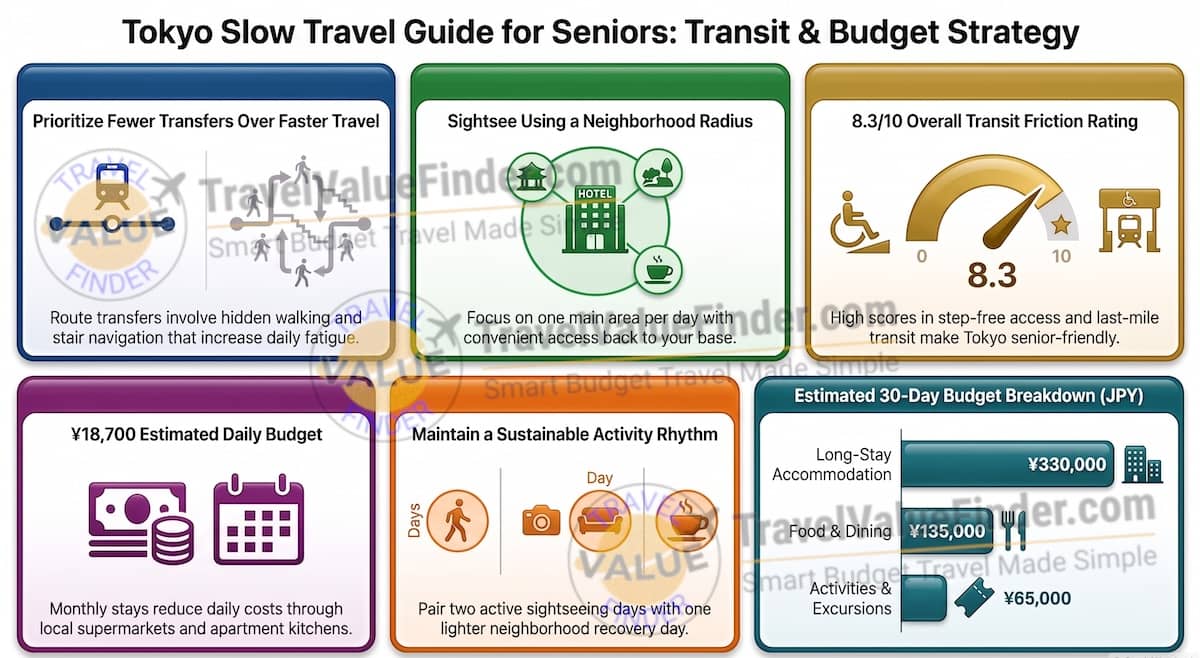
It is the sequence required to reach them: walk to a station, find the correct entrance, navigate a large concourse, wait for a train, change lines, find the right exit, then walk again.
A route that looks simple on a map can therefore be tiring. For senior travel, the best itinerary is often the one with fewer changes rather than the shortest theoretical travel time.
A 30-Day Tokyo Slow Travel Model
- Central Tokyo and familiar routes – 5–6 days: establish your base and explore nearby districts, parks, shopping areas and easy attractions.
- Eastern Tokyo – 4–5 days: combine areas such as Asakusa and Ueno instead of treating each as a separate rushed excursion.
- Western Tokyo – 4–5 days: explore Shinjuku, Shibuya and nearby neighborhoods with recovery time between major outings.
- Culture, gardens and museums – 4–5 days: spread indoor attractions across the month rather than creating museum marathons.
- Food, markets and everyday Tokyo – 3–4 days: leave room for markets, local restaurants, department-store food halls and cafés.
- Regional excursions – 3–4 days: consider selected day trips such as Kamakura, Yokohama or Nikko.
- Flexible/rest days – 4–5 days: weather, laundry, shopping, recovery, repeat visits or doing very little.
Do Not Plan Tokyo by Attraction Count
A common mistake is building Tokyo around the number of famous sights that can technically fit into one day. For senior travel, that can produce a day that looks efficient on paper but feels exhausting.
Create a daily radius instead: one primary area, one or two meaningful stops, a comfortable lunch option, and an easy way back to your accommodation. Anything extra is a bonus.
Tokyo Neighborhood Strategy: Your Base Matters More Than Usual
There is no single best Tokyo neighborhood for every senior traveler. The useful question is whether your base makes ordinary days easy.
- A station with routes you can understand and use comfortably
- A supermarket or convenient food option within an easy walk
- A pharmacy and basic services nearby
- Elevator-accessible accommodation with minimal stairs
- A quiet enough sleeping environment
- Restaurants that do not require a complicated journey every evening
- A practical route back from the districts you expect to visit most often
For a 30-day stay, neighborhood convenience can matter more than being beside a famous attraction. A slightly less central apartment with an easier routine may provide better overall travel value.
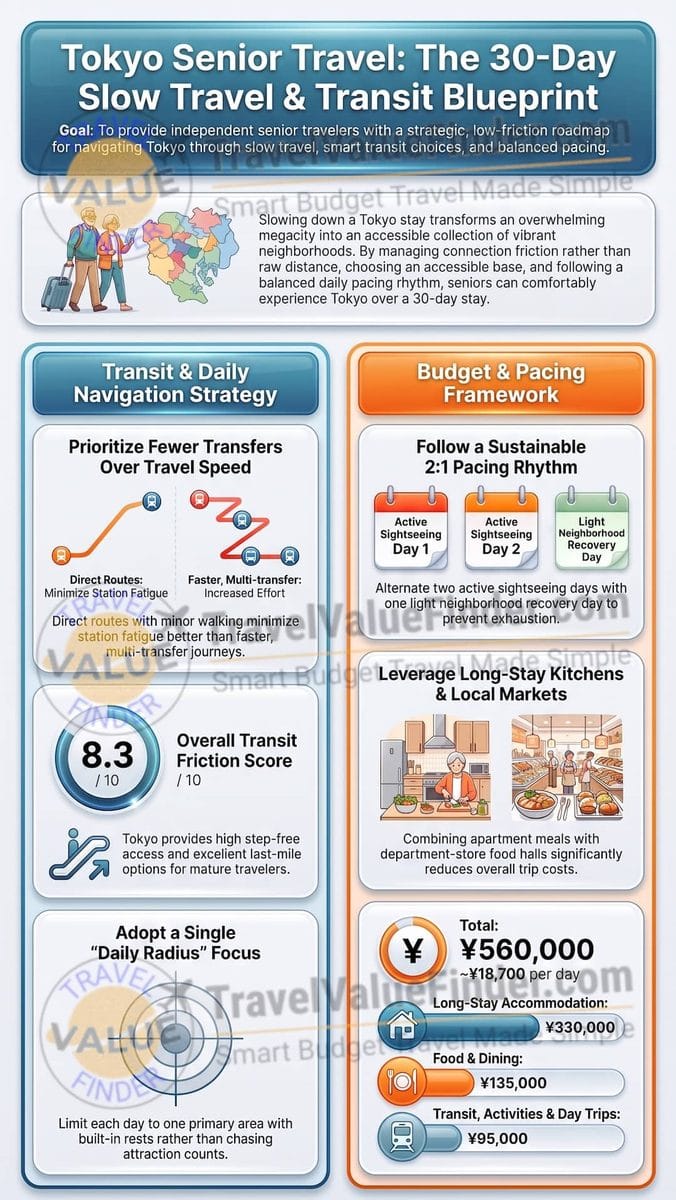
Tokyo Transit Friction Audit
Tokyo has an extensive urban rail network, which is a major advantage, but extensive does not automatically mean effortless. The planning issue is complexity: different operators, large stations, transfers, platforms, exits and walking connections.
| Planning factor | TVF planning score |
| Step-Free Potential | 8/10 |
| Topography / Surfaces | 8/10 |
| Last-Mile Options | 9/10 |
| Senior Transit Integration | 8/10 |
| Overall Transit Friction | 8.3/10 |
These are Travel Value Finder editorial planning scores, not an official accessibility assessment. Station-by-station conditions can differ.
The Tokyo Rule: Fewer Transfers Can Beat Faster Travel
When comparing routes, do not look only at the fastest journey time.
Consider transfers, walking within stations, platform changes, stairs or elevators, and the distance from the final exit to your destination. A slightly slower route with one train and a short walk may be better than a faster route involving several transfers.
Walking in Tokyo: The Hidden Daily Cost
Tokyo is not defined by one dramatic hill problem. The issue is cumulative walking. A day can include walking from the apartment to the station, through the station, between platforms or exits, around a large neighborhood, and back again.
Build recovery into the day. A café stop, department-store lunch, park bench, taxi for the final leg, or early return to the apartment can prevent a manageable day from becoming exhausting.
Crowds Change the Physical Experience
Crowding deserves its own place in senior travel planning.
A busy station or popular district can require more standing, slower movement and greater concentration than the same route at a quiet time. Where practical, schedule major attractions early or choose less congested periods.
Illustrative 30-Day Tokyo Budget
| Category | Illustrative 30-day amount |
| Long-stay accommodation | ¥330,000 |
| Local transportation | ¥30,000 |
| Food and dining | ¥135,000 |
| Activities and regional trips | ¥65,000 |
| Illustrative total | ¥560,000 |
| Approx. daily equivalent | ¥18,700/day |
This is a planning example rather than a universal Tokyo price. Actual spending varies with season, neighborhood, accommodation, exchange rates, dining, shopping and paid attractions.
Why a Month Can Improve Tokyo’s Value
A short Tokyo trip can encourage expensive convenience: central hotels, rushed taxis, multiple attraction tickets and frequent restaurant meals. A longer stay can change that.
A kitchen or basic cooking facilities may reduce restaurant dependence; a local supermarket becomes useful; and taxis can be reserved for journeys where they genuinely reduce friction.
A Practical Tokyo 30-Day Rhythm
A sustainable rhythm might be two active sightseeing days followed by a lighter neighborhood or indoor day, then another active day and a flexible afternoon.
This is not a rule; it is a way to stop every day from becoming a major excursion.
The test is simple: after three or four days, would you still want to continue at the same pace? If not, the itinerary is too dense.
Tokyo Day Trips Worth Considering
- Kamakura- history, temples and a change from the capital, with walking demands planned carefully.
- Yokohama – a substantial outing without committing to a very long regional journey.
- Nikko – culture and scenery, but plan around transport and walking rather than simply listing sights.
- Kawagoe – a possible lower-pressure historical excursion depending on interests and energy.
Day-trip conditions, transport schedules and attraction access can change, so check current official information before traveling.
What to Look for in a Tokyo Long-Stay Apartment
- Elevator access and a straightforward route from building entrance to apartment
- A bathroom practical for your mobility needs
- A real bed and comfortable seating
- Laundry access
- Nearby groceries and simple meals
- Reliable heating/air conditioning appropriate to the season
- A quiet sleeping environment
- A station or route usable without repeated complicated transfers
Tokyo by Season
Spring and autumn can be attractive for sightseeing, but popular periods can also bring higher demand and crowded attractions.
Summer can be hot and humid, making long outdoor walking days more demanding.
Winter brings cooler conditions and shorter daylight.
For senior travelers, the best season is the one matching your tolerance for heat, crowds, prices and walking.
Where Tokyo May Not Work as Well
- Travelers who dislike large stations, complex transit systems or frequent navigation decisions.
- Travelers who want a compact historic center where most major sights are walkable.
- Travelers planning several distant districts every day without recovery time.
- Travelers with significant mobility limitations who need every route and facility to meet specific accessibility requirements; Tokyo should be assessed at the individual station, hotel and attraction level.
Who Tokyo Is Best Suited To
Tokyo is particularly interesting for independent senior travelers who enjoy food, neighborhoods, museums, gardens, shopping, public transportation, technology, history and everyday city life.
It is also a strong candidate for travelers who like slow travel but worry that a month in one city will become repetitive.
Tokyo Senior Travel: Bottom Line
Tokyo is not an easy city because it is small or simple. It can work well for senior travelers because it gives you enormous choice once you slow the itinerary down.
Treat transportation as part of the physical itinerary.
Fewer transfers, sensible neighborhood grouping, strategic taxi use, regular rest periods and a practical long-stay base can make a bigger difference than simply choosing the ‘best’ attractions.
For a 30-day trip, Tokyo becomes less about conquering a megacity and more about learning how to live in it temporarily. That is where slow travel starts to show its value.
Frequently Asked Questions
Is Tokyo senior friendly?
Tokyo can work very well for independent senior travelers, especially when the itinerary is paced carefully. The main challenges are large stations, cumulative walking, transfers and crowds.
Is Tokyo easy for seniors to get around?
Public transportation offers extensive coverage, but ease depends on the route. Fewer transfers and simpler station journeys can be preferable to the fastest possible route.
How long should seniors stay in Tokyo?
A two- to four-week stay can work particularly well for travelers who prefer slow travel. A 30-day model lets you spread major attractions out and include lighter days.
What is the biggest senior-travel challenge in Tokyo?
Cumulative effort is the key issue: walking to stations, navigating large stations, transferring, standing and walking again can make a sightseeing day more tiring than the map suggests.
Is Tokyo good for slow travel?
Yes, if you treat Tokyo as a collection of neighborhoods rather than one checklist. Staying longer lets you build routines and explore at a more comfortable pace.
Should seniors use taxis in Tokyo?
Taxis can be useful strategically, particularly when they eliminate a difficult final walk or complicated transfer. They do not need to replace public transportation for every journey.
Does Travel Value Finder give Tokyo an official accessibility rating?
No. The scores here are Travel Value Finder editorial planning assessments designed to help travelers think about transport friction. They are not official accessibility certification.
Explore the Travel Value Finder Senior Travel Framework
Tokyo is one destination within the broader Travel Value Finder Senior Travel series. The parent guide explains the slow-travel approach, long-stay economics, Transit Friction framework and destination-planning principles.
See the related senior travel framework for Kyoto, Japan.
Sources