Travel Value Finder

Leslie Nics, TravelValueFinder.com | Last updated: October 2026 |
Porto can look like a city made for slow travel.
The historic center is compact, the Douro River provides a natural focal point, cafés and restaurants are everywhere, and the city can serve as a base for exploring northern Portugal.
But there is another side to Porto that matters if you are traveling independently after 55.
The hills are real. Some streets are steep or uneven. The famous historic neighborhoods can involve stairs, slopes, and cobblestones. What looks like a short distance on a map can sometimes feel considerably longer on foot.
That makes Porto an interesting destination for the Travel Value Finder Senior Travel framework.
Instead of asking simply, “Is Porto a good place to visit?” we ask a more practical question:
Can Porto work as a comfortable single-hub destination for a slower, independent traveler who wants to stay for several weeks rather than rush through the city?
This page applies the Travel Value Finder senior-travel framework specifically to Porto.
It looks at transportation, walking, accommodation, a 30-day travel rhythm, costs, and the possibility of using Porto as a base for regional day trips.
Table of Contents
Why Porto Works as a Single-Hub Destination
One of the biggest advantages of Porto is that you do not need to change hotels every few days to experience northern Portugal.
Moving between hotels means packing, checking out, carrying luggage, waiting for transportation, checking in again, and learning another neighborhood.
For many independent travelers, particularly after 55 or 60, reducing those transitions can make a trip considerably easier.
Porto gives you another option: choose one comfortable base and explore outward from it.
You can spend some days exploring Porto itself and other days taking shorter regional trips.
That creates a different style of retirement travel.
Instead of Porto → Lisbon → Coimbra → Braga → Douro Valley → another hotel → another train, you can potentially use Porto as your home base and return to the same apartment or hotel each evening.
This is the basic idea behind the Travel Value Finder single-hub approach.
The 30-Day Porto Slow Travel Model
A month in Porto does not have to mean sightseeing every day. In fact, that would miss the point.
The categories overlap. A day in Porto might involve a market in the morning, lunch nearby, a short walk, and an afternoon back at your accommodation. That is still travel. You do not need to fill every hour with attractions.
| Activity | Approximate Days |
| Exploring Porto neighborhoods | 10–12 |
| Relaxed days near your accommodation | 4–5 |
| Regional day trips | 5–6 |
| Museums, gardens and cultural activities | 3–4 |
| Food, markets and café days | 3–4 |
| Flexible/rest days | 2–3 |
Why This Pace Can Work After Retirement
Retirement travel gives you something that a one-week vacation often does not: time.
You can wait for better weather. You can return to a neighborhood you enjoyed. You can spend an afternoon reading beside the river. You can shop at a local market instead of eating every meal in a tourist restaurant.
You can take a day off without feeling that you have wasted one of your seven vacation days.
That flexibility is one of the strongest arguments for slow travel after retirement.
Why Staying in One Place Can Change the Economics
Longer stays can change the cost structure of a trip.
A traveler staying for three or four nights may naturally choose a hotel and eat more meals outside.
A traveler staying for a month has different options.
A furnished apartment with a kitchen can make occasional self-catering practical. You can buy breakfast supplies locally. You can do laundry without paying hotel laundry prices. You can choose a neighborhood restaurant because you like it rather than because it happens to be next to today’s attraction.
And you do not repeatedly pay the financial and physical cost of moving between destinations.
An Illustrative Porto Monthly Budget
The following should be treated as a Travel Value Finder planning example, not a current universal price quote.
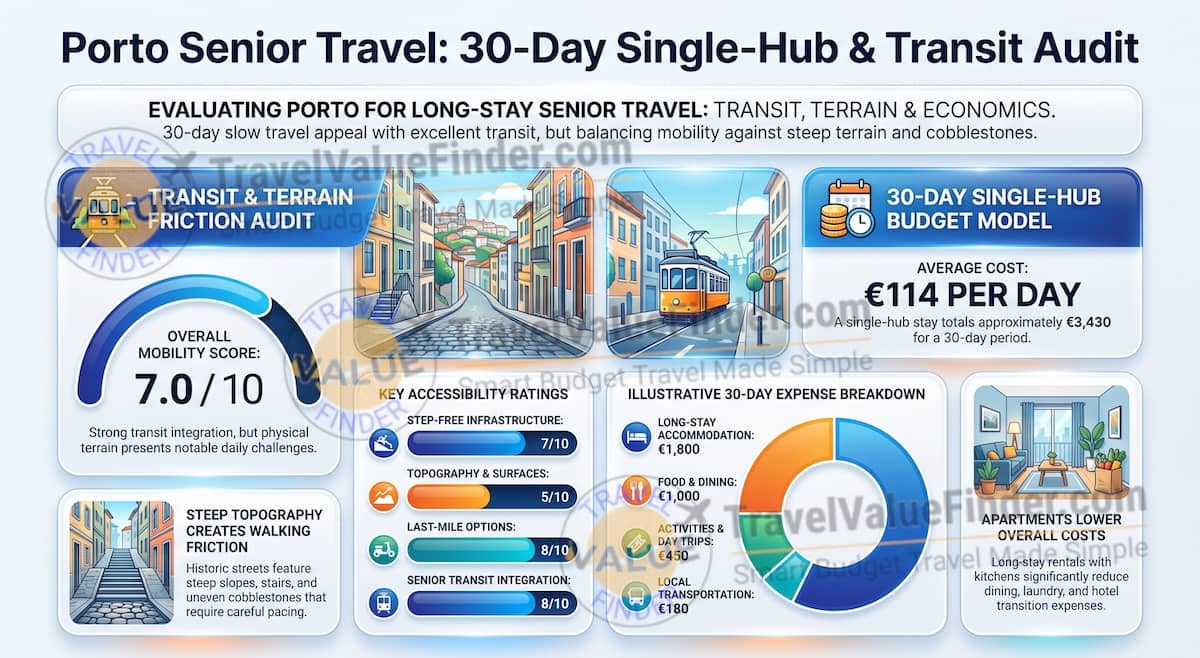
That works out to roughly €114 per day.
Your actual figure could be substantially different. Accommodation is particularly sensitive to season, neighborhood, property type and length-of-stay pricing. Dining habits can also move the total considerably.
The purpose of the model is not to claim that €3,430 is “the cost of Porto.” It is to show how a traveler might think about the economics of a month-long single-hub trip.
| Expense | Illustrative 30-Day Budget |
| Comfortable long-stay accommodation | €1,800 |
| Local transportation | €180 |
| Food and dining | €1,000 |
| Activities and regional trips | €450 |
| Illustrative total | €3,430 |
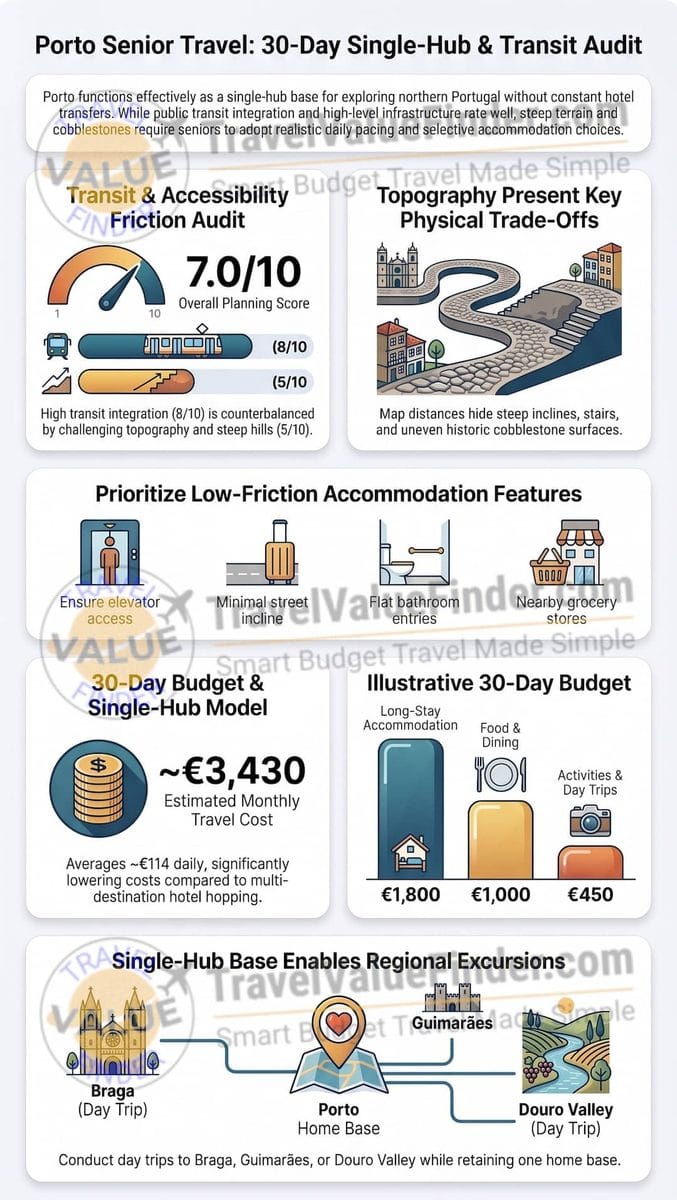
Porto Transit Friction Audit
Transportation is one of the most important parts of senior travel.
A destination can be beautiful and affordable but still become tiring if every outing involves difficult transfers, long walks, steep streets or complicated last-mile transportation.
The Travel Value Finder framework therefore looks at four practical areas:
- Step-free infrastructure
- Topography and walking surfaces
- Last-mile transportation
- Integration of public transportation into an independent travel routine
| Factor | TVF Planning Assessment |
| Step-Free Infrastructure | 7/10 |
| Topography & Surfaces | 5/10 |
| Last-Mile Options | 8/10 |
| Senior Transit Integration | 8/10 |
| Overall Planning Score | 7.0/10 |
These are Travel Value Finder editorial planning scores, not an official accessibility rating or certification.
Porto’s Hills Matter
The biggest issue for many senior travelers is not whether Porto has transportation. It does.
The question is what happens between the transportation stop and the place you actually want to reach.
Porto’s historic areas contain slopes, stairs, uneven surfaces and cobbled streets.
A route that appears short on a map may therefore require considerably more effort than the distance suggests.
That is why the accommodation location becomes especially important.
A traveler who chooses a convenient base near suitable transportation can have a very different experience from someone who chooses accommodation based solely on the cheapest nightly rate.
Porto Walking: The Important Trade-Off
Porto is a fascinating walking city. It is also a city where you should be selective about how much walking you do.
There is a difference between: “Porto is walkable.” and “Every part of Porto is easy to walk.” They are not the same statement.
The historic character of Porto is part of its appeal. But that character also means that some streets are steep, narrow, uneven or paved with traditional surfaces.
For independent senior travelers, a better strategy is to divide walking into manageable sections.
- Morning: Explore one neighborhood.
- Lunch: Eat nearby.
- Afternoon: Rest or return to your accommodation.
- Evening: Short local outing rather than another major sightseeing circuit.
This can preserve energy for the experiences that matter most.
Using Porto as a Regional Day-Trip Hub
One of the reasons to consider Porto for a longer stay is its position in northern Portugal.
Instead of moving your luggage around the region, you can make selected day trips and return to your Porto base.
Braga
Braga provides a change of scenery and a chance to experience another important Portuguese city. The journey can be much simpler when you are treating it as a day trip rather than another hotel change.
Guimarães
Guimarães offers historic architecture and a compact center that can work well as a separate day of exploration.
Douro Valley
The Douro is one of the major experiences associated with northern Portugal. A day in the Douro can be approached in several ways, depending on whether you prefer organized transportation, rail travel, a tour or another arrangement.
For senior travelers, the important question is not simply how beautiful the destination is. Ask: How much physical effort is involved from door to door?
Aveiro
Aveiro provides another possible change of scenery and can be considered as part of a broader northern Portugal itinerary.
The advantage of the single-hub model is that you can choose only the day trips that fit your energy, interests and budget. You do not have to visit every possible destination.
A Possible 30-Day Porto Rhythm
Week 1: Settle In
Spend the first several days learning your neighborhood.
Do not rush immediately into long day trips. You are establishing your temporary home.
- the nearest supermarket
- a pharmacy
- a café you like
- a convenient transportation stop
- a comfortable restaurant
- the easiest route back to your accommodation
Week 2: Explore Porto
Now start exploring different parts of the city. Rather than attempting to see everything in two days, spread major sights across several outings. This leaves room for rest and spontaneous discoveries.
Week 3: Regional Exploration
This can be the time for selected day trips. Choose perhaps two or three destinations rather than trying to cover the entire region. The objective is variety without constant movement.
Week 4: Live More Locally
By the final week, you may already have favorite places. Return to them. Try another restaurant. Visit a market. Take a slower afternoon. Spend time in a neighborhood you initially overlooked.
This is where the difference between a vacation and slow travel becomes particularly noticeable.
What to Look for in a Porto Long-Stay Apartment
Accommodation can make or break a senior travel experience. For Porto, pay particular attention to the following before booking.
1. Elevator Access
Never assume that an apartment building has an elevator because the property description looks modern. Check the actual building access.
2. Bedroom Location
If the property has several levels, understand where the bedroom and bathroom are located.
3. Bathroom Layout
Look for a bathroom that is easy to enter and use. A beautiful apartment is not necessarily a comfortable apartment.
4. Grocery Convenience
A supermarket within a reasonable distance can be more valuable during a month-long stay than a famous attraction five minutes away.
5. Transportation
Look at the complete journey. Do not simply ask how far the apartment is from a metro station. Ask what the walk from the apartment to that station actually looks like.
6. Noise
A central location can be convenient but noisy. For a month-long stay, a quieter bedroom can be worth paying more for.
7. Seating and Living Space
For a short hotel stay, a comfortable bed may be enough. For 30 days, you want somewhere you can actually live. A proper chair, sofa or living area can become surprisingly important.
Where Porto May Not Work as Well
No destination should be presented as perfect. Porto’s biggest challenge for this particular travel model is its physical terrain.
Travelers who have significant difficulty with steep slopes, stairs or uneven surfaces may find some historic areas tiring.
Another issue is that central accommodation can come with compromises.
You may have:
- better location but more noise
- more character but fewer modern conveniences
- lower cost but more walking
- beautiful historic surroundings but difficult access
That is why “cheap accommodation” should not be the only objective.
The better question is: What combination of location, comfort, transportation and price gives me the lowest overall travel friction?
Who Is Porto Best Suited To?
Porto may particularly suit independent senior travelers who:
- enjoy cities with strong local character
- prefer slower travel
- are comfortable managing their own itinerary
- like cafés, markets and neighborhood restaurants
- want to combine city exploration with regional trips
- prefer staying several weeks rather than changing hotels frequently
- can manage some walking on slopes and uneven surfaces
- value having a comfortable base
It may require more careful planning for travelers who need consistently level walking routes or minimal exposure to stairs and steep streets.
That distinction matters. Senior-friendly does not mean universally easy.
Porto Senior Travel: The Bottom Line
Porto makes an interesting case for the Travel Value Finder single-hub approach.
Its advantages are not simply about attractions. The bigger question is whether you can build a comfortable temporary routine around one base.
For the right traveler, that could mean:
One apartment. One neighborhood. Several days exploring Porto. A few carefully chosen regional trips. Plenty of time to slow down.
The main caution is Porto’s terrain.
The city rewards exploration, but some parts demand more physical effort than a map suggests. That makes accommodation selection and daily pacing particularly important.
For an independent senior traveler who enjoys urban exploration and can manage some hills and uneven surfaces, Porto can be approached not as a city to “complete” in three days, but as a place to temporarily live.
And that is the central idea behind this Senior Travel series:
Travel differently, not less.
Porto Senior Travel FAQ
Is Porto a good destination for senior travelers?
Porto can work well for independent senior travelers who enjoy a slower pace, urban exploration and regional day trips. The main consideration is the city’s hills, stairs and uneven historic surfaces.
Is Porto easy to walk for seniors?
Some areas are relatively easy to explore, but Porto should not be treated as uniformly flat or effortless. Historic areas can involve steep streets, stairs and uneven paving, so daily routes should be planned carefully.
How long should seniors stay in Porto?
For a slower trip, two to four weeks can provide a very different experience from a short city break. A longer stay also makes it possible to combine Porto with selected day trips without changing accommodation.
Can Porto work as a single-hub destination?
Yes, particularly for travelers who want to explore northern Portugal without repeatedly changing hotels. Porto can serve as a base for selected regional excursions while keeping the same accommodation.
Is Porto expensive for retirees?
The answer depends heavily on accommodation, dining habits, season and activities. A month-long planning model can be useful because it separates accommodation, transportation, food and activities rather than relying on a single daily tourist budget.
What should seniors look for when booking accommodation in Porto?
Check elevator access, stairs, bathroom layout, neighborhood slope, transportation connections, grocery access, noise and the amount of comfortable living space. For a long stay, these factors can matter more than simply choosing the lowest nightly rate.
Does Travel Value Finder rate Porto’s accessibility officially?
No. The Transit Friction figures used in this article are Travel Value Finder planning assessments. They are intended to help travelers think about transportation and physical effort and should not be treated as official accessibility certification.
Explore the Senior Travel Framework
This Porto audit is part of the broader Travel Value Finder Senior Travel framework.
The Senior Travel article explains how to approach independent travel after 55 using practical factors such as travel pace, transportation, walking effort, accommodation, long-stay economics, day-trip logistics and destination friction.
See Seville senior travel applying the same single-hub and Transit Friction framework.
Next: Vienna Senior Travel
Sources
US Department of State: Portugal, International Travel Information