Travel Value Finder

Leslie Nics writes for TravelValueFinder.com. Revised September 2026, after travel across Madrid, Barcelona, Valencia, and southern Spain.
Where to base yourself in Spain for retirement travel comes down to matching a region to your pace, not chasing a ranked list. Spain does not have one retirement personality. It has several, and each draws a different kind of traveler back year after year.
Table of Contents
Four Kinds of Spain
Climate plays a role in choosing a region, but so does pace, language, and how much company you actually want on a given afternoon. The table below groups the country by what each area tends to suit best.
| If You Want | Look At | Why |
| City energy and culture | Madrid, Barcelona | Museums, transit, and constant things to do |
| A calmer city with beaches | Valencia | Big city amenities at a walkable, relaxed scale |
| An established social scene | Costa del Sol, Costa Blanca | Long running English speaking retiree communities |
| Quiet and green landscapes | Northern Spain | Cooler summers, fewer crowds, a local pace |
| Authentic, local daily life | Inland cities like Zaragoza or Cordoba | Less tourism, stronger local culture |
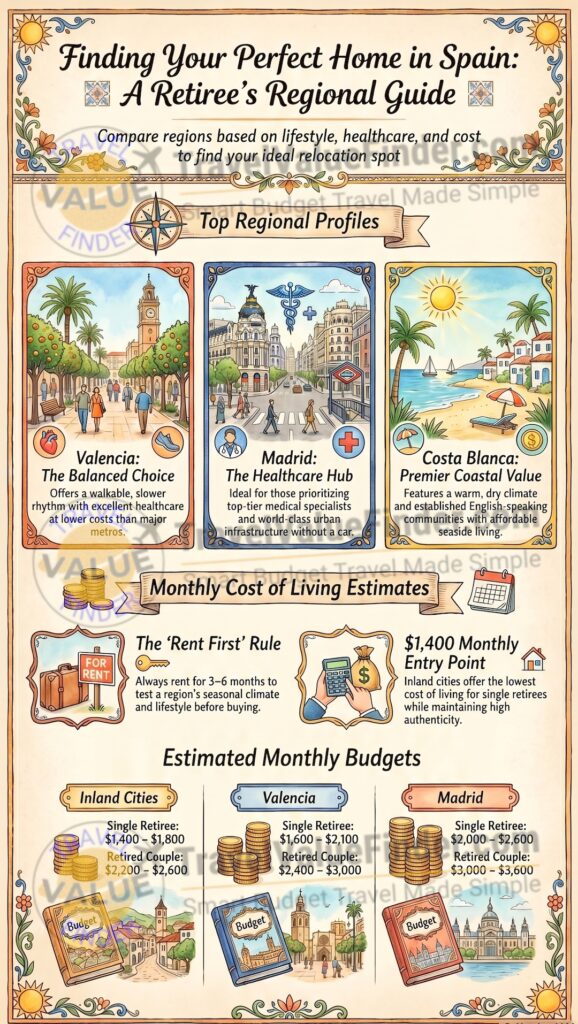
Best Places in Spain for Retirement Travel
The country is large enough that a traveler who loved one region can find the next one feels like a different country entirely. That range is part of the appeal, and it is worth treating a first visit as a scouting trip rather than a final decision.
City Energy: Madrid and Barcelona
Madrid offers year round culture, strong public transport, and a genuinely walkable city core. It suits travelers who want museums, concerts, and constant activity within easy reach.
Browse cheap hotels in Madrid if you want to test the city before committing to a longer stay.
Barcelona brings a similar energy with a stronger international feel and a coastline attached. It rewards travelers who enjoy busy neighborhoods over quiet ones.
See cheap hotels in Barcelona for a first visit before deciding if the pace suits you long term.
Madrid’s central location also makes it an easy hub for exploring the rest of the country, with fast trains reaching most major cities in under three hours. Barcelona’s international airport offers more direct flights home for travelers splitting time between Spain and the US.
Balanced City Living: Valencia
Valencia splits the difference between big city amenities and a relaxed daily rhythm. Neighborhoods stay walkable, the Turia park cuts a green ribbon through the city, and the beach sits a short tram ride away.
It works especially well for travelers who liked Barcelona’s energy but want less crowding. Many long stayers treat Valencia as their calmer alternative after trying the bigger cities first.
The city’s food scene deserves its own mention, since paella actually originated in the surrounding region rather than Barcelona, where it is more often served to tourists. Valencia’s central market, one of Europe’s oldest working markets, gives long stayers a genuine daily errand rather than a tourist attraction.
Valencia was the city that finally felt like a place to slow down, not just a city to visit.” Leslie Nics, TravelValueFinder.com
Getting between these regions is easier than most first timers assume.
Spain’s high speed rail network, one of the most extensive in Europe. It connects Madrid, Barcelona, Valencia, and Seville in a few hours each, which makes sampling more than one region in a single trip realistic rather than exhausting.
Established Community: The Costa del Sol and Costa Blanca
These southern coasts have the longest running retiree communities in Spain. English is common, social groups are easy to find, and the routines of daily life feel familiar fast.
The trade off is a more touristy feel in the busiest towns. Travelers who want the same warm climate with fewer crowds often look slightly inland from the main coastal strip.
Golf courses, English language churches, and international grocery stores are all common along these coasts, built up over decades of northern European retirees choosing the same towns.
That infrastructure makes a first stay easier, even if it trades away some of the local character found further inland.
Quiet and Green: Northern Spain
Galicia and Asturias trade heat for green hills and cooler summers. Life here moves at a noticeably slower, more local pace than the southern coasts.
English is less common here, so a little Spanish goes a long way. Travelers drawn to quiet landscapes over social scenes tend to prefer this region above all others.
The food culture in the north leans heavily on seafood, cider, and hearty mountain cooking, a real contrast to the olive oil and citrus flavors further south.
Rain is also far more common here than in most of Spain, which some travelers find refreshing after a hot southern summer and others find genuinely surprising.
Authentic and Inland: Zaragoza and Cordoba
Inland cities rarely make typical retirement lists, which is part of their appeal. Daily life here feels more local and less shaped around visitors.
These cities suit travelers comfortable navigating mostly in Spanish who want culture without a coastal crowd. They reward patience with a more grounded sense of place.
Cordoba’s history as a center of Islamic, Jewish, and Christian culture gives it an architectural richness that rivals cities several times its size. Zaragoza, roughly midway between Madrid and Barcelona, offers a similar depth with an even smaller crowd of foreign visitors.
If I had to pick one region to return to on repeat, it would be Valencia, though the right answer changes with the season and the company: a summer stay pulls me toward the north, while a mild winter pulls me straight back to the coast.
Across every region, the things travelers underestimate tend to repeat.
How much quieter inland towns feel compared to any coastal spot.
How much English use drops outside Madrid, Barcelona, and the established coastal communities.
How different the same town can feel in August compared to February, and how much a short train ride changes your sense of isolation.
Is Madrid or Barcelona better for a first visit?
Neither is objectively better. Madrid feels more local and central, while Barcelona leans more international and coastal.
Do I need to choose just one region?
No. Many travelers split time between a city base and a coastal one across different seasons.
Is Northern Spain worth visiting outside summer?
Yes, though winters run cooler and wetter than the south. Many visitors prefer it in late spring and early fall.
How do these regions compare for an extended, months long stay?
See our guide to Spain for retirees for how a longer, slower stay actually unfolds.
Are inland cities harder to settle into?
They take a bit more effort socially without an established expat scene. Many travelers find that effort pays off in a more genuine daily rhythm.
Is public transport reliable across Spain’s regions?
Between major cities, yes, with an extensive high speed rail network. Within smaller inland towns, a car makes daily life considerably easier.
Do these regions get very hot in summer?
Madrid and the inland cities run hotter than the coasts in July and August. Northern Spain stays noticeably cooler throughout the summer months.
Sources
Country and safety detail from the US Department of State. Tourism context from Turespana, Spain’s national tourism board. Climate figures from Agencia Estatal de Meteorologia. Rail detail from Renfe, Spain’s national rail operator.