Travel Value Finder


Knowing how to plan an affordable Southeast Asia trip comes down to three choices:
- which countries you route through,
- which season you travel in, and
- how you cross borders.
Daily costs across the region still run $20 to $55, among the best value left in world travel.
This guide skips the country popularity contest and focuses on the decisions that actually move your total trip cost.
Leslie Nics, TravelValueFinder.com | Last updated: September 2026 | Based on firsthand Southeast Asia travel research and current 2026 pricing for US travelers
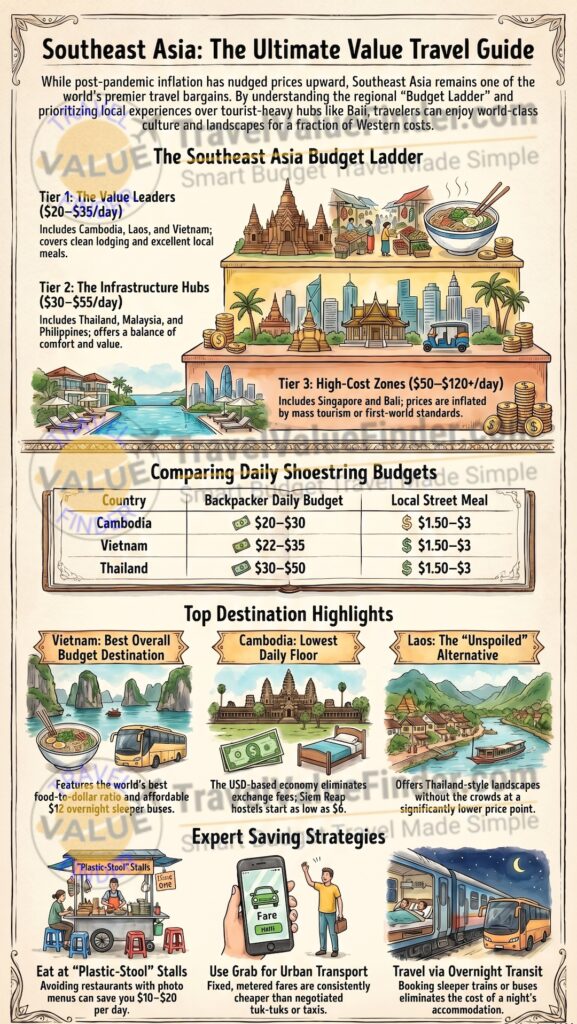
Table of Contents
People Also Ask
What is the cheapest country in Southeast Asia? Cambodia and Laos, both running $20 to $35 a day for a clean room, three meals, and local transport.
Is Southeast Asia still cheap in 2026? Yes, though prices have climbed since 2019. Most travelers still spend far less than in Europe or North America.
How much does one month in Southeast Asia cost? Roughly $800 to $1,700 on the ground, not counting international flights, depending on travel style.
Do I need cash or card in Southeast Asia? Both. Cities take cards widely, but markets, buses, and border crossings usually require local cash.
What Southeast Asia Actually Costs, Country by Country
Prices vary more within the region than almost anywhere else in world travel. This single table replaces the need to compare a dozen separate blog posts.
| Country | Daily Cost Range | Standout Value |
| Cambodia | $20 to $35 | USD economy, no currency conversion needed |
| Laos | $20 to $35 | Fewest crowds, dramatic landscapes |
| Vietnam | $22 to $35 | Best food value in the region |
| Indonesia, outside Bali | $25 to $40 | 17,000 islands, most still uncrowded |
| Thailand | $30 to $50 | Easiest infrastructure for a first trip |
| Malaysia | $30 to $50 | English widely spoken, strong food scene |
| Philippines | $30 to $50 | Island scenery rivaling anywhere on earth |
| Bali, Indonesia | $40 to $60 | Higher cost, see the levy section below |
These ranges cover a clean private room or dorm bed, three real meals, local transport, and at least one paid activity a day. Prices sit closer to the low end outside major tourist hubs.
Mainland Southeast Asia, meaning Cambodia, Laos, Vietnam, and Thailand, generally runs cheaper than island heavy Indonesia and the Philippines. Inter island transport adds a cost the mainland route avoids.
Splitting Your Time Across Low and Mid Cost Countries
A route that leans heavily on the lowest cost countries stretches a budget the furthest. It also means more time in fewer, less developed destinations.
| Route Style | Country Mix | Effect on Budget |
| Value focused | Mostly Cambodia, Laos, Vietnam | Lowest daily average, more time per stop |
| Balanced | Mix of all tiers | Moderate average, easier logistics and infrastructure |
| Comfort focused | Mostly Thailand, Malaysia, Philippines | Higher daily average, more amenities and reliability |
A four week trip that spends three weeks in value focused countries and one week in a comfort focused country often lands close to the balanced average overall.
There is no wrong split. A value focused route suits longer trips, while a comfort focused route suits travelers with less time and a higher daily budget.
Build Your Route by Season, Not by Country Popularity
Most travelers pick countries first and dates second. Flipping that order often saves more money than any single destination choice.
| Season | Months | Effect on Cost |
| Dry, peak season | December to February | Highest prices, 20 to 40 percent above shoulder rates |
| Shoulder season | March to May, September to November | Best balance of good weather and lower prices |
| Wet, low season | June to August | Lowest prices, rain mostly arrives in short afternoon bursts |
Wet season scares off more travelers than the actual weather justifies. Vietnam and Laos stay very travel friendly through the rainy months.
Island destinations are the exception. Coastal Thailand, the Philippines, and Bali are worth timing around dry season specifically.
The Real Cost of Crossing Borders
Multi country routes are one of this region’s biggest advantages. Border logistics still carry real costs that rarely make it into a daily budget number.
| Crossing | Typical Cost | Notes |
| Thailand to Laos, bus and border | $25 to $40 | Includes visa on arrival fee for Laos |
| Laos to Vietnam, bus and border | $30 to $45 | Longer route, often an overnight journey |
| Cambodia to Vietnam, bus and border | $15 to $25 | Shorter crossing, multiple daily departures |
| Regional budget flight, AirAsia or Scoot | $30 to $90 | Cheaper booked 4 to 6 weeks ahead |
E-visa fees add up fast on a multi country route. Vietnam charges $25, Cambodia charges $36, and Laos runs $30 to $42 on arrival.
Budget $80 to $120 in visa fees alone for a three country route. Few trip budgets plan for this until it appears at the border.
Land crossings also cost time, often a full travel day. Factor that lost day into your itinerary, not just your wallet.
One Fee Every Bali Trip Must Include
Bali carries a mandatory cost that many older guides still miss entirely. Every foreign visitor must pay a provincial tourist levy of IDR 150,000, about $9 to $10, through the official Love Bali portal before entering the island.
The levy launched in February 2024 to fund cultural preservation and environmental projects. It is separate from any visa fee and paid once per entry.
Enforcement has tightened through 2026, with spot checks now common at major attractions. Pay it online in advance and keep the QR code saved on your phone.
One Week Versus One Month: How Daily Cost Actually Drops
Trip length changes the real daily cost more than almost any single money saving tip. Longer stays absorb fixed costs across more days.
| Trip Length | Typical Daily Cost | Why It Shifts |
| 1 week | $45 to $60 | Visa fees and short stay room rates raise the average |
| 2 to 3 weeks | $35 to $50 | Weekly guesthouse rates begin to apply |
| 1 month or more | $28 to $40 | Fixed costs spread thin, slower pace cuts transport |
A one week trip to Southeast Asia rarely reaches the low daily numbers quoted in most guides. Those numbers usually describe month long travel.
A Real Week on the Ground: Chiang Mai to Luang Prabang
One concrete route beats a dozen abstract tips. Here is a real cross border week, priced at 2026 rates.
| Day | Location | Ground Cost |
| 1 to 3 | Chiang Mai, Thailand | $32/day, guesthouse, street food, temples |
| 4 | Bus to Laos border, visa on arrival | $38 total, transport plus visa fee |
| 5 to 7 | Luang Prabang, Laos | $30/day, guesthouse, waterfalls, markets |
Total for the week lands near $260, or about $37 a day including the border crossing. That figure includes the one time visa cost most calculators skip.
A second common route, Cambodia into southern Vietnam, runs even leaner. Expect closer to $30 a day across a similar week, helped by Cambodia’s lower guesthouse rates.
Both routes prove the same point. A short cross border trip costs more per day than a month long one, but still beats most Western destinations easily.
Activity and Entrance Fee Costs Vary More Than Food Does
Street food prices stay fairly consistent across the region, usually $1.50 to $4 a meal. Entrance fees swing far more widely by country and site.
| Attraction Type | Typical Cost | Example |
| Major historic site | $10 to $37 | Angkor Wat multi day pass, temple complexes |
| Waterfall or nature park | $1 to $5 | Kuang Si Falls, national park entry fees |
| Guided day tour | $15 to $60 | Island hopping, cave tours, cooking classes |
| City temple or museum | Free to $5 | Most city temples, some museums |
Budget one or two paid activities a day rather than every possible attraction. Free temples, markets, and viewpoints fill most of the gaps just as well.
Money Habits That Matter More Than Country Choice
A few habits protect a Southeast Asia budget more reliably than picking the cheapest country on paper.
- Withdraw larger amounts less often in Cambodia, where ATM fees run $5 to $7 per withdrawal
- Carry small denomination local cash for markets, tuk-tuks, and border crossings
- Buy a local SIM at the airport on arrival, usually under $10 for a full month of data
- Keep a small USD cash reserve for Cambodia, which runs almost entirely on dollars
None of these habits require research once packed as routine. They matter far more than which single country ranks cheapest that year.
A no fee travel debit card avoids foreign transaction charges that quietly add a few dollars a day across a month long trip. Set one up before departure.
Cards work widely in Thailand, Malaysia, and city hotels across the region. Villages, markets, and border towns still expect cash almost everywhere.
Health Prep and Gear Costs Before You Fly
A Southeast Asia budget should include a small pre trip health allowance. Skipping it is a common way first time travelers get caught off guard.
- Check current vaccine recommendations for your specific countries well before departure
- Pack a basic first aid kit, since rural pharmacies can be limited outside major cities
- Bring a light rain layer for wet season travel in June through August
- Budget for mosquito repellent with DEET, sold locally but worth having on arrival
Comprehensive travel insurance is worth treating as fixed, non negotiable cost. Motorbike accidents remain a leading cause of travel insurance claims in the region.
Rabies exposure from a dog or monkey bite requires a full vaccination course if it happens. Confirm your policy covers medical evacuation before you fly.
Common Mistakes on a Multi Country Southeast Asia Route
Route based mistakes cost more than daily spending habits. These show up specifically when crossing between countries.
- Assuming every country’s visa process works the same way as the last one
- Not checking land border operating hours before planning a same day crossing
- Booking too many one or two night stops, losing time and money to constant transit
- Skipping ferry schedule checks between islands, where departures can be limited
- Converting a large amount of cash at once at a poor airport exchange rate
- Forgetting that some e-visas require a printed copy, not just a phone screenshot
For a full breakdown of daily spending strategy once you land, see our guide to traveling on $50 a day.
Staying Longer: What Changes for 2026 Long Stay Travelers
More travelers now stay a season instead of a few weeks. Visa rules for longer stays shifted in several countries heading into 2026.
Thailand now allows a 30 day visa free entry for US passport holders, extendable once at an immigration office. Vietnam’s 90 day e-visa now allows multiple entries.
Neither Cambodia nor Laos offers a long stay visa built for remote workers yet. Most long stay travelers combine several shorter visas instead of one extended permit.
Confirm current visa rules directly with each country’s official immigration portal before booking. Rules shift more often than most travel guides update.
Frequently Asked Questions
What is the cheapest way to travel between Southeast Asia countries?
Overnight buses and trains, which also save a night of accommodation compared to a daytime journey between the same two points.
How much should I budget for visas on a multi country trip?
Plan for $80 to $120 across a three country route, since most e-visas and arrival visas run $25 to $42 each per person.
Is it cheaper to book one long trip or several short ones?
One longer trip. Fixed costs like flights and travel gear are spread across more travel days, lowering the daily average.
Do I need to pay the Bali levy if I am only passing through?
Yes, if you clear immigration in Bali. The fee applies to entry into the province, not the length of your stay.
What is the biggest hidden cost on a Southeast Asia budget?
Border crossing visa fees, which rarely appear in daily cost estimates but add up quickly on multi country routes.
How I feel About Exploring Southeast Asia
Southeast Asia remains one of the strongest travel values on earth. The math simply works better once you plan by season and route, not by country ranking.
Pick a season, build a realistic border budget, and let the trip run longer than a week. Those three choices matter more than any single destination pick.
The region has changed since 2019, and prices reflect that. What has not changed is how far a modest daily budget still goes here compared to almost anywhere else.
Sources
- Bali Provincial Government, Official Love Bali Tourist Levy Portal
- US Department of State, Southeast Asia Country Travel Advisories
- CDC, Travel Health Destination Pages
- Tourism Authority of Thailand, Official Visitor Information